Showing posts with label O Globo. Show all posts

Monday, July 27, 2009

Brazilian Journalism Is Pretty Bad, But Not for Those Reasons

I've often decried the quality of Brazilian journalism, so I found this editorial fascinating. The author, Jorge Fernando dos Santos, is horrified by the decline of Brazilian newspapers, as the title ("Brazilian Newspapers Are Dying an Inglorious Death") makes clear. He writes:
Two growing trends in the media market have become apparent. On one hand, there is the increased number of tabloids destined to the less favored sectors of the population. On the other, magazines directed to those with greater buying power
treat pseudo-celebrities as news.
The first trend has the merit of attracting new readers who were not used to reading newspapers, but has the flaw of sensationalism and shallow news analysis. These tabloids are big sellers.
Nevertheless, they violate the national language with blatant mistakes and underestimate the mental capacity of its readers. The second trend magazines usually have good graphic quality, but stumble by adulating the rich who are not always newsworthy.
I think this is pretty spot-on. At least with my experiences in Rio, nearly every newsstand is littered with these sensationalist tabloids that emphasize violence, sex, and celebrity (and I don't mean that in a codger-y way - many actually put barely-clothed women on the front page of the "newspaper" to draw your attention). If you actually look for a newspaper (again, at least in Rio), your option is usually O Globo, which, as I've commented before, is far from the standard-bearer of journalism that one would generally want. Finding something like the much-better Folha de São Paulo in Rio is not so easy (though no doubt, it's probably simple to find it in São Paulo).

The popular magazines are about as bad. You go to any medical office, dentist, etc., and you're bombarded with magazines that highlight, literally from cover-to-cover, what various celebrities are doing, where they're being seen, with whom they're being seen, etc. I do not exaggerate when I say these popular magazines (which many people even subscribe to in their mail) make People look like a literary review.

And those magazines that are interesting and engaged, offering critical analysis of the news or valuable literary and cultural commentary and production, such as Carta Capital or Piauí, respectively, are usually priced too high for anybody outside of the upper-middle class to spend money on them.

So print-journalism in Brazil is in a sorry state of affairs, no question, and it has been for a long time (at least since the dictatorship, when O Globo owner Roberto Marinho hopped in bed with the military in order to eliminate his opposition via censorship and repression).However, dos Santos blames two peculiar and specific culprits for this decline: the federal government, and the internet. According to dos Santos,
The end of the diploma requirement to be a professional journalist in Brazil is yet another chapter in the bitter story of Brazilian printing press' decadence. Days before the fateful decision by the Brazilian Supreme Court (STF), the Press Law had been dismantled, an act which left the sector legally vulnerable.
It should be noted that in almost every country there are legal mechanisms which regulate mass media. Here, it seems barbarity rules.
Dos Santos also admits that the print media itself has been complicit in lowering standards, but leading the editorial by blaming the government seems lazy and ignorant of the previous 30-40 years of Brazilian journalism. I don't know if the diploma requirement to be a professional journalist really matters or not - dos Santos offers absolutely no argument as to why this is a bad thing, but rather assumes the horrible-ness of the ruling of the Supreme Court is self-evident. What is more, while more Brazilians are getting into university, it's still a very class-based system, where students from the middle- and upper-class stand a far better chance of getting into the top schools (all of which are state-run, rather than private schools, and all of which are free of tuition) than the poor. This is due to a variety of reasons, including the fact that one often has to attend an expensive private secondary school in order to gain the education required to enter the free, public universities; the poor quality of many public high schools, which the poor overwhelmingly attend while the middle- and upper-classes attend private schools; the difficulty of the exams requiring at least a year's worth of private preparation, something which costs a lot of money; and the lack of time many of the poor have to study for the entrance exams as they work to make ends meet. All of this does nothing to say how qualified somebody is as a journalist; as with any field, the simple possession of a degree does nothing to speak to your ability or knowledge. Dos Santos seems to be valorizing a diploma in a dangerous way for a society in which a majority still do not have access to a college education. And to be clear, the court's decision may ultimately be bad for Brazilian journalism, but there's nothing in dos Santos's argument to explain why that's the case, and he seems to be resting his opinion on a particularly class-based framework that excludes the possibility that many who do not have a college education in journalism could be and are still very capable journalists.

As for the internet, he blames its rapid pace for the fact that "daily newspapers got carried away by the speed of information, as if the radio had not been invented long before these new media. Cover page editors insist on publishing obvious and repetitive headlines which do not add to the facts." While I completely agree that the headlines are "repetitive" and lack facts, that isn't really the internet's fault - having looked at newspapers from the 80s and 90s (and earlier), it's been like that for a long time, honestly since at least O Globo's ascendance (though I'm not sure O Globo is to blame; it may be, but it may not, and it would be a worthwhile subject for a journalism or history dissertation unto itself).

At the end, I agree with dos Santos's specific complaints about Brazilian journalism. It is sensationalist; it is simplistic; it is celebrity-focused; it does lack critical analysis; it is focused on profits. However, the reasons are much more complicated and deeply rooted than dos Santos allows for in his blaming of the government and the internet. Even when he does say that journalism has taken steps itself to dumb itself down (particularly over the "profit" issue), he neglects other major factors, including (but not limited to) more than 10 years of censorship during the military dictatorship, which forced newspapers to reduce the complexity of reporting and analysis. Thus, while dos Santos's complaints are fully legitimate, I think he's more than a bit simplistic in diagnosing why Brazilian print media has arrived to the point it is at today.

Friday, March 06, 2009

The Most Uninformative, Substance-less, Vapid, and Sexist Foreign Examination of U.S. Diplomacy EVER

Earlier this week, my much beloved O Globo had an image up on their front page that showed Hillary Clinton and said beneath it, "The New Face of American Diplomacy" (Portuguese only - sorry, only not really, because you're really better off if you don't know firsthand what O Globo is saying). Thinking, "huh - a foreign point of view on the new administration's diplomatic efforts - let's have a look," I clicked on the link, and the first page read:

"Hillary Clinton hasn't mastered foreign languages, but she visited over 80 countries in her 8 years as first-lady. The Secretary of State never negotiated an agreement between two hostile nations and, at first glance, appears much less prepared than her recent predecessors. She has neither the academic and political specialization of Condoleezza Rice, nor the military know-how of Colin Powell, nor the international credibility of Madelein Albright. But she has more charisma.

Get to know a little more about the woman who will be the spokesperson of Obama's diplomacy and who will have to face collossal challenges, such as the Arab-Israeli conflict, the complex relations with Russia and Iran's nuclear ambitions."

OK. Seemed like it could be a bit anti-Clinton, perhaps, but my intrest was piqued, so I clicked to "learn more" about how Brazil viewed the pros and cons of Clinton's abilities as the "new face of American diplomacy."

Which would have been fine and even interesting, had that been what I got. Instead, I got the option to click on any of the following to find out more about her: "Hair," "Forehead," "Eyes," "Ears," "Necklace" [really], "Clothes," "Book," and "Purse." Already a bad sign, I decided to get it over with, and clicked on "purse," which opened a new graphic of an open purse, telling me such vital information as what perfumes and makeup she likes!!!! YES!! THIS IS DIPLOMACY!!! Already surprised, not at the vacuity of O Globo and the appalling gendered "analysis" of Clinton's "abilities" as the head American diplomat, but at my expectations that it could be anything otherwise, I began silently cursing myself for falling for it, and O Globo for being the 70% shareholder of Brazilian media. That said, already covered in the stink of O Globo, I clicked on some of the other options to see if it could get any worse than the "purse" "analysis."

Turns out, it didn't get "worse," - it just remained as shallow. The "Necklace" option read in its entirety: "Adept with the classic style, Hillary doesn't go without a necklace and pearl earrings." "Hair" told me all about how long her hair was (because, you know, my eyes hadn't been able to discern that, nor could my mind come up with the phrase "just above her shoulders" on its own), and, in the kind of truly deep political analysis only O Globo could offer, telling me that she "uses a spray to give her hair more shine and texture." "Book" told me what her favorite books are (not surprisingly,) while "Ears" told me her favorite music (including the Eagles - the Dude would not abide this) and "Eyes" told me what her favorite movies are. Because, you know, if I want to know about a person's abilities as diplomat, nothing is as revealing as knowing that he or she enjoys The Wizard of Oz or Casablanca (though how awesome would it have been if her favorite movie was something like Manos: Hands of Fate or the Criterion Collection edition of I Am Curious?) The "clothes" "info" was equally uninformative (she likes pantsuits! Again, something I'd have never noticed if it weren't for Globo's cunning analysis!!!), but as an added bonus, I could CHANGE THE COLOR OF HER PANTSUIT ON THE GRAPHIC!!! I never knew diplomacy could be so much FUN!!!! Only Clinton's "forehead" really gave anything relatively deep compared to the other tripe, and it was simply a basic biography of her, saying where she was born and when, what her degree and specialization was in (children's rights), and what she'd done in her life, all in 4 paragraphs!

It is no secret how much I hate O Globo, a fact that wouldn't matter nearly so much if it didn't control a majority of the Brazilian media and didn't make Fox News occasionally look rational and well-researched. Still, just when I think it can't get any more vacuous, sexist, and un-analytical, they come up with this absolutely mind-blowing shit (and let's be clear - it is nothing more than that, in the most perjorative sense of the word). Twenty minutes later, I still didn't know whether to just laugh or just get despondent.

Three days later, I still don't know.

Sunday, December 14, 2008

Rio's Mayor Cesar Maia - A Not-So-Fond Farewell

If you want a true measure of how little good a local politician has done, just take a look at Rio de Janeiro's outgoing mayor, Cesar Maia. Maia was a former member of the Leninist Brazilian Communist Party and was actually exiled during the dictatorship, but has gradually shifted to the furthest right-wing political party in Brazil (the Partido Frente Liberal, Liberal Front Party).

In his first term (when he was still a member of the centrist Partido Movimento Democratico Brasileiro), he actually accomplished a couple of major social improvements, most notably the completion of Rio's Linha Amarela (a highway connecting the Northern zone of Tijuca with the southern Zone of Barra) and the launch of the Favela-Bairro Project, which tried to integrate the outlying favelas into the city via infrastructural improvements.

However, something happened inbetween his first term (1993-1996) and his second and third terms (2001-2004 and 2005-2009 - between his first and second, he was not allowed to run for reelection). Since 2001, Maia has been the worst kind of Carioca politician, one who appeals to the basest classism of the middle-class and wealthy elites of the Zona Sul (who elected him in 1992, as well as his hand-picked successor in 1997, before returning Maia to office in 2001 and 2005). He has done absolutely nothing for social improvement. As police continue indiscriminately killing people in the favelas, Maia has virtually disappeared from the scene of governance, allowing them to do so while leaving governors (now Sergio Cabral) and Lula to deal with the issue. Infrastructurally, he has let the entire city rot, with the roads getting worse and worse throughout the city and being slow to react to problems with major tunnels that connect the city (it is, after all, built around 3000-foot tall mountains, an impressive thing considering it's a coastal city). He has even offered a solution to the street dogs that one finds sometimes in the city (and which cause nobody any harm) - two years ago, he offered to round them all up and kill them, eliciting protests from animal-lovers and the homeless (many of whom see the dogs as pets). As he leaves office, he leaves exactly one public transportation project in progress (the creation of Ipanema's first subway stop). In short, Maia has done nothing but espouse the hateful, classist, racist vitriol of his supporters from the furthest right in the political system in Brazil to get re-elected twice (2001 and 2005).

So how bad was he? Bad enough that, playing off president Juscelino Kubitschek's "50 years in 5" program in the 1950s, historians are calling Maia's administration, "4 years in 12." Now that's an excellent bit of political snark, made better by the unfortunate fact that, in the best analysis of Maia's time as mayor, it's true.

*(And as a quick postlude, I could tear into Globo for siding with the historians in its headline of "4 years in 12," given that Globo was the main organ that helped Maia win through its coverage, and that O Globo shares his contempt for the poor and "dark-skinned," but this isn't the first time that O Globo has bitten the back of the groups and individuals whose actions it supports and whose ideologies it shares, and it won't be the last time this happens. Globo is a hypocritical beast that acts pious at all times while trying to make the most money while pushing a repugnant right-wing ideology. But that's not news...)

Monday, November 17, 2008

O Globo - Setting a New Low in a Front Page (Non-)News Story

My favorite Brazilian media conglomeration/whipping boy, O Globo, is at it again. Among their front-page stories is the absolutely earth-shaking report that "Traffic signs with different speed limits cause confusion in Barra." Barra refers to Barra da Tijuca, one of the richest (and most disgusting) parts of Rio de Janeiro. Barra is referred to as the "Miami of Rio," and I'd totally agree, only Barra residents say that as a source of pride, whereas I say it as a source of major denigration. But this story is totally typical of O Globo. It focuses on what has to be one of the biggest non-stories I can remember reading in any language recently. Rio's a big city - 11 million people or so - and there are a lot of far more important things going on in other parts of the city, ranging from police violence to economic development to governmental issues to cultural events. Yet the one neighborhood that shows up on the front page is Barra da Tijuca, socio-economically one of the least-representative neighborhoods of Rio and of Brazil more generally. Yet in some ways, I can't fault O Globo for putting this up on the front page. One of the major roles of modern media is to cater directly to your audience, and there is no audience that is more typical of the elitist, racist, classist ideologies of O Globo than residents of Barra.

And for any residents of Barra who are reading and are confused by the signs, I'll make things really simple for you: the speed limit is usually 80 km/h (50 miles/hr), but with the construction, it slows down a little further up the road to 60 km/h. You should drive 80 until you get to the sign that reads "60 km/h," and then follow that speed limit until you see another speed limit posted.

Saturday, August 16, 2008

Brazil's Media: Ignoring Its Role In Supporting Police Violence and Racism Yet Again

Quite awhile back, I discussed how Brazilian media always justified police murders of innocent civilians in the favelas by referring to all the dead as "traficantes" or "bandidos." By using these criminal terms, the media simultaneously reflected and reified racist and classist attitudes that held the poor as responsible for their own situation while uncritically dehumanizing the innocent victims in the favelas.

In an absolute stunner, O Globo has apparently caught on to this, running a headline right now (11:05 PM EST on Saturday) claiming "No Rio, mortos em confrontos com a polícia são sempre ‘bandidos’" ("In Rio, the dead from police confrontations are always "bandits"). The report goes on to discuss how reports of violence and the dead from the favelas always treated the dead as criminals, even when they were not. This recognition that the police were and are violating basic human rights in the favelas and that innocent civilians are killed on a daily basis in the favelas would seem to be progress.

However, in true Globo fashion, nowhere in the article does the media conglomerate take any blame or accept any responsibility for the media's portrayal of the dead in the favelas. The article conveniently scapegoats the police, saying that the police always claimed that the dead were all "bandidos," and thus the media simply had been misinformed by the police.

I don't buy this for a second. Again, O Globo is the largest media conglomerate in Brazil, and one of the largest in the world. Any organization with any true journalistic standards, even an organization with standards as dubious and corrupt as O Globo's, could and should ask questions, be critical of police reports, do detailed in-depth investigations to see if the one side of the story they were given was true or not. O Globo did none of these things, yet it can't even accept the responsibility for this, despite numerous chances. Indeed, already in the second paragraph of the article, while discussing the 2002 murder of a sixteen-year-old student who was, of course, declared to be a "traficante," Globo glosses over its complete failure to investigate anything. The article mentions this case, and comments simply, "Nobody investigated [it]." ("Ninguem investigou.") This would have been a perfect chance for O Globo to try to at least admit that they have failed to ever be critical of any police reports that painted all the poor as traficantes while ignoring numerous human rights reports that chronicled in great detail the murder of civilians in the favelas. O Globo could have done this, could have taken advantage of this opportunity, right here, right now. But it doesn't. Instead, it simply says that "nobody investigated," and then moves on, continuing to blame the police instead of taking even one second to criticize itself for having spent decades simply swallowing what police reports said as the cops tried to cover their own tracks, and then regurgitating these same reports to the public en masse via television, newspapers, and magazines.

As for why, even now with this article, O Globo does not step up and admit its mistakes of the past, the answer is simple. Reporting of one side of the story of favela violence (the police's) without ever actually investigating the events in the favelas was neat and easy; it fit conveniently with the political ideology of O Globo's ownership and transmissions. O Globo has always been steeped in right-wing politics, even before it hopped in bed with the military dictatorship in order to expand its control. For decades, O Globo has subtly vomited racism and classism in virtually all of its forms of expression, be it print journalism, television news, or even the novelas. This just added one more reason why O Globo did not feel the need to further investigate police claims - the police's insistence that all the poor dead had it coming, regardless of innocence or guilt, fit perfectly with O Globo's general attitude to the poor (upon whom, in a sick irony, O Globo depends largely upon for its viewership of the national evening news and novelas).

I'd like to hope that people in Brazil will start to peel some of the wool from their eyes with this report, but I know better. Those who might have been persuaded by this article knew a long time ago that there are basic injustices and human rights violations in the favelas on a daily basis; those who were not remotely sympathetic to the dead favelados, even the innocent ones, will, like Globo, blame the police and move on, never stopping to question either the media conglomerate's (or other media outlets in Brazil) coverage and treatment of the poor and marginalized in Brazilian society, nor the basic structures of racism and classism in Brazil.

Saturday, August 02, 2008

Just How Low Brazil's Media Can Go

Courtesy of the Latin Americanist comes this linked report on Aecio Neves and the media's treatment of him. Aecio Neves is the grandson of Tancredo Neves, former Minas Gerais senator and the first president-elect after Brazil's military dictatorship (Tancredo died after the election but before the inauguration, leading to his running-mate Jose Sarney assuming office in an interesting game of politicking that is too fascinating but lengthy to go into here). Neves has been the favorite for the PSDB's candidate in 2010 among political analysts since even before Lula's re-election in 2006, when many thought he'd make a run (he declined, saying he was too "young and inexperienced" to be president, as he wasn't even 50 at the time; he'll be 50 in March 2010).

I see absolutely no reason not to believe anything in the report itself. O Globo is even more evil than it comes out in the report. O Globo's political, social, cultural, and economic ideologies have always been patnetnntly clear - it's the worst kind of right-wing propaganda machine hiding behind the facade of "news." It is already throwing its support behind Aecio because it suspects that it can get the best relations with him if he is elected. O Globo enjoyed a love affair with the presidency during the Fernando Henrique Cardoso years, and Neves is from the same party (PSDB). Additionally, while Lula has remained cordial, he hasn't just bowed in when Globo put pressure on him in the media, nor has he given O Globo the kind of unrestricted access it wants of a president. Indeed, it's not a stretch to say Lula has been the worst president for O Globo in over 40 years, for a number of reasons: Lula has refused to so openly go into Globo's pocket as his predecessors (although his government has still been cordial to Globo); Globo's ownership and political line is right-wing (Roberto Marinho, O Globo's late founder, was in bed with the dictatorship from the 1960s to the 1980s, even going so far as to describe a million-person protest against the dictatorship in the early 1980s as a gathering for Sao Paulo's 400th anniversary, and NOT a political protest); and Lula's class, background (as laborer and labor leader who never went to college), and speaking (he's not the most intellectual speaker) all are exactly the kinds of things O Globo reacts against and tries to put down across both its news and entertainment programs. That O Globo would throw itself behind Neves so early (elections aren't until 2010, let's not forget) is no big surprise, and fits in perfectly with O Globo's efforts to not just influence, but directly change Brazil's political scene and its right-wing ideologies.

As for Estado de Minas Gerais, the newspaper, that's no less of a non-surprise to me. Minas prides itself on its political importance, and between the 1890s and 1930s, Minas and Sao Paulo alternated presidents, with each state taking turns providing Brazil's next president (in a political period called "Cafe com Leite" - coffee with milk. Minas was Brazil's leading dairy producer at the time, and Sao Paulo, coffee). However, since 1930, Minas has had only one president, Juscelino Kubitschek (the man who moved the capital to Brasilia), and he left office in 1960 (again, Tancredo Neves, while elected president, never served). Estado de Minas has nothing to lose in supporting Neves, and plenty to gain, both in terms of being a leader of regional identity, and in the rewards it may reap from Neves should he win.

The one thing I would say (and this is far from a defense of the man himself) is I'm almost certain Neves is not behind this. Again, the Brazilian media, and especially O Globo, has been one of the fiercest practitioners of self-censoring journalists who do not toe the company line politically. Certainly, Neves can and has exploited O Globo's favoritism towards him, but in that, I can't blame him; any politician who had O Globo throwing itself at him or her would do well to take advantage, particularly because pissing off O Globo can very realistically end your political career; it's simply an organization that you do not want to piss off unless you really have nothing to lose, or owe nothing to O Globo (and certainly, Lula owes nothing to O Globo). So it may be Machiavellian of Neves to take advantage, but I'm sure that he was not the one who has initiated all this - indeed, O Globo was really behind Neves in 2006, too, until he simply said he wasn't going to run for president yet.

I'd like to say that this report was really shocking to me, but it's not; it's still depressing, but the fact that Brazilian media, and especially O Globo, is a corrupt, monopolistic organization that serves as right-wing propaganda and worries more about its commercial power than reporting the news is no big secret. Still, it's worth watching the report, particularly for those wanting to better understand how Brazilian media operates.

Friday, November 02, 2007

Favelas, Landslides, Traffic: More Consequences of Brazil's Social Inequalities

Before I came to Brazil, my wife would comment on how hard it rained here and how flooded the streets would get, but I had started to believe she had exaggerated. It had rained here since I got here, and it had rained hard, but I'd never seen anything of the Biblical proportions that she would describe to me.

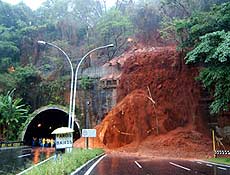
However, that rain happened last week. In the course of about 3 hours, parts of Rio saw 4 inches of rain. Streets were so flooded that the water came up to the bumpers (and over them) of cars in some parts of Rio. The three-lane road I live on became a one-lane road, as cars could not safely drive in either the left nor right lanes due to the flooding. And, in the biggest mess, there was a giant landslide that blocked off the Rebouças Tunnel (a nearly mile-and-a-half long tunnel), which goes right under Corcovado (the mountain with Jesus on it), and is one of the major north-south arteries in Rio, closing the tunnel for over a week and resulting in the kind of traffic jams and packed subways I've never seen in my life (one day, traffic was backed up for at least 8 miles along multiple roads.

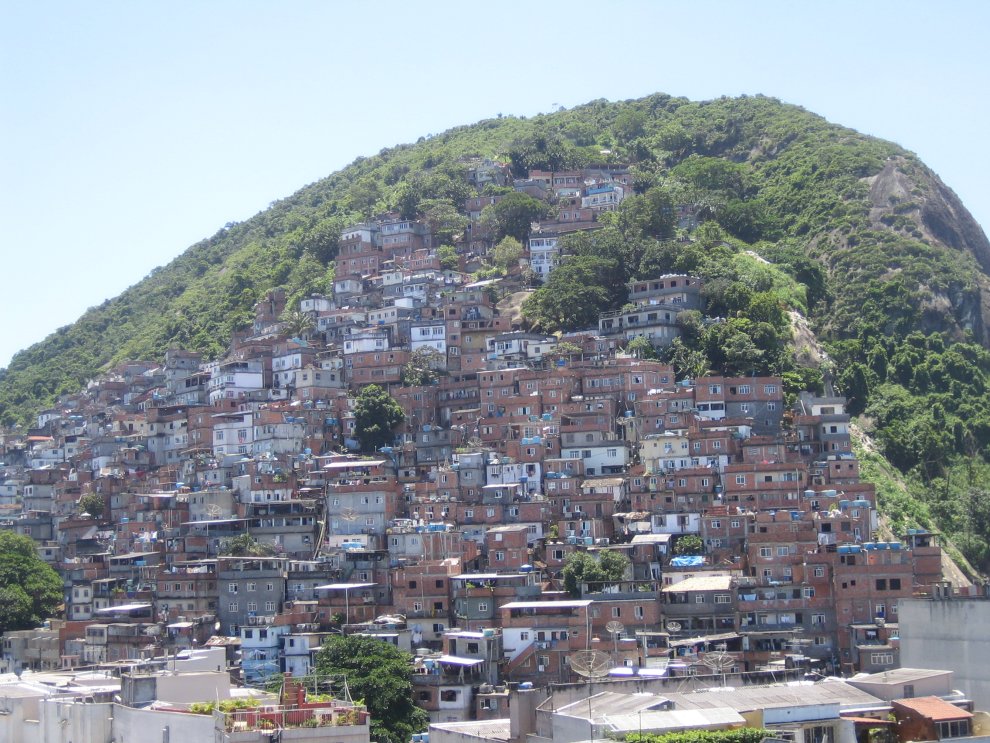
Rebouças has since reopened, but the problem of landslides continues. Not only did Rio's right-wing mayor, César Maia, apparently stop 64% of the land-containment projects that would stop such landslides. However, there has also been a consideration of how urban growth has factored into the risk of landslides here. As is known, Rio's favelas have spread out along the mountains of the cities, where the high-rises of the wealthier cannot be reasonably built. The problem is real enough that even O Globo (the largest media conglomerate of Brazil and the bastion of right-wing middle- and upper-class ideology) deigned to write about the favelas beyond the simple narrative of drug "wars". However, the approach is not surprising. The article frames the question simply - the growing number of favelas can, is, and will continue to affect the way the environment is impacted (though the point is in no way stressed in environmental terms) and will result in future landslides like the one that slowed the city down for 10 days.

Of course, this ignores the larger issue at hand: why the favelas are growing. It's no secret that the wage gap in Brazil is one of the worst in the world (regardless of how you're measuring, it falls in the top 3 worldwide, and often is number one). It's also no secret that, since the 1950s, the rural-urban exodus has been massive (going from 30-70% urban rural to 70-30%). With the wealth increasingly concentrated in the hands of the few, not just urban but rural as well, the rural poor have been forced to move to the urban centers to try to survive. However, the options in these urban centers (particularly Rio and São Paulo) are not great, based on existing classist and racist structures (while it's not universal, let's not forget that, in Brazil, oftentimes the poorer you are, the "browner" or even black you are). Thus, the poor, over the last 50 years, have increasingly become poorer, and have increasingly concentrated in urban centers.

(And, while it's tangential to my concerns here, let's not forget the impact this growth has environmentally. Not only do many of these favelas lack basic sanitary services. They build upon mountains, resulting in deforestation on the micro-level, which in turn not only can lead to more landslides but also damages the very delicate balance of the gradually-recovering Atlantic rainforest, which even exists here in Rio, where the Tijuca forest is the world's largest urban forest. Thus, these are not strictly economic and social problems; their environmental impact is longterm and damaging as well).

And yet this kind of consideration of the basic economic structures and inequalities in Brazil are not emphasized or investigated, in the media or by society at large. The growing favelas are not a symptom of the economic and social problems facing Brazil; they are a cause of transit problems in Rio. I know I've hit on this repeatedly, but it's worth emphasizing once again, and this article sheds light on yet another example of Brazil's refusal to ask questions and deeply consider the problems of poverty, race, and class here. But, as much as the media, the middle class, and the elites, here in Rio and elsewhere, may want to ignore it, the simple truth remains that, until society can try to reduce the wage gap and offer humane conditions to all of its citizens, these (relatively minor yet scandalous to the wealthy) transit problems will never go away.