To push back a little on Erik's view of the Battle in Seattle, I'm posting the video from GRITtv's discussion yesterday. Don't get me wrong; I think Erik has a lot of valid points (Ann Friedman made some similar ones in this excellent post from the other day at the Prospect).
I think in general that it's often wrong to classify progressivism (and feminism, and many other things) as movements. They're belief systems, often stagnant ones. By comparison, the Obama campaign WAS a movement--a moment where hundreds of thousands of people came together to fight for one objective, even if lots of us did it with clear-eyed knowledge that a year out we'd be disappointed and arguing with the president we gave so much of our time and effort to elect.
We do need movements, though. We need those moments where we can come together and accomplish something, like in Seattle--and we need to extend those beyond moments. How do we turn those moments into sustained pressure? I like what I've seen from the National Equality March, and the fight in Maine (even though it too lost). But I want more. Anyway, I digress.
People asked what the organizers of Seattle would say if they were asked: well, it was only ten years ago. They're still around, and a bunch of them were on GRIT yesterday. You want to know what they think? Here's video.
Since Trend and Erik have done them already, I'm submitting my Michael Jackson-related thought.
Well, really I've had lots of them. But a few of them I spun into an essay on pop and populism for Global Comment, because I'm just a nerd like that. So here: my Michael Jackson related thought.
Which came first, really? Nixon’s “Silent Majority” and the retreat of a real solid progressive movement leading to the Reagan Revolution and faux-populism used to convince people to vote to give their money to the rich, or a fragmenting media culture that killed off the chance for a true mass bond?
It is no accident that the last real pop superstar, Michael Jackson, hit the apex of his popularity in the Reagan years. There was at least an idea of a mass consensus in this country, even though no one really could’ve defined what that consensus was, and yet while we had a white man in office slowly hacking away at the rights of people of color, women, gays and lesbians, and anyone who didn’t fit into a nuclear-family, gender-binary, reactionary ideal of an America that never really existed, our number one superstar was a man celebrated and loved not in spite of his fluid sexuality, racial ambiguity, and androgyny, but because of it.
Michael Jackson: pop superstar, appealing to men and women, old and young, and subversive as hell.
I haven't touched on this subject for a while, but here goes.
I've been seeing a bit of lefty pushback on Twitter against the overwhelming support for the Iranian "Green" movement. People snarking about whether Americans would be supporting the Iranians if it was Ahmadinejad who had had the election stolen from him, saying they "don't know who the good guys are," etc.
First off, by talking about whether we'd support Ahmadinejad, they miss the point. The regime in power is the only one who has the power to steal the election and then enforce the decision. Maybe the party out of power, the loosely-defined "Reformist" group, could steal a city or two, but they would have no power to send the Revolutionary Guard into an area to consolidate their own power. A revolt in the streets is almost necessarily a revolt against the regime in power. Even after the coup in Venezuela, for instance, the popular rising that put Chavez back in power was against the junta that had already taken control.
The result is a populist revolt in the streets, with thousands and even millions of people pouring out to support their candidate, even though by some accounts it is less about Mousavi than it is about getting rid of Ahmadinejad. Robert Dreyfuss at the Nation notes:
The anti-Ahmadinejad coalition is deep and broad. It includes conservative, Old Guard founders of the Islamic Republic, who view Ahmadinejad with disdain and who resent the coming to power of his coterie of Revolutionary Guard commanders; the large and growing majority of Iranian clerics and senior ayatollahs, many of whom have long viewed the Leader, Ayatatollah Ali Khamenei, as an upstart and usurper since he was elevated to his position 20 years ago; nearly the entirety of Iran's business class, especially those involved in high-tech, aviation, oil and gas, and heavy industry, who blame Ahmadinejad for his catastrophic mismanagement of the economy and for the crippling economic sanctions; the entire class of Iranian reformists, from more liberal-minded clerics like former President Khatami to more centrist ex-officials such as former Prime Minister Mousavi, the presidential candidate; a large contingent of Iranian women, energized by the role of Zahra Rahnavard, Mousavi's wife, who I met in Tehran, who campaigned vigorously for her husband and for women's rights; and of course, the educated elite of Iran, including students, artists, filmmakers, intellectuals, writers, and musicians.
It is, in other words, not about one particular candidate, but about the promise of change. The word was derided here in the U.S. as empty rhetoric, but it means something. And so trying to lump the people in the streets into one group, or darkly warning that they're not as progressive as we'd like is both wrong and misses the point.
Americans thrill to the sight of Iranians in the streets not because we have deep personal feelings about Ahmadinejad, but because of a simple feeling of solidarity with a people pushing back against their corrupt regime. A simple feeling that if thousands of people are willing to take to the streets to proclaim their rights, we should support them. It's basic populism.
The handwringing over Mousavi not being a Western liberal or even much of a reformer is also beside the point. Mousavi is not so much leading this revolution as he is forced to keep up. The people in the streets are in charge, and with the lack of a central communications structure, there is no mechanism for him to control the crowds. People are communicating with each other, and the fact that huge crowds are coming out every day in spite of the government's best efforts to shut down communications speaks to the level of popular anger and the effectiveness of peer-to-peer networking, to use a new-media-wankish term.
Personally, I'm in love with the rising in Iran because it represents the type of populism I want to see: the people demanding their rights from a repressive government. It doesn't matter if I don't agree with the government they choose: it is not my decision. It is their decision, and though they all don't agree with one another on every point (much like, well, people in this country or any other don't agree on every point with the candidates we elect), they are fighting for the right to make that decision. That's a movement I can support with a clear conscience.
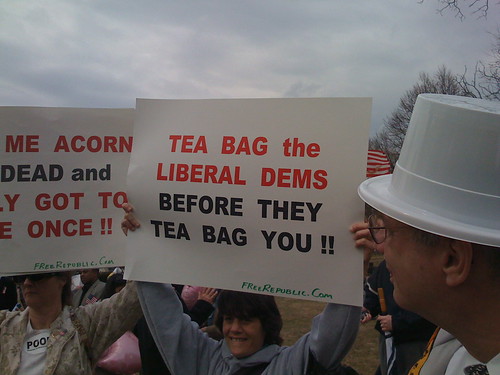
So this morning I heard NPR quote without argument the idea that the tea bag protests were "populist outrage" at government spending. And of course, I dispute that idea--if there was so much populist outrage at government spending, where were these people back in 2004 when Howard Dean ran on a platform of among other things, returning to a balanced budget, while Bush was racking up record deficits?
The populist anger welled up because people who are struggling to pay the rent were watching their governments pay billions of dollars to the same companies that caused the recession that was making it hard for people to pay the rent.
The press has a long history of simply ignoring protests or, when they do cover them, making them sound like they're a few nut jobs who hate America. So when Fox News decided to cover the tea bag protests and legitimize them, the other news stations responded--even the hosts, like Olbermann and Maddow, who live to discount the junk spewing from Fox wound up oddly legitimizing the protests by talking about them. People who were pissed about bailouts suddenly heard their anger reflected--but deflected from the plutocrats who richly deserved it onto Obama's budget, which would, among other things, give those people struggling to pay the rent a tax CUT.
Where does balance come in? Well, as Jay Rosen pointed out, "he said/she said" has long been a substitute for actually finding out which side is telling the truth. And Digby noted that the press also uses the lack of official voices making an argument as an excuse not to cover the argument--hence the usual coverage of political protests not legitimated by an Establishment political figure.
So when Republican Congresscritters jumped onto the tea parties as a way to seem in touch with the people, the protests gained even more legitimacy, and news stations were "forced" to cover them. Now they're news! Politicians are there! Look, Rick Perry wants to secede!
And so suddenly protests that were populated mostly by John Birchers and Ron Paulies and people generally opposed to the very existence of government are being covered as if they're seriously representative of the opinions of half the American people. "Balance," right? We have to cover all the people's opinions!
Except the relative loudness (and in many cases, well-fundedness) of certain voices doesn't mean they actually represent large portions of American people.
But if you have enough money and elected officials, you can get any view into the sphere of legitimate debate (to cite Rosen again). Meanwhile, the actual left-wing equivalent of the tea party protesters are more like the few anarchists in any crowd of protesters, and protest movements full of average people (and far larger than the tea parties) are ignored or only covered when violence breaks out.
Basically, this is a perfect storm of the problems with the press: pack coverage leads mainstream journalists to follow the lead of Fox News, of all ridiculous outlets. Ideals of "balance" lead journalists to cover these protests far more than they actually deserve relative to how many people actually attended them. "Official" voices serve to legitimate wild, outlandish ideas. (Secession! Could you imagine if Deval Patrick suggested that Massachusetts secede?) And of course, money talks. Left-wing anti-government types tend to also be opposed to corporatism, while right-wing anti-government types seem to have no problem with mass corporate rule.
And so we have a situation in which a very narrowly held view suddenly is being discussed constantly, while very widely held views (like the idea that we should actually investigate the torture regime of the Bush administration) get ignored.
Yes, I know, as a feminist blogger I'm supposed to be OUTRAGED at Eliot Spitzer, right?
Yeah, F that.
When the man is right, he's RIGHT. And he is absolutely right on on the financial crisis, and I wish he hadn't been stupid enough to be caught with his pants down acting like a hypocrite. My views on sex work (decriminalize, harm reduction) aside, the point is that Spitzer's voice is an important one that is simply not getting heard on this issue.
Today, he appeared on Fareed Zakaria, for my money the only person on CNN worth watching (I know Karthika agrees with me on this subject). In his first interview since resigning from office, Spitzer, who went after AIG when he was NY Attorney General, called out executives, regulators, and congresspeople alike. He denounced false populism from legislators who had plenty of authority to enforce regulation (:cough: Chuck Schumer) and noted that the SEC and other regulatory agencies had plenty of authority to do what they needed--like I wrote here, they simply didn't do it.
Then there's a novel idea. Why not bring in the man who took on Wall Street and AIG long before it was trendy? Elliot Spitzer. Call me crazy. But he foresaw the bubbles and disasters resulting from deregulatory frenzy and the financial service industry's creation of toxic credit default swaps and derivatives. As the Sherriff of Wall Street, Spitzer launched investigations and lawsuits deploying the creative cudgel of the previously-obscure 1921 Martin Act. Yes, he acted miserably toward his wife and family and he should pay the price for that. But some believe Spitzer was taken down by certain "masters of the universe" seeking vengeance for his aggressive policing of their financial fraud and corruption.
"The search for villains is emotionally satisfying, but...it does not solve the problem," Spitzer said, and he's right. And whatever you think of his past screwups, he's right the hell on and has EVERY moral authority to speak out on AIG and Wall Street, and far more than most.
After Spitzer, Fareed lost a whole bunch of credit with me by convening a "panel of experts" to talk about populist rage. His panel? Megan McArdle, Henry Blodget (formerly investigated by Spitzer on fraud charges from his tenure at Merrill Lynch, now a "journalist"), and Roy Smith (formerly of Goldman Sachs). A bunch of experts on populism, in-fuckin-deed.
Or absolutely not. Fareed's had Barbara Ehrenreich on before--he knows where to find actual populists and outside voices, if he wanted them. Instead, he chose a bunch of the very same vapid insiders who both caused the current crisis, and failed to see it coming--or made excuses for it. One of his "experts" is banned from ever working in securities again after fraud charges. Seriously?
This is exactly what's wrong with the media. The reliance on insider voices, a circle of consensus and a very, very narrow sphere of legitimate debate. You're talking about public rage without a single voice of public rage? People are organizing a march on Wall Street--where are they? Where are the labor voices, the people? How about William Greider, with a great op-ed in the Washington Post today?
How about our own Erik, whose study is actually relevant? How about historians, organizers, anyone who is actually used to dealing with "the great unwashed"? (Y'know, us?)
This isn't helping. Following Spitzer's great interview with this panel of so-called experts is insulting--or maybe a failed attempt at balance?
I was starting to have a little faith in the media for a second. But by the end of that, I just wanted my pitchfork again.
Maybe that was what Fareed was going for? Stoking the populist rage rather than understanding and explaining it?
Hi kids, it's that time again. The time when I busted my ass on an article for GlobalComment and now I beg you to read it. Well, not beg. Ask nicely. I pretend that y'all come here to occasionally read what I write in between the historical images and debates over Eagles records. Ha.
Anyway, I got my pitchfork all sharp at the AIG bonuses, noted some suggested solutions, pointed out Eliot Spitzer's article with information on the real outrage here, and calculated how much more these assholes make than your average auto worker, whose contract is certainly not nearly as important as some overpaid douchebag who ran the country into the ground.
AIG has received $170 billion—yes, with a B—in federal taxpayer bailout dollars since the first payment from then-Treasury Secretary Hank Paulson, while George W. Bush was still in the White House. Its current CEO, Edward Liddy, was put in place by Paulson after the government took a stake in the company. The company is now nearly 80% owned by the federal government—in essence, the taxpayers. You know, us.
Anger over the bonuses is a nonpartisan sentiment—Republican Senator Chuck Grassley of Iowa implied that the AIG executives should make a public apology and then either quit or commit seppuku, and Democratic Representative Barney Frank said, “We can’t keep them from getting bonuses but we can keep them from having their jobs. … In high school, they wouldn’t have gotten retention (bonuses), they would have gotten detention.”
...
Executives and government officials should take note of the public anger. No longer are huge bonuses the stuff of aspiration and dreams. They’re evoking anger. That sound you hear is the death knell of trickle-down economics.
Americans have heard for 29 years that we were going to reap the benefits of tax cuts on the rich, while seeing our own real incomes shrink and get replaced by credit. We aren’t going to accept being told that inequality is simply the proper outcome of a market economy. We know we work hard, and it’s about time we got some recognition of that fact.
I wrote briefly about Santelli's disingenuous attempt at populism the other day.
Turns out, there's more to the story. A whole lot more. The whole "Chicago Tea Party" movement is a front for some familiar right-wing faces, according to this piece published at PLAYBOY, of all places. Some highlights (it's long):
What we discovered is that Santelli’s “rant” was not at all spontaneous as his alleged fans claim, but rather it was a carefully-planned trigger for the anti-Obama campaign. In PR terms, his February 19th call for a “Chicago Tea Party” was the launch event of a carefully organized and sophisticated PR campaign, one in which Santelli served as a frontman, using the CNBC airwaves for publicity, for the some of the craziest and sleaziest rightwing oligarch clans this country has ever produced. Namely, the Koch family, the multibilllionaire owners of the largest private corporation in America, and funders of scores of rightwing thinktanks and advocacy groups, from the Cato Institute and Reason Magazine to FreedomWorks. The scion of the Koch family, Fred Koch, was a co-founder of the notorious extremist-rightwing John Birch Society.
So today’s protests show that the corporate war is on, and this is how they’ll fight it: hiding behind “objective” journalists and “grassroots” new media movements. Because in these times, if you want to push for policies that help the super-wealthy, you better do everything you can to make it seem like it’s “the people” who are “spontaneously” fighting your fight. As a 19th century slave management manual wrote, “The master should make it his business to show his slaves, that the advancement of his individual interest, is at the same time an advancement of theirs. Once they feel this, it will require little compulsion to make them act as becomes them.” (Southern Agriculturalist IX, 1836.) The question now is, will they get away with it, and will the rest of America advance the interests of Koch, Santelli, and the rest of the masters?
Read the whole thing. It's worth it. It's real journalism.
This prompts another bit of thought: with this piece coming out of Playboy, Greg Palast publishing at Suicide Girls and Larry Flynt's willingness to sue the government to get journalists battlefield access, is porn the new way to fund investigative journalism? New media models, indeed.
I'm half joking, of course, but it bears consideration, with newspapers dying left and right. Somebody's got to do the work, and somebody's got to pay for it. And good journalism is good journalism, whether it's published at the New York Times, Mother Jones, or Playboy.
When I have more time and brain space I plan to take populism back up. But tonight, NPR's Mara Liasson was discussing "populist anger" with bailouts and such, and referenced that damn Santelli rant.
"if we really want to subsidize the losers' mortgages or would we like to, at least, buy cars and buy houses in foreclosure and give them to people that might have a chance to actually prosper down the road. And reward people that can carry the water instead of drink the water."
Santelli, a former futures trader, made his now-famous rant from a Chicago commodities trading floor. Bastion of Real America, that. But he had the stones to declare, "This is America!" because he was cheered. Because we know from the McCain campaign that the Real America is whichever part agrees with you.
But Michael Hiltzik at the LA Times schools Santelli with two sentences:
Well, no. America is a place where 8 million families are threatened with losing their homes, not a futures pit filled with braying traders.
By The Nation I of course mean the progressive journal.
I've grown increasingly tired of the chorus of blindness and deafness to the economic crisis floating around. It is not my intention to start a blog war or a bunch of drama with this, but I'll just say this: Layoffs are not an opportunity to "find yourself." Being broke is not fun. Unemployment--if you can even get it--isn't the same amount of money you'd get working. Health insurance disappears. People with multiple degrees don't start businesses from the ground up and miraculously succeed during downturns, let alone crises of this magnitude. They go hunting for any job they can get, and the ones they take that they're massively overqualified for? Guess who isn't getting those jobs.
Biden is "really pushing hard" on "a more progressive populist approach to economic policy," says Mike Lux, the transition's liaison to the progressive movement. "I'm just delighted that there's somebody with his clout that's doing this, otherwise our side would be in a lot worse shape."
He isn't talking about Biden being out on the campaign trail stoking up angry white folks. He's talking about recognizing that people on the street are suffering. He's talking about an awareness that this crisis isn't simply about "Zombie banks" (though the use of that term makes jokes about the zombie apocalypse a hell of a lot less funny). It's about real people losing jobs or unable to find them. And while Larry Summers is off in la-la land trying to make economic policy that still somehow fits his deregulation fetish, Biden's wife is teaching in a community college and he's still connected to the rest of the world.
But what I really wanted to call your attention to was this piece, a collection of stories from Nation readers who have found themselves unemployed and are struggling.
On January 14 I was told that because I was the last one hired in my department, I was to be laid off. I had heard about the procedures for layoffs, but still I was surprised by how I was treated: I had to clear my desk immediately (my computer was already locked), and my co-workers could not even look me in the eye, nor did my boss say goodbye. I have not heard from any of them since that day, and I don't expect to.
It saddens me that so many people of my generation are in the same boat: overeducated, underemployed and in over our heads in student loan debt. It is hard not to be angry at my parents' generation for their years of out-of-control consumerism and lax regulations. Fortunately, a lot of us are ready and willing to work hard to right so many wrongs.
The stories are hard to read, because they remind me that in only a few months this will be me, looking for a job in the worst economy I've ever seen, with student loans coming due and my health insurance cutting off. There are more here.
In January 2008 I was given a choice: take a 50 percent reduction in salary or be let go with three months severance pay. I chose severance, mostly due to the fact that I could not survive on the new salary. For the last year I've worked as a sales rep at another company for considerably less, trying to build a client base that took me years to get previously. I've burned through my savings just to get by and I'm unable to sell my house for what I owe on it even despite doing things the "right" way when I bought it. I have to stop paying the mortgage so I can pay for doctor visits for the kids and groceries. I can't afford the minor surgery and physical therapy to get a back problem fixed completely so I get by at the price of a dependency on pain meds, but hey--at least THOSE are generic and cheap. Despite a BA and management experience my attempts to find another position have been unsuccessful.
At the bone, this is what I mean when I say we need to rethink populism. Understanding the people that are suffering when we aren't, and supporting each other when we are. And especially, after the comments that have come up so far on the subject, recognizing the reasons why everyday people get angry and buy into xenophobia and all it entails.
In principle, I totally agree that "the people" should be in control of society and not a bunch of politicians and bankers. But the reality of populist movements in American society has generally not been good. The unleashed anger of the white working class has all too often manifested itself by attacking people for difference. It's allowed ugly racism and anti-Semitism to replace organizing for the well-being of all poor people.
I am probably permanently scarred on the term because of the Populist movement of the late 19th century. I don't want to get into too much detail on the movement's aims because they are so obscure and related to specific economic problems of late 19th century rural states. But here's the basic story. Farmers in the Plains and South were getting screwed big time by railroad interests who charged expensive and unfair rates to farmers to get their goods to market. The Gilded Age was a time when big corporations dominated American life and the railroads were among the most powerful. They worked with other monopolies to buy Congress and ensure zero regulation, including how much they paid their workers or how much they charged people to use their services. There were other issues as well that were forcing farmers into poverty, including a glutted cotton market that impoverished Southern farmers.
Beginning in 1867, farmers began to organize into the Grange movement, which was a sort of social organization of farmers. Although not particularly political at first, as conditions worsened and attempts to improve their collective economic lot failed, they turned their anger upon eastern bankers (i.e., Jews), railroad companies, and the "human vampires" who sucked the blood of the American farmer. In its early years, this movement seemed fairly successful. Between 1869 and 1874, farmers in several Midwestern states got laws passed limiting what railroads could charge. But the railroads successfully challenged these laws and in 1886, the Supreme Court ruled them unconstitutional in Wabash v. Illinois.
The Grange declined but farmers continued organizing into the Farmers' Alliance, which during the 1880s and early 1890s was a dominant force in many states. At first, the Alliance even included black farmers, who organized into associated but segregated Colored Farmers Alliances. In 1890, the Farmers Alliance met in Ocala, Florida to put together their political platform. It called for the graduated income tax, direct election of US senators, more credit, regulation of transportation and communication networks, and other economic ideas that are pretty obscure today. In 1892, they ran James B. Weaver for President who won Kansas, Colorado, Idaho, and Nevada, as well as electoral votes in Oregon and North Dakota. In 1896, the Democratic candidate William Jennings Bryan took over their platform, in particular the free coinage of silver, which was meant to increase currency and cause inflation, thus solving the very serious currency shortages that meant that farmers could not get credit. He lost and the high tide of the Populist movement passed. But many of the Populist ideas were adopted by the Progressive movement and became law during the 1900s and 1910s.
So what's the problem? Despite the early flirtation with biracialism, as time went on, Populism turned nasty. Always saturated with the anti-Semitism so dominant in American society during these years, Populist attacks upon Jews became harsher. Moreover, when people's economic woes didn't subside and when the path to changing those problems seemed impossible, that frustration and hatred turned upon black people, intellectuals, and anyone else who seemed different and threatening.
The biggest issue of course was racism toward African-Americans. Again, for the turn of the century South, the early years of Populism are about as good as it got. Even as late as 1900, poor whites and blacks worked together in North Carolina to briefly come to power. But many of the early Populist leaders spent the rest of their career as race-baiting small p populists, stirring up the anger of farmers who brought them to power by promoting white supremacy. Arguably the worst example is Tom Watson, the long-time Georgia politician. In his early years, Watson supported working with blacks. But after the failure of the Populists, he turned into a national firebreather for white supremacy. He remained in power through race baiting of the worst kind. He inflamed public opinion against the Jewish factory manager Leo Frank who was convicted (probably wrongly) of killing a girl who worked for him. When Frank's sentence was commuted in 1915, Frank was dragged from his jail cell and lynched after Watson had demagogued the issue for his own benefit and fanned the flames of anti-Semitic hatred. Watson also became a fanatical anti-Catholic, calling for the recreation of the Ku Klux Klan to fight against this menace.
William Jennings Bryan, while not exactly a Populist, knew that the anger of the poor at the outrages they claimed to suffer at the hands of outsiders kept him a leading national figure. He failed in his three runs for president and was not a particularly good Secretary of State under Woodrow Wilson. But he was popular and powerful enough to achieve these high positions of power. He's most known today for his defense of Tennessee's anti-evolution law in the Scopes Trial of 1925. In some ways, the Scopes Trial is the epitomy of small p populism for me. It's about poor white outrage over outsiders they see destroying their lives--in this case eastern elitist intellectuals who supposedly rejected God and hated religion.
So when I think of "populism" as a concept, I think of the race-baiting Tom Watson, the anti-intellectual William Jennings Bryan, and the millions of Americans who turned to hate when their economic outrage was awoken but not empowered. I think of the millions who listened to Father Coughlin in 1935 and Bill O'Reilly in 2009 as the descendants of America's historical populism. So when we talk about becoming populists ourselves, I have to know what that means exactly and how people will respond differently than in the past. Who are "the people?" What happens if they start turning toward hate when the big corporations retain control? Have we moved past such possibilities in today's society? Will people not turn against immigrants in violent ways?
There's no doubt that I get too hung up on the semantics of these things. But it's a lot easier to call for a populist movement than to control that anger if you actually do manage to raise the ire of millions. If that anger is channeled into concrete goals, it can be a good thing. CIO organizing in the 1930s is a great example of this. But if it is left free to flow in whichever way, it can also be dangerous.
Rachel Maddow addressed populism the other night and got me thinking. During the election, we most often heard populism mentioned in reference to Sarah Palin and Mike Huckabee, and often in a sort of derogatory tone from certain David Brooks-ish commentators who pined for a more elitist Republican party (oh, the irony, it is thick).
But populism is inherently little-d democratic, and should also be a mainstay of today's Democratic party. Yet we somehow got pigeonholed as the party of East Coast and West Coast champagne liberal snobs. The party that actually supports the rights of working people got written off as the party of pointy-headed rich intellectuals.
Barack Obama won by not being afraid of that label and utterly defusing it. The idea of calling this man, raised by a single mother and forged in the streets of Chicago as a community organizer, was somehow more elitist than a guy who couldn't remember how many houses he owned, was laughable.
Also laughable were the desperate attempts of his opponents to make him look out of touch. Hillary Clinton's stage-managed whiskey shot, anyone?
This might be the election where we figured out that populism doesn't mean condescending to America. It means actually understanding the crap Americans are going through.
Michelle Goldberg (h/t matttbastard, who inspires more of my posts than I should admit to you lately), wrote an excellent piece about the rise of the Sarah Palin wing of the Republican party.
Now, the irony is that the more marginalized the GOP becomes, the more powerful the religious right becomes within it because it’s one of the last constituencies standing. The 2006 and 2008 elections each left the party more socially conservative than before, as moderates were defeated. The remaining voters seem to like it this way: According to a recent Rasmussen poll, a plurality of Republicans think their party has been too moderate during the Bush years, and fully 55% of them want their party to model itself more on Sarah Palin. The conservative intelligentsia has spent the past generation hymning the virtues of simple heartland believers indifferent to the opinions of coastal eggheads and cultured cosmopolitans. Now, they’re going to have to realize that that includes them.
She referenced Tom Wolfe's famous "Radical Chic" essay, which pokes fun at Leonard Bernstein's attempt to hobnob with Black Panthers.
In one of my courses last year, we read Wolfe the same week as we read Hunter S. Thompson. Thompson was the kind of populist that we should be looking at now, moving forward. The consummate outsider, constantly angry at the powerful, constantly on the side of the little guy.
When I get angry at NPR's Science Friday for being completely clueless about the purpose of an auto industry bailout, it's that spirit that I'm invoking.
It's not condescendingly taking a whiskey shot or implying that your audience is racist. It's much more than that. Obama managed to ride populist support into the White House without ever attempting to change who he was. Because he gets it. He knows what it's like to be broke, to have to decide between paying your heat and buying food. And yeah, it's been a long time and two Ivy League schools since he's had to make those choices, but I don't think he's forgotten.
Thoughts? I think populism is a word we should be looking at and reclaiming more. (as in, this might be the first post in a series.)
One of the most fascinating things to me about teaching this semester is that I have not mentioned the Populists in my US, 1877-1920 course except in passing. I also do not discuss the Populists in my modern US survey course.
I was surprised when they didn't get mentioned in my survey course, but I am downright shocked at their omission this semester. But when I think about, the Populists seem to me to be such an outlier to American history, that I'm not sure what kind of larger narratives they fit into.
Part of this is that I teach the Gilded Age and Progressive Era course thematically rather than by chronology. I simply think the era makes almost sense chronologically because so much is happening at the same time. So I talked a lot about race, with weeks on Native Americans, segregation, imperialism, and immigration. Then I moved on to discussions of gender and sexuality for a couple of weeks (and God do they love talking about the history of sex. So do I which makes it fun!). Now I've moved on to politics. The semester is ending so next week I am discussing political Progressivism and the week after World War I. This was the week I thought I would squeeze the Populists in--I'm discussing labor. But again, they are such outliers to the larger questions of labor during the GAPE. So they are just getting dropped. I am also not discussing William Jennings Bryan or the election of 1896 at all. Were I teaching this course chronologically, or from a primarily political perspective, all of this would get serious play.
But what do you think matters more for students, birth control or Populists? Hell, what matters more for our understanding of the past? I would fall decidedly on the side of birth control. Next semester, I am teaching a labor course. There I am already planning on taking a week to talk about rural labor during the GAPE and that of course will be dominated by the Populists. But I wonder if I am the only U.S. historian who sees the Populists fading from their teaching narratives, as interesting as they might be.
J. Lester Feder's article on country music and conservatism in The American Prospect is quite interesting but I feel needs a bit more context. Feder is right that country music started with a more populist politics than conservative. He's also correct about the role of the 1960s in turning country music toward conservatism and the transformative role "Okie From Muskogee" had in tapping that market.
But I think Feder overstates how much of a transformation this was. Country music also had a close relationship with conservatism, if not the Republican Party. Southern populism (as opposed to the Populist Party) always had strong strains of social conservatism and evangelical religion. Moreover, with the brief exception of the early days of the Populists, it was always very racially conservative. So when Feder uses the example of early country musicians stumping for Tom Watson as a way to show that country music has not always been conservative, he forgets Watson's racial views. Watson and other southern populist politicians may have supported economic equality for the region's white people, but that does not exclude connections between the music and conservative ideas of the day. Country musicians may have supported FDR, but they also were staunchly segregationist. Country musician and politician Jimmie Davis wrote "You Are My Sunshine" and ran a populist campaign for Louisiana governor, but he was a virulent racist.
Feder also states that country music appealed to "middle America" because of its yearning for past values, which may or may not be true. Country music did expand its reach outside the South in these years. But much of that came from southerners taking their music with them when they left for California, the Pacific Northwest, or the factories of the North. That started far earlier than the 1960s as well. Among the country musicians to get their starts in the Pacific Northwest, hardly the genre's strongest bastion, were Loretta Lynn, Buck Owens, and Charley Pride. More than a simpler lifestyle, I argue that much of the genre's popularity outside its home region came from homesickness for the old southern home. Part of that is a desire for a simpler time, but it's more rooted in place and geography than Feder admits.
Finally, Feder writes that it was only in recent years that mainstream country music became a place where conservative talking points were repeated in the music. That's more or less true. But country music is a totally different animal than it was 30 years ago. It's not just a move toward the Republican Party within the Nashville establishment--it's also a move away from good music. This article is written with the Dixie Chicks in mind, particularly Emily Robinson saying, "You know it's a strange place to be sometimes without a genre." But it's hardly just politics that has led to this scenario for them. They always existed on the margins of acceptability in mainstream country music. They sold well and that got them airplay but it is not as they ever represented the mainstream of the Nashville establishment. Their music (which I am quite tepid about by the way) is not Brooks & Dunn and therefore you didn't see too much sadness by the music establishment when they were banished from the mainstream.
Anyway, Feder's article is pretty good and worth reading. But there's a lot more to this story than his brief article can explain.