Wednesday, March 04, 2009

I schooled Bobby Jindal

It's over at Global Comment, but I'll post some of it here to get you to go read it over there.

...Infrastructure spending is the backbone of the stimulus bill, which includes $98.3 billion in funding for transportation and other building projects. $2 billion of that is headed for the Army Corps of Engineers, with an additional $375 million just for the Mississippi river and its tributaries. The Corps are the ones responsible for maintaining the levees around New Orleans that failed so dramatically during Hurricane Katrina. Also designated for Louisiana is $73.5 million for public housing, which could go to rebuilding homes destroyed by the storm or torn down in its aftermath...

By rejecting the last two provisions, Jindal is denying unemployment benefits to nearly 25,000 citizens of his state, as projected by the National Employment Law Project. He’s also incorrect that he would be forced to raise taxes on businesses in order to maintain the benefits after the federal money runs out.

Jindal’s fact-stretching continued with his claims in his speech that the stimulus bill was funding a high-speed train from Las Vegas to Los Angeles—not true, money budgeted for high-speed rail has not been allocated yet—and will be allocated by Republican Transportation Secretary Ray LaHood. He also disparaged “volcano monitoring,” which coupled with other U.S. Geological Survey facilities and equipment, was a rather small area of the stimulus bill at $140 million.

Jindal will be accepting 98% of the federal stimulus dollars earmarked for his state, so his stand on the unemployment benefits looks far less like a principled stand against government spending and far more like political posturing for a rumored 2012 presidential run.


Read the whole thing.

Added Illustration


Since Erik wrote about it below.

Smoking our way out of the red...

You may have heard that the California Assemblyman Tom Ammiano has introduced the increasingly infamous AB 390, a measure that would legalize, regulate, and tax the production, wholesale, and retail of marijuana. His contention is that the taxes alone would generate over a billion dollars per year in revenue.

Part of the tax revenue would go to bullshit "awareness" and prevention campaigns (you remember the ones from school, right? A school assembly where some asshat comes to tell you "Just Say No" and all it does is make you want to sneak behind the bleachers and smoke a bowl during chemistry? I'm being fairly glib here, but I really hate wasted resources, however well-intentioned, be it anti-drug campaigns, those insufferable tobacco "Truth" ads, sensitivity / sexual harrassment training seminars, etc.), but the real savings would come from no longer incarcerating non-violent marijuana crimes. Particularly wise is striking the following from the California Health and Safety Code:

11359. Every person who possesses for sale any marijuana, except as otherwise provided by law, shall be punished by imprisonment in the state prison.

With AB 390, this is gone. In 2007 alone, California had 16,000 felony arrests for marijuana, and marijuana-related offenses are responsible for upwards of 34% of California's prison population (at $30,000 a head per year, that's a chunk of change). Talk about some savings, and a better use of law enforcement man hours.

Under the Bush Administration and the reign of some of the most extremist attorneys general in memory, this idea would have surely been met with some heavy-handed federal opposition. Riding the heels of AG Holder's announcement that medical marijuana laws would be left to the states to enforce, perhaps we could hope that the Obama administration would allow a state to implement something like AB 390.

The Better Side of The New Republic

Despite Marty Peretz running The New Republic into the ground, the magazine has always had great arts coverage. Most importantly, it has employed Stanley Kauffmann as its lead film critic for about 50 years now. Which makes him I think 143 years old. I've linked to a couple of his reviews before, but every now and then, you remember just how old he is (in his 90s and still working). When Jimmy Stewart died, Kauffmann talked about Stewart as a young man. He has talked about Brando starring in a play he wrote before Brando was a star. Today, he reviews Katyn, the new film by the great Polish director Andrzej Wajda. Wajda is one of my favorites with such amazing films as A Generation, Kanal, Ashes and Diamonds, Man of Marble, Man of Iron, Danton, The Siberian Lady MacBeth, etc., etc. Freedom, World War II, and the war's aftermath have always been central concerns for Wajda and Katyn by all accounts is a crowning achievement that addresses all of these issues. Anyway, Kauffmann says this in his review:

One evening in 1939, exactly when the Germans and Soviets were invading Poland, I was at a ballet performance in New York. An announcement was made that a leading man in the company, a Pole, had asked to do a special piece as his Polish declaration of protest and love. (I forget his name.) He then came out and performed a solo dance to a Chopin polonaise, which was not much as ballet but was nonetheless overwhelming. I thought of that dancer, of the audience's wave of sympathy and helplessness, when I saw the last shot of Wajda's film--which I won't disclose.

1939? A mere 70 years ago. What I think is great about Kauffmann's incredibly long career is the limitless font of past knowledge he draws from. He's just about the only person still alive and probably the only person still active in film who remembers the silents. His life almost spans the life of cinema.

Peretz

I had to steal this awesome bit from Cogitamus. This is from a 1976 story about Peretz taking over The New Republic.

Martin Peretz, a very wealthy young man who has used his money sometimes wisely and always enthusiastically but not always with satisfying results in politics, contributed to the last campaign of Senator Ralph Yarborough. Yarborough had courageously tried to be an authentic liberal all his life, but because the effort had had to be made within the twisted and oppressive confines of Texas politics, he had himself become somewhat twisted and paranoic. He hated intensely and he admired intensely; after receiving his money from Peretz and talking with him for a while, over beers, Yarborough slammed an arm around his new patron's shoulder and expressed his admiration: "Marty, I like you. I like you lots. Your motivations in politics are the same as mine -- spite and revenge."

That is hilarious. And so so true.

Historical Image of the Day


John Birch Society president Ralph Westfall speaking in favor of the Vietnam War, UCLA, 1965.

Is Brazil the Next Major "Imperialist" Power in South America?

A few weeks back, Upside Down World published an interesting report asking if Brazil is "creating its own 'backyard' in Latin America?" The article looked at Brazil's rapidly expanding foreign investments in recent years (from $250 million dollars US in 2003 to $10 billion dollars US in 2004 alone) and some recent points of contention (with Ecuador and Paraguay, particularly), and asks if Brazil is on its way to becoming an imperialist force in the region. It chronicles the various investments Brazil has made recently, from cattle farms in Uruguay to private companies' involvement in Ecuador to the Itaipu dam agreement with Paraguay to suggest Brazil may be trying to become a hegemonic power in Latin America.

I find the charge of "Brazilian imperialism" interesting but wrong-headed. I suppose from the strictest economic standpoint, Brazil's growth may look somewhat like imperialism, particularly to the political left of the region. I have a hard time buying into this right now, though, simply because countries can only grow their investments internally so much before they have to invest elsewhere. Brazil has invested wisely, and is succeeding for this. Accusing Brazil of becoming "imperialist" simply because it has succeeded in what all of the countries of South America have been trying to do to one degree or another for quite some time makes about as much sense to me as accusing a successful local coffee shop of becoming "corporate" when it expands and has multiple locations in an area.

What is more, I think the "imperialist" charge loses any legitimacy when it comes to dealing with the term from a geopolitical standpoint (because it's not just about economics). Indeed, I would even suggest that having Brazil become such a major global force is probably a net gain for South America as a whole. For too long, Latin America (including Brazil) hasn't really had a powerful geopolitical or economic voice that was willing to stand up for its interests in the global market. Now that Brazil is gaining that power, and has similar past experiences with its neighbors in the global economy, Brazil is definitely in the position to defend the region as a whole, and to use its power to sway American and European powers. I admit that Brazil could disregard its neighbors demands on issues such as equality and fair treatment in the way that the United States and Europe has traditionally disregarded anything that didn't line their own pockets and the pockets of their allies.

However, this just doesn't seem likely to me. First, these are Brazil's neighbors, and not just foreign countries, and it would really hurt Brazil's standing in the region. Secondly (and deriving from the first point) Brazil's global standing in the economy, while growing exponentially, is still relatively new and fragile, and Brazil can't afford to isolate entire neighboring countries where it has invested so heavily. Unlike China, the U.S., or major European countries (at least before the global meltdown), Brazil could not just cut its losses in one part of the world and focus elsewhere without major repercussions in its own economy. Thus, I think it is fair to say that, at least thus far, Brazil in the 2000s has been rather sympathetic to the interests of its neighbors, even while it tries to defend its own economic interests. There was evidence of this "sympathy-factor" when Evo Morales nationalized petroleum production, including holdings by Brazil's Petrobras, back in 2007. Lula calmly responded to the nationalization and took Morales on his word to "re-work" the deal, ultimately still getting a good deal on gas coming from Bolivia, but with terms more favorable to Bolivia than they previously had been, as well. The Paraguay case makes things look bad, but the Itaipu issue has been a contentious one that has been bubbling for years. It may still work to Paraguay's disadvantage, which would be disappointing and unfortunate. Brazil has a lot invested in that dam in terms of economy and infrastructure, and it very well may end up being shortsighted in its efforts to get the best deal possible for Brazil, while angering Paraguay and perhaps offending neighboring countries. But the operative word here is "may" - things still aren't resolved, and there's not a lot of concrete evidence that lets us conclude already that the Itaipu discussions are going to go well or poorly. And even if things do work out in a way in which Brazil comes off as an economic bully on this issue, I still don't think the dam and the recent issues between Ecuador and Brazil (which were since resolved) are enough to really point towards an emerging but latent imperialism on Brazil's part, at least not right now. I could be wrong on this down the road - presidents do funny things for strange reasons sometimes - but for the foreseeable future, at any rate, I really don't see Brazil joining the "traditional exploiters" in its treatment of the other South American countries anytime in the near future.

Tuesday, March 03, 2009

Updated Pointless Map


visited 43 states (86%)
Create your own visited map of The United States or jurisdische veraling duits?

I love pointless maps. Having traveled to Florida for the first time last weekend (thank you environmental history conference!), I wanted to give an update. 7 states to go.

Florida Tomato Struggle

Brian reminds us of one of the most disgusting and unknown issues in the United States--the virtual, and sometimes literal, slavery experienced by tomato pickers in Florida. He links to Barry Estabrook's piece in Gourmet discussing this:

At this writing, that appears to be the official government position in the state of Florida, and it could explain why the fields of the Sunshine State provide such fertile ground for modern-day slavery. In the past dozen years, police have broken up and prosecuted seven slave operations there, freeing more than 1,000 men and women who were kept captive and forced to work for little or no money and threatened with death if they tried to escape. (For more on the plight of the Florida tomato pickers, see my article “The Price of Tomatoes” in the March 2009 issue of Gourmet.)


Charlie Crist doesn't care. Mel Martinez doesn't care. Jeb Bush didn't care. I'm not sure that leading Florida Democrats care either. There are people trying to help the tomato pickers. The Coalition of Imolokee Workers has worked for a long time trying to bring attention to the plight of these oppressed workers. While they get occasional attention in the liberal press, the nation as a whole doesn't know and doesn't care about these workers.

If you care, you can send an e-mail to Charlie Crist telling him to crack down. I just did and I hope you will too.

Community Gardens

I've gotten involved in a community garden at Southwestern. It's small, with some students, faculty, and staff all working together and on individual plots. It's been a lot of fun. It's also good to grow your own food, or at least have some clue how to do so. I'd certainly like to do more of it, but in recent years I've been gone a lot, which makes it a bit unfeasible. Anyway, here's a little article on it that the school put on their website. Yours truly is "quoted" in it, though I know for sure that I did not say those words. Actually, what I first said when I was asked why I was involved, and this is a direct quote, was that "food ain't gettin' any cheaper." Which I hoped would be the quote in the piece. That didn't sound very professorial though, so I said something about food and pesticides, which is quasi-quoted here.

The plot shown is also the one I am working on. The quality of those vegetables mostly belongs to the person I am working with, who brought some more grown plants when we did it. However, a few days later, the fucking deer ate a bunch of them. If anyone wants some venison, I'm thinking of acquiring quite a bit of it.

One of Gabon's Natural Preserves Under Threat (with Bonus Racist Colonialist Terminology from the New York Times)

There's a lot that's disturbing about this article: the threat to Gabon's (allegedly) nationally-protected forests and the damming of one of its more impressive waterfalls; the ways in which reliance upon oil for the nation's income are threatening the environment as president Omar Bongo promotes iron ore mining; the fact that Bongo has been president since 1967 (forty years!); the expectation that ecotourism will be your economic salvation without any of the extremely complex and involved infrastructural development and planning the ecotourism industry requires; the extremely understaffed park rangers, who in no way could protect much of the park when they are only 15 people. All of these are very serious issues, and I have very little hope for Gabon on this issue, especially given the economic straits it is facing and the general disregard the Chinese seem to be showing for the environment in this case (which, unfortunately, has been all too common a theme among development projects).

I also realize it's probably one of the least important aspects of the article, but the New York Times' editors most certainly should have done a better job editing Polgreen's report. Gabon is coming off bad enough as it is; there's no need to use words like "wily" to describe president Bongo, and passages like "In neighboring countries, impoverished hordes have razed and burned their forests to plant crops and make charcoal. They have slaughtered the gorillas, elephants, chimpanzees and hippos in jungles for meat. But the Gabonese flocked to cities, living in comparative splendor," while perhaps factually correct, also rely on some of the poorest choices of words to describe residents of Africa (or anywhere else) in sweeping generalities. Unfortunately, talking to people who are quite familiar with the Times' reports on Africa, this is about par for the course.

Historical Image of the Day


This week's images will revolve around the rise of the Republican right. Good times, I know.

Democrats for Barry Goldwater, 1958.

Earmarks

Sorry for the lack of blogging the last few days. I am profoundly overwhelmed right now. The big problem is this article due on March 15 that I feel still needs a lot of work. Anyway, I'll try to keep up but I might be a bit quieter than usual.

Anyway, I did want to mention real quick what a quixotic campaign McCain has against earmarks. His anti-earmarks amendment just failed in the Senate by a fairly sizable margin. The problem with this campaign is that earmarks are not bad things. There might be better ways to fund projects, but in principle most of the projects seem pretty OK to me. McCain is also twittering (i.e., some staffer) the most ridiculous of the projects each day. Here are some for today:

*$819, 000 for catfish genetics research in Alabama
*$190,000 for the Buffalo Bill Historical Center in Cody, Wyo.
*$400,000 for copper wire theft prevention efforts
*$47,500 to remodel and expand a playground in Ottawa, Ill.
*$209,000 for blueberry production in Georgia…
*$285,000 for the Discovery Center of Idaho in Boise

How is any of this bad? Scientific studies need to be funded. I'm glad to see a historical and a scientific museum get some money. Playgrounds are good. I like blueberries. I don't know much about copper wire prevention except to say that if thieves are stripping copper wire from telephone lines that this is not a good thing.

So what's not to like here? Plus all of these things create jobs. Yet John McCain is more worried about stopping some money going to an Idaho museum than fixing the economy. No wonder he got blown out last fall.

From Colony to Superpower, Part XIII

This is the thirteenth installment in the 20 part series Rob Farley and I have commenced to review George Herring's From Colony to Superpower: U.S. Foreign Relations since 1776. See the Herring Review tag below for previous entries.

That World War II is the most transformative and important event in the twentieth century seems without question. In the United States, the nation rapidly transitioned from a country committed to limited engagement with the world outside of trade to the world's most powerful nation. Franklin D. Roosevelt was the primary architect of this project. In the last chapter, Herring seemed rather critical of FDR, and to a certain extent he remains so here. But Roosevelt also did a tremendous job preparing the U.S. for the war against significant domestic opposition in the 18 months before the war, allowing a still unprepared U.S. to transition into the war fairly quickly. A lesser leader might not have done this and it could have been 1943 before the U.S. was ready to fight at all. Generally, the narrative of the war is fairly uninteresting to me. I basically don't care about wars as a subject of study, except for their domestic implications. So I'll move on to some specific issues of interest.

One problem with a lot of diplomatic histories is that wars dominate the narrative at the expense of other topics. To no small extent, Herring does this as well; it's understandable but his tentative interests in the cultural side of America's relations with the world almost totally disappear in this chapter. I do think he does a good job discussing Latin America, the Middle East, and Asia. This is one of the strongest sections of the book. He shows both the benefits of the Good Neighbor policy in Latin America for short-term stability and its downside through allowing dictators like Somoza and Trujillo to consolidate their repressive regimes with tacit U.S. support. The sons of these two leaders even attended West Point. The minimal weapons provided by the U.S. allowed these governments to kill its own civilians. Whether the Good Neighbor policy was in the best long-term interests of the nation is a question Herring doesn't really explore.

In the Middle East, Herring does a great job getting into how the U.S. comes to see oil as the world's most important resource and how by 1943, the nation is becoming increasingly involved in Iran and other nations to ensure a steady supply both for the war and the postwar world. In Asia, Roosevelt wanted to slowly bring colonialism to an end, something fiercely resisted by Churchill and De Gaulle. But his own racism, and the racism of the entire nation, made taking the proper actions unlikely. Thinking the Vietnamese and other Asians were children who needed to be protected, the U.S. ultimately did little to end colonialism and moreover began to see itself dictating policy to the region. In China, Chiang's corruption became ever more obvious during World War II. Chiang had powerful friends but constantly frustrated the U.S. government who frankly saw Mao's communist movement as more effective and quite likely the winners of the Chinese civil war.

Herring also usefully discusses the fate of the Jews. While many criticize Roosevelt for not doing more to stop the Holocaust, Herring points out that he faced massive anti-Semitism both in the State Department and the U.S. population. Plus, nothing he could have done would likely have saved many Jewish lives. Roosevelt's classic ambivalence shows up very strongly in figuring out what to do with Jews after the war. He gave lip service to both Jews and Muslims on the issue and never had a strong plan, but he could also see the hornet's nest he was walking into. It's almost taboo to say this, but the establishment of Israel is one of the great foreign policy disasters of the 20th century. While one cannot question that Jews were not safe most anywhere in Europe, creating a state under constant siege that has to displace the people already living there and then oppressing them in occupied territories has not exactly been a huge success. The failure of the Jewish state to establish long-term stability in the face of low birthrates compared to the Islamic population suggests either it losing its Jewish identity or apartheid; either way, it's likely that we'll still be dealing with these same problems in another 60 years.

The person who comes off the worst in this chapter is Churchill. It's not surprising--Churchill was an excellent wartime leader but was a bastard of the first order who had no business leading the British during peacetime. His racism, outright colonialism, willingness to sell nations out, and unwillingness to consider changing Britain's traditional foreign policy prerogatives in the face of the obvious decline of the empire did little to make him a sympathetic leader today. Of course, he was facing massive challenges and perhaps changing who he was is way to unrealistic, but I have trouble arguing with the British people throwing him out of office the first chance they got.

Finally, no discussion of the war is complete without the atomic bomb. Herring is right in criticizing FDR for keeping Truman (and all his VPs) out of the loop. Although I'm sure he didn't want to dwell on his mortality, it was clear by early 1945 that FDR was running out of time. Truman was completely unprepared for the task of steering the nation through the end of the war. However, he did pretty well. His most controversial move was using the atomic bomb against Japan. It was unnecessary and immoral, but also almost inevitable. The nation spent such a huge amount of money on the thing that to not use it would have caused incredible outrage in Congress and among the general public, perhaps leading to the impeachment of Truman and the end of many politicians' and soldiers' careers. Without an outright surrender of the hated Japanese, there was no chance Truman would have made any other decision, and I think the same is true of Roosevelt, although of course we can't know.

There's more to say about US-Soviet relations, Yalta, and all of that, but I'll leave it to Rob and respond to his piece.

Monday, March 02, 2009

How to Overthrow a Government (I): Brazil in 1964

Brazil's political trajectory since independence is one of the weirder ones in Latin America. In a nutshell, Brazil took a fundamentally different path from the rest of Latin America, gaining independence peacefully and immediately setting up a monarchical empire that lasted until 1889, when Brazil finally became a constitutional republic. However, the presidency from 1889 to 1930 was little more than a cyclical network of oligarchs alternately from the major states of Sao Paulo and Minas Gerais. In 1930, Getulio Vargas, from the southern state of Rio Grande do Sul, challenged this hegemony and, after losing what many felt was a fraudulent election, Vargas was swept into power via a bloodless revolution. Vargas was a figure far too complicated to go into here, but he ruled as president/dictator from 1930 to 1945, wildly vacillating from the left to the right and back again. After a five-year respite, Vargas returned to the office of president by being popularly elected in 1950. However, as scandal built up around him when one of his bodyguards try to kill one of his main rivals (the despicable Carlos Lacerda), Vargas committed suicide, becoming a national hero and leaving a gaping vacuum in the office of president. After much turmoil (including threats of military intervention), Juscelino Kubitschek was elected in 1955, serving until 1960 and overseeing an era of development that culminated in the creation of Brasilia in the middle of nowhere and a decreasing income for the growing expenses that arise from the basic model of import-substitution industrialization.


This brings us to the 1960s. In 1961, Janio Quadros, a relative political outsider who Brazil's right felt would represent their interests strongly, was elected president. However, Quadros ran an erratic administration, offering seemingly contradictory policies from day-to-day and giving one of Brazil's highest honors to Che Guevara, further alienating a right-wing that had been discontent with Vargas and Kubitschek and that, in the context of the Cold War and the Cuban revolution , was increasingly frightened of the "Communist threat." When Brazil's legislature resisted Quadros's efforts to increase his authority, he offered his resignation only six months into his administration, expecting the population to rise up and support him and the legislature to decline his offer. Instead, they accepted, and the leftist vice-president (at this time, the vice-president of the country was elected separately), Joao Goulart, a disciple of Vargas, was to assume power.


However, Goulart was on a visit to Communist China, which was even more threatening to the anti-communist right. With a sudden power vacuum, Brazil's military leaders, who had been vaguely and ominously hovering over the political happenings since at least 1945 and who were strongly anti-communist, entered into the political scene. They threatened a military coup if Goulart were given full control of the presidency. Not wanting to cede civilian governance, the legislature agreed to become a Presidental Parliamentary system, in which Goulart's power would be greatly reduced for an indeterminate amount of time. Goulart accepted this situation because he had too, but he soon began working to restore full presidential power, which finally happened after a special election on the matter was held in late 1963.


At this point, believing he had a mandate for social reform and progress, Goulart tried to shift Brazil further to the left. He pushed for land reform and expropriated refineries and unused farm land. This leftward shift was not playing well in an increasingly polarized Brazil, however. While many workers, Vargas supporters, and even soldiers rallied to Goulart's causes, the middle-class and elites (led by Carlos Lacerda), conservatives, military, and anti-communitsts increasingly felt threatened by Goulart. What is more, the United States under Lyndon Johnson in 1964 was increasingly aware of the situation in Brazil.


Nor was the political climate of the Cold War the only thing working against Goulart. The effects of ISI were getting more severe, and Brazil was facing rapidly increasing inflation during his administration, reaching 85% and higher. Basic goods like rice and bread were getting harder and harder to find in stores, leading to long lines. What is more, Goulart at times seemed uncertain of which way he was leading the country, wavering between the policies of his fiercely leftist brother-in-law (and governor of the southern state of Rio Grande do Sul), Leonel Brizola, and the unions, and a more conciliatory, centrist approach to reform. These vacillations only made Goulart appear weak, something the media jumped on in their portrayals of Goulart in the media. Finally, Lyndon Johnson, already getting the United States further involved in Vietnam, was increasingly sensitive of Brazil's situation, not wanting to see "another Cuba" in the America, particularly one that geographically occupied more than half of the South American continent.


The breaking point came in March of 1964. The soldier corps of the military was increasingly demanding greater pay and making clear their support of Goulart, something that troubled the military brass to no end - if they lost control of the conscripts, the leaders would have nothing. Goulart tried to capitalize on this in a major rally held in the center of Rio de Janeiro on March 13th, finally taking a stance with his brother-in-law and abandoning his half-hearted centrist efforts. At another speech in Rio, Goulart said that the conscripts should rise up against their officers if their political will was not respected or was repressed. This was the last thing the military wanted to hear. On March 31st, General Olympio Mourao Filho ordered his army unit, stationed on the border of Rio de Janeiro and Minas Gerais states, to move on Goulart in Rio.


However, the coup's success was far from a guaranteed thing. Many members of the military brass were initially hesitant to openly support such a blatant coup d'etat. What is more, many felt that Goulart would be able to rally the lower-class troops, students, union members, and others to his defense, and if the resistance were drawn out, the military would be irrevocably stained. However, none of that support really substantially materialized beyond isolated rallies supporting Goulart, and the president himself left Rio quietly on a plane for Brasilia before heading to the southern part of the country and then into Uruguay, where he would spend the rest of his life. Also, the previously-hesitant military brass on April 1st came out in full support of Moura's resistance, leading to the great comment that "Brazil's military went to bed in favor of the government and woke up revolutionaries." [The dictatorship and its supporters would try to legitimize the military government by claiming that it was they who had launched a "revolution" against Goulart, an argument I would still hear strains of occasionally when I was in Brazil].

However, in a sign of things to come later down the road, the military could not agree on how power should now be set up. The speaker of Brazil's house of representatives, Pascoal Ranieri Mazzilli, became the titular president of Brazil, as the constitution declared. However, Mazzilli was simply a front for an emerging military junta, led by Artur Costa e Silva. Costa e Silva wanted to have power to himself, but the rest of the military made it clear that they wanted Marshal Humberto Castelo Branco, one of the highest-ranking generals and a World War II veteran, to lead the country. Lyndon Johnson, who had begun sending ships covertly to the coast of Brazil "just in case," was satisfied when Marshal Humberto Castelo Branco, one of the highest-ranking leaders in the military, officially became president on April 8th, and called the ships back.


A majority of Brazilians were extremely satisfied and even relieved with the results. Political conservatives had genuinely feared the "godless" and "Communist" path they felt Goulart was leading them down, even marching by the hundreds of thousands in Rio de Janeiro and Sao Paulo in demonstrations against Goulart "for love of God and liberty." Many of the poor were tired of struggling to find basic foodstuffs and combatting the inflation that was disproportionately affecting them. What is more, Brazilians overwhelmingly and firmly believed that the military intervention was justified as a temporary measure to "restore order," and Brazil would soon return to democracy.


And so began Brazil's military dictatorship, which would last twenty-one years, five presidents and one junta, and oversee the torture of thousands and the disappearance of hundreds of people before it finally peacefully stepped down, as it eventually planned, in 1985.


Brazil's Drug War Also Targeting Privileged

About a year and a half ago, I wrote about the growing ecstasy drug trade among middle- and upper-class kids in Rio de Janeiro. At the time, I was relatively pleased to see the cops were moving beyond just targeting the poor in the favelas in their "drug war," though I had my doubts that such a war on middle- and upper-class drugs would continue in Brazil.

Apparently, my doubts were misplaced:

Drug trafficking in Brazil has become increasingly demonized in the eyes of the law — to the point where drug financiers can now receive stiffer prison sentences than murderers — and the country’s elite is not being spared.

Just last week, federal police officers arrested 55 people, many of them in Rio de Janeiro, in a nationwide investigation focused on upper-middle-class youths who the police said were smuggling Ecstasy, LSD and other synthetic drugs into Brazil from Europe.


This does strike me as good news overall in terms of realities in Brazil right now. For years, the police have launched extremely repressive measures to fight the drug trade in the favelas, using military occupations and indiscriminate killings (as well as entering militias to control the drug trade and gain profits for themselves), all while middle- and upper-class drug usage has been relatively untouched. Unfortunately, as with corruption among police in the drug wars in the favelas, the ecstasy cases are also rife for police corruption:
Ecstasy’s emergence as the drug of Brazil’s wealthy has opened the door even wider for corrupt police officers to seize upon users and their families. Now that Brazil has eliminated prison sentences for drug users, sending them to treatment or community service instead, the police are extracting sometimes hundreds of thousands of dollars in bribes in exchange for not charging those caught with Ecstasy as drug dealers, according to defense lawyers and three convicted drug dealers now out of prison.

This is both unfortunate and unsurprising. But again, within the realities of the drug trade and law in Brazil, at least the same attitudes and mechanisms are increasingly being applied relatively equally across the social spectrum.

Of course, many of the middle- and upper-class youths who have been busted for dealing ecstasy feel they are being treated horribly unfairly and extremely. However, it's hard for me to feel too much sympathy for people like Lucas, a middle-class kid busted for bringing drugs into the country, when he complains “I was treated like a hardcore criminal and put in jail together with killers, kidnappers, you name it.” Two-and-a-half years may seem severe for what many might consider a "youthful mistake," but Lucas deserves no better treatment than the drug dealers caught in the favelas. Indeed, he might think he was dealt with brutally, but at least he was arrested at the airport when he tried to smuggle drugs into the country, rather than having the police come into his neighborhood with guns blazing, leaving a couple dozen dead in their wake. After all, the Brazilian "war on drugs" may be levelling the field somewhat by going after the non-poor sectors of dealers, too, but even then, the poor in the favelas still face more adverse conditions than Lucas did. And at least he lived to go to jail, rather than ending up another one of the dead traficantes on the streets of a favela.

That said, regardless of whether you are in favor or against increasing the efforts to combat drug use in any country, it's really encouraging to see Brazil going after drug production, dealing, and usage regardless of the drug or the socio-economic classes with which a particular drug is associated. And the fact that the story is based in São Paulo (and not Rio) indicates that the drug war is no longer something just for Rio's favelas, even if the gap in treatment of wealthier drug users and dealers and the poorer dealers and users still exists.

Populism: UR Doin It Rong redux


I wrote briefly about Santelli's disingenuous attempt at populism the other day.

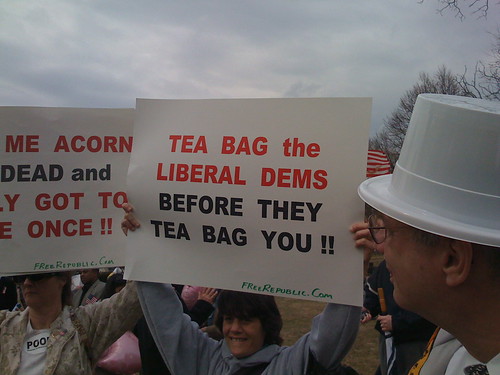
Turns out, there's more to the story. A whole lot more. The whole "Chicago Tea Party" movement is a front for some familiar right-wing faces, according to this piece published at PLAYBOY, of all places. Some highlights (it's long):

What we discovered is that Santelli’s “rant” was not at all spontaneous as his alleged fans claim, but rather it was a carefully-planned trigger for the anti-Obama campaign. In PR terms, his February 19th call for a “Chicago Tea Party” was the launch event of a carefully organized and sophisticated PR campaign, one in which Santelli served as a frontman, using the CNBC airwaves for publicity, for the some of the craziest and sleaziest rightwing oligarch clans this country has ever produced. Namely, the Koch family, the multibilllionaire owners of the largest private corporation in America, and funders of scores of rightwing thinktanks and advocacy groups, from the Cato Institute and Reason Magazine to FreedomWorks. The scion of the Koch family, Fred Koch, was a co-founder of the notorious extremist-rightwing John Birch Society.


So today’s protests show that the corporate war is on, and this is how they’ll fight it: hiding behind “objective” journalists and “grassroots” new media movements. Because in these times, if you want to push for policies that help the super-wealthy, you better do everything you can to make it seem like it’s “the people” who are “spontaneously” fighting your fight. As a 19th century slave management manual wrote, “The master should make it his business to show his slaves, that the advancement of his individual interest, is at the same time an advancement of theirs. Once they feel this, it will require little compulsion to make them act as becomes them.” (Southern Agriculturalist IX, 1836.) The question now is, will they get away with it, and will the rest of America advance the interests of Koch, Santelli, and the rest of the masters?


Read the whole thing. It's worth it. It's real journalism.

This prompts another bit of thought: with this piece coming out of Playboy, Greg Palast publishing at Suicide Girls and Larry Flynt's willingness to sue the government to get journalists battlefield access, is porn the new way to fund investigative journalism? New media models, indeed.

I'm half joking, of course, but it bears consideration, with newspapers dying left and right. Somebody's got to do the work, and somebody's got to pay for it. And good journalism is good journalism, whether it's published at the New York Times, Mother Jones, or Playboy.

How to Overthrow a Government - Intro

In the comments to Sarah's third entry discussing Namoi Klein's The Shock Doctrine (below), I commented that I would try to contextualize exactly what the conditions were that led to the coup d'etat that overthrew Brazil's democratic government and established a military dictatorship that would last for 21 years (1964-1985). Additionally, I said I'd try to address the context and history of the events leading up to the coup in Chile, as well - while they are better known, there are still a lot of complex factors that are often overlooked.

However, as I started trying to write that post, I realized there was way too much to discuss, even in a casual and not-comprehensive narrative, to be able to just lump Chile and Brazil together. What is more, it's not like economic and/or geopolitical interests were only at play in the military governments set up in Chile and Brazil. Throughout Latin America, governments were overthrown, counter-coups were launched, military politics were on the rise, and the U.S. had various roles in the events in numerous countries, from the Caribbean to Tierra del Fuego. And while Chile is the most famous case, and Brazil is geographically the biggest case (which really means very little), there are plenty of other examples that are fascinating in their own rights, some more often referenced (Guatemala in 1954 or, most frequently, Cuba in 1959), but many more ignored (Paraguay in 1954, Argentina throughout the 1950s, 1960s, and 1970s, Urugay in 1973, and Ecuador, with a military government established in 1972 that would find itself overthrown in 1976 by....another military government). All of these cases are really interesting, and I thought (somewhat vainly and perhaps erroneously) that it might be interesting for some of you (our dear readers) if I did a series on the establishment of various governmental overthows in Latin America in the 20th (and even 19th) century, giving a general context, history, and discussing the role the U.S. and other countries had (or didn't have) in these events.

Thus, I introduce "How to Overthrow a Government." It will probably be pretty open-ended, given how many times governments (democratically elected or not) have been toppled in Latin America. I would like to make it clear, though, that no matter how sensational and frequent these overthrows may have been, Latin America is not some cesspool of instability where governments are as strong as wet paper and where political disorder is the common theme. Politics in Latin America, as anywhere (including the U.S.) are dynamic, and have their own regional political specificities that shape events in their countries, and while judgements certainly can be passed on various governments' strengths or shortcomings, I simply ask that people not take this series to show what a bunch of backwards "banana republics" Latin American countries are.

That said, I hope to have the series started later today, addressing (of course) Brazil first, particularly in light of Sarah's post, and I hope to have Chile up by the end of the week. After that, I hope to keep things fairly regular and interesting, and we'll just see where it goes.

Sunday, March 01, 2009

Argentina's Military Officers Now Can Be Tried for Torturing Their Own Soldiers

I've dealt with cases of justice against Argentina's military regime several other cases before. However, a particularly interesting new ruling occurred last week, in which an Argentine court ruled that the torture officers inflicted upon their soldiers during the Malvinas/Falklands War constitutes a "war crime" and a "crime against humanity." The ruling opens the way for prosecution of officers, many still active and fairly high in the military chain of command, who tortured their soldiers before sending them off to the 1982 war with England. The accusations number over 70, alleging incidents of staking soldiers to the ground with a mask over their faces, being forced to stand in holes filled with water up to their wastes for hours on end, food- and water-deprivation, and "direct physical torture." I really don't know where this will lead (though one person quoted in the article said that Argentina will "have a year full of headlines coming"), but it does offer some important insights into how poorly Argentine military conscripts and soldiers were treated by their own officers. We (myself included) too often simplify the Argentine military (and other military dictatorships) as monolithic entities that acted as a unified whole from top to bottom. This ruling is excellent not only for the path to justice it opens for dozens of soldiers, but also in revealing just how pervasive torture was in the Argentine military (when you're using it on your own soldiers, it's pretty deeply rooted), and how dynamic and heterogeneous militaries (in charge of governments or not) are in terms of class, race, ideologies, and numerous other factors.

The Shock Doctrine 3: The Other Doctor Shock

Edit: Matt's post up for this week here.


(Milton Friedman, talking about greed and how every society in the world runs on it.)

Moving into chapter 2 of The Shock Doctrine, Naomi Klein has taken us from New Orleans to Montreal to Chicago and now from Chicago to Indonesia, Brazil and finally Chile, where we'll see the first real example of radical/disaster capitalism in action. (What's going on here? See the intro here, my posts here and Matt's posts here.)

In my readings of the previous chapters, I've noted that there's a thread of commonality with religion running alongside the development of radical capitalism--not just through the uneasy relationship that the two formed with the rise of the religious right in the Republican party, but in the religious devotion to markets as a good in themselves. In other words, the "doctrine" part is important to remember.

As Klein traces the rise of Milton Friedman, shown above in all his glory, she throws in plenty of religious metaphors to make this clear. A capitalist "Eden," a "prelapsarian" state that the Friedmanites aimed for, a "sacred feature" referred to by economist Frank Knight of the Chicago school. She even notes Friedman's "ecstatic love" of his work and the excitement that rose around him that made him the primary target of her research. He wasn't the first to propose these ideas, but he was good enough to convince lots of people that he was right.

She notes that the dogma requires that:

"It follows ineluctably that if something is wrong within a free-market economy--high inflation or soaring unemployment--it has to be because the market is not truly free."


I might be hammering this point a bit, but it is VERY important to note that this loop is possibly neverending. That simply, people who believe this will always find an excuse to keep believing it, a reason that the market was suffering not from the unregulated greed of the few with little concern for the many, but simply some invisible chains of bondage (the spiritual cousin of the "invisible hand"?)

These true believers aimed their ire not at the Marxism they rose in opposition to, but at Keynesian mixed economies. Klein notes that they wanted a "capitalist Reformation" (again, the religious metaphor) to cleanse capitalism of the taint of social spending and market regulation.

Her discussion of the developmentalist economies of Indonesia and specifically Brazil and Chile would probably be better left to Trend and Erik (maybe you guys can fill in some of the blanks here on the Brazilian junta and its connection to the fall of Allende?) but what I took from the discussion was that the U.S. was willing to export the ideas of the Chicago school economists to developing nations before testing them at home. American people have a nasty habit of protesting when you take away their rights or social support--though as we'll get to, the 9/11 attacks provided a shock that gave the Bush administration some of its leeway to get away with "reforms."

Klein also notes that the corporate sector needed an intellectual like Friedman to spread his gospel--that they could appear to be embracing something proposed by a "scientist" (she mentions the "science is measurement" sign at the University of Chicago) rather than just pushing their own self-interest. But economics is not a science in that it's untestable in a laboratory. Hence, Chile.

The binary logic followed by the Friedmanites and the U.S. government as a whole assumed that the governments in Iran, Indonesia, Brazil and Chile had to be pro-Soviet Communism since they were not in favor of U.S. capitalism. They could not conceive of a third way. I hope I don't have to tell any readers of this blog what our involvement in Mossadegh's Iran has led to. But in case you need it, Klein references Senate hearings and declassified documents to make her case for CIA involvement in all of the above countries.

Though we've associated the Bush administration with a profound anti-intellectualism, it is frightening to see that the expansion of disaster capitalism came from a program that purported to help educate future leaders in Chile--by paying for them to attend the University of Chicago and study economics. Klein calls it intellectual imperialism, and she's right. But it is also heartening to note that it didn't work.

It took the CIA and actual violence to do that. The shocks, in other words, that would shape the philosophy.