Sunday, March 08, 2009

The Shock Doctrine 4: States of Shock


“If that track record qualifies Chile as a miracle for Chicago school economists, perhaps shock treatment was never really about jolting the economy into health. Perhaps it was meant to do exactly what it did—hoover wealth up to the top and shock much of the middle class out of existence.” - The Shock Doctrine, page 105


(Previous posts here, Matt's posts here, here and here.)

Trend gave us an excellent rundown of the events in Chile that led to the Chicago School takeover of its economic policy, so I don't need to sum that up here.

Pinochet embraced the Chicago Boys' prescription for Chile's economy, according to Klein, because he liked the idea of a complete revolution rather than a temporary correction. He drove out the other members of the junta and appointed several of the Friedmanites to high government positions, and privatized, slashed social spending, and deregulated. This, predictably led to...

inflation, unemployment, and poverty. So the solution? MORE privatization, deregulation, and slashing social spending. Oh yes, and a calculated terror campaign in which thousands of people were "disappeared." Argentina, Uruguay, and Brazil followed soon after, though some of them took notes from Pinochet and attempted to conceal their torture and murder under a blanket of plausible deniability--in order to stay open to foreign investment, of course.

Klein points out that for all Friedman's free-market utopianism, what resulted was more corporatism than purist capitalism. The countries were run by repressive regimes with deep ties to the corporations who profited from them. Sound familiar? (Well, minus some of the repression.)

The parallels with Bush's disaster capitalism are easier to see when you phrase it in these terms. Bush didn't need a coup (just a disputed election) when September 11 happened (coincidentally, exactly 28 years after the coup in Chile started radical capitalist experimentation).

Warrantless wiretapping certainly isn't mass disappearances of citizens, but it is a tool that keeps everyone in fear that they are next. It suppresses dissent and keeps people in fear for their basic safety, while around them their economic safety net is dismantled. America hadn't undergone enough of a shock to allow, for instance, Social Security privatization, but in Chile and the other Friedmanite regimes, torture and repression left people unable to fight back.

Roger Cohen in the New York Times (h/t Matt) referred to Obama's "counter-revolution," an interesting choice of words considering that The Economist called the spread of disaster capitalism in Latin America its own "counterrevolution."

Which revolution is Obama countering, then? The Reagan revolution, perhaps, since even Bill Clinton furthered Reaganite principles of deregulation and privatization and slashing social programs (:cough: Welfare reform)?

Friday night, I attended a panel discussion put on by The Nation in New York. It featured Joseph Stiglitz, Barbara Ehrenreich, Bill Fletcher, Jr., Jeff Madrick and Chris Hayes discussing the economic meltdown. Stiglitz referred repeatedly to the economic situation in the 70s in Latin America as what we need to avoid--and what we are in danger of repeating.

Madrick noted as well that "This is not recession as usual. This is not recession-plus as usual," but Ehrenreich reminded us that "It's always folly to say this is the end of capitalism."

She went on to note that "What we have to shake off is the curious religion that is market fundamentalism," and Fletcher referred to "the great crap game that is called capitalism."

The fact that there was a line around the block for this event says something about the times, and the amount of little white note cards with audience questions that Hayes had to sort through was evidence that people are scared right now. I fear what this situation would look like at the moment with McCain in office, and the panelists all agreed that it is hard to criticize Obama because he's so much better than what we've had for the past however many years (Madrick pointed out that the standard of living for most Americans has been declining since 1974--in other words, we were better off under NIXON).

Still, the more I read through The Shock Doctrine, the more I realize the parallels. Naomi Klein was supposed to be at this event, and she would've fit in quite well between the economists and the socialists, diagnosing not only the technical problems with our current situation, but the moral and ideological problems there as well.

But the panel on Friday night gave me hope because it proposed solutions. Because we talked about a return to a living wage, a resurgence in unions (EFCA battle coming to a political theater near you), real health care (ditto), and a change in our banking system--a return to "plain vanilla" lending, Madrick called it.

"What are the social functions which a good financial system should serve?" Stiglitz asked, and Milton Friedman might have rolled over in his grave. Still, these are questions being asked right now, and the people in power for the first time in my lifetime may actually be willing to attempt an answer.

Catholic Church's Unsurprising-but-Extreme Stance on Abortion Causes Outrage in Brazil

The Catholic Church in Brazil ended up making headlines this week with its dogmatic stance on abortion. A nine-year-old girl in Northeastern Brazil had been raped by her stepfather, and was pregnant with twins. Brazil does not allow abortion except in cases of rape or the danger of the mother's health, and this particular case fell under both of those categories, as doctors announced that the girl would die before she could give birth, simply because her uterus at 9 years of age simply could not foster twins. Thus, the girl underwent an abortion.

The Catholic Church, of course, came out on the wrong side of this issue once again, excommunicating the doctors who performed the abortion, as well as mother of the girl (but not the child-raping stepfather).

Archbishop Jose Cardoso Sobrinho of the coastal city of Recife announced that the Vatican was excommunicating the family of a local girl who had been raped and impregnated with twins by her stepfather, because they had chosen to have the girl undergo an abortion. The Church excommunicated the doctors who performed the procedure as well. "God's laws," said the archbishop, dictate that abortion is a sin and that transgressors are no longer welcome in the Roman Catholic Church. "They took the life of an innocent," Sobrinho told TIME in a telephone interview. " Abortion is much more serious than killing an adult. An adult may or may not be an innocent, but an unborn child is most definitely innocent. Taking that life cannot be ignored."

Of course, far from standing down, the Vatican fully supported Sobrinho:
Cardinal Giovanni Battista Re, head of the Roman Catholic Church’s Congregation for Bishops, told La Stampa, an Italian daily newspaper, that the case was sad, but that “the real problem is that the twins conceived were two innocent persons, who had the right to live and could not be eliminated.”
Suffice to say, the issue is causing all kinds of outrage in Brazil, and let us be absolutely clear that, although there are many devout Catholics in Brazil, the overwhelming majority of the population side with the girl's family and the government on this one. Even Lula, a very ardent Catholic himself, was none-too-subtle in his views earlier this week, saying that he was bothered both "as a Christian and a Catholic" by the Archbishop's comments and stance and declaring that "I think, in this aspect, medicine is more correct than the bishop."

As I've commented before, the Church is quickly alienating any of its remaining support in its strongest bastion, Latin America. This is just adding to that, revealing a rigidity and intolerance that has been behind the Catholic Church for hundreds of years. One of the excommunicated doctors (who insists he will continue to attend mass) put the Church's idiocy best: "My sadness comes from the fact that the Church could choose the side of fraternity, but it chose the side of conflict. This isn't the Church that people like, that the people want. The people want a church of forgiveness, love, and compassion."

Thanks to its stance on issues like abortion and people like Sobrinho, people just aren't going to get that from Catholicism, and it's likely to continue its decline unless it makes some fundamental shifts.

...UPDATE - Having gotten around to the rest of the internets this afternoon, it appears that Scott and Randy have also gotten to this story (with Randy's including this particular bit of lunacy in Connecticut)

Historical Image of the Day


Fake ad run in Hustler magazine supposedly interviewing Jerry Falwell about sex with his mother in an outhouse while drinking Campari. This led to the Hustler Magazine v. Falwell case in front of the Supreme Court in 1988 where the Court struck down an earlier Virginia court ruling granting Falwell $150,000 in damages for "intentional infliction of emotional distress."

Saturday, March 07, 2009

Historical Image of the Day


Ralph De Toledano presenting his book "Let Our Cities Burn" to Jesse Helms, 1975. This book was a screed against public sector unions.

Monetizing new media: is it time?

The new media world went into outrage last week when Newsday announced that it would no longer be offering its online content for free. We’ve received online information for free for so long that it is almost unthinkable to have to pay for it. In 2007, the New York Times quickly realized that it made more money from advertising revenue than it ever would from online subscriptions. And the sooner news organizations accept that, the better.

However, in the aftermath of possibly one of the worst weeks for the news industry, it’s perhaps important to consider other options. Left with little choice, journalists and media scholars have been debating business models the past couple of months – about the same amount of time that I have been in the non-existent journalism job market, so I figured I might as well look for light at the end of the tunnel!

Andrew Currah of Oxford University, proposed recently in a Reuters report that “kitemarks” - similar to watermarks - could be a reasonable solution to this monetization problem. Kitemarks, which are certifications that would distinguish supposedly reliable online content from noise on the Web, have stirred a controversy in the democratic world of cyberspace. But as Currah explained to Poynter, the idea is not, as some people perceive it, intended to be an"apartheid between bloggers and journalists,” but rather a digital label that would enhance transparency.

Media Standards Trust, the organization that proposed it, insists this would not be a top-down stamp of approval, but more like a cyber postcode that would enable users to determine who the information came from, primary sources, updates, modifications, and journalistic standards adhered to. Merely integrating and consolidating information might urge users to stay on a page longer, thus stimulating ad revenue. In addition, metatags can aid search engine optimization and social media marketing.

Another thing Currah notes in his Reuters report is that since the Web allows a faster feedback to publishers and writers – in the form of traffic, clickthroughs, clickheats, navigation routes, unique visitors, and so on, it may enable them to review performances of individual reporters, and redirect resources to the right stories.

What is deeply concerning about this sort of quest for eyeballs is the kind of populist news that results from it. As Currah notes, such clickstream data is beginning to define the agenda of news organizations as opposed to editorial values. Add to this the fact that some newspapers are now using such Web metrics in order to determine pay for their journalists, and monetization comes a full – and terrifying - circle.

Web sites that keep tabs of such data are beginning to focus on soft news features, such as celebrity gossip and sports. One of the biggest advantages of Internet news is that the vastness and tolerance of the Web allows very specific information to be conveyed to niche audiences. This is fast eroding.

Currah insists that instead of diluting the quality of news in this quest for high volume traffic, publishers should pursue a more targeted approach to acquire readers; editorial judgment should be invested in “anchoring” particular types of audiences by offering content that is specific to both the brand of the news outlet and its reader interests. Here, Web sites would follow “editorial isolines” as opposed to the windsocks that merely blow in the direction of clickstream data. In addition to restoring the quality of news, this would prove to be a more sustainable business model. For one, it would help advertisers who seek engaged readers as opposed to mere glancers.

OJR’s Eric Ulken makes an interesting deduction, where he questions if revenue is being diluted on individual sites due to the re-packaging of stories. Coming from a marketing standpoint, he sort of echoes Currah’s conclusions, by stating that if news organizations focused more on unique stories that cannot be found anywhere else on the Web, they would significantly increase their chances of attracting and retaining visitors, and prevent the divvying up of eyeballs, if you will.

There is no saying that kitemarks and editorial isolines will solve new media's revenue-generating problems, however. Chris Anderson of Wired has long proposed freeconomics as a possible way to charge readers for content, an idea that has been tried, tested, and dropped, time and again, but is probably more acceptable at a time when the media industry is clearly imploding. Giving away part of the item for free (think Adobe) and then charging for the complete or enhanced product has worked for companies like Amazon and Netflix. But this is going to be hard to work into a business that has not only always provided content for free, but also one where the product is considered a universal right.

The option of micropayments is creeping back into the conversation, a concept that may be aided by the launch of Amazon’s e-book on the iPhone. Walter Isaacson makes a fairly convincing case for micropayments for worthy news content. Sites could charge users very small amounts for purchase of individual articles, features, and even blog posts through a one-click system, he writes. David Carr similarly pined for an iTunes-style paid-content system for newspapers a couple months ago.

I would have no problem with the idea of micropayments, if it didn’t so conflict with the distributive and democratic nature of the Internet.

Perhaps more in line with the philosophy of cyberspace is a word that seems to be on every media pundit’s mouth today: Kachingle. A Web content payment service that proposes to acquire donations from Web surfers on a voluntary basis, Kachingle medallions would give readers a choice to donate money to the sites they frequent; this would allow them to support anything from a media stalwart to an obscure blog. Kachingle would then divvy up the amount a reader donates among the various sites he or she wishes to contribute to, based on the frequency of visits and time spent on each site. Virtually any publisher could showcase his or her Web site on Kachingle.

Steve Outing has the details, and his willing endorsement.

It’s hard to imagine that the media industry could survive on such a free-willed concept but for the fact that many non-profit news organizations are already doing so. Think of it as tech-savvy public funding.

Friday, March 06, 2009

The Most Uninformative, Substance-less, Vapid, and Sexist Foreign Examination of U.S. Diplomacy EVER

Earlier this week, my much beloved O Globo had an image up on their front page that showed Hillary Clinton and said beneath it, "The New Face of American Diplomacy" (Portuguese only - sorry, only not really, because you're really better off if you don't know firsthand what O Globo is saying). Thinking, "huh - a foreign point of view on the new administration's diplomatic efforts - let's have a look," I clicked on the link, and the first page read:

"Hillary Clinton hasn't mastered foreign languages, but she visited over 80 countries in her 8 years as first-lady. The Secretary of State never negotiated an agreement between two hostile nations and, at first glance, appears much less prepared than her recent predecessors. She has neither the academic and political specialization of Condoleezza Rice, nor the military know-how of Colin Powell, nor the international credibility of Madelein Albright. But she has more charisma.

Get to know a little more about the woman who will be the spokesperson of Obama's diplomacy and who will have to face collossal challenges, such as the Arab-Israeli conflict, the complex relations with Russia and Iran's nuclear ambitions."

OK. Seemed like it could be a bit anti-Clinton, perhaps, but my intrest was piqued, so I clicked to "learn more" about how Brazil viewed the pros and cons of Clinton's abilities as the "new face of American diplomacy."

Which would have been fine and even interesting, had that been what I got. Instead, I got the option to click on any of the following to find out more about her: "Hair," "Forehead," "Eyes," "Ears," "Necklace" [really], "Clothes," "Book," and "Purse." Already a bad sign, I decided to get it over with, and clicked on "purse," which opened a new graphic of an open purse, telling me such vital information as what perfumes and makeup she likes!!!! YES!! THIS IS DIPLOMACY!!! Already surprised, not at the vacuity of O Globo and the appalling gendered "analysis" of Clinton's "abilities" as the head American diplomat, but at my expectations that it could be anything otherwise, I began silently cursing myself for falling for it, and O Globo for being the 70% shareholder of Brazilian media. That said, already covered in the stink of O Globo, I clicked on some of the other options to see if it could get any worse than the "purse" "analysis."

Turns out, it didn't get "worse," - it just remained as shallow. The "Necklace" option read in its entirety: "Adept with the classic style, Hillary doesn't go without a necklace and pearl earrings." "Hair" told me all about how long her hair was (because, you know, my eyes hadn't been able to discern that, nor could my mind come up with the phrase "just above her shoulders" on its own), and, in the kind of truly deep political analysis only O Globo could offer, telling me that she "uses a spray to give her hair more shine and texture." "Book" told me what her favorite books are (not surprisingly,) while "Ears" told me her favorite music (including the Eagles - the Dude would not abide this) and "Eyes" told me what her favorite movies are. Because, you know, if I want to know about a person's abilities as diplomat, nothing is as revealing as knowing that he or she enjoys The Wizard of Oz or Casablanca (though how awesome would it have been if her favorite movie was something like Manos: Hands of Fate or the Criterion Collection edition of I Am Curious?) The "clothes" "info" was equally uninformative (she likes pantsuits! Again, something I'd have never noticed if it weren't for Globo's cunning analysis!!!), but as an added bonus, I could CHANGE THE COLOR OF HER PANTSUIT ON THE GRAPHIC!!! I never knew diplomacy could be so much FUN!!!! Only Clinton's "forehead" really gave anything relatively deep compared to the other tripe, and it was simply a basic biography of her, saying where she was born and when, what her degree and specialization was in (children's rights), and what she'd done in her life, all in 4 paragraphs!

It is no secret how much I hate O Globo, a fact that wouldn't matter nearly so much if it didn't control a majority of the Brazilian media and didn't make Fox News occasionally look rational and well-researched. Still, just when I think it can't get any more vacuous, sexist, and un-analytical, they come up with this absolutely mind-blowing shit (and let's be clear - it is nothing more than that, in the most perjorative sense of the word). Twenty minutes later, I still didn't know whether to just laugh or just get despondent.

Three days later, I still don't know.

Historical Image of the Day


Ronald Reagan presenting his famous "A Time For Choosing" speech, supporting Barry Goldwater and making his own name as a conservative hero, 1964.

Thursday, March 05, 2009

Jon Stewart Schools Santelli

Historical Image of the Day


Phyllis Schlafly led rally against Equal Rights Amendment, 1982

Digital Colonialism

Sylvia/m has a great post up on digital colonialism--not of the recent femisphere explosion type, but of a more insidious type.

See, I was annoyed this morning by this Columbia Journalism Review piece about the joys of "pro-am" journalism. Karthika's the resident expert on crowdsourcing and the like, but I think (as I wrote before) that there are a lot of problems with this model. One of them is what Sylvia focuses on in her piece--the slant of the blogosphere and new media in general toward middle-class, white US or Western interests. This is a question of access, but also of which voices are privileged.

Then in comments on Trend's wonderful breakdown of the coup in Chile and the overthrow of Allende, boz noted that the notion that many Americans on the left have that we (meaning the US government and the CIA, specifically) are responsible for the overthrow of so many governments in the world is a bit narrow and colonialist, itself.

And then Sylvia's piece about the blogosphere--feminists in particular, but the lessons apply to the left blogosphere in general--kind of summed up a lot of what I was thinking about.

It is not simply an international problem; it happens here in America as well. There are countless people without access to the internet, and who find themselves at the mercy of those who do have access to speak their truths to power. How often do the voices of feminism or the voices of Main Street, for example, reach the ears of the people behind the keyboards? Do people who write and use this medium for contributing to transformative change have an obligation to work for broader internet access and broader outreach?

There is also a broader presence of cyber-discovery, as seen in the recent hoaxes of finding new “tribes” or tracking “dead’ or “dying” languages using digital tools. There’s a distinct Western, anthropological gaze at work that reminds me personally of something out of the 19th century. How is the internet changing how we relate to each other geographically and politically, beyond the idea of having more people to date? How do we address these ways of relating?


I would say that we absolutely have an obligation to work for broader access and outreach. I want to see broadband as a right--and from what I can tell, Obama's FCC team agrees--but more than that, there needs to be a change in thought.

I've got so many thoughts rushing around in my head on this subject, so many tangentially related bits. That the U.S. left needs to get off its savior complex and start working in solidarity with local groups rather than trying to sweep in and fix things. That we here on the Internets need to open up far more than we already have to other voices in other places.

That the problem with journalism these days cannot be fixed by crowds of people spreading useless stories like "bittergate," and that no amount of crowdsourcing will replace having actual foreign bureaus with full-time staff who speak the language, know the country and the people, and can actually provide context to stories rather than parachuting into conflict zones.

I don't have answers, only questions here. But I think you should read Sylvia's piece.

How to Overthrow a Government (II): Chile in 1973

When compared to its more unstable neighbors, Chile prided itself on its rich democratic tradition. Since declaring independence in 1818, Chile had seen some political turbulence, but not with the frequency of dictatorships, monarchies, and overthrows witnessed in places like Argentina, Bolivia, and Brazil. Indeed, since 1932, Chile had not seen its democratic processes interrupted. This rich tradition and national pride has made the overthrow of democratically and constitutionally-elected Salvador Allende on September 11, 1973, and the establishment of Augusto Pinochet's seventeen-year dictatorship of Augusto Pinochet, that much harder to swallow. By the time Chileans realized that there would be no quick return to democracy like many of them had imagined when Allende was overthrown, Pinochet's repressive apparatus would be in place, greatly quashing any resistance to his rule.

Since 1932, Chile had operated on a system in which the population voted for one of any number of candidates, and the Chilean Congress would then ratify the winner of the plurality. This latter step was generally little more than a formality, no matter how low the plurality. Thus, when Jorge Alessandri, a center-right candidate, defeated Salvador Allende in his first presidential run in 1958, Alessandri only garnered 31% of the vote (versus Allende's 28.9%), and was ratified by Congress.

After his 6-year term was up, the center-left Christian Democrat coalition, led by Eduardo Frei, won the presidency, defeating Allende and Julio Durán, the center-right coalition's candidate. While a member of the center in Chile's political spectrum, Frei's six-year term witnessed an increasing progressiveness. During his administration, Frei initiating limited land reform, promoted neighborhood associations, and pushed for social justice, even going so far as to grant the Rapa Nui of Easter Island full citizenship for the first time since Chile had acquired the island in 1888.

By the time the 1970 elections rolled around, the atmosphere was increasingly polarized. While Frei had endeared himself to many on the left, they also felt that his reforms were not enough, while many on the right who were initially open to his administration were incresingly fearful of Chile's leftward shift, fearing a turn to "communism" or becoming "another Cuba." Nor were Chileans alone in this. President Richard Nixon, together with National Security Advisor Henry Kissinger, authorized spending millions of dollars for the other candidates in an effort to prevent Allende's victory. Unfortunately for Nixon, when the votes were tallied, Allende won the plurality with 36.3% of the vote over previous president Jorge Alessandri (35.7%) and Christian Democrat Radomiro Tomic (27.8%). Many thought the congressional approval would once again be a mere formality. However, Allende's opponents quickly mobilized in an effort to prevent his approval, thereby throwing his presidency in doubt, and even the CIA launched a major propaganda campaign in an effort to sway the outcome. Only after Allende signed a statute guaranteeing he would defend Chile's constitution did Congress approve Allende's election 153-35.

Nixon and Kissinger were appalled at the approval of Allende's election, fearing Chile was about to become another Cuba in the Western Hemisphere. In an effort to destabilize the situation, Nixon cut nearly all U.S. funding to Chile in an effort to undermine stability. They also took far more covert measures to try to remove Allende. Kissinger and the CIA were constantly trying to find military leaders who would perform a coup against Allende upon Allende's victory. Unfortunately for them, the chief of the Army, Gen. Rene Schneider, supported the Constitution, and would not support a coup against the constitutionally and democratically elected Allende. However, an anti-communist general, Roberto Viaux, who had also attempted a coup against Frei in 1969, tried to kidnap Schneider in October 1970 in an effort to prevent Allende's inauguration. Viaux botched the attempt, though, and Schneider ended up dead, resulting in the Chilean military and people supporting Allende heading into the inauguration. While no documentary evidence has demonstrated that the U.S. was involved in this attempt, it had previously had contacts with Viaux. Due to the botched kidnapping, though, the U.S. lay low, being forced to wait.

Being finally approved, Allende was inaugurated on 3 November, 1970. Aware that he had only 6 years to implement his reforms, Allende began setting about trying to show the world how to establish a "peaceful path to socialism." Allende nationalized the copper industry in Chile (something also begun under Frei, when Chile became a 51% holder of the El Teniente copper mine, one of the largetst in the country), as well as nationalizing health care. He also established several wage increases that benefitted Chile's workers in his first two years, as well as launching more comprehensive land reform and educational reform. In his first year, his economic plan actually led to a reduction of Chile's inflation, and it witnessed remarkable growth.

These efforts left many on both the left and right dissatisfied. Conservative sectors of society, fearful of things such as "nationalization" and reform, and disheartened by the economic growth under Allende in that first year, began actively mobilizing against him. They also tried to disrupt the economy, often reducing production of basic goods and foodstuffs or hoarding these items in warehouses in order to drive demand and prices up and create market instability. The U.S. also withdrew much of its funding to Chile upon Allende's election. Independently of internal factors, as well, the economy began to take a beating in 1971, as copper prices dropped globally, greatly impacting the Chilean economy. The right used these instances to try to further stoke discontentment, and even many moderates in Chile became disturbed by the leftward path Allende was taking. However, many on the left were equally dissatisfied, feeling that Allende was not moving fast enough. Many of his more radical and poorer supporters tried to force his hand by performing land and factory occupations and expropriations in large numbers. Many intellectuals argued that the only way true reform could happen would be if the entire system was overthrown and Chile started over. Entire sections of his coalition, such as the Socialist Party, were leery that Allende could really implement the revolution they desired.

Matters in Chile really began to deteriorate in 1973. That year, the mid-term elections were held, and the Popular Unity actually increased its presence, winning 43% of the seats. To the right and many in the center, this was too much, and they began taking to the streets to protest the encroaching "Communism." Sectors of the military also were beginning to take notice of the growing instability and political division of Chile, and feared that the entire country would be torn into civil war if things continued down that path. Meanwhile, the Popular Unity's supporters, encouraged by the election results, continued to rally for Allende in the streets and push for more land and factory takeovers. Allende, a cosummate politician in terms of playing the game smartly, was increasingly finding himself pushed towards a path he was hesitant to fully embrace for practial political reasons.

In the meantime, the Chilean economy in 1973 continued to worsen, as income from exports continued to decline. The economy was also finding itself wracked by the emergence of the first petroleum crisis. Inflation was rampant and only picking up steam, and bread-lines at supermarkets were getting longer and longer, leading to dissatisfaction among middle-class and workign-class housewives who were responsible for groceries and cooking. Strikes had also been breaking out since 1972, when truckers went on strike to protest against Allende, crippling the supply system in Chile. Soon, small business owners, copper workers, and other went on strike in protest of Allende, while the left launched counter-strikes for support. Additionally, the far-right paramilitary group Patria y Libertad ("Fatherland and Liberty"), with support from the CIA, had begun attempting to sabotage Chile's infrastructure in order to further weaken Allende, and the CIA continued exploring options for launching a successful coup. In August, Chile's chamber of deputies passed a resolution that openly asked the military to intervene and restore "order" to the country. In another major blow, Allende lost one of his major supporters, the constitutionalist head of the Army, Carlos Prats, who resigned when officers' wives protested in front of his home, calling him a "coward" for failing to help Chile emerge from the morass. His replacement as Commander in Chief of the Army was his second-in-command, Augusto Pinochet, a general many believed was, like Prats, loyal to Allende.

As September dawned, the prospects for Allende were increasingly diminishing. He was simply losing control of the country. Into this growing vacuum, a military junta composed of the heads of the Navy, Air Force, and Army decided to act. Navy chief Jose Toribio Merino planned the coup, and on the morning of September 11, 1973, the Navy captured the coastal port-town of Valparaiso, only 74 miles from Santiago. The national police went to the presidential palace, La Moneda, to defend Allende, who held out hope that Pinochet was still loyal to him. By mid-morning, though, it was clear that he had no military support, and that all of Chile outside of Santiago had fallen. General Gustavo Leigh, the head of the Air Force, ordered La Moneda to be bombed by aircraft. Allende refused to resign, though, and issued an address to the nation via radio. The military arrived at La Moneda and stormed the palace, with Allende dead inside in what was probably a suicide. By the end of September 11th, the military junta, led by Pinochet, was in control, with open support from a Nixon administration that was proud of the role it had played in the overthrow of a democratically and constitutionally elected president, support the new Chilean government would continue to enjoy by such dignitaries as Kissinger, Milton Friedman, and Jesse Helms.

And so, on September 11th, 1973, many Chileans went to bed satisfied with the end of Allende and pleased with the military intervention. While those Chileans slept, that new military government that had already begun rounding up, torturing, and murdering leftists and other "subversives" that it felt had put Chile in such grave danger. Augusto Pinochet shored up control of the junta, becoming the sole leader of Chile. Thus was established Chile's first military dictatorship, which would last another 17 years and would oversee the deaths of over 3000 of its own citizens in Chile, aid in the deaths of many others throughout South America, torture tens of thousands more of its own civilians, launch its own terrorist action in Washington D.C. in 1976 that left two dead, and leave millions affected by its actions.

Wednesday, March 04, 2009

I schooled Bobby Jindal

It's over at Global Comment, but I'll post some of it here to get you to go read it over there.

...Infrastructure spending is the backbone of the stimulus bill, which includes $98.3 billion in funding for transportation and other building projects. $2 billion of that is headed for the Army Corps of Engineers, with an additional $375 million just for the Mississippi river and its tributaries. The Corps are the ones responsible for maintaining the levees around New Orleans that failed so dramatically during Hurricane Katrina. Also designated for Louisiana is $73.5 million for public housing, which could go to rebuilding homes destroyed by the storm or torn down in its aftermath...

By rejecting the last two provisions, Jindal is denying unemployment benefits to nearly 25,000 citizens of his state, as projected by the National Employment Law Project. He’s also incorrect that he would be forced to raise taxes on businesses in order to maintain the benefits after the federal money runs out.

Jindal’s fact-stretching continued with his claims in his speech that the stimulus bill was funding a high-speed train from Las Vegas to Los Angeles—not true, money budgeted for high-speed rail has not been allocated yet—and will be allocated by Republican Transportation Secretary Ray LaHood. He also disparaged “volcano monitoring,” which coupled with other U.S. Geological Survey facilities and equipment, was a rather small area of the stimulus bill at $140 million.

Jindal will be accepting 98% of the federal stimulus dollars earmarked for his state, so his stand on the unemployment benefits looks far less like a principled stand against government spending and far more like political posturing for a rumored 2012 presidential run.


Read the whole thing.

Added Illustration


Since Erik wrote about it below.

Smoking our way out of the red...

You may have heard that the California Assemblyman Tom Ammiano has introduced the increasingly infamous AB 390, a measure that would legalize, regulate, and tax the production, wholesale, and retail of marijuana. His contention is that the taxes alone would generate over a billion dollars per year in revenue.

Part of the tax revenue would go to bullshit "awareness" and prevention campaigns (you remember the ones from school, right? A school assembly where some asshat comes to tell you "Just Say No" and all it does is make you want to sneak behind the bleachers and smoke a bowl during chemistry? I'm being fairly glib here, but I really hate wasted resources, however well-intentioned, be it anti-drug campaigns, those insufferable tobacco "Truth" ads, sensitivity / sexual harrassment training seminars, etc.), but the real savings would come from no longer incarcerating non-violent marijuana crimes. Particularly wise is striking the following from the California Health and Safety Code:

11359. Every person who possesses for sale any marijuana, except as otherwise provided by law, shall be punished by imprisonment in the state prison.

With AB 390, this is gone. In 2007 alone, California had 16,000 felony arrests for marijuana, and marijuana-related offenses are responsible for upwards of 34% of California's prison population (at $30,000 a head per year, that's a chunk of change). Talk about some savings, and a better use of law enforcement man hours.

Under the Bush Administration and the reign of some of the most extremist attorneys general in memory, this idea would have surely been met with some heavy-handed federal opposition. Riding the heels of AG Holder's announcement that medical marijuana laws would be left to the states to enforce, perhaps we could hope that the Obama administration would allow a state to implement something like AB 390.

The Better Side of The New Republic

Despite Marty Peretz running The New Republic into the ground, the magazine has always had great arts coverage. Most importantly, it has employed Stanley Kauffmann as its lead film critic for about 50 years now. Which makes him I think 143 years old. I've linked to a couple of his reviews before, but every now and then, you remember just how old he is (in his 90s and still working). When Jimmy Stewart died, Kauffmann talked about Stewart as a young man. He has talked about Brando starring in a play he wrote before Brando was a star. Today, he reviews Katyn, the new film by the great Polish director Andrzej Wajda. Wajda is one of my favorites with such amazing films as A Generation, Kanal, Ashes and Diamonds, Man of Marble, Man of Iron, Danton, The Siberian Lady MacBeth, etc., etc. Freedom, World War II, and the war's aftermath have always been central concerns for Wajda and Katyn by all accounts is a crowning achievement that addresses all of these issues. Anyway, Kauffmann says this in his review:

One evening in 1939, exactly when the Germans and Soviets were invading Poland, I was at a ballet performance in New York. An announcement was made that a leading man in the company, a Pole, had asked to do a special piece as his Polish declaration of protest and love. (I forget his name.) He then came out and performed a solo dance to a Chopin polonaise, which was not much as ballet but was nonetheless overwhelming. I thought of that dancer, of the audience's wave of sympathy and helplessness, when I saw the last shot of Wajda's film--which I won't disclose.

1939? A mere 70 years ago. What I think is great about Kauffmann's incredibly long career is the limitless font of past knowledge he draws from. He's just about the only person still alive and probably the only person still active in film who remembers the silents. His life almost spans the life of cinema.

Peretz

I had to steal this awesome bit from Cogitamus. This is from a 1976 story about Peretz taking over The New Republic.

Martin Peretz, a very wealthy young man who has used his money sometimes wisely and always enthusiastically but not always with satisfying results in politics, contributed to the last campaign of Senator Ralph Yarborough. Yarborough had courageously tried to be an authentic liberal all his life, but because the effort had had to be made within the twisted and oppressive confines of Texas politics, he had himself become somewhat twisted and paranoic. He hated intensely and he admired intensely; after receiving his money from Peretz and talking with him for a while, over beers, Yarborough slammed an arm around his new patron's shoulder and expressed his admiration: "Marty, I like you. I like you lots. Your motivations in politics are the same as mine -- spite and revenge."

That is hilarious. And so so true.

Historical Image of the Day


John Birch Society president Ralph Westfall speaking in favor of the Vietnam War, UCLA, 1965.

Is Brazil the Next Major "Imperialist" Power in South America?

A few weeks back, Upside Down World published an interesting report asking if Brazil is "creating its own 'backyard' in Latin America?" The article looked at Brazil's rapidly expanding foreign investments in recent years (from $250 million dollars US in 2003 to $10 billion dollars US in 2004 alone) and some recent points of contention (with Ecuador and Paraguay, particularly), and asks if Brazil is on its way to becoming an imperialist force in the region. It chronicles the various investments Brazil has made recently, from cattle farms in Uruguay to private companies' involvement in Ecuador to the Itaipu dam agreement with Paraguay to suggest Brazil may be trying to become a hegemonic power in Latin America.

I find the charge of "Brazilian imperialism" interesting but wrong-headed. I suppose from the strictest economic standpoint, Brazil's growth may look somewhat like imperialism, particularly to the political left of the region. I have a hard time buying into this right now, though, simply because countries can only grow their investments internally so much before they have to invest elsewhere. Brazil has invested wisely, and is succeeding for this. Accusing Brazil of becoming "imperialist" simply because it has succeeded in what all of the countries of South America have been trying to do to one degree or another for quite some time makes about as much sense to me as accusing a successful local coffee shop of becoming "corporate" when it expands and has multiple locations in an area.

What is more, I think the "imperialist" charge loses any legitimacy when it comes to dealing with the term from a geopolitical standpoint (because it's not just about economics). Indeed, I would even suggest that having Brazil become such a major global force is probably a net gain for South America as a whole. For too long, Latin America (including Brazil) hasn't really had a powerful geopolitical or economic voice that was willing to stand up for its interests in the global market. Now that Brazil is gaining that power, and has similar past experiences with its neighbors in the global economy, Brazil is definitely in the position to defend the region as a whole, and to use its power to sway American and European powers. I admit that Brazil could disregard its neighbors demands on issues such as equality and fair treatment in the way that the United States and Europe has traditionally disregarded anything that didn't line their own pockets and the pockets of their allies.

However, this just doesn't seem likely to me. First, these are Brazil's neighbors, and not just foreign countries, and it would really hurt Brazil's standing in the region. Secondly (and deriving from the first point) Brazil's global standing in the economy, while growing exponentially, is still relatively new and fragile, and Brazil can't afford to isolate entire neighboring countries where it has invested so heavily. Unlike China, the U.S., or major European countries (at least before the global meltdown), Brazil could not just cut its losses in one part of the world and focus elsewhere without major repercussions in its own economy. Thus, I think it is fair to say that, at least thus far, Brazil in the 2000s has been rather sympathetic to the interests of its neighbors, even while it tries to defend its own economic interests. There was evidence of this "sympathy-factor" when Evo Morales nationalized petroleum production, including holdings by Brazil's Petrobras, back in 2007. Lula calmly responded to the nationalization and took Morales on his word to "re-work" the deal, ultimately still getting a good deal on gas coming from Bolivia, but with terms more favorable to Bolivia than they previously had been, as well. The Paraguay case makes things look bad, but the Itaipu issue has been a contentious one that has been bubbling for years. It may still work to Paraguay's disadvantage, which would be disappointing and unfortunate. Brazil has a lot invested in that dam in terms of economy and infrastructure, and it very well may end up being shortsighted in its efforts to get the best deal possible for Brazil, while angering Paraguay and perhaps offending neighboring countries. But the operative word here is "may" - things still aren't resolved, and there's not a lot of concrete evidence that lets us conclude already that the Itaipu discussions are going to go well or poorly. And even if things do work out in a way in which Brazil comes off as an economic bully on this issue, I still don't think the dam and the recent issues between Ecuador and Brazil (which were since resolved) are enough to really point towards an emerging but latent imperialism on Brazil's part, at least not right now. I could be wrong on this down the road - presidents do funny things for strange reasons sometimes - but for the foreseeable future, at any rate, I really don't see Brazil joining the "traditional exploiters" in its treatment of the other South American countries anytime in the near future.

Tuesday, March 03, 2009

Updated Pointless Map


visited 43 states (86%)
Create your own visited map of The United States or jurisdische veraling duits?

I love pointless maps. Having traveled to Florida for the first time last weekend (thank you environmental history conference!), I wanted to give an update. 7 states to go.

Florida Tomato Struggle

Brian reminds us of one of the most disgusting and unknown issues in the United States--the virtual, and sometimes literal, slavery experienced by tomato pickers in Florida. He links to Barry Estabrook's piece in Gourmet discussing this:

At this writing, that appears to be the official government position in the state of Florida, and it could explain why the fields of the Sunshine State provide such fertile ground for modern-day slavery. In the past dozen years, police have broken up and prosecuted seven slave operations there, freeing more than 1,000 men and women who were kept captive and forced to work for little or no money and threatened with death if they tried to escape. (For more on the plight of the Florida tomato pickers, see my article “The Price of Tomatoes” in the March 2009 issue of Gourmet.)


Charlie Crist doesn't care. Mel Martinez doesn't care. Jeb Bush didn't care. I'm not sure that leading Florida Democrats care either. There are people trying to help the tomato pickers. The Coalition of Imolokee Workers has worked for a long time trying to bring attention to the plight of these oppressed workers. While they get occasional attention in the liberal press, the nation as a whole doesn't know and doesn't care about these workers.

If you care, you can send an e-mail to Charlie Crist telling him to crack down. I just did and I hope you will too.

Community Gardens

I've gotten involved in a community garden at Southwestern. It's small, with some students, faculty, and staff all working together and on individual plots. It's been a lot of fun. It's also good to grow your own food, or at least have some clue how to do so. I'd certainly like to do more of it, but in recent years I've been gone a lot, which makes it a bit unfeasible. Anyway, here's a little article on it that the school put on their website. Yours truly is "quoted" in it, though I know for sure that I did not say those words. Actually, what I first said when I was asked why I was involved, and this is a direct quote, was that "food ain't gettin' any cheaper." Which I hoped would be the quote in the piece. That didn't sound very professorial though, so I said something about food and pesticides, which is quasi-quoted here.

The plot shown is also the one I am working on. The quality of those vegetables mostly belongs to the person I am working with, who brought some more grown plants when we did it. However, a few days later, the fucking deer ate a bunch of them. If anyone wants some venison, I'm thinking of acquiring quite a bit of it.

One of Gabon's Natural Preserves Under Threat (with Bonus Racist Colonialist Terminology from the New York Times)

There's a lot that's disturbing about this article: the threat to Gabon's (allegedly) nationally-protected forests and the damming of one of its more impressive waterfalls; the ways in which reliance upon oil for the nation's income are threatening the environment as president Omar Bongo promotes iron ore mining; the fact that Bongo has been president since 1967 (forty years!); the expectation that ecotourism will be your economic salvation without any of the extremely complex and involved infrastructural development and planning the ecotourism industry requires; the extremely understaffed park rangers, who in no way could protect much of the park when they are only 15 people. All of these are very serious issues, and I have very little hope for Gabon on this issue, especially given the economic straits it is facing and the general disregard the Chinese seem to be showing for the environment in this case (which, unfortunately, has been all too common a theme among development projects).

I also realize it's probably one of the least important aspects of the article, but the New York Times' editors most certainly should have done a better job editing Polgreen's report. Gabon is coming off bad enough as it is; there's no need to use words like "wily" to describe president Bongo, and passages like "In neighboring countries, impoverished hordes have razed and burned their forests to plant crops and make charcoal. They have slaughtered the gorillas, elephants, chimpanzees and hippos in jungles for meat. But the Gabonese flocked to cities, living in comparative splendor," while perhaps factually correct, also rely on some of the poorest choices of words to describe residents of Africa (or anywhere else) in sweeping generalities. Unfortunately, talking to people who are quite familiar with the Times' reports on Africa, this is about par for the course.

Historical Image of the Day


This week's images will revolve around the rise of the Republican right. Good times, I know.

Democrats for Barry Goldwater, 1958.

Earmarks

Sorry for the lack of blogging the last few days. I am profoundly overwhelmed right now. The big problem is this article due on March 15 that I feel still needs a lot of work. Anyway, I'll try to keep up but I might be a bit quieter than usual.

Anyway, I did want to mention real quick what a quixotic campaign McCain has against earmarks. His anti-earmarks amendment just failed in the Senate by a fairly sizable margin. The problem with this campaign is that earmarks are not bad things. There might be better ways to fund projects, but in principle most of the projects seem pretty OK to me. McCain is also twittering (i.e., some staffer) the most ridiculous of the projects each day. Here are some for today:

*$819, 000 for catfish genetics research in Alabama
*$190,000 for the Buffalo Bill Historical Center in Cody, Wyo.
*$400,000 for copper wire theft prevention efforts
*$47,500 to remodel and expand a playground in Ottawa, Ill.
*$209,000 for blueberry production in Georgia…
*$285,000 for the Discovery Center of Idaho in Boise

How is any of this bad? Scientific studies need to be funded. I'm glad to see a historical and a scientific museum get some money. Playgrounds are good. I like blueberries. I don't know much about copper wire prevention except to say that if thieves are stripping copper wire from telephone lines that this is not a good thing.

So what's not to like here? Plus all of these things create jobs. Yet John McCain is more worried about stopping some money going to an Idaho museum than fixing the economy. No wonder he got blown out last fall.

From Colony to Superpower, Part XIII

This is the thirteenth installment in the 20 part series Rob Farley and I have commenced to review George Herring's From Colony to Superpower: U.S. Foreign Relations since 1776. See the Herring Review tag below for previous entries.

That World War II is the most transformative and important event in the twentieth century seems without question. In the United States, the nation rapidly transitioned from a country committed to limited engagement with the world outside of trade to the world's most powerful nation. Franklin D. Roosevelt was the primary architect of this project. In the last chapter, Herring seemed rather critical of FDR, and to a certain extent he remains so here. But Roosevelt also did a tremendous job preparing the U.S. for the war against significant domestic opposition in the 18 months before the war, allowing a still unprepared U.S. to transition into the war fairly quickly. A lesser leader might not have done this and it could have been 1943 before the U.S. was ready to fight at all. Generally, the narrative of the war is fairly uninteresting to me. I basically don't care about wars as a subject of study, except for their domestic implications. So I'll move on to some specific issues of interest.

One problem with a lot of diplomatic histories is that wars dominate the narrative at the expense of other topics. To no small extent, Herring does this as well; it's understandable but his tentative interests in the cultural side of America's relations with the world almost totally disappear in this chapter. I do think he does a good job discussing Latin America, the Middle East, and Asia. This is one of the strongest sections of the book. He shows both the benefits of the Good Neighbor policy in Latin America for short-term stability and its downside through allowing dictators like Somoza and Trujillo to consolidate their repressive regimes with tacit U.S. support. The sons of these two leaders even attended West Point. The minimal weapons provided by the U.S. allowed these governments to kill its own civilians. Whether the Good Neighbor policy was in the best long-term interests of the nation is a question Herring doesn't really explore.

In the Middle East, Herring does a great job getting into how the U.S. comes to see oil as the world's most important resource and how by 1943, the nation is becoming increasingly involved in Iran and other nations to ensure a steady supply both for the war and the postwar world. In Asia, Roosevelt wanted to slowly bring colonialism to an end, something fiercely resisted by Churchill and De Gaulle. But his own racism, and the racism of the entire nation, made taking the proper actions unlikely. Thinking the Vietnamese and other Asians were children who needed to be protected, the U.S. ultimately did little to end colonialism and moreover began to see itself dictating policy to the region. In China, Chiang's corruption became ever more obvious during World War II. Chiang had powerful friends but constantly frustrated the U.S. government who frankly saw Mao's communist movement as more effective and quite likely the winners of the Chinese civil war.

Herring also usefully discusses the fate of the Jews. While many criticize Roosevelt for not doing more to stop the Holocaust, Herring points out that he faced massive anti-Semitism both in the State Department and the U.S. population. Plus, nothing he could have done would likely have saved many Jewish lives. Roosevelt's classic ambivalence shows up very strongly in figuring out what to do with Jews after the war. He gave lip service to both Jews and Muslims on the issue and never had a strong plan, but he could also see the hornet's nest he was walking into. It's almost taboo to say this, but the establishment of Israel is one of the great foreign policy disasters of the 20th century. While one cannot question that Jews were not safe most anywhere in Europe, creating a state under constant siege that has to displace the people already living there and then oppressing them in occupied territories has not exactly been a huge success. The failure of the Jewish state to establish long-term stability in the face of low birthrates compared to the Islamic population suggests either it losing its Jewish identity or apartheid; either way, it's likely that we'll still be dealing with these same problems in another 60 years.

The person who comes off the worst in this chapter is Churchill. It's not surprising--Churchill was an excellent wartime leader but was a bastard of the first order who had no business leading the British during peacetime. His racism, outright colonialism, willingness to sell nations out, and unwillingness to consider changing Britain's traditional foreign policy prerogatives in the face of the obvious decline of the empire did little to make him a sympathetic leader today. Of course, he was facing massive challenges and perhaps changing who he was is way to unrealistic, but I have trouble arguing with the British people throwing him out of office the first chance they got.

Finally, no discussion of the war is complete without the atomic bomb. Herring is right in criticizing FDR for keeping Truman (and all his VPs) out of the loop. Although I'm sure he didn't want to dwell on his mortality, it was clear by early 1945 that FDR was running out of time. Truman was completely unprepared for the task of steering the nation through the end of the war. However, he did pretty well. His most controversial move was using the atomic bomb against Japan. It was unnecessary and immoral, but also almost inevitable. The nation spent such a huge amount of money on the thing that to not use it would have caused incredible outrage in Congress and among the general public, perhaps leading to the impeachment of Truman and the end of many politicians' and soldiers' careers. Without an outright surrender of the hated Japanese, there was no chance Truman would have made any other decision, and I think the same is true of Roosevelt, although of course we can't know.

There's more to say about US-Soviet relations, Yalta, and all of that, but I'll leave it to Rob and respond to his piece.

Monday, March 02, 2009

How to Overthrow a Government (I): Brazil in 1964

Brazil's political trajectory since independence is one of the weirder ones in Latin America. In a nutshell, Brazil took a fundamentally different path from the rest of Latin America, gaining independence peacefully and immediately setting up a monarchical empire that lasted until 1889, when Brazil finally became a constitutional republic. However, the presidency from 1889 to 1930 was little more than a cyclical network of oligarchs alternately from the major states of Sao Paulo and Minas Gerais. In 1930, Getulio Vargas, from the southern state of Rio Grande do Sul, challenged this hegemony and, after losing what many felt was a fraudulent election, Vargas was swept into power via a bloodless revolution. Vargas was a figure far too complicated to go into here, but he ruled as president/dictator from 1930 to 1945, wildly vacillating from the left to the right and back again. After a five-year respite, Vargas returned to the office of president by being popularly elected in 1950. However, as scandal built up around him when one of his bodyguards try to kill one of his main rivals (the despicable Carlos Lacerda), Vargas committed suicide, becoming a national hero and leaving a gaping vacuum in the office of president. After much turmoil (including threats of military intervention), Juscelino Kubitschek was elected in 1955, serving until 1960 and overseeing an era of development that culminated in the creation of Brasilia in the middle of nowhere and a decreasing income for the growing expenses that arise from the basic model of import-substitution industrialization.


This brings us to the 1960s. In 1961, Janio Quadros, a relative political outsider who Brazil's right felt would represent their interests strongly, was elected president. However, Quadros ran an erratic administration, offering seemingly contradictory policies from day-to-day and giving one of Brazil's highest honors to Che Guevara, further alienating a right-wing that had been discontent with Vargas and Kubitschek and that, in the context of the Cold War and the Cuban revolution , was increasingly frightened of the "Communist threat." When Brazil's legislature resisted Quadros's efforts to increase his authority, he offered his resignation only six months into his administration, expecting the population to rise up and support him and the legislature to decline his offer. Instead, they accepted, and the leftist vice-president (at this time, the vice-president of the country was elected separately), Joao Goulart, a disciple of Vargas, was to assume power.


However, Goulart was on a visit to Communist China, which was even more threatening to the anti-communist right. With a sudden power vacuum, Brazil's military leaders, who had been vaguely and ominously hovering over the political happenings since at least 1945 and who were strongly anti-communist, entered into the political scene. They threatened a military coup if Goulart were given full control of the presidency. Not wanting to cede civilian governance, the legislature agreed to become a Presidental Parliamentary system, in which Goulart's power would be greatly reduced for an indeterminate amount of time. Goulart accepted this situation because he had too, but he soon began working to restore full presidential power, which finally happened after a special election on the matter was held in late 1963.


At this point, believing he had a mandate for social reform and progress, Goulart tried to shift Brazil further to the left. He pushed for land reform and expropriated refineries and unused farm land. This leftward shift was not playing well in an increasingly polarized Brazil, however. While many workers, Vargas supporters, and even soldiers rallied to Goulart's causes, the middle-class and elites (led by Carlos Lacerda), conservatives, military, and anti-communitsts increasingly felt threatened by Goulart. What is more, the United States under Lyndon Johnson in 1964 was increasingly aware of the situation in Brazil.


Nor was the political climate of the Cold War the only thing working against Goulart. The effects of ISI were getting more severe, and Brazil was facing rapidly increasing inflation during his administration, reaching 85% and higher. Basic goods like rice and bread were getting harder and harder to find in stores, leading to long lines. What is more, Goulart at times seemed uncertain of which way he was leading the country, wavering between the policies of his fiercely leftist brother-in-law (and governor of the southern state of Rio Grande do Sul), Leonel Brizola, and the unions, and a more conciliatory, centrist approach to reform. These vacillations only made Goulart appear weak, something the media jumped on in their portrayals of Goulart in the media. Finally, Lyndon Johnson, already getting the United States further involved in Vietnam, was increasingly sensitive of Brazil's situation, not wanting to see "another Cuba" in the America, particularly one that geographically occupied more than half of the South American continent.


The breaking point came in March of 1964. The soldier corps of the military was increasingly demanding greater pay and making clear their support of Goulart, something that troubled the military brass to no end - if they lost control of the conscripts, the leaders would have nothing. Goulart tried to capitalize on this in a major rally held in the center of Rio de Janeiro on March 13th, finally taking a stance with his brother-in-law and abandoning his half-hearted centrist efforts. At another speech in Rio, Goulart said that the conscripts should rise up against their officers if their political will was not respected or was repressed. This was the last thing the military wanted to hear. On March 31st, General Olympio Mourao Filho ordered his army unit, stationed on the border of Rio de Janeiro and Minas Gerais states, to move on Goulart in Rio.


However, the coup's success was far from a guaranteed thing. Many members of the military brass were initially hesitant to openly support such a blatant coup d'etat. What is more, many felt that Goulart would be able to rally the lower-class troops, students, union members, and others to his defense, and if the resistance were drawn out, the military would be irrevocably stained. However, none of that support really substantially materialized beyond isolated rallies supporting Goulart, and the president himself left Rio quietly on a plane for Brasilia before heading to the southern part of the country and then into Uruguay, where he would spend the rest of his life. Also, the previously-hesitant military brass on April 1st came out in full support of Moura's resistance, leading to the great comment that "Brazil's military went to bed in favor of the government and woke up revolutionaries." [The dictatorship and its supporters would try to legitimize the military government by claiming that it was they who had launched a "revolution" against Goulart, an argument I would still hear strains of occasionally when I was in Brazil].

However, in a sign of things to come later down the road, the military could not agree on how power should now be set up. The speaker of Brazil's house of representatives, Pascoal Ranieri Mazzilli, became the titular president of Brazil, as the constitution declared. However, Mazzilli was simply a front for an emerging military junta, led by Artur Costa e Silva. Costa e Silva wanted to have power to himself, but the rest of the military made it clear that they wanted Marshal Humberto Castelo Branco, one of the highest-ranking generals and a World War II veteran, to lead the country. Lyndon Johnson, who had begun sending ships covertly to the coast of Brazil "just in case," was satisfied when Marshal Humberto Castelo Branco, one of the highest-ranking leaders in the military, officially became president on April 8th, and called the ships back.


A majority of Brazilians were extremely satisfied and even relieved with the results. Political conservatives had genuinely feared the "godless" and "Communist" path they felt Goulart was leading them down, even marching by the hundreds of thousands in Rio de Janeiro and Sao Paulo in demonstrations against Goulart "for love of God and liberty." Many of the poor were tired of struggling to find basic foodstuffs and combatting the inflation that was disproportionately affecting them. What is more, Brazilians overwhelmingly and firmly believed that the military intervention was justified as a temporary measure to "restore order," and Brazil would soon return to democracy.


And so began Brazil's military dictatorship, which would last twenty-one years, five presidents and one junta, and oversee the torture of thousands and the disappearance of hundreds of people before it finally peacefully stepped down, as it eventually planned, in 1985.

Brazil's Drug War Also Targeting Privileged

About a year and a half ago, I wrote about the growing ecstasy drug trade among middle- and upper-class kids in Rio de Janeiro. At the time, I was relatively pleased to see the cops were moving beyond just targeting the poor in the favelas in their "drug war," though I had my doubts that such a war on middle- and upper-class drugs would continue in Brazil.

Apparently, my doubts were misplaced:

Drug trafficking in Brazil has become increasingly demonized in the eyes of the law — to the point where drug financiers can now receive stiffer prison sentences than murderers — and the country’s elite is not being spared.

Just last week, federal police officers arrested 55 people, many of them in Rio de Janeiro, in a nationwide investigation focused on upper-middle-class youths who the police said were smuggling Ecstasy, LSD and other synthetic drugs into Brazil from Europe.


This does strike me as good news overall in terms of realities in Brazil right now. For years, the police have launched extremely repressive measures to fight the drug trade in the favelas, using military occupations and indiscriminate killings (as well as entering militias to control the drug trade and gain profits for themselves), all while middle- and upper-class drug usage has been relatively untouched. Unfortunately, as with corruption among police in the drug wars in the favelas, the ecstasy cases are also rife for police corruption:
Ecstasy’s emergence as the drug of Brazil’s wealthy has opened the door even wider for corrupt police officers to seize upon users and their families. Now that Brazil has eliminated prison sentences for drug users, sending them to treatment or community service instead, the police are extracting sometimes hundreds of thousands of dollars in bribes in exchange for not charging those caught with Ecstasy as drug dealers, according to defense lawyers and three convicted drug dealers now out of prison.

This is both unfortunate and unsurprising. But again, within the realities of the drug trade and law in Brazil, at least the same attitudes and mechanisms are increasingly being applied relatively equally across the social spectrum.

Of course, many of the middle- and upper-class youths who have been busted for dealing ecstasy feel they are being treated horribly unfairly and extremely. However, it's hard for me to feel too much sympathy for people like Lucas, a middle-class kid busted for bringing drugs into the country, when he complains “I was treated like a hardcore criminal and put in jail together with killers, kidnappers, you name it.” Two-and-a-half years may seem severe for what many might consider a "youthful mistake," but Lucas deserves no better treatment than the drug dealers caught in the favelas. Indeed, he might think he was dealt with brutally, but at least he was arrested at the airport when he tried to smuggle drugs into the country, rather than having the police come into his neighborhood with guns blazing, leaving a couple dozen dead in their wake. After all, the Brazilian "war on drugs" may be levelling the field somewhat by going after the non-poor sectors of dealers, too, but even then, the poor in the favelas still face more adverse conditions than Lucas did. And at least he lived to go to jail, rather than ending up another one of the dead traficantes on the streets of a favela.

That said, regardless of whether you are in favor or against increasing the efforts to combat drug use in any country, it's really encouraging to see Brazil going after drug production, dealing, and usage regardless of the drug or the socio-economic classes with which a particular drug is associated. And the fact that the story is based in São Paulo (and not Rio) indicates that the drug war is no longer something just for Rio's favelas, even if the gap in treatment of wealthier drug users and dealers and the poorer dealers and users still exists.

Populism: UR Doin It Rong redux


I wrote briefly about Santelli's disingenuous attempt at populism the other day.

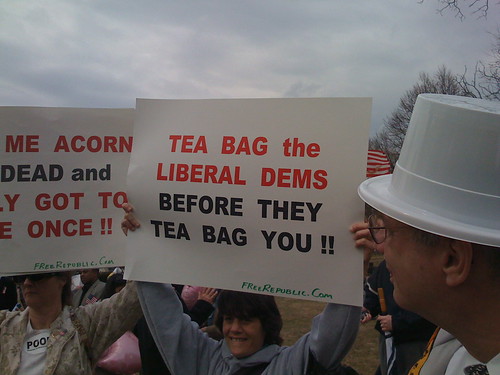
Turns out, there's more to the story. A whole lot more. The whole "Chicago Tea Party" movement is a front for some familiar right-wing faces, according to this piece published at PLAYBOY, of all places. Some highlights (it's long):

What we discovered is that Santelli’s “rant” was not at all spontaneous as his alleged fans claim, but rather it was a carefully-planned trigger for the anti-Obama campaign. In PR terms, his February 19th call for a “Chicago Tea Party” was the launch event of a carefully organized and sophisticated PR campaign, one in which Santelli served as a frontman, using the CNBC airwaves for publicity, for the some of the craziest and sleaziest rightwing oligarch clans this country has ever produced. Namely, the Koch family, the multibilllionaire owners of the largest private corporation in America, and funders of scores of rightwing thinktanks and advocacy groups, from the Cato Institute and Reason Magazine to FreedomWorks. The scion of the Koch family, Fred Koch, was a co-founder of the notorious extremist-rightwing John Birch Society.


So today’s protests show that the corporate war is on, and this is how they’ll fight it: hiding behind “objective” journalists and “grassroots” new media movements. Because in these times, if you want to push for policies that help the super-wealthy, you better do everything you can to make it seem like it’s “the people” who are “spontaneously” fighting your fight. As a 19th century slave management manual wrote, “The master should make it his business to show his slaves, that the advancement of his individual interest, is at the same time an advancement of theirs. Once they feel this, it will require little compulsion to make them act as becomes them.” (Southern Agriculturalist IX, 1836.) The question now is, will they get away with it, and will the rest of America advance the interests of Koch, Santelli, and the rest of the masters?


Read the whole thing. It's worth it. It's real journalism.

This prompts another bit of thought: with this piece coming out of Playboy, Greg Palast publishing at Suicide Girls and Larry Flynt's willingness to sue the government to get journalists battlefield access, is porn the new way to fund investigative journalism? New media models, indeed.

I'm half joking, of course, but it bears consideration, with newspapers dying left and right. Somebody's got to do the work, and somebody's got to pay for it. And good journalism is good journalism, whether it's published at the New York Times, Mother Jones, or Playboy.

How to Overthrow a Government - Intro

In the comments to Sarah's third entry discussing Namoi Klein's The Shock Doctrine (below), I commented that I would try to contextualize exactly what the conditions were that led to the coup d'etat that overthrew Brazil's democratic government and established a military dictatorship that would last for 21 years (1964-1985). Additionally, I said I'd try to address the context and history of the events leading up to the coup in Chile, as well - while they are better known, there are still a lot of complex factors that are often overlooked.

However, as I started trying to write that post, I realized there was way too much to discuss, even in a casual and not-comprehensive narrative, to be able to just lump Chile and Brazil together. What is more, it's not like economic and/or geopolitical interests were only at play in the military governments set up in Chile and Brazil. Throughout Latin America, governments were overthrown, counter-coups were launched, military politics were on the rise, and the U.S. had various roles in the events in numerous countries, from the Caribbean to Tierra del Fuego. And while Chile is the most famous case, and Brazil is geographically the biggest case (which really means very little), there are plenty of other examples that are fascinating in their own rights, some more often referenced (Guatemala in 1954 or, most frequently, Cuba in 1959), but many more ignored (Paraguay in 1954, Argentina throughout the 1950s, 1960s, and 1970s, Urugay in 1973, and Ecuador, with a military government established in 1972 that would find itself overthrown in 1976 by....another military government). All of these cases are really interesting, and I thought (somewhat vainly and perhaps erroneously) that it might be interesting for some of you (our dear readers) if I did a series on the establishment of various governmental overthows in Latin America in the 20th (and even 19th) century, giving a general context, history, and discussing the role the U.S. and other countries had (or didn't have) in these events.

Thus, I introduce "How to Overthrow a Government." It will probably be pretty open-ended, given how many times governments (democratically elected or not) have been toppled in Latin America. I would like to make it clear, though, that no matter how sensational and frequent these overthrows may have been, Latin America is not some cesspool of instability where governments are as strong as wet paper and where political disorder is the common theme. Politics in Latin America, as anywhere (including the U.S.) are dynamic, and have their own regional political specificities that shape events in their countries, and while judgements certainly can be passed on various governments' strengths or shortcomings, I simply ask that people not take this series to show what a bunch of backwards "banana republics" Latin American countries are.

That said, I hope to have the series started later today, addressing (of course) Brazil first, particularly in light of Sarah's post, and I hope to have Chile up by the end of the week. After that, I hope to keep things fairly regular and interesting, and we'll just see where it goes.

Sunday, March 01, 2009

Argentina's Military Officers Now Can Be Tried for Torturing Their Own Soldiers

I've dealt with cases of justice against Argentina's military regime several other cases before. However, a particularly interesting new ruling occurred last week, in which an Argentine court ruled that the torture officers inflicted upon their soldiers during the Malvinas/Falklands War constitutes a "war crime" and a "crime against humanity." The ruling opens the way for prosecution of officers, many still active and fairly high in the military chain of command, who tortured their soldiers before sending them off to the 1982 war with England. The accusations number over 70, alleging incidents of staking soldiers to the ground with a mask over their faces, being forced to stand in holes filled with water up to their wastes for hours on end, food- and water-deprivation, and "direct physical torture." I really don't know where this will lead (though one person quoted in the article said that Argentina will "have a year full of headlines coming"), but it does offer some important insights into how poorly Argentine military conscripts and soldiers were treated by their own officers. We (myself included) too often simplify the Argentine military (and other military dictatorships) as monolithic entities that acted as a unified whole from top to bottom. This ruling is excellent not only for the path to justice it opens for dozens of soldiers, but also in revealing just how pervasive torture was in the Argentine military (when you're using it on your own soldiers, it's pretty deeply rooted), and how dynamic and heterogeneous militaries (in charge of governments or not) are in terms of class, race, ideologies, and numerous other factors.

The Shock Doctrine 3: The Other Doctor Shock

Edit: Matt's post up for this week here.


(Milton Friedman, talking about greed and how every society in the world runs on it.)

Moving into chapter 2 of The Shock Doctrine, Naomi Klein has taken us from New Orleans to Montreal to Chicago and now from Chicago to Indonesia, Brazil and finally Chile, where we'll see the first real example of radical/disaster capitalism in action. (What's going on here? See the intro here, my posts here and Matt's posts here.)

In my readings of the previous chapters, I've noted that there's a thread of commonality with religion running alongside the development of radical capitalism--not just through the uneasy relationship that the two formed with the rise of the religious right in the Republican party, but in the religious devotion to markets as a good in themselves. In other words, the "doctrine" part is important to remember.

As Klein traces the rise of Milton Friedman, shown above in all his glory, she throws in plenty of religious metaphors to make this clear. A capitalist "Eden," a "prelapsarian" state that the Friedmanites aimed for, a "sacred feature" referred to by economist Frank Knight of the Chicago school. She even notes Friedman's "ecstatic love" of his work and the excitement that rose around him that made him the primary target of her research. He wasn't the first to propose these ideas, but he was good enough to convince lots of people that he was right.

She notes that the dogma requires that:

"It follows ineluctably that if something is wrong within a free-market economy--high inflation or soaring unemployment--it has to be because the market is not truly free."


I might be hammering this point a bit, but it is VERY important to note that this loop is possibly neverending. That simply, people who believe this will always find an excuse to keep believing it, a reason that the market was suffering not from the unregulated greed of the few with little concern for the many, but simply some invisible chains of bondage (the spiritual cousin of the "invisible hand"?)

These true believers aimed their ire not at the Marxism they rose in opposition to, but at Keynesian mixed economies. Klein notes that they wanted a "capitalist Reformation" (again, the religious metaphor) to cleanse capitalism of the taint of social spending and market regulation.

Her discussion of the developmentalist economies of Indonesia and specifically Brazil and Chile would probably be better left to Trend and Erik (maybe you guys can fill in some of the blanks here on the Brazilian junta and its connection to the fall of Allende?) but what I took from the discussion was that the U.S. was willing to export the ideas of the Chicago school economists to developing nations before testing them at home. American people have a nasty habit of protesting when you take away their rights or social support--though as we'll get to, the 9/11 attacks provided a shock that gave the Bush administration some of its leeway to get away with "reforms."

Klein also notes that the corporate sector needed an intellectual like Friedman to spread his gospel--that they could appear to be embracing something proposed by a "scientist" (she mentions the "science is measurement" sign at the University of Chicago) rather than just pushing their own self-interest. But economics is not a science in that it's untestable in a laboratory. Hence, Chile.

The binary logic followed by the Friedmanites and the U.S. government as a whole assumed that the governments in Iran, Indonesia, Brazil and Chile had to be pro-Soviet Communism since they were not in favor of U.S. capitalism. They could not conceive of a third way. I hope I don't have to tell any readers of this blog what our involvement in Mossadegh's Iran has led to. But in case you need it, Klein references Senate hearings and declassified documents to make her case for CIA involvement in all of the above countries.

Though we've associated the Bush administration with a profound anti-intellectualism, it is frightening to see that the expansion of disaster capitalism came from a program that purported to help educate future leaders in Chile--by paying for them to attend the University of Chicago and study economics. Klein calls it intellectual imperialism, and she's right. But it is also heartening to note that it didn't work.

It took the CIA and actual violence to do that. The shocks, in other words, that would shape the philosophy.

Historical Image of the Day


Anti-gambling comic featuring Dallas Cowboys coach Tom Landry. Not sure of the date, but I'm guessing early 1970s.