Monday, October 19, 2009

On the Weekend Violence in Rio de Janeiro

This past weekend, violence in Rio's favelas flared up, with ugly results:

Some 2,000 police officers patrolled the streets of Rio de Janeiro Sunday after a bloody confrontation between rival drug gangs and authorities that killed 14 over the weekend, including two police officers. [A third died this morning, according to reports in Brazil - Trend].

Two suspected drug traffickers were killed and four were arrested in Sunday's operations by Rio de Janeiro's military police, the official news agency Agencia Brasil reported.

Of course, these events have led many in both Brazil and abroad to comment on what this means in light of Brazil recently being awarded the 2016 Olympics. Boz broached this subject earlier today:

It's not credible to think that Rio's drug gangs have a unified grand plan of Olympic disruption that they're implementing. However, their ability to create a climate in insecurity and harm Rio's reputation is certainly a greater factor with the Olympic announcement. I expect them to continue to challenge the security forces and attempt some more high-profile attacks in the coming year.

I absolutely agree with that first part of the paragraph. This wasn't some coordinated response to the Olympics; hell, it wasn't even an uncoordinated response to the Olympics. Some of the news stories have insinuated this clearly indicates that this is a threat to Olympic athletes, as the favela in question (Morro dos Macacos) is "only five miles" from where one of the villages will be, not taking into account that that's five miles by air, not five miles through mountains, lakes, buildings, and the world's largest urban forest. In grand terms, this means pretty much nothing in terms of the Olympics or the athletes.

I find Boz's final sentence more interesting. I certainly think the drug gangs will challenge the police, but it's not like this is the first time that they've challenged police,given the military tactics used against civilians in the favelas, where it's not uncommon to see images like this one (from the CNN story):

A policeman advances through an alley of Rio on March 25, 2009, during an anti-drug operation.

Indeed, I once ended up on a city bus that passed through a favela in downtown Rio, and while it was as uneventful as most bus rides (and less eventful than some that never went near a favela), I was still alarmed to see military men with assault rifles poised just hanging out on street corners, alert but not in battle. You want to know the dynamics of the favelas? That picture hits it perfectly - a small kid who probably has nothing to do with the drug trade, a very well-armed individual from the military police, and somewhere unseen, actual drug lords. And kids like the one in this picture, along with old women and plenty of others untouched by the drug trade, are often killed (with some estimates hitting the thousands of innocent civilians dead).

But back to Boz's comments. Yes, they will challenge the police, and they have in the past, but, in spite of the major framing of this story, that's not what this event was. Yes, a police helicopter was shot down. But this wasn't even a case of police raiding a favela and violence erupting. This was a battle between drug gangs. The helicopter was shot down when flying over the favela to see what was going on, and as Boz himself points out, the helicopter getting shot down wasn't even intentional; according to reports, the bullets that hit the helicopter were basically stray bullets, and they weren't even from .30 caliber machine guns (though I agree with Randy that it's disturbing the gangs have this kind of weaponry, though again, it's not like the police haven't shown a propensity to murderous actions, too). With all due respect to Boz, he mistranslates that passage of the article, which reads [and I translate], "the helicopter was hit by light fire - nothing that was fired from a .30 caliber machine gun or that could have been caused by a rocket-propelled grenade found in gangs' arsenals."

So while some pitch a fit over Brazil getting the Olympics over Chicago in light of this weekend's events, they're completely out of touch with what the history, the context, and the meaning of this weekend's events. As Boz says, it wasn't some coordinated (or even uncoordinated) response to the Olympics; it wasn't even an attack initially launched on the police. It was gang warfare located away from the sites of the future Olympics that ultimately included the deaths of 3 police officers as well as at least 14 "traficantes" (though, as always, that title and/or figure is questionable). Is it a threat to the Olympics? No more so than every other incident of favela violence has been a threat to the Olympics, which is to say, not at all. The favela violence is kept to the favelas, and regardless of what you think of that, it does not mean anything to the Olympics yet. And the Brazilian government is not just ignoring this problem - today Lula pledged an extra $60 million to Rio to help combat violence in the city. This wasn't an internal "protest" to the Olympics, and it wasn't an event that should make anybody reconsider awarding Rio the Olympics. It simply was what all the other incidents of favela violence have been - sad episodes of violence, with plenty of blame to go around.


Vandalism of the Year


Apparently, Vicente Fox's Statue used to be a giant hand that made the "V" symbol. I say used to because, as you can see, somebody with a wicked sense of humor and a decent understanding of politics modified the statue in one very important way. Courtesy pc.

Sunday, October 18, 2009

Stop the Presses!

Derek Anderson has thrown a touchdown, making it two for the season!

Now, back to your regularly scheduled internet-surfing.

Saturday, October 17, 2009

Facial Hair of the Weekend

In the midst of the playoffs, some baseball facial hair seems appropriate. Former Cleveland Indian great Casey Blake, now of the LA Dodgers, with what is hands down the best beard in baseball.

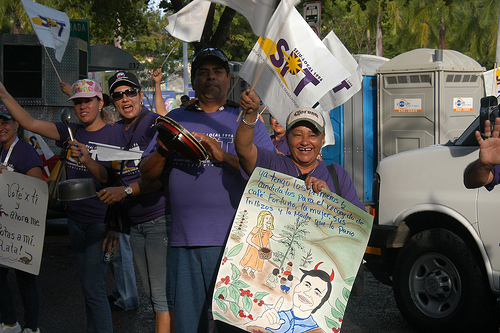
Puerto Rico On Strike


While CNN was obsessing over that damn Balloon Boy (who wasn't actually in the balloon and therefore was an even bigger waste of time than tea party protests), Puerto Rico had a historic general strike. Estimates range between 100,000-200,000 people in the streets marching. Of course, the corporate media ignored it. I wrote about it for Global Comment--as usual, I'll start the piece here and encourage you to read it over there, since they help pay my bills (and there's other stuff worth reading there as well!)

Fortuño’s plans fought: lessons from protest in Puerto Rico

I’ve seen a focus in the United States on mass political action in the past year like nothing I’ve seen in my lifetime. From the huge crowds at Barack Obama’s campaign rallies and the unprecedented amount of donors and volunteers that helped elect the man President to the recent cynical discovery of organized dissent by the Republican party, we’ve watched groups large and small take to the streets.

Whether this is a sign of a newly energized, engaged American body politic will take some time to say. After all, some demonstrations still receive more attention than others, with the right-wing media machine led by FOX News trumpeting the success and inflating the numbers of tea party protests while decrying protests from the left, and the purported liberal media spending a good chunk of time arguing those numbers and attempting to root out the funders behind the right-wing actions—often while genuine grassroots action goes on under their noses, ignored or even punished by those in charge.

Almost completely ignored this week was the one-day general strike in Puerto Rico following the attempted imposition of shock-therapy-style economic reforms by the new governor. Chief among those reforms was a decision to lay off more than 20,000 public employees. The layoffs would drive Puerto Rico’s already-astounding 15 percent unemployment rate to over 17 percent.

More than 100,000 workers took to the streets to protest on October 15–Eliseo Medina, Service Employees International Union Executive Vice President, told me he thought the crowd was over 150,000. “It was tremendous. I’ve been in the labor movement for 44 years and this was the most impressive event I’ve ever seen. It was up there with the immigrant mobilizations of 2006,” Medina said. “It was one of the most diverse events that I’ve ever seen in a society. Lawyers, workers, students, psychologists, priests and minsters and nuns and everyday people. It was truly an amazing sight. It was pretty clear, our rejection of Governor Fortuño’s policies.”


Read the whole thing.

Historical Image of the Day


I am stealing straight from Dave Noon at LGM. These historical images also serve as a teaching archive and I have to remember this commercial.

Sadly, Argentina Makes the World Cup; Unsurprislingly, Maradona's Still a Jerk

I was really hoping against hope that Ecuador would win its game, and Uruguay would beat Argentina, keeping the latter out of the 2010 World Cup. That said, anybody proclaiming the glory of Argentina for barely sneaking in as the 4th of four qualifiers from South America (with a fifth up for grabs against Costa Rica) is delusional. That team has serious issues facing them going into next year, and if they don't get a #1 seeding (which they very well may not), they may not make it out of the first round, a la France in 2002.

That said, Diego Maradona is still a first-rate loudmouth buffoon, not just for acting like this is a true triumph, but for the way he expressed such "triumph":

Following the match which Argentina defeated Uruguay 1-0, Maradona delivered a expletive-laden tirade, broadcast on live TV, directed at reporters and critics whom he claimed had shown no confidence in his work.

“This is for those who didn’t trust this team and for those who treated me as garbage. We’re in the South Africa World Cup; with nobody’s held and with all honours. Those who didn’t believe in me suck it…” he told most of the Argentine media at the press conference following the match.

Classy - you barely get your team in the World Cup, are facing real issues with both your players' style and seeming lack of interest in playing while you're the coach; you've threatened to leave the team before the World Cup, throwing everything in turmoil; and now, you're neurons failed to stop what was going through your head from coming out of your mouth, and you're facing disciplinary action and possible suspension heading into the World Cup in less than 9 months.

I think it's safe to say who Maradona wants an Argentine World Cup victory for, and it isn't Argentina.

Randy has more.

Friday, October 16, 2009

Bad Days in American History: October 16, 1859

150 years ago today, John Brown and his followers seized the federal arsenal at Harper's Ferry, Virginia, hoping to inspire slaves to revolt across the South. This event went a long ways in precipitating the Civil War.

Readers of the site might be surprised to see John Brown's Raid listed as a Bad Day in American History. Brown was fighting to end slavery, the most miserable, disgusting institution in the history of the United States. Certainly I've spared no expense in attacking those who committed treason in defense of slavery.

While I may not impinge Brown's dreams, his actions set a dangerous precedent, which is why I am writing about this today. History is always reinterpreted to fit the present. Right now, Brown's actions resonate very strongly with the anti-abortion movement. In particular, extremists who want to kill abortion doctors see Brown as an inspiration who acted out of moral principle, even if his actions cost lives. I don't like this precedent one bit. In that light, it's easy to see Brown as a complete lunatic (which he was, regardless of how you feel about his actions) whose actions must be condemned so as to not be repeated. If you completely isolate Brown in his time, maybe one can say he was justified in his actions. But if people emulate him, what cause is it not worth killing for if you believe in it strongly enough? John Brown's raid scares me.

Historical Image of the Day


Clifford Berryman editorial cartoon depicting Secretary of Agriculture Henry Wallace as Adolf Hitler and American farmers as goose stepping Nazis, Washington Star, February 16, 1938

Thursday, October 15, 2009

3 Ways Not To Be A Good Parent

1. Name your child after a raptor.

2. Force your children to be on Wife Swap, not once, but twice

3. Allow them to play in the experimental flight machines you keep in your backyard.

That is all.

We Clearly Live in a Post-Racial Society

Good ol' Louisiana.

Keith Bardwell, Justice of the Peace in Tangipahoa Parish refuses to conduct interracial marriages:

Bardwell said he has discussed the topic with blacks and whites, along with witnessing some interracial marriages. He came to the conclusion that most of black society does not readily accept offspring of such relationships, and neither does white society, he said.

"I don't do interracial marriages because I don't want to put children in a situation they didn't bring on themselves," Bardwell said. "In my heart, I feel the children will later suffer."

If he does an interracial marriage for one couple, he must do the same for all, he said.

"I try to treat everyone equally," he said.


Race totally doesn't matter in America anymore....

Via Think Progress

Worcestershire Sauce, circa 1876

If the Times is going to start pressing Gilded Age recipes upon us, I demand some delicious ways to prepare passenger pigeon.

Historical Image of the Day


"Little Lefty," Cartoon from The Daily Worker, August 6, 1937

Wednesday, October 14, 2009

RIP - Al Martino and Captain Lou Albano

Al Martino (aka "Johnny Fontaine" from The Godfather) has died at 82, while Captain Lou has escaped the mortal coil at 76. Martino may have had a great singing career - I literally know nothing about it, which I suppose is a shame. That said, Johnny Fontaine was probably my second-favorite "secondary" character from The Godfather (after the baker who made the cake and helped Michael scare off Tattaglia's men). As for Captain Lou, he will rightly be remembered for his wrestling career and his associations with Cyndi Lauper. That said, he'll also always have a fond place in my heart as I watched his live-action Super Mario Brothers TV show as a child in the late 80s. I'm sure the show is really terrible (something a simple viewing of the show's intro has more than confirmed). I'd rather remember Albano, and Martino, fondly as minor-but-beloved pop culture figures from my youth.

Historical Image of the Day


"While Washington Makes Up Its Mind," cartoon by John T. McCutcheon, Chicago Tribune, 1930

Tuesday, October 13, 2009

Baseball Playoff Predictions - ALCS and NLCS

Save for picking the Sox in 5 (oops), and suspecting the Cards could eke out at least one win against the Dodgers, the LDS worked out about how I expected (and I really had the least amount of conviction on the Sox-Angels series). That said, here are my quick picks:

Yankees (in 6) over Angels: I hate doing this. I really really really really really hate doing this. I spent five minutes sitting here, trying to convince myself maybe the Angels could pull it off. They certainly looked good against the Sox, even getting help from aging, semi-unlikely sources (why hello, Vlad Guerrero!). That offense is still good; the defense above average; and the pitching...

...hell, I can't do it. The Yankees just look better overall. I really do think the Angels' defense is better. But that bullpen. And the Yankees just have too much offensive power (fuck you, Mark Teixeira), too deep a pitching lineup. And in spite of my hopes that age would some day catch up with him (and it eventually will), there's still Mariano Rivera. I know the Angels have a recent history of being Yankee-killers in the playoffs, and words don't express how badly I want it to happen again. I think they'll get a couple wins, but I just don't see it happening, as much as I want it to.


Phillies (in 6) over Dodgers. On paper, these two teams stack up really well. The offenses are equally potent. The Dodgers' bullpen may have been more steady in the regular season, but Charlie Manuel's sticking with Brad Lidge and not undermining his confidence seems to be paying off, at least for the LDS. The Dodgers have a slight advantage in the bullpen still, I think, but the Phillies hold the edge in starting pitching. Cliff Lee is still a workhorse, and with a few days rest here and a good setup for pitching in games 2-4, I just like the Phillies a bit better here. I know I'm being redundant in picking two 6-game series' here, but I don't think any of the teams is so bad to get swept, and even if one of the two series only goes 5 games, it will be a close 5 games.

Monday, October 12, 2009

Thank You, Tom Waits

Dear Tom,

Awhile back, I wrote you, asking for a new album. Apparently, those words were not idle, and while it's not an album of all-new material, a bonus disc composed strictly of your stage banter is more than acceptable. I can't wait to hear this.

Thanks so much. And I still can't wait to see you as the devil.

Gratefully,

Mr. Trend

PS: And you're offering the first 8 of 17 tracks for free download at your site? You truly are the coolest man alive.

Bad Days in American History: October 10, 1973

I had this written to post on Saturday, but I have been at a conference in Denver that I assure you included no drinking of delicious Colorado beers, and I didn't have time to post this.

On October 10, 1973, Spiro Agnew, Vice-President of Richard Nixon, resigned in disgrace under investigation for a variety of crimes, including tax evasion, extortion, bribery, and conspiracy.

Of course, Agnew had always been a class act. The only reason he was on the presidential ticket in the first place was his first-rate race baiting, under the euphemism of law and order. He was the perfect compliment to Nixon's Southern Strategy and politics of white resentment. He served his four plus years as Nixon's attack dog. Not that Nixon wasn't good at that himself. But Agnew had a great way of hurling insults, insulting hippies and black people, and becoming a hero of the rising conservative movement.

Agnew would have been a tremendously successful politician in the modern conservative movement. Almost totally without scruples except for self-promotion, Agnew almost reads as a precursor for Sarah Palin. Both had meteoric rises to nomination in a position for which they were completely unqualified to serve. Both rose politics of resentment to the top. Both relished personally attacking their opponents. Both had absolutely no clue about foreign policy, much to the worry of the top of the ticket. Both did not get along with the presidential candidate. While we don't know much about Palin's opinions of Jews, Agnew was a virulent anti-Semite. And both were corrupt to the core.

After Agnew's disgraceful resignation, he wrote a memoir published in 1980. In it, he claimed that Nixon and Al Haig planned to assassinate him if he refused to resign from the vice-presidency. While one hardly wants to put anything past Nixon or Haig, in this case, those guys seem pretty above board. Compared to Spiro Agnew, anyone sounds good!

Like a lot of bad things, it was tinged with good. Maybe it was a good day when Agnew resigned. Because I sure would rather have had Gerald Ford take over the Oval Office upon Nixon's resignation than Agnew.

Historical Image of the Day


"Work Promotes Confidence," WPA poster, New York Federal Arts Project

"Internet Left Fringe," eh?

I don't know if this is true, or if this is Harwood's own phrasing on something that a "White House source" said, but I'm going to take a few seconds to play with it in any case.

First off, the corporate media has far more reason to dismiss bloggers as the "Internet left fringe" than staffers of a president who was put in office on the backs of millions of "Internet left fringe" donors and volunteers. Yet it seems that Obama's staff, headed of course by one Rahm Emanuel, he of the "fuck the 50-state strategy, take the corporate money" thought process, has bought into the "Church of the Savvy" position that bloggers are a sad, silly minority of people online who will never be satisfied with anything.

Sure, I've seen people on the Internet whining that Obama is no different than Bush. It shouldn't have taken a Nobel Peace Prize for us to know that that line is objectively false. That doesn't mean that we don't get to be pissed when Obama's not living up to his promises. And as Jane Hamsher and the others who raised hundreds of thousands of dollars for candidates to support a public option could tell you, the "internet left fringe" can move dollars and poll numbers and support.

As for the National Equality March, like other protests for social justice, it gets written off as "fringe" by the same mainstream media that fetishized the tea parties. It seems they don't have enough corporate sponsorship to be taken seriously. As usual, real grassroots is threatening to those in power, whether their power is corporate media or political insiderdom.

It's too bad, though, for Rahm and his cohorts and for Harwood and the rest of the media. The netroots got a taste of its own power (ironically, starting with its ability to put Obama in the White House) and it's not going away, it's growing. And more and more of us are leaving the basement, taking off the pajamas, and going to an office for a media job--to which we bring the same political ideas, the same social justice values, and the same drive to get the job done that we did when blogging was something we squeezed in in our spare time because we just cared so damn much.

(In other news, today's my first official day at the new job. Wish me luck!)

Saturday, October 10, 2009

Facial Hair of the Weekend

To make up for my gaffe last week, the other South American leader with a full beard (though nowhere near as full or good as Lula's): Fernando Lugo, President of Paraguay.

A Modest Proposal

As the Honduras situation remains at a standstill, I offer the following suggestion. With the U.S. men's national team heading to Honduras for a World Cup qualifier, let "soccer diplomacy" settle it. If Honduras wins, Micheletti can stay in office; if the U.S. wins, Zelaya, with international support, returns to finish out his term.

I haven't figured out what to do in the case of a draw, though....

Friday, October 09, 2009

Hack-tacular!

Dear Ed Rollins,

You're a grade-A hack, so I don't expect more of you. Still, if you do think the Peace Prize is cheapened with Obama's reception of it, I've got news for you. If you're looking for the moment when the Nobel Peace Prize was cheapened, it didn't happen today. It happened back in 1973, when a man who supported Pinochet (and would soon support a dictatorship that in just 6 years killed 30,000 people in Argentina) was given the award.

With historical perspective, I remain,

Mr. Trend.

Some More Thoughts on Obama's Nobel Peace Prize

To follow up on what Sarah said regarding the announcement of Obama's Peace Prize, I think a lot of her points are valid. Like the rest of the world, I was initially surprised. In face, my confusion may have outdone most others - I woke up to NPR this morning hearing the following: "Today, the following announcement was made in Sweden [long pause, during which I'm thinking, within the first 30 seconds of waking up, "Please say Philip Roth has finally gotten the Nobel Prize in Literature"]," only to find that Obama has won the Nobel Peace Prize.

Like just about everybody both left and right, my initial reaction (now within the first 60 seconds of waking up) was, "Really?"

However, I apparently seem to think this makes more sense than a lot of people (both left and right). I understand the arguments against it from both sides (well, I don't understand the total vitriol that's already coming from the right, but I expect it): it's too early, it's just a "here's a prize for not being Bush," "what's left if he actually does accomplish something?," "He has two wars going on and is about to escalate Afghanistan - how is that peace?" All of this makes sense to me, and I'd share those feelings, if I thought this was really just about Barack Obama the man's accomplishments.

But I don't. Not exactly, anyways.

This really does seem to be an award for a particular diplomatic approach that embraces more than multi-lateral talks and openness (though it certainly offers that, as well). Maybe others have forgotten, or maybe I've overstated its importance, but Bush's "cowboy diplomacy" approach was so appalling from an international relations standpoint and in terms of all reason and respect to the world, that Obama really does mark a major shift. Sure, he has failed at some important domestic policies (thus far, though to all those saying "a peace prize after only 9 months?? But he's failed at health care and reforms!", I'd remind them, "well, yes - but as you yourself admit, it's only been 9 months"). We have focused on this a lot, and rightfully so. But I think in doing so, there's been a (again logical) focus on the domestic side, what between the health care and the economy and don't ask/don't tell.

But from the international standpoint, I really can't emphasize enough how much a shift Obama is. He hasn't caved to pushes for more aggression against Iran, and even his apparently-possible escalation in Afghanistan seems to be actually well-reasoned and considered; even if you don't agree with it, it's not like he's just diving in, consequences be damned. And let's not forget - America was closer than it likes to think to electing a guy who joked we should "bomb bomb bomb, bomb Iran."

And while you can and should argue that in many ways, Obama's policies reflect a return to Bill Clinton's, I don't think that holds in the case of international relations. Obama has proven himself much more open and reasoned in his policy making than even Clinton did. It's about more than just being willing to talk to Chavez face-to-face at a meeting of the OAS, or have Bill Clinton pull some tricky negotiations to release hostages in North Korea, or find a path that the entire international community is willing to follow in dealing with Iran. Indeed, one simply has to look at Honduras since June. Obama has taken an approach to Latin American coups that the U.S. has never seen before - an open, non-partisan condemnation of what was clearly an illegal removal of a president, combined with a refusal to get directly involved by sending troops in. The U.S. had done this any number of times before, and every time, it was wrong to do so. For once, Obama relied on diplomacy, and even while condemning the actions, has refused to directly interfere in Honduras. Sure, he's had the State department take measures to restrict the aid and cash flow to Honduras from the U.S., but that's within his prerogative as president, all the while respecting Honduran sovereignty.

That sounds simple, unimportant; but from a history where the U.S. basically took every opportunity to meddle in, interfere with, and even directly undo democratic processes in Latin America from 1846 to 2002, this is a major, major shift. And it's representative of Obama's policies thus far - respect, doing what's within his power without overstepping the sovereignty of others, all the while working to maintain global relations. Honduras isn't the reason; it's symptomatic of the broader, subtle, but major shifts in how the U.S. is forging a new path in its diplomatic history under Obama.

In that regard, I think he's more deserving of the award than many. Is it too soon? I think that's a fair argument. Is it confusing? A bit (even after having awakened after a cup of coffee). Is there room for improvement? Of course - show me one person who's already perfect. That said, I think this is in part about Obama, and the (what I think is very real) change he brings to American foreign policy. But to focus on it just being about him is to miss the larger point, I think; it's also about embracing a major change in diplomatic relations between the U.S. and the world at large, a change that the U.S. initiated under the leadership of a particular man. And I'm fine with that.

Some Thoughts on Obama's Nobel Prize

No, really, I'm not kidding, he won the Nobel Peace Prize.

I questioned the prize committee's definition of the word "peace" when Al Gore won it for environmental activism, which seemed a wee bit of a stretch for me. This time around, the committee at least seems to be thinking in the general direction of "peace":

The committee praised Obama for his "extraordinary efforts to strengthen international diplomacy and cooperation between peoples" during his nine months in office and singled out for special recognition Obama's call for a world free of nuclear weapons, which he first made in an April speech in Prague.

Heralding Obama as a transformative figure in U.S. and international diplomacy, the committee said: "Only very rarely has a person to the same extent as Obama captured the world's attention and given its people hope for a better future. His diplomacy is founded in the concept that those who are to lead the world must do so on the basis of values and attitudes that are shared by the majority of the world's population."


So. This will, no doubt, make conservatives flip the fuck out. Maybe it'll move his poll numbers among the rest of the population. (Maybe the Nobel committee just wants us to get some decent health care?) But what reaction do I, an American progressive/hippie pinko commie type have to the bestowing of the Peace Prize on the president whom I spent the better part of a year volunteering to get elected?

The snark is flowing fast on Twitter. Melissa Harris-Lacewell: Because he appointed all his electoral adversaries to the cabinet. #ReasonsBHOwonNPP and Because he invited a white policeman over for a beer! #ReasonsBHOwonNPP #BlackMenDontDoThat.

But really, it does seem a little...early? I mean, the man's been president for nine months. The extraordinary goodwill that he's generated around the world? Mostly a result of him so very obviously NOT being George W. Bush. I mean, yes, he's done some things that are impressive. He's given speeches in Muslim countries calling for understanding, he's called for a world without nuclear weapons, he's not behind the coup in Honduras and has actually taken some steps to return the rightful president, etc. He wants to get out of Iraq, though it appears to be going far slower than we'd have hoped.

Let's be clear: we didn't elect Dennis Kucinich. Shit, we KNEW we weren't electing Dennis Kucinich. But I think a lot of us were hoping for more than we've gotten. Pushing for the Patriot Act renewal and more funding for war in Afghanistan harder than he seems to be pushing for a public option on health care is only the latest set of disappointments.

I wonder what's left to give him if he DOES accomplish something major? If he manages to broker peace between Israel and Palestine? Hell, if he actually ends the two wars he inherited? Our own Matt Duss joked: Obama will receive prize on Dec 10. Has until then to end Isr-Pal conflict, get Iran to abandon nukes, end Iraq/Afgh wars. No pressure. (I guess they could always give a prize to Hillary Clinton for all that, and once and for all cause Bill's head to explode: Carter, Gore, Obama and HIS WIFE?)

Others pointed out the massive peaceful protests in Iran this year and how that deserves more of a peace prize than Obama. Mousavi's history with prior Iranian regimes probably discounted him (fairly, I think) but what about acknowledging the people who crowded the streets protesting for change? What about the people in Honduras calling for the return of their president under repressive conditions?

The Nobel Prize and other things like it celebrate individual achievement, but working for peace isn't an individual thing. It requires collective action. It requires solidarity, communication, interaction. It's not like writing a great book (or a great oeuvre). In a way, giving the peace prize to a sitting president while peace protesters are arrested in this country demeans the massive, not-officially-sanctioned peace movement that marched against wars in Iraq and Afghanistan.

Yet a lot of those people worked to put Obama in office as the best way to stop American warmongering, so perhaps blogger Cyn3matic was right when she said: Nobel Peace Prize=GIANT repudiation of W and the misbegotten Bush-Cheney years. This is the world saying, '08 voters, we AGREE. She noted that she felt vindicated in her anti-war marching years ago by this vote, and so perhaps in some way this is an acknowledgment of all the American people.

Spencer Ackerman thinks so:

But turning it down would be a slap in the face to an international community that is showing, in the most generous way possible, that it wants the U.S. back as a leading component of the global order. The issue is not Barack Obama. It’s what the president represents internationally: a symbol of an America that is willing, once again, to drive the international system forward, together, toward the humane positive-sum goals of peace and disarmament. The fact that Obama hasn’t gotten the planet there misses the point entirely. It’s that he’s beginning, slowly, to take the world again down the path.


So while I see what Obama's done so far as a step in the right direction on some issues, perhaps, but mostly just shifting us back to where we were under Clinton (a place that I was not at all happy to be, so we're clear), I guess the rest of the world thinks something bigger is changing here.

Wednesday, October 07, 2009

Historical Image of the Day


Arthur Getz, "Harvest," Post office mural, Bronson, Michigan.

Baseball Playoff Predictions

Despite my abysmal predictions (Yankees finishing 3rd; Indians, A's, Rays, Mets, and Cubs finishing first) I'm either A) heartened by some of my predictions on the quality of the divisions (within two games of the final first-place record for the AL Central and West and NL Central, and nailing the final record for the NL East's first-place team), or B) too stupid to know to never repeat that exercise again.

So, without further ado, my playoff predictions for the first round.

Yankees (in 3) vs. Twins. I want to root for the Twins, I want the Yankees to fail. I want C.C. Sabathia to continue to manifest his insanity in the post-season. I want A-Rod to continue to be Mr. April. But none of that is going to happen in this series, the most lop-sided of them all.

Red Sox (in 5) vs. Angels. The Angels' offense is much better, but the bullpen is much worse. Boston is hurting, but I'm going to pull a former-homerism here, and say that the spark of Victor Martinez (and Beckett-Lester starting 1-2 isn't too shabby, either) is going to put the Sox over the edge.

Phillies (in 4) vs. Rockies. To exercise former-homerism again, if Cliff Lee was good in the AL, he's been filthy for the Phils since the July trade. I wouldn't want to face him twice, even with the Phillies' bullpen. Him, plus a more than functional starting staff and a good offense, will just outmatch the Rockies, who may put up a fight for a game or two.

Dodgers (in 4) vs. Cardinals. I know Tony LaRussa is experienced enough to deal with this kind of mediocrity on his team (hello, 2006 World Series), and I know that the Dodgers slumped in the second half. That said, I still like the Dodgers on paper, and while the series' aren't played on paper (and my predictions based on paper didn't work out in reality), I can't really embarrass myself further here.

Tuesday, October 06, 2009

In Defense of Grizzly Bear

I don't really know that Grizzly Bear or their new album need much defending - it's brilliant, and they're excellent, too. Still, for those who think it's just the latest hipster fad, listen to "Foreground" performed live here. Ed Droste's voice should take care of any convincing that remains.

Historical Image of the Day


American Youth Congress poster, 1930s.

Monday, October 05, 2009

Bad Days in American History: October 5, 1877

Today, I begin a new historical series, "Bad Days in American History." Mostly, this is because a publisher sent me a US history calendar with events that happened on different dates. I was looking at this the other day and thinking, "Damn, there's a lot of really depressing things there. I think I should write about it." The calendar is also key because it does a lot of my work for me, since I don't have to think of this stuff and look up the date and things like that which all take time and energy.

Let's start with this date 132 years ago. On October 5, 1877, Chief Joseph and the Nez Perce Indians surrendered to General Oliver O. Howard and the U.S. Army after the Battle of the Bear Paw, which is a battle in the same way that a massacre of fleeing innocent refugees is a battle. This was a disgusting act by the US military, pure and simple. The Nez Perce were fleeing their home in northeastern Oregon, southeastern Washington, and western Idaho due to the continued influx of white settlers onto their land and being forced onto increasingly smaller and more marginal reservation land. A large group of Nez Perce decided to go to Canada instead of agree to this, although others stayed on the reservation. Why couldn't the US government just let them go to Canada. There weren't that many of them. They weren't attacking white settlers, though there were some desperate measures taken against whites at the end. On the contrary, whites were attacking them, both in their Wallowa Mountains at home and on the road to Canada.

After weaving through Yellowstone National Park, facing the US Army at the Big Hole near the Idaho-Montana border, and nearly reaching Canada, the government massacred a group of the remaining Nez Perce rather than let them cross. By this point, the Nez Perce were starving. Most had lost many if not all their family members. Continued fighting was impossible.

Now, there is the supposed famous Chief Joseph speech where he said:

"Tell General Howard I know his heart. What he told me before, I have it in my heart. I am tired of fighting. Our chiefs are killed; Looking Glass is dead, Too-hul-hul-sote is dead. The old men are all dead. It is the young men who say yes or no. He who led on the young men is dead. It is cold, and we have no blankets; the little children are freezing to death. My people, some of them, have run away to the hills, and have no blankets, no food. No one knows where they are—perhaps freezing to death. I want to have time to look for my children, and see how many of them I can find. Maybe I shall find them among the dead. Hear me, my chiefs! I am tired; my heart is sick and sad. From where the sun now stands, I will fight no more forever."


This is almost certainly not true though. A white officer probably wrote this. We don't know if Chief Joseph said much of anything at the time. We do know though that he and his people were sent to a small patch of land in eastern Oklahoma, where their population continued to plummet. Eventually, Joseph was allowed to go to the Colville Indian Reservation in northeastern Washington, which while not traditional Nez Perce land, was at least in the same universe and not in Oklahoma.

But hey, we named a dam after him!

Note as well that I have a lot of family on traditional Nez Perce land. No doubt my ancestors played a role in this shameful incident. It's a real point of family pride for me, let me tell you.

Environmentalists Kicked Off Hopi and Navajo Reservations

A core myth of the environmental movement is that of the Ecological Indian, which I've talked about here before. Environmentalists think Native Americans are their "natural" allies, with natural having more than one meaning in this context. But what happens when indigenous people don't act like environmentalists think they should? What happens when they invite corporate development of their resources? Often, environmentalists accuse them of betraying Indian values, whatever that means, or even of not deserving to be called Native Americans. And sometimes, the tribes get pissed:

Navajo Nation President Joe Shirley, Jr., said Wednesday that he strongly supports the Hopi Tribe’s resolution to declare local and national environmental groups unwelcome on Hopi land.

“I stand with the Hopi Nation,” President Shirley said. “Unlike ever before, environmental activists and organizations are among the greatest threat to tribal sovereignty, tribal self-determination, and our quest for independence.”

“By their actions, environmentalists would have tribes remain dependent on the federal government, and that is not our choice. I want the leaders of all Native American nations to know this is our position, and I would ask for their support of our solidarity with the Hopi Nation in the protection of their sovereignty and self-determination, as well as ours.”

...

“Environmentalists are good at identifying problems but poor at identifying feasible solutions,” President Shirley said. “Most often they don’t try to work with us but against us, giving aid and comfort to those opposed to the sovereign decision-making of tribes. They support tribes only when tribes are aligned with their agenda, such as our opposition to renewed uranium mining in the Grand Canyon and on Native land.”

“Environmentalist actions led to the demise of Navajo logging and the closure of our sawmill at Navajo, New Mexico but did nothing to replace the 600 jobs that were lost,” President Shirley said. “Environmentalist actions led to the closure of the Mohave Generating Station and the shutdown of the Black Mesa Mine but did nothing to replace the 400 paychecks that were lost or the tribal revenue that was not replaced.”

“Now, environmentalists are doing all they can to prevent the development of the Desert Rock Energy Project, which includes misleading the public by saying Navajos oppose it and failing to mention it is the cleanest coal plant the EPA has ever evaluated, or that its twin is being built right now in Duisburg, Germany, one of the greenest countries in Europe.”


This brings up very interesting issues. I don't really have any problem with environmentalists fighting these things because coal plants and logging are generally very bad things. At the same time, it's really hard to oppose tribal sovereignty. Like with the developing world, a lot of white people want to keep Native Americans in a bucolic and romantic past, not giving them chance to develop like the First World. And environmentalists are doing a terrible job in identifying other job opportunities for Native Americans. The reservations are poor places. People there need work. Or some kind of economic assistance. This is particularly true of tribes that have not embraced gaming, like the Hopi and Navajo. If we don't want them logging and mining, we need to have some real alternatives for them.

This is What the Honduran Coup Looks Like


This is the Honduran coup and the military that supports it:

Rosamaria Valeriano Flores was returning home from a visit to a public health clinic and found herself in a crowd of people dispersing from a demonstration in support of the ousted president, Manuel Zelaya. As she crossed the central square of the Honduran capital, a group of soldiers and police officers pushed her to the ground and beat her with their truncheons.

She said the men kicked out most of her top teeth, broke her ribs and split open her head. “A policeman spit in my face and said, ‘You will die,’ ” she said, adding that the attack stopped when a police officer shouted at the men that they would kill her.

Ms. Valeriano, 39, was sitting in the office of a Tegucigalpa human rights group last week, speaking about the assault, which took place on Aug. 12. As she told her story, mumbling to hide her missing teeth, she pointed to a scar on her scalp and to her still-sore left ribs.


What's even more disturbing is the support the coup is getting from Senator Jim DeMint and many other major Republicans. Sarah has a great article about this at Global Comment. I think some of this support comes from a desire to replicate the neo-imperialistic American relationship with Latin America during the Cold War. I also wonder how much of this isn't a dark fantasy of what conservatives could do in the United States to a popularly elected but (to them) detestable government. I think a lot. I think DeMint might just support this because he thinks such actions, and the beatings of hippies and unionists and anti-war protesters and other undesirables that result, is a desirable response to the Obama presidency. Certainly the violent rhetoric coming out of the teabaggers (when their mouths aren't full of testicles that is...) suggest extremist and authoritarian desires. I don't want to read too much into DeMint's actions, but I do think it's worth considering.

Historical Image of the Day


This week I want to focus images displayed and discussed at the excellent website Picturing U.S. History. This is useful stuff for thinking about how to use images in class. In truth, although I have collected these images on the site over the years, I don't have a very sophisticated pedagogy for using them. So this site is helping me think harder about how to use the images.

For the week I am going to highlight images they have collected of artistic representations of the Great Depression and New Deal.

"Forging Ahead," New York Federal Art Project, Works Project Administration poster, 1936-41.

Signs of Continued Economic Collapse

Alan Greenspan predicts 3% economic growth in the 3rd quarter.

I figure you can just take the opposite of whatever Greenspan thinks and be more or less accurate.

Sunday, October 04, 2009

Historical Image of the Day


United Farm Workers solidarity march with KC Auto Trades Strike, Washington state, 1977

Saturday, October 03, 2009

Some (Lengthy) Thoughts on Brazil Winning the 2016 Olympics

Words don't express how much this means to Brazil. As Erik noted, there's a particular sense of pride about Brazil, and I think it's safe to say that this is based in no small part on the fact that Brazilians feel their country is often overlooked in the name of the "developed" world. In many regards, they're right - people in the U.S. are stunned when I explain to them that Brazil would be larger than the U.S. if the U.S. didn't have Alaska (which is almost three times bigger than Texas, the second largest state). Brazil is also somewhere between the eighth and tenth largest economy in the world (depending on how you measure it), and is projected to be the fifth largest by 2016. And it's pretty depressing the number of times that, when I've explained I'm going to Brazil, I've been met with the responses "How's your Spanish?" or "Oh, where - Buenos Aires?" Brazil's a massive, rapidly developing country that's taking a major place on the national level, and yet its grandness and growing importance is often overlooked. So this really means a lot to Brazilians on multiple levels.

How much? Well, this should give you a sense of the expectation and anticipation that was building yesterday. It is so huge, I have yet to see or hear any of the vaunted O Globo commentators (some of Brazil's most jaded and cynical citizens) say anything bad. As one reader put it, "For the 190 million Brazilians, this is more than a prize." And O Globo has offered nothing but praise for Lula on this, which, to my memory, is an unprecedented event since his election in 2002.

And speaking of Lula.....crazies on the right are already celebrating that the elimination of Chicago was some great loss for Obama. Even if you accept this premise (which I don't - disappointment, perhaps, but not some major repudiation of the Obama administration), it's nothing compared to the loss it would have been to Lula, which would have been more substantial and personal. While Obama recently decided to go to Copenhagen to lobby for his home city, Lula has been involved in Brazil's efforts to get the Olympics for years. He was quickly involved in the process, keeping up to date on the proceedings and meeting with officials, when he was elected, and when Brazil lost the bid to host the 2012 Olympics four years ago, Lula ratcheted up his involvement. Some may have think Obama has a little egg on his face now, but Lula would have been covered with a chicken-farm's worth of yolks had Brazil not won.

But it was about much more than personal pride, to Lula and to Brazilians. A lot of countries are still positivists at their core, thinking that their "nation's" history is a tale of constant progress. However, positivism has been particularly heavy-handed in Brazilian history since the 1800s. French positivism played a major role in the hand-wringing over Brazil's ethnic identities in the late-1800s and early-1900s, as they feared they were "inferior." Indeed, while bringing settlers from Switzerland, Germany, and other parts of Northern Europe had its economic reasons (the gradual decline in slavery leading up to abolition in 1888 meant that a new labor force was needed), Brazilian economic, political, and intellectual elites could have tried to target any group; they targeted Northern Europeans not just because they seemed like good workers, but because their "work ethic" and whiteness could help Brazil "improve itself" via Comtean eugenics. Since Brazil's post-colonial history, the country's politics and nation's identity has always been closely concerned with the notion that Brazil "progress" enough to join the "developed" world, a place many Brazilians have for generations felt Brazil deserved due to its size, beauty, productivity, uniqueness, etc.

This may seem like I'm overstating things on the positivist/"progress" front, but there are historical examples of this from 1821 onwards. Ever see Brazil's flag? Those two words translate as "Order and Progress," and it's been there since the establishment of the Republic in 1889. Up until the 1930s, Brazilian intellectuals, academics, and elites struggled with the fact that they weren't as "white" as other developed nations, so when Gilberto Freyre suggested that the mixture of indigenous, Afro-descendant, and Portuguese actually made Brazil better and stronger by combining the best elements of all three groups (and we are dealing with anthropology and sociology as they functioned in the 1930s, to be fair), Brazil suddenly embraced its ethnic background as a benefit for the first time, as if saying, "finally, we have a way to be proud of ourselves and we've overcome a major racial obstacle to progress!" It may sound silly, and I am simplifying some rather complex processes for the sake of space, but it is one of the main reasons Brazilians today still deny that there is racism in Brazil.

And as for development projects - Brasilia in 1960; Juscelino Kubitschek's pledge to help Brazil develop "50 years in 5" upon his election in 1955; the (failed) Trans-Amazonian highway, the pet project of the Medici administration during Brazil's dictatorship; all of these, and many many more, were projects adopted in no small part to prove Brazil was finally "developed." You see the language everywhere in the documents from their respective times; some of these policies were practical, while others were really adopted just to show the world what Brazil could do (Brasilia and the Transamazonia, especially).

In the last few years, however, all of Brazil's claims to "progress" seem to have been finally coming to more accurately reflect reality, rather than what Brazilian elites (and many Brazilians themselves) wanted to believe. After the economic troubles brought on by neo-liberal policies in the 1990s, Brazil has seen a remarkable level of economic growth that may be unprecedented in its history. Purchasing power is reaching social classes that had previously been shut out. While the American, European, and Asian markets have been struggling for over a year with the financial collapse of 2008, Brazil entered into an official recession this June, and exited it one quarter later. Nor is it restricted to economics; Brazil has become a major player in international politics in a way it never has been before, serving as a leader not only in South America, but joining China and India as one of the major emerging global powers alongside (possibly declining) powers like the U.S. and western Europe. Much of this has been due in no small part to Lula's government, yes, but these processes have been in play for hundreds of years, with accompanying hopes and disappointment regarding the status of Brazil in the world. Yet it finally seems like, more than ever before, Brazil is perched on (if not already entering) a phase as a global power that many elites and non-elites alike have dreamed about for nearly two hundred years.

Are there critics? I imagine so - there's no way 190 million people all feel exactly the same. But the depth this pride reaches is really foreign to jaded Americans who had to deal with Vietnam, Nixon, Bush, etc. As one final example, some of my most politically-cynical Brazilian friends couldn't contain their joy. When I logged on to facebook, one was proudly declaring (in French) that Brazil would be ready to her friends in France, fully proud of her country; another simply wrote, "Who said national pride is a thing of the past?" And these are some of the most jaded, cynical people I know in Brazil.

All of this is a very long way of saying, this means a lot more to Brazilians than it would have meant to those in Chicago, or Tokyo, or even Madrid, and it means a lot more than one can easily say. Between the World Cup and the Olympics, I think it's safe to say Brazilians are finally getting the international stage that they've wanted for generations in order to prove themselves to the world once and for all.

And prove itself, Brazil will. I've already started hearing codgery statements from some Americans that this was the wrong choice. The arguments are as tired as they are uninspired, as uninformed as they are offensive. Brazil is too "Latin," too "corrupt," underprepared, too "dangerous." All of these arguments could be easily brushed aside if people weren't so bigoted. Yes, Brazil struggled with getting the Pan-American games ready on time in 2007 - I was there. They promised things they (or anybody else) never could have achieved (like a third subway line in a few years) just to get the games. The federal government had to step in 4 months before the games and put construction on a 24-7 schedule to be ready. But you know what? The games were ready, and they went off perfectly. And Brazil learned from them. Just this past week I was reading an article (that I now can't find to link to) in a Brazilian journal in which an official admitted Brazil over-pledged itself in the Pan-American Games bid, and this time, instead of making a couple of grand claims, they had focused on making many achievable claims, ones they could fulfill.

How ready will Brazil be? Well, I would argue they're better prepared than any country that's hosted the Olympics in recent history. While many places have had to build new stadiums and facilities out of nothing, Brazil already has more than half of the facilities it needs for the Olympics, thanks to the Pan-American games and the World Cup coming to Brazil in 2014. But it's about more than just facilities. Rio has done an amazing job in expanding its travel options, relying on express bus lines as much as subways, and expanding those lines in the last few years (and again, I was there and saw the dramatic changes). Environmentally, too, it's already much better off than Beijing, and will be in 2016. If nothing else, there won't be that pollution. And you don't think the World Cup will be a good trial run for running things in Brazil? Please. Even if things don't go perfectly in 2014, Brazil's has two full years to focus on improvements. Did Beijing get that same chance? Or Sydney? Or Atlanta? No.

Which of course, leads to "safety." The violence in Brazil is real, but it's also overblown to the level of borderline-racist/classist paranoia. Yes, the favela violence is appalling. But do you think the police are going to be going into the Olympic village with guns blazing? And do tourists get mugged? Sure. Is it because they drew too much attention to themselves and went to places they never should have gone? Absolutely. I have known Brazilian and non-Brazilian mugging victims in Brazil, and in every single case, without exception, they said, "it was my fault - what I did was stupid." Whether it was pulling out a really obviously expensive camera in a poor neighborhood, or walking down the street with lots of cash in their hands, it was dumb, and they knew it. And it's not like Chicago, or Tokyo, or Madrid wouldn't have similar issues. And as one final point, last time I checked, Brazil didn't have any anti-abortion terrorists running around threatening the games. So Americans really don't have a lot of room to complain about "violence" or "danger" to me. As for corruption? Again, it's not like that hasn't happened outside of Latin America.

At the end of the day (and a very long post), I see this as nothing but good for Brazil and for the world. There's the pride issue, certainly. And while I wouldn't overstate the economic boon this will be, it certainly will help. In response to questions about Olympic stadiums, well....Maracana will be the big stadium, and I guarantee it isn't going anywhere after the Olympics. And as for other facilities, like pools, tracks, etc. - they're already there from the Pan-American games. They'll be updated, but they won't be destroyed afterwards. Just as in 2007, once the Olympics end, they will revert to public places where there are programs for children, physically disabled people, and others from all social groups who can swim, play basketball, track, and other events. This will help everyday Brazilians in the long-run, simply because it has already begun to help them in the wake of the 2006 Pan-American games (when not even the World Cup was a guarantee, to say nothing of the Olympics).

As one final addendum, I want to say that I'm actually proud of the IOC. It really is inexcusable that it has taken so long to have an Olympic games in South America; likewise, the fact that it's only been in a Latin American country once (in 1968), and in the southern hemisphere twice (both times in Australia) shows how Eurocentric the system is. While I found it unlikely, the possibility of Madrid following London infuriated me yesterday, especially since, if it were to win, it would have been due in no small part to the appeal of Spaniard and former Olympic chair Juan Antonio Samarach said it should be in Madrid because he is 89 and "I am near the end of my time." At the risk of seeming like a jerk, this infuriated me - "Oh, I'm sorry, you were chair for 21 years, until 2001? And you'd like to see the Olympics in Spain? Oh, where were you in 1992? And you're 89? So, how likely will you be around to 96?" While I don't begrudge Samarach his feelings and pride, Spain has had its chance, and will again.

Right now, it's Brazil's time.

Annoyance with Blogger

While my annoyance with the blogspot site has declined significantly since the early years of the blog (among other things the site wouldn't allow us to post for 2 months because of technical problems), their new rule of a maximum of 2000 labels for our posts is really annoying. Not because it's entirely unreasonable, though I don't see what difference it makes to them. But because it is arbitrary and post-dated--we have currently used about 3300 tags in the five years this blog has existed. So in order to use any new tags, which I in fact need for organizing photos for teaching, I have to go back and eliminate about 1300 tags plus some more for future growth. Looks like it'll be a fun weekend!

Racism or Nativism: The Anti-Obama Rallies and Race

James Vega has a provocative and I believe solid piece about the racialism of the teabagging rallies. After carefully examining just what sorts of images of Obama appeared on signs at the rallies, Vega notes that relatively few contained the traditional iconography of anti-black racism. Rather, they remind him more of the late 19th century "yellow peril" anti-Asian freakout.

The “yellow peril” comparison suggests a much more robust conceptualization of the protesters attitudes – not as an antagonism against African-Americans in particular, but as a broader antagonism to the growing racial and social diversity of America in general – to the replacement of a white-dominated, traditional, conservative small-town American culture with a “Tiger Woods” racial mélange of white, black, brown red and yellow Americans and an eclectic urbanized culture of diverse tastes, values, music, clothing, slang and even sexual preference and expression. It is a reaction against a new world of Spanish signs on stores, Asians and Indian families moving in next door, gays calmly accepted as part of ordinary daily life and the necessity of having to be retrained in new jobs and fields in response to the economic demands of a complex globalized world. The “real America” the protesters want to restore is the America of Tom Sawyer and Thornton Wilder’s “Our Town” – a culture rooted in the rural and small town values that are still a very real and significant part of America.

Democrats need to call this perspective by its correct name. It is not simply anti-Black racism, but rather a modern version of the “nativism” or cultural xenophobia that has been a recurring feature of American culture and politics throughout the country’s history – a fear not simply of alien and foreign ideas but of wrenching social and cultural change in general.


Vega goes on to explain why its so important that Democrats are careful what they call this reaction--because a lot of Americans are not willing to call this racism. It doesn't sit right with them. Many Americans think of racism as a strictly bound set of actions--supporting segregation, not allowing blacks to vote, maybe opposing your family members from relationships with people of other colors. Outside of that, they don't see it that way.

I know these teabagging actions are racist and you know they are racist, but that doesn't mean everyone sees it this way. I think there is a non-zero chance of Democrats overplaying this card and alienating some white voters who don't like to hear their own attitudes called racist when they oppose segregation and such. I'm a big believer in accurate nomenclature and while these actions are racist, they are also more accurately nativist. Calling it such probably makes more sense politically as well.

Historical Image of the Day


United Farm Workers rally, Washington state, 1990

Labor and Climate Change

New AFL-CIO president Richard Trumka is making a lot of noise about labor being 100% behind climate change legislation and creating green jobs. That's great, but it's a bit hard to enforce on the local level. Global Labor Strategies has a piece about some locals joining with industry to oppose climate change legislation. These locals are hardly the only examples of this. The United Auto Workers has done a terrible job supporting emissions legislation and the United Mine Workers consistently goes to the mat to support mountaintop removal and the American coal economy. In this case, it's just a few locals in Alaska who would benefit from the building of pipelines and such.

Part of the problem is the decentralized nature of unionism in the United States. There are dozens of unions, many of which are today very small. The AFL-CIO is a federation, not a dictatorship. Unions have come and gone over the last decades, including the defection of the CIO itself in the 1930s and more recently SEIU's Change to Win coalition. So if a union is angry with the federation, they can just leave. Moreover, if the UAW wants to lobby to kill climate change legislation, there's little the AFL-CIO can do to stop them.

It's hard to blame workers for this. They desperately hold on to their jobs, knowing that GM will probably ship them to Mexico anyway, but maybe extreme loyalty to the company will engender loyalty from the company to them. That's not going to happen, but put yourself in the workers' position. West Virginia coal miners don't have a lot of other economic options. Despite the fact that mountaintop removal has vastly reduced employment in coal over the past twenty years and that the coal companies would replace every single worker with technology if they could, in a lot of West Virginia and Kentucky, a job in coal is the best job you can get. By far.

The answer to this dilemma is a more centralized labor federation with more power in the governing body. That's probably not going to happen, as the different unions can't agree on much of anything except to support Democrats in elections. But perhaps Trumka can rally the unions on these issues and convince workers that unionized green jobs are their bright future.

Friday, October 02, 2009

Facial Hair of the Weekend

In honor of Rio de Janeiro getting the 2016 Olympics, capping a remarkable two-term presidency for the man, I give you Luis Inacio "Lula" da Silva, president of Brazil (and, to my knowledge, the only head of a non-Islamic state with a beard).

Tlateloco Massacre, 41 Years Ago Today

On October 2, 1968, the Mexican police massacred somewhere between 200 and 300 protesters in the Tlateloco neighborhood of Mexico City. It was 1968, the protesters were activists against a variety of issues, some of which were unique to Mexico, others part of the zeitgeist of that year. On a day when the Olympics were given to the first Latin American nation since Mexico held them in 1968, it's worth noting the connection. President Gustavo Diaz Ordaz was determined not to let protesters get in the way of Mexico's glorious Olympic triumph and ordered the massacre.

A friend who is a Mexican historian guided me around the neighborhood one day. At the time, most of the high-rise apartment buildings surrounding the plaza were government owned, with PRI (the dominant political party) placing government workers in them. According to my source, the presidential guards went into the apartments, told residents that if they'd lose their jobs if they said anything, and used their windows to set up snipers. The military on the ground and snipers in the apartment building began firing on the peaceful protesters.

The ensuing massacre completed the PRI's bankruptcy and the absolute end of any claims the Mexican government had to being a revolutionary state. In fact, I'd argue that the Mexican Revolution really wasn't revolutionary much at all after the mid 1920s. Sure, there were some important reforms put into place, but the PRI quickly institutionalized itself. By the 1940s, the one-party state became far more concerned with its own survival than with the stated goals of the 1917 Constitution. Not only was Diaz Ordaz heavily involved, but future Mexican presidents such as Luis Echeverria, who was charged with genocide in 2006, though he was later cleared. That this kind of massacre clearly does not meet any reasonable definition of genocide is besides the point, the man should live out his last years behind bars.

Of course, the Mexican government made an enormous tactical error by ordering the massacre. Not only did it permanently stain the PRI, something that it still has to deal with today, but it also stained the Olympics, which are more remembered today for the massacre and for the Black Power salute than anything that happened in the competitions. In fact, one might call the Mexico City Olympics the least successful ever, though Atlanta in 96 was pretty bad and obviously Berlin in 36 had some pretty serious issues.

Historical Image of the Day


United Farm Workers t-shit, asking consumers to boycott wine grape growers in Washington, 1980s or 90s.

Speaking of Morally Bankrupt Republican Foreign Policy

Neo-con leader Elliott Abrams of course learned absolutely nothing from Iraq. Here he is on Fox News saying that the Iranian people would welcome a U.S. invasion of their country. Uh-huh. Just like in Iraq and Afghanistan.

FOX: 59 percent of respondents to our Fox News poll say that force should be used. How would Tehran react to that?

ABRAMS: It’s a very big question, Alisyn. My own view is that most Iranians now — after June, after the stealing of the election — would not rally around the flag. People used to say that — that if there’s an attack on Iran, you know the population is going to get patriotic. But that’s what Americans would do. I don’t know that it’s what Iranians are going to do, considering the way that regime is hated in Iran.


Christ. Of course neoconservatism is just the flip side of the hardcore Marxist coin--the problem is always that the ideology has not been implemented well enough.

More DeMint

So it looks like Jim DeMint and his merry band of right-wing lunatics are going to visit Honduras after all to support the coup leaders, even though doing so violates the Logan Act of 1799 stopping unauthorized U.S. citizens from negotiating with foreign governments. Mitch McConnell made a big deal out of it and of course the Obama Administration caved.

I suppose it doesn't matter since DeMint's not going to be able to actually do anything except hold up Obama's appointments. He's not going to save the coup leaders. But the moral compass of the Republican Party is somewhat below sane.

Rio Gets the 2016 Olympics

Outstanding. This is monumental for a number of reasons, both for Brazil and in other regards. I'll have more on this later today or tomorrow. Suffice to say, it was the right choice, and the only fully defensible one.

And if you're wondering what this means to Brazilians....well, the newspapers tell the story well (and my favorite thing thus far - among the "breaking news" at Folha de Sao Paulo, one of the better Brazilian newspapers, is the headline " 'Janeiro' is the most-mentioned word on Twitter." I would have thought it would be "Rio").

Thursday, October 01, 2009

You Mean A Senator Can't Directly Undermine U.S. Foreign Policy? An Outrage!!!

Jim DeMint is such a freaking moron. He's outraged, OUTRAGED!, because President Obama has stopped him from going to Honduras to encourage the coup leaders to resist U.S. efforts to undermine them.

The Republican embracing of the coup is despicable. DeMint and many other congressional Republicans really want America's Cold War relationship with Latin America to return. They can't stand a left of center leader in America's old playground. Meanwhile, I wonder what would have happened if John Kerry had gone to Iraq in 2003 to encourage Saddam to resist the United States? I'll beat DeMint would have been totally behind that!

What Max Baucus Needs to Hear

From Left in the West, a letter from a longtime Baucus supporter in Montana to the senator:

Dear Sen. Baucus,

I just want to let you know how disappointed I was with your vote yesterday to refuse to entertain either of the public option amendments that came before your committee. I've been a supporter, donor, and advocate on your behalf for many, many years. But yesterday you had a chance to do something important for small businessmen like me, and you let me down. My BC/BS premium went up 20% this year, over $1,200, and I'm healthy. I have no realistic option here in Lewistown. So, next time you need a ride from the airport, call someone else. Signs put up around the county? Good luck with that. A contribution? Ask Blue Cross. I'm done. My next vote will go to a real Democrat. You had a chance to make history. Instead, you'll go down in history as someone who could have made a difference, and chose not to. That's if history remembers you at all. I should have known it would end up like this.

Profoundly disappointed,

Jeff

Baucus really has blown this. It's unclear whether he cares about his long-term reputation or if his only concern is campaign contributions. But any chance Max Baucus has to be remembered as a good senator is gone.

Water and Future Wars

Patrick Wrigley has an excellent article on how water suppliers are straining relations between Turkey and Iraq. The Tigris and Euphrates rivers both start in Turkey. With growing strains on water resources, Turkey can put Iraq behind the 8-ball should they choose to do so. Turkey needs the water. Iraq needs the water. But Turkey has it first. It's likely we can expect this to be a leading issue of contention between these two nations in coming years. Syria also has rights to some of this water and will also play an important role in these conflicts.

Turkey needs the water for both crops and dams. The more water used and impounded in Turkey, the worse the situation for Iraq and Syria.

With 40% of Turkey's water potential coming from trans-boundary waters, the country's future water security and its relations with its southern neighbors rests on this very policy. The government continues to argue that this is an opportunity for international cooperation rather than conflict. However, according to Erkin Erdogan, project coordinator for ecological issues at the Heinrich Boll Foundation in Istanbul, "As far as I can see, it [negotiation] is not working. Conflict with the Kurdish government [of northern Iraq] is ongoing. They say they have good relations but it is not the case. Several times Iraq has made quite harsh press announcements. The possibility of solving the problem is not that great. Turkey wants to use all its advantages."

This issue is certainly not new. In 1990, president Saddam Hussein demanded that Turkey increase the water flow through to Iraq to 700 cubic meters per second. The Turkish president, Yildirim Aktuna, declined the request, which led to the suspension of a security protocol between the countries. However, the issue has now taken on added urgency. Iraq has been afflicted by a crippling drought at a time when water flows from Turkey are diminishing.

Many analysts believe that the development of a series of dams on the Euphrates and Tigris rivers would severely undermine Syria and Iraq's access to water. According to Erdogan, "One of the main issues with the Ilisu dam is the issue of hegemony. It will let the Turkish government control the Tigris River and will have a bad affect on the other countries. This is a mechanism to control the water in the region."

The Turkish government argues that it is constantly seeking solutions to trans-boundary water issues. However, for Ankara, the Euphrates-Tigris basin is seen as the key to the country's future energy needs and to the socio-economic development of the southeast of the country. Meanwhile, for Iraq, the land between the two rivers, a symbol of the country's abundant natural heritage is slowly turning into a badge of want.


But it's not just in Turkey and Iraq that we may see these problems. Mexico and the United States have long-standing issues over the Colorado and Rio Grande. The Nile runs through several countries before getting to Egypt. The Danube and other European rivers have cross many borders as well. Particularly in a place like Iraq, water shortages could combine with other instabilities to lead to war, terrorism, totalitarian government, and other very bad outcomes. Water issues should be a top U.N. priority in coming years because the 21st century could easily see water become a major reason for warfare.

What Could Possibly Go Wrong?

Helmut notes that starting today, you can take a gun into a bar in Arizona.

More here.

Honduras's Business Elites Propose New Solution to Presidential Crisis

Well, this is interesting:

Stung by the loss of their American visas and concerned about Honduras’s increasing international isolation, the country’s leading businessmen have put forward their own plan to resolve the political crisis here.

In the plan, which was made public earlier this week, supporters of the coup that ousted President Manuel Zelaya three months ago have for the first time suggested his return as president. But at the same time the plan calls for him to face trial on charges that he stole money while in office.

In my first reaction, I can't say I'm terribly sympathetic to their concerns. "What? You overthrew a democratically-elected leader who had annoyed you, but who technically hadn't done anything illegal? And then, when you supported his overthrow and the world condemned it, you lost your business and travel privileges? Oh, that's so sad!"

If anything, I think this response is the first time the U.S. (and much of the rest of the world) has gotten things right when it comes to political turmoil in Latin America. For too many years, decades, generations, business leaders have supported the overthrow of democratically-elected governments, be it Guatemala in 1954, Brazil in 1964, Chile in 1973, Argentina in 1976, or any other number of Latin American dictators. While military governments committed human rights abuses and genocide, the countries' respective business elites got richer, often times even while the income gap between rich and poor grew (as in the case of Brazil, certainly, and elsewhere). For the first time, the U.S. has not condoned such actions; if business leaders want to help undermine democratic processes in their own countries, they will feel the effects of their actions in the way that hurts them the most - by hitting their pocketbooks and their privileges. In some ways, it's almost like the international-economic equivalent of Sherman's march through Georgia - "you want to go ahead and do this? Fine. But we're going to make you feel the effects of what you've done. You aren't exempt from the consequences of your actions any longer."

In terms of the actual plan for a restoration of Zelaya's presidency, I don't think it will actually work. Zelaya's lawyer may be blustering, but he's probably part-right that the presumption of guilt will already be there in any trial against Zelaya. At the same time, it's become increasingly clear that A) Micheletti is in no way going to try to resolve this thing, and B) his continued presidency is a disgrace for civil and human rights in Honduras. Micheletti has certainly eclipsed any "crimes" Zelaya may have committed. So in some ways, a "third path" that involves real change (beyond Micheletti stalling and Zelaya calling for negotiations without any real political platform from which to work) is at least an encouraging sign that somebody will find a solution that both Micheletti and Zelaya can agree to.

And if you want any more evidence that Micheletti's a power-hungry degenerate of the first order, you really don't have to look much further than this:
Mr. Facussé said that Mr. Micheletti agreed to consider his plan after he suggested that Mr. Micheletti step down as leader of the de facto government and be named congressman for life.
Ah, yes - the "congressman/senator-for-life" position, held by such dignitaries as Augusto Pinochet himself. Yet, if Facussé's account is correct, then a lifelong position of power is enough to convince Micheletti to give up the presidency? It's really not too hard to see what's going on here.

Finally, for those who read Portuguese, a Brazilian journalist in the embassy in Tegucigalpa has put up a few blog posts about his experiences from inside the embassy. And even if you can't read Portuguese, the first image he took says plenty about what's going on in Honduras.

Historical Image of the Day


UFW picketing a Safeway store, Seattle, 1969

Give the Olympics to Rio

Can we just give the 2016 Olympics to Rio already. I know Obama is in Copenhagen to sell Chicago's bid. Maybe that makes a difference. At the end of his 2nd term, it would be a cap to his presidency I guess.

At the same time, who cares. Does anyone outside of Chicago really care if the United States hosts the Olympics ever again?

Meanwhile, getting the Olympics would be a huge boon to Rio's pride. I've spent a good bit of time in modernizing nations on the verge on international prestige. When I was in Rio in 2007, there was an international vote on what the Seven Wonders of the World would be. Do you remember this? I wouldn't have either. Because what American would care? But Brazil put on an enormous campaign to get the Jesus statue above Rio listed. Ads were everywhere, commercials flooded the airwaves. It won and a huge celebration followed.

Similarly, my time in South Korea, which followed the Olympics, was a period of huge national pride for the Koreans. They had just won the World Cup, though they hated sharing it with the Japanese. Every year they waited for the Nobel Prizes to be named in hopes that a Korean would finally win. This stuff meant a LOT to them.

The Olympics would mean far more to Brazilians than to Americans. Rio can clearly handle the event. It's a pretty cut and dried choice as far as I'm concerned.

Randy has more.