Showing posts with label Favelas. Show all posts

Wednesday, May 11, 2011

"Pra Ingles Ver": Brazil, Favelas, and the Preparations for the World Cup

A spate of stories on Rio de Janeiro has recently emerged, focusing on the preparation for the 2014 World Cup and 2016 Olympics, focusing on the forced removal of people from favelas (shanty towns). The media has focused on Rio de Janeiro, historically the city most closely tied to favelas in the public imagination. The reports started in late-April, as The Guardian reported on the removal of favelas to prepare infrastructure (car parks, roads, etc.) for the tourists who will visit Rio in 2014 and 2016. More recently, Reuters has published a similar report, and even ESPN had the story as its main feature yesterday afternoon.
The story is fairly simple: favelas historically have sprung up on the hillsides and marginalized areas of Rio de Janeiro, often within eyeshot of some of Rio's wealthiest neighborhoods. As the city prepares for the massive tourist influx of the 2014 World Cup (where the final will be held) and the 2016 Olympics, it has begun to work on infrastructural improvements that center around tourism and "modernization" at the expense of the poor. As a result, favela residents are forced out of their homes and their homes are torn down so that streets can be widened, subway stations can be built, car parks can be constructed, etc. The city of Rio, in charge of these efforts, has promised the residents that new homes will be constructed for them elsewhere, but thus far, there is little evidence the city will actually follow through with these promises, prompting both Amnesty International and the United Nations to express concerns that the government of Rio (and other cities) is violating the basic rights of the Brazilian poor.
This criticism is more than valid and fair. It's not just that the poor are being marginalized, "removed" from places where they might serve as an uncomfortable reminder to the rest of the world of the terrible inequalities in income in Brazil. As the ESPN article points out, the poor are also being discursively rendered invisible:
This is Rio in the imagination of the 2016 Olympic planners: a 19-page brochure full of coloro photographs and grand statements outlining their bid. The opening spread shows children dancing on a beach beneath an enormous Brazilian flag, and, above a photo of wind surfers riding waves with a backdrop of Christ the Redeemer. The pages proclaim a new birth. "It is driven by sport, with athletes and the entire sports community looking forward to the lasting benefits the games will bring."
The brochure promises to change the economy, to educate children and even to protect the world's largest "urban forest." The obligatory quote from Pele is included. The document is full of maps and photos and plans, but there's no mention of the war on the hill that overlooks Maracana Stadium, where the opening ceremonies will be held.
The word "favela" never appears.
Of course, the promoters of the projects deny that this is about class or the effort to marginalize the poor. The Reuters article cites a city official in Rio:
"The city is absolutely not trying to gentrify and push the poor away," said Jorge Bittar, Rio's housing secretary and a member of Rousseff's leftist Workers Party*. "These new routes are meeting a demand that's been there for decades in Rio...the people who will use the buses are the poor, not the rich."
[*This association between Bittar and Rousseff is more than problematic itself. City governments and the federal government have to collaborate, but they are also nearly completely independent of one another as outlined in Brazil's constitution. There is a good amount of political science scholarship out there that shows how the PT [the Workers Party] at the local level operates independently of the national party, and often has different approaches, policies, and even ideologies. What unites the two is a general concern for social programs and a more even distribution of wealth in Brazil; obviously, though, how that takes place in policy at the national level and the local level can be and is very different. For that reason, directly associating Bittar to Rousseff is problematic, because it makes ties between the president and local officials that simply don't exist. A comparative example would be to tie Obama directly to something that a Democratic official in the New York City government said. - CS]
Bittar's comment is problematic in and of itself: the fact that the subways and cars are costly enough that they are for the "rich;" the fact that subway lines don't even go to many the many areas of Rio that are poor/marginalized; the fact that the government failed to provide this infrastructure "for decades" and that it took the international events of the Olympics and World Cup to finally address the needs of the poor. Yet it also cuts at the heart of the issue: while the government of Rio feels it is adequately addressing the needs of the poor even as it prepares for a massive influx of tourists (even more than usual), it is also pretty clear that the rights of many of Brazil's poor are not only being ignored; the government is directly violating these rights and needs.
Certainly, this is depressing news, and it is good that the media is highlighting this story. It serves as yet another reminder that the outsiders' view of Brazil as a beach-haven of glamor and beauty has a very high cost. Yet the media reports this story as if it is a recent development, when in reality that could not be further from the truth.
The entire history of the favelas, from their creation in the late-1800s and early-1900s to the present, hinges on the forced removal, relocation, and marginalization of Rio's poor. Indeed, the original creation of the favelas took place in the early-1900s as the city of Rio "renovated" what is now down-town Rio de Janeiro by tearing down the Castelo mountain in order to build better roads and forcing many poor residents to the margins of the city. In the late-1910s, Brazil prepared for the visit of members of the Belgian royal family, Rio once again underwent a "beautification" project designed to show Europeans that Brazil was "civilized;" once again the poor were relocated, creating a ring of favelas around the newly-elite downtown areas. As the rates of urbanization rapidly increased in the twentieth century (in 1930, 70 percent of Brazil's population lived in rural areas, and only 30% in urban centers; by 1980, those numbers were reversed), favelas expanded along the margins of the city, not just in Rio but in places like Sao Paulo, Bahia, and elsewhere. Throughout the twentieth-century and into the twenty-first, the story of favelas has been one of creation, development, and relocation in the face of ongoing "modernization" efforts for the wealthier parts of Brazilian cities.
To be clear, this is not intended to defend the current forced removal of favela residents as just another phase in history. What they are going through is depressing not just for the process, but for its familiarity, as once again, Brazil's poor are forced aside "pra ingles ver" ("for the English to see," an old phrase that goes back over a century and captures the preoccupation to appear "civilized"/"modern"/"developed" to other countries). As Brazil prepares for the World Cup and the Olympics, the government of Rio is violating basic human rights. Saddest of all, however, is the fact that the story of what is happening in no way surprising or new.

Wednesday, April 14, 2010

Around Latin America

-One of the top officials of the Stroessner regime has died, and with him, hopes at getting answers for some victims' families have died as well. Alberto Cantero, who spent 10 years in prison for his role in "disappearances," passed away at the age of 75 this week, taking with him to the grave secrets of how victims of the 35-year-dictatorship were tortured and killed and where they are buried.
-In Argentina, former detention centers are facing disrepair as the Buenos Aires government has not paid for their upkeep. These centers, while no longer in use, still serve as powerful sites in retaining the memory of the horrors of the 7-year dictatorship that left upwards of 30,000 Argentines dead.
-The trial of former Costa Rican president Miguel Angel Rodriguez has begun in Costa Rica. Rodriguez is charged with corruption after he allegedly accepted bribes from a French telecommunications company while in office.
-PBS aired "Worse than War" tonight. In it, Daniel Goldhagen confronted former Guatemalan dictator Efrain Rios Montt, who led the government during some of the most brutal massacres of Guatemala's decades-long civil war. You can see the Rios Montt footage from the documentary here.
-In Brazil, the poor continue to be disproportionately affected by last week's floods and landslides. The Rio state government has begun destroying favelas on lands deemed unsafe, dislocating hundreds of poor cariocas. The flood has also indefinitely shut down trips to the Christ Redeemer statue, as workers try to dig the railway and roads to Brazil's iconic statue out from all of the mud.
-Speaking of the favelas, I highly recommend this article, which details the relations between favela residents and the police who often occupy the favelas for long periods of time in the "war on drugs."
-In more bad news out of Brazil, the country is in shock after a 40-year-old worker confessed to the rape-murder of six teenage boys near Brasilia. The story comes in the wake of scandal within the Church after a Catholic priest was videotaped having sex with a 19-year-old former altar boy while others alleged they had also been abused by the priest.
-Finally, on a more lighthearted note, this is absolutely a battle I can support 100%:
The growing presence of alien spirits in the Brazilian caipirinha has led enthusiasts to attempt to "rescue" their national drink. The Save the Caipirinha campaign was launched last month with an online petition that has attracted 10,000 signatures from cachaca fans, chefs, and celebrities.
"We formally declare that we no longer wish to see our caipirinha being made with vodka or sake instead of cachaca," reads the campaign manifesto, the brainchild of the Cachaca Leblon brand. "We do not accept that this drink, which is famous and respected around the world, be disrespected in Brazil."
I couldn't agree more. When I first arrived in Brazil, "caipivodkas" were huge among young drinkers, and I was horrified. It wasn't just that it was flavorless alcohol with fruit in it; cachaca is so good as it is in Brazil that substituting it with vodka made about as much sense to me as substituting Brazilian beef with a hot pocket. I none-too-politely pointed out that I failed to understand why on earth I would consume a flavorless drink, much less one I could make in the United States, when they had such amazing cachacas that were unavailable to me in the United States. I'm glad to see the battle against caipivodkas (and caipi-sakis) gaining traction in Brazil, and will make it a point to consume many caipirinhas as a political statement next time I'm there.

Friday, April 09, 2010

The Social Effects of the Rains in Rio

By now, you may have heard of the devastation in Rio de Janeiro and Niteroi (across the bay from Rio de Janeiro). On Tuesday,the city received 288 millimeters (11.3 inches) of rain in a 24-hour period. Stop and think about that - nearly a foot of rain in 24 hours. The results were devastating. Well over 100 were dead before Wednesday, and that was before more mudslides in the mountainous areas buried hundreds more alive, leaving Niteroi to declare a state of emergency while Rio declared three days of mourning and dealt with destruction in the storm's wake as well. Overall, news sites and blogs alike have done a good job covering the story, and I have little to add to them in terms of the basic facts of the immediate story.

However, the deaths point directly to the social inequalities of Brazil and remind us once again how class, race, and environment are inherently tied together in this type of disaster. In Rio, the poor and marginalized were most directly impacted. This is because of the simple arrangement of urban space in Rio de Janeiro. And this isn't a recent project - state-led efforts to displace the poor from the best land in the city date back to the late-1800s. While the government has tried to improve infrastructure in the favelas (notably during Leonel Brizola's terms as governor from 1983-1987 and 1991-1994), that hasn't prevented the elites over the 20th century from buying up and developing the best land, flat and near the beach, within the city, forcing the poor to the outskirts of the city or to build the favelas along the side of the region's mountains. And when rains like this happen, what would have been a landslide that perhaps affected few suddenly turns into a catastrophe that leaves hundreds dead.

And it's really hard to blame the favelados for this. Certainly, where they build had and has very real environmental consequences, but to place the blame for this on their shoulders is to ignore the broader socio-economic realities and history of Rio for well over 100 years. Due to the enormous gap in wealth (which only increased in Brazil in the last 30 years of the 20th century), as well as increasing urbanization throughout the 20th century (the country went from 70% rural/30% urban in the early-20th century to 70% urban/30% rural by the 1980s, even as the population grew), Rio's poor have constantly found them forced to live and get by in the geographically and environmentally worst places available (the landslide in Niteroi that buried 200 was built on top of an old landfill, not exactly prime real-estate). Indeed, it's quite common to see luxurious apartment buildings in places like Sao Conrado, Tijuca, Ipanema, Botafogo, and elsewhere within direct eyeshot of a favela, making the tragedy only that much more painful for the poor. Those with the least in Rio were stripped of everything they had, within eyesight of apartment buildings housing Rio's middle- and upper-classes, resting safely on flat, solid ground.

Certainly, the rains in Rio and the loss of life are horrible and sad, no matter how you cut it. But this isn't an isolated incident, or a once-in-a-lifetime kind of disaster; it's a direct result of issues revolving around poverty and urban space. Virtually none of the dead from these rains are middle- or upper-class. They were safe in land and buildings that have been their province for generations, even while the poor were excluded, isolated, and forced to make do with the options available to them, which by and large happened to be mountainsides that could erode in heavy rainfall. Obviously, favelas do lead to environmental degradation that can result in loss of hundreds of lives; at same time, city has adopted policies since late-1800s that have forced poor to the "marginal" parts of Rio, either on outskirts and/or forcing poor to build fragile housing along moutains; thus, when there is plenty of rain, favelas suffer disproportionately while middle-class and upper-class housing is safe. And while certainly the nearly-foot of rain has led to a very high death count, these kinds of landslides are not infrequent on a smaller scale when Rio sees even moderate rainfall (which happens annually), affecting both people's lives and basic infrastructure in the city. And thanks to climate change, some climatologists predict Rio (and Brazil) can expect with much greater frequency the kind of rainfall they saw Tuesday, which will undoubtedly lead to the deaths of more of Rio's poor, all while the wealthy and well-off can look out their windows, click their tongues at the tragedy, and never think about the broader social processes that have led to such a loss of life.

Friday, January 08, 2010

Reports on Police Violence and Prison Conditions in Brazil

In yet even more cheerful news from Brazil, Human Rights Watch once again put Brazil on its list for police violence.

According to NGO Human Rights Watch, an alarming number of police killings have gone unpunished in Brazil. Police officers from the states of Rio de Janeiro and São Paulo have killed more than 11,000 people since 2003.

Most of these killings are claimed to have been “resistance” killings — those that occur when police officers return fire in self-defense. Police officials say these killings are in resistance to gangs linked to drug trafficking.

However, Human Rights Watch says otherwise. The group led a two-year investigation, called Lethal Force, that focused on 51 such killings and found evidence that police officers often took steps to cover up the true nature of the deaths.
This should come as no surprise to people familiar with Brazil or regular readers here. The solution, according to HRW, is to appoint independent investigators and prosecutors to focus on the extrajudicial killings. That would be nice, and there have been some forays into prosecutorial action and even some newer tactics within police forces, but with the broader lack of concern about the fate of the poor in Brazil and the deep-seated impunity most police have enjoyed, nothing short of a massive and complete overhaul of the police system, structure, and workforce forced upon Rio from the federal government will accomplish an eradication of this, and that simply isn't happening for obvious logistical reasons.

Nor is that the only problem facing Brazil, in terms of policing and human rights. A British journalist had the chance to see some of the prison conditions in Brazil, and he learned firsthand that they were nothing short of appalling. In addition to the horrible crowding and understaffing, there are broader fundamental problems:
Many of the people being held have only been charged with extremely minor offences – such as shoplifting – but administrative inefficiencies in the conduct of trials means that it is not uncommon for them to spend longer on remand than their final sentence. Many should not even be there at all. The Brazilian judiciary have recently reopened the files in a number of states and found that around 20% of the people currently in prison should be released and a further 30% moved to lower security.

Locking up petty thieves with hardened killers also provides the gangs with a steady stream of new recruits. Their leaders are responsible for the day to day administration of many prisons, controlling the distribution of food, medicine, and hygiene kits and enforcing whatever internal discipline exists. Two and half years ago the Primeiro Comando da Capital (PCC), São Paulo's most powerful crime gang, launched a series of co-ordinated attacks against police officers and prison staff in a protest over prison conditions, which resulted in around 450 killings. The PCC was initially formed by a group of prisoners to "avenge the death of 111 prisoners" who were killed during the suppression of a prison protest in 1992.

As Foley points out, this also needs major reforming, which is easy to say and hard to do. I think prison reform in Brazil has a better chance to be accomplished fairly quickly in comparison to police reform. Either way, though, in spite of Brazil's recent growth, expansion, and success in the international arena, it is still very difficult to be either poor or a criminal in Brazil, and there is little hope that the basic structural situation facing those groups is going to improve anytime soon.

Thursday, December 10, 2009

The Favelas, Infra-Structural Development, and the Eco-Wall: Good and Bad Manifestations of the Brazilian State

To build on Erik's post below, I wanted to add a little more on the so-called "eco-wall" put up around a favela in Rio. In addition to the report that CNN put up (it was actually the major story on cnn.com when I woke up yesterday morning, much to my shock and satisfaction, as stories about the favelas, and particularly the repression they face, are usually buried deep within CNN's site), there was another report that involved eyewitness journalistic accounts of the favela, which was not too far from where I lived in Rio (within 10 minutes, I could see the favela, and within 20 minutes, I could be in it).

For all of the talk of how "violent" the favelas and their residents are, I thought this part of the journalist's account was worth highlighting:
According to officials it’s an “ecobarrier” built to protect the surrounding rainforest, but a lot of people we talked to were offended.

They felt they were being caged in and saw it as an attempt to further separate the crime-ridden slums from the affluent condos on the beaches below.

But what struck me was just how safe Santa Marta was.

When I lived in Rio eight years earlier it was unthinkable to enter any favela without a police escort.

At night you could hear shoot-outs between rival drug gangs and nearby neighborhoods complained of “lost bullets” that tore through their homes while they slept.

That’s changed with Rio’s “pacification” plan. Santa Marta is one of the favelas that’s been occupied by police. They built a permanent headquarters in the community and have set up checkpoints where gangs used to sell drugs.

We actually saw very few police when we hiked along the winding paths, but the sense of security was palpable.

I commented on this "'pacification' plan" a couple of days ago. I don't know how "accurate" this journalist's report is - it is possible that it was just a particularly peaceful time when he was there, or that this was "pra ingles ver" ["for the English to see"], as they say. Still, I think there's a very real chance that his sentiment reflects the broader atmosphere in Santa Marta, and if what he saw and felt were the permanent conditions in Santa Marta, then I think the new approaches of the police may actually be working, at least in this favela. I've long said that infrastructural development in the favelas would be central to a shift in the policy towards Brazil's poor and marginalized; it seems that Santa Marta has only reinforced that suggestion.

That said, I think the eco-wall is absolutely the wrong kind of infrastructure to establish in the favelas. As I said in comments to Erik's post, I think the problems with the eco-wall are twofold. It was nearly impossible for Santa Marta to spread into the forest due to its location - the mountains around it are simply too steep. While the favela did manage to creep into a part of the mountains, the settled area is already steep enough that they have to have a tram to take residents from the bottom of the hill to the top. In that part of Rio (Botafogo), the mountains simply are unable to even support favelas, so deforestation for settlement is near impossible. My second problem (as much with the article Erik originally commented on, as well as the broader question at hand) is that it treats eco-protection and segregation as an "either/or" proposition, when it's not. It's absolutely possible (and, in this case, likely) that you could do eco-protection while (further) marginalizing sectors of society. Ultimately, this to me is segregation, plain and simple: where Santa Marta is located butts up against the federally protected forest of Tijuca, which is the largest urban forest in the world. What is more, Santa Marta simply cannot expand, and really hasn't - it was the same this past summer when I went to Brazil as it had been when I was first there in 2005. If this were an earnest effort to protect the environment without segregating the poor, it would have happened elsewhere in the city - not Botafogo.

Given the new tactics in São Paulo and the apparent success (though I'd like to see more reports) of the new tactics in Santa Marta, I feel that for the first time, there is a not-illegitimate hope that the violence in the favelas may have a real chance to decline. To re-state my original skepticism, the fact that Santa Marta is one of over 1000 favelas in Rio alone means there is a very long way to go. Still, these efforts indicate that, for the first time ever, the federal state and state government of Rio may actually be taking measures to establish infrastructural improvements that could decrease the violence. But eco-walls like the one in Santa Marta are counterproductive, as they produce no real benefits and antagonize residents that the state is trying to win over.

Wednesday, December 09, 2009

Rio's Eco-Wall

Rio is building walls around some favelas, presumably to protect the surrounding forest. I'm not sure how I feel about this. I definitely support saving as much forest as possible. But it's not like the Brazilian government is all the committed to forest protection. Compared to what happens everyday in the shrinking Amazon forests, the favela residents are making next to no impact. Is the wall segregation and social control, as the residents suggest? Or is this the Brazilian government making a positive environmental statement in an area where they can exert some real control? I tend to believe the favela residents here. This really screams of social control masquerading as environmental protection.

Tuesday, December 08, 2009

Report: Police Killed 11,000 People in Favelas in Last Six Years

At the beginning of the year, I commented on reports that Rio's police were trying new tactics in the favelas in an attempt to reduce the power of drug gangs in the favelas. However, I expressed skepticism of how well it would work broadly, since the program was for two favelas, and not the 1000+ favelas of Rio (a concern that Rio's police chief also expressed in the excellent Jon Lee Anderson article). Last week, NPR also highlighted the program in the Santa Marta favela, basically updating the report on which I had commented in January. In some ways, I'm encouraged by the fact that, after almost a full year, the police have not abandoned this program. If you're going to establish infrastructure and a relationship with people who live in the favelas in order to undermine the drug lords, then you need to have a long-term presence of a benevolent state (rather than lightning-flash attacks and retreats of repressive forces), and NPR's report suggests that the program is getting that support. At the micro-level, this is encouraging, even if some officers still believe "a heavy hand is necessary in violent slums."

Unfortunately, that heavy hand has been devastating in the favelas, as a new report suggests that the police have killed over 11,000 people in the favelas in the last six years, with many of those killings being execution-style murders. Even if many of those killed were involved with violent crime, they should receive a trial and sentencing. Brazil's prison system may be bleak (another issue too complicated to get into here), but it's still better than summary executions. Certainly, Santa Marta is a point of light in police tactics, but the overall picture is still extremely bleak, and until Brazil (and not just Rio) launches major programs in the style of the Santa Marta program and completely eliminates impunity for police involved in extrajudicial killings, the murder of innocent civilians, and participation in militias, then conditions in the favelas are unlikely to get any better.

Sunday, November 29, 2009

An Outstanding Journalistic Report on the Favelas

Jon Lee Anderson (he of the definitive biography of Che Guevara) has an absolutely outstanding article up in the Guardian on life in one of Rio's favelas. It's fairly comprehensive - Anderson spoke with politicians, police, members of the drug network, and even the head of a gang in one of Rio's favelas. It's a very long article, and I may have more to say on it later (I don't always agree with some of Anderson's phrasings or some of the items he excludes), but overall, it's extremely good, and really provides a lot of insights into the social nuances and complexities of life in the favelas while simultaneously describing but not glorifying or simplifying the violence. Again, I cannot overstate how good the article is, and highly recommend anybody and everybody spend the half hour or so reading it.

Thursday, November 12, 2009

How the Repression in the Favelas Goes Beyond Simple Police Violence

For those who think that I may overstate the police violence in Rio's favelas, here is an article that touches upon many of the issues I've discussed in the past.

A dispute over drug trafficking territory in Rio de Janeiro has intensified lately, leaving in its wake unprecedented acts of violence, such as the downing of a police helicopter in the northern zone of the city on October 17. Three policemen died and another two were injured. This event has drawn the attention of the international media, who are raising the issue of public security for the 2016 Olympics to be held in Rio.

Police response to the attack has been predictable: more repressive, violent force in the favelas (shantytowns). In this war between the police and the drug traffickers, 24 people have been killed. Among the dead are police, drug traffickers, and, as the city government has just admitted, three innocent bystanders.

The mainstream media's coverage of the helicopter attack seems to have given the police the green light for the use of excessive violence, such as the practices of "exterminations" and the invasion of houses without any warrants.

That last sentence gets at something very important. The police occupations of favelas goes well beyond the murder of innocent civilians alongside drug dealers. Residents in the favelas are often confronted with scenes like this and this, and face daily violations of basic right. "Police invasions" may sound sanitized, but stop and ask yourself: how would you like it if the police periodically just raided your home, threw things around, and violated your home and your privacy, with absolutely no warrant or no cause whatsoever? You'd probably be pretty outraged; after all, the police would have violated the 4th amendment of the Bill of Rights (if you're a U.S. resident), and that's a pretty serious offense. And that still doesn't deal with the strip searches that police employ. It's not like Brazil is so different; it's constitution may only date back to 1988, but it still prevents the entering and searching of a home without a warrant. Yet police constantly violate this provision in the favelas.

And the violence still continues, as well, getting uglier and uglier all the time. To wit:

An independent study in Brazil suggests that the soaring number of police killings of suspected criminals in Rio's war on drugs is linked to bonuses now paid to 'courageous' police officers, according to a newspaper report Monday.

The group that conducted the study - the Institute for Studies on Religion (ISER) - tallied the deaths of 10,216 people from 1995 to 2007 in police raids on the favelas, or slums, and other places inhabited by drug gangs, according to the daily O Estado de Sao Paulo.

It found that the ratio of dead to wounded climbed significantly after the city started offering bonuses to police in 1995 to particularly courageous officers.


All of this really gets at the crux of the problem: it's not just that favelados are subject to arbitrary acts of violence from the forces allegedly designed to "protect" Brazilians. It's that one of their most basic constitutional rights is constantly ignored, as police ignore with impunity the constitution when they enter favelas. Many uninformed reports in the international media worry about the Olympics in Rio in 2016, but they have nothing to worry about. It's the favelados who face this indiscriminate violence and repression of basic rights on a daily basis who have to worry.

Tuesday, November 10, 2009

Madonna's Interest in Brazil

I guess this is good:

Madonna, who has promoted school building in the African country Malawi, is now turning her star power onto projects to improve the notorious slums of Rio de Janeiro.

The 51-year-old star is in Rio to visit some of the Brazilian city's slums, or "favelas", and meet with one of the country's richest businessmen to discuss setting up social projects, said state Governor Sergio Cabral.

"She will get to know some social projects; she is enchanted with Rio and wants to help," Cabral said.
I tend to be cynical, but I'll actually give Madonna the benefit of the doubt on this. I'm not sure how much she can help - funding social programs is indeed a very important step, but it doesn't always address the broader aspects of the drug trade. Likewise, social programs are well and good, but Rio also needs to be taking major steps to curb police violence. Still, given that this news is coming not from one of Madonna's PR people, but from the governor of Rio de Janeiro, would seem to indicate there is a general concern on her part. Her heart seems to be in the right place on this, and I'll say this: her solution for the problems facing the favelas is much better than David Lynch's proposal.

Saturday, October 24, 2009

Understanding the Complexities of the Drug Trade in Rio's Favelas


Randy points us to this article in The Economist. The article does a great job explaining succinctly why A) there appears to be so much violence in Rio, and B) why it's in the favelas, and not a city-wide event:

"A further reason for Rio’s spectacular violence is that it has three large, competing drug factions, whereas in other big cities (including the largest, São Paulo) one gang is dominant. A recent study from Rio de Janeiro state’s government on the economics of the local drug business suggests that, because of this competition, far from living like characters in an MTV hip-hop video, Rio’s dealers are operating at “close to break-even”.

Using a conservative estimate for total annual drugs sales in the city, of R$316m ($182m), the study reckons that after buying the product from wholesalers, employing a sales force and investing in capital (guns, mainly), Rio’s dealers make combined annual profits of R$27m ($15m). The wage structure within the factions appears to be surprisingly flat, far more so than in the American gang analysed in 2000 by two academics, Steven Levitt and Sudhir Venkatesh. Rio’s dealers seem to be an exception to Brazil’s national picture of unequal income distribution."

It's a quick run-down, and does a good job distributing the blame. While many uninformed non-Brazilians, many racist/classist (no matter how much they deny it) Brazilians, and foreign media reports place the blame solely on the drug gangs (and the favelados more generally), the economist reminds us that there's a long legacy miscues (to put it euphemistically) from other groups as well, including governmental policy-making:

Past mistakes include making accommodations with drug-dealing factions in the hope of keeping them peaceful. Rio’s police force is also part of the problem. Some of the weapons used by drug dealers are sold to them by the police, and officers still execute too many people on the spot rather than bother with prosecuting suspects, making favela-dwellers regard them as no more a source of justice than the drugs gangs.

The article also mentions the existence of militias in the favelas and around them, though it doesn't mention that these militias are often composed of former and current members of the police. Nonetheless, the (brief) article is the first I've seen in the foreign press that really understands the complexities of the violence and drug economy in Brazil. These complexities are why last week's violence was not initially an attack on police forces in Rio (as many headlines and reports tacitly or explictly framed it), and are why the Olympics are not in any grave danger from these types of incidents. And if the media, both in Brazil and abroad, would take better care to understand and report on these complexities, then maybe bringing an end to the violence could be a more realistic possibility than it is when media reports simply frame the city as a place of extreme violence and treats all the urban poor and favelados as criminals. Maybe then, images like the one above will become more uncommon.

Monday, October 19, 2009

On the Weekend Violence in Rio de Janeiro

This past weekend, violence in Rio's favelas flared up, with ugly results:

Some 2,000 police officers patrolled the streets of Rio de Janeiro Sunday after a bloody confrontation between rival drug gangs and authorities that killed 14 over the weekend, including two police officers. [A third died this morning, according to reports in Brazil - Trend].

Two suspected drug traffickers were killed and four were arrested in Sunday's operations by Rio de Janeiro's military police, the official news agency Agencia Brasil reported.

Of course, these events have led many in both Brazil and abroad to comment on what this means in light of Brazil recently being awarded the 2016 Olympics. Boz broached this subject earlier today:

It's not credible to think that Rio's drug gangs have a unified grand plan of Olympic disruption that they're implementing. However, their ability to create a climate in insecurity and harm Rio's reputation is certainly a greater factor with the Olympic announcement. I expect them to continue to challenge the security forces and attempt some more high-profile attacks in the coming year.

I absolutely agree with that first part of the paragraph. This wasn't some coordinated response to the Olympics; hell, it wasn't even an uncoordinated response to the Olympics. Some of the news stories have insinuated this clearly indicates that this is a threat to Olympic athletes, as the favela in question (Morro dos Macacos) is "only five miles" from where one of the villages will be, not taking into account that that's five miles by air, not five miles through mountains, lakes, buildings, and the world's largest urban forest. In grand terms, this means pretty much nothing in terms of the Olympics or the athletes.

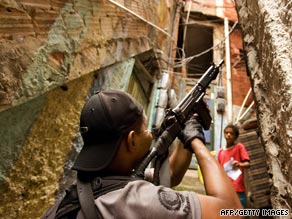
I find Boz's final sentence more interesting. I certainly think the drug gangs will challenge the police, but it's not like this is the first time that they've challenged police,given the military tactics used against civilians in the favelas, where it's not uncommon to see images like this one (from the CNN story):

A policeman advances through an alley of Rio on March 25, 2009, during an anti-drug operation.

Indeed, I once ended up on a city bus that passed through a favela in downtown Rio, and while it was as uneventful as most bus rides (and less eventful than some that never went near a favela), I was still alarmed to see military men with assault rifles poised just hanging out on street corners, alert but not in battle. You want to know the dynamics of the favelas? That picture hits it perfectly - a small kid who probably has nothing to do with the drug trade, a very well-armed individual from the military police, and somewhere unseen, actual drug lords. And kids like the one in this picture, along with old women and plenty of others untouched by the drug trade, are often killed (with some estimates hitting the thousands of innocent civilians dead).

But back to Boz's comments. Yes, they will challenge the police, and they have in the past, but, in spite of the major framing of this story, that's not what this event was. Yes, a police helicopter was shot down. But this wasn't even a case of police raiding a favela and violence erupting. This was a battle between drug gangs. The helicopter was shot down when flying over the favela to see what was going on, and as Boz himself points out, the helicopter getting shot down wasn't even intentional; according to reports, the bullets that hit the helicopter were basically stray bullets, and they weren't even from .30 caliber machine guns (though I agree with Randy that it's disturbing the gangs have this kind of weaponry, though again, it's not like the police haven't shown a propensity to murderous actions, too). With all due respect to Boz, he mistranslates that passage of the article, which reads [and I translate], "the helicopter was hit by light fire - nothing that was fired from a .30 caliber machine gun or that could have been caused by a rocket-propelled grenade found in gangs' arsenals."

So while some pitch a fit over Brazil getting the Olympics over Chicago in light of this weekend's events, they're completely out of touch with what the history, the context, and the meaning of this weekend's events. As Boz says, it wasn't some coordinated (or even uncoordinated) response to the Olympics; it wasn't even an attack initially launched on the police. It was gang warfare located away from the sites of the future Olympics that ultimately included the deaths of 3 police officers as well as at least 14 "traficantes" (though, as always, that title and/or figure is questionable). Is it a threat to the Olympics? No more so than every other incident of favela violence has been a threat to the Olympics, which is to say, not at all. The favela violence is kept to the favelas, and regardless of what you think of that, it does not mean anything to the Olympics yet. And the Brazilian government is not just ignoring this problem - today Lula pledged an extra $60 million to Rio to help combat violence in the city. This wasn't an internal "protest" to the Olympics, and it wasn't an event that should make anybody reconsider awarding Rio the Olympics. It simply was what all the other incidents of favela violence have been - sad episodes of violence, with plenty of blame to go around.


Sunday, September 20, 2009

Another Small Step in the Fight to Reign in Police Violence in Rio de Janeiro

It took four years, but this week, two former Rio de Janeiro police officers were sentenced to 500 years in prison for their roles in the massacre of 29 people in one of Rio's suburbs in 2005.

The ex-police officers joined three other former colleagues already sentenced to long terms in the case, which was dubbed the Baixada massacre after Rio de Janeiro's poor northern outskirts where prosecutors say a group of police officers fired on pedestrians, bar patrons and a crowd in a public square in 2005.
As the report also points out, nobody in Brazil can serve more than 30 years in prison, so the sentences for the two men (of 483 and 540 years) are obviously symbolic. Still, the fact that another case involving police killing innocents has resulted in prison is a small step in the right direction. Hopefully such cases will become more frequent, especially for those who kill innocents in the favelas.

Wednesday, July 08, 2009

Another Faint but Encouraging Effort to Rein In Police Violence in the Favelas in Rio de Janeiro

This week, prosecutors in Rio de Janeiro have charged 30 police officers with executing young men in the favelas in "death squad"-style murders, and have asked that the officers be imprisoned.

The state prosecutors' office said it had examined the deaths of 20 people in the Brazilian city between 2007 and 2008 and found strong evidence that many were executed. Police said the victims had resisted arrest.
The majority of the victims, all between 14 and 29 years old, were killed at close range or with bullets in their backs and only two of them had criminal records, the office said.
"This is activity typical of a death squad, shown by the technical evidence which disproves the police version that there was a confrontation," prosecutor Alexandre Thermistocles said in a statement.

I don't know that these officers will actually end up in prison. "Justice" in Brazil is....fickle, to put it politely, and it strikes me as unlikely that there will be a speedy resolution to these charges. Honestly, I expect the police to be let off relatively lightly, if not completely free. After all, it's not like these kinds of killings have not been going on for years, and it's not like they don't enjoy the popular support of many civilians in Rio. Indeed, the fact that the woman who condemns the police for killing people and saying after the fact that the victims were just "bandidos" doesn't want to be named "for fear of retaliation" makes clear that the police can and do still act with relative impunity in the favelas.

That said, the fact that the prosecutors are charging police with these murders is a faint glimmer of optimism. Just a few years ago, charges would never have been brought forth, and the police's version that people with bullets in their backs (often from close range) were "bandits" who were "firing back" would have been blindly accepted by most people. And this isn't the first time that these charges have been made publicly against police. So in the sense that at least these charges are being made publicly and be legal authorities, I'm encouraged. But only slightly. Until these charges lead to real prison time for the murderers in the police force; until the police cannot act with impunity in the favelas; and until there is a major overhaul in the justice system and the treatment of favelados in Rio, things will remain unsatisfactory, and human rights abuses within the favelas will continue.

Monday, March 02, 2009

Brazil's Drug War Also Targeting Privileged

About a year and a half ago, I wrote about the growing ecstasy drug trade among middle- and upper-class kids in Rio de Janeiro. At the time, I was relatively pleased to see the cops were moving beyond just targeting the poor in the favelas in their "drug war," though I had my doubts that such a war on middle- and upper-class drugs would continue in Brazil.

Apparently, my doubts were misplaced:

Drug trafficking in Brazil has become increasingly demonized in the eyes of the law — to the point where drug financiers can now receive stiffer prison sentences than murderers — and the country’s elite is not being spared.

Just last week, federal police officers arrested 55 people, many of them in Rio de Janeiro, in a nationwide investigation focused on upper-middle-class youths who the police said were smuggling Ecstasy, LSD and other synthetic drugs into Brazil from Europe.


This does strike me as good news overall in terms of realities in Brazil right now. For years, the police have launched extremely repressive measures to fight the drug trade in the favelas, using military occupations and indiscriminate killings (as well as entering militias to control the drug trade and gain profits for themselves), all while middle- and upper-class drug usage has been relatively untouched. Unfortunately, as with corruption among police in the drug wars in the favelas, the ecstasy cases are also rife for police corruption:
Ecstasy’s emergence as the drug of Brazil’s wealthy has opened the door even wider for corrupt police officers to seize upon users and their families. Now that Brazil has eliminated prison sentences for drug users, sending them to treatment or community service instead, the police are extracting sometimes hundreds of thousands of dollars in bribes in exchange for not charging those caught with Ecstasy as drug dealers, according to defense lawyers and three convicted drug dealers now out of prison.

This is both unfortunate and unsurprising. But again, within the realities of the drug trade and law in Brazil, at least the same attitudes and mechanisms are increasingly being applied relatively equally across the social spectrum.

Of course, many of the middle- and upper-class youths who have been busted for dealing ecstasy feel they are being treated horribly unfairly and extremely. However, it's hard for me to feel too much sympathy for people like Lucas, a middle-class kid busted for bringing drugs into the country, when he complains “I was treated like a hardcore criminal and put in jail together with killers, kidnappers, you name it.” Two-and-a-half years may seem severe for what many might consider a "youthful mistake," but Lucas deserves no better treatment than the drug dealers caught in the favelas. Indeed, he might think he was dealt with brutally, but at least he was arrested at the airport when he tried to smuggle drugs into the country, rather than having the police come into his neighborhood with guns blazing, leaving a couple dozen dead in their wake. After all, the Brazilian "war on drugs" may be levelling the field somewhat by going after the non-poor sectors of dealers, too, but even then, the poor in the favelas still face more adverse conditions than Lucas did. And at least he lived to go to jail, rather than ending up another one of the dead traficantes on the streets of a favela.

That said, regardless of whether you are in favor or against increasing the efforts to combat drug use in any country, it's really encouraging to see Brazil going after drug production, dealing, and usage regardless of the drug or the socio-economic classes with which a particular drug is associated. And the fact that the story is based in São Paulo (and not Rio) indicates that the drug war is no longer something just for Rio's favelas, even if the gap in treatment of wealthier drug users and dealers and the poorer dealers and users still exists.

Sunday, January 11, 2009

New Police Tactics in Rio's Favelas - Will They Be Successful?

A year ago, I offered some comments on the major shift Sao Paulo police had employed in their efforts to combat drug trafficking in the favelas. Within that shift, there were two keystones, one tactical (a more concentrated effort to combat just the drug dealers, rather than going into the favelas with guns blazing), and one policy-based (establishing a stronger state presence in the favelas via infrastructure and social programs to combat the return of trafficking once the police left). At the time, I also commented that Sao Paulo's approach offered at least some actual examples of how the Rio police could perhaps better undertake their own efforts in the favelas.

Well, it seems that the Rio police actually are finally trying to address the issue as well in two separate favelas:

The police have regularly launched large operations in Brazil's favelas, or slums, in their battle against drug gangs over the years, but authorities say the occupation of Santa Marta, a relatively small, contained neighborhood, is part of a new approach, a pilot project for the future of crime fighting in this violent city. Brazilian police officers are attempting counterinsurgency tactics similar to those used by U.S. soldiers in Iraq -- setting up small bases occupied around the clock inside violent neighborhoods, developing intelligence by living among their adversaries, and using government funds to rebuild broken areas and generate goodwill.
While in some ways, I'd welcome any shift away from entering favelas with guns blazing only to leave a few days later claiming the victory of a couple of dozen dead "traficantes," I'm not particularly sure following the U.S. model in Iraq is the guarantor of success. Suffice to say, the results in the Santa Marta (and Cidade de Deus, another site of new tactics) have been mixed. Some people in Santa Marta are satisfied with the police presence:
Barreto, 44, was lifting sacks of cement alongside several other construction workers employed by the state government to build some 50 sturdy houses to replace the decrepit wood shacks. "I think things are better now. People are feeling safer after the police occupation," he said.
The outstanding thing about this to me is not that the police efforts seem to be somewhat successful in driving some of the drug rings out; this happens often, only for the traffickers to return when the police leave the favelas. What's particularly notable here is the fact that the government was helping to build nicer houses for the residents, as well as employing the favela's residents in these projects, giving them an alternate source of income not tied to any "criminal activity." Any kind of success in an operation on this is absolutely determined by the strength of presence of the bureaucratic state in the wake of police operations, and this component has been completely absent from any efforts in the favelas in Rio up to this point. I fully agree with Boz that, if there's any hope that these efforts have long-term positive effects, it's up to the government to keep that sustainability going beyond the police actions. Thus far, I've seen nothing (and the article gives no indication) of how long the local, state, or federal government plan will support this project or what job opportunities the favela residents may have after temporary projects like construction, but the fact that there's any governmental follow-up action in the wake of police activity is a major shift, and one that is essential to attaining any mark of "progress" in combating crime, be it in the favelas or elsewhere.
However, the picture is far from perfect:
"The problem is that they [the police] act in this aggressive way, focusing on the poor areas, as if that's where the real criminals are actually living," said Rafael Dias, an investigator with Justiça Global, a human rights organization in Brazil. "The people in these neighborhoods do not have safety now. They have an occupation."
This really gets at the crux of the issue in terms of the difficulty of dealing with crime in the favelas. Although I've been hyper-critical of police activity in the favelas (and rightfully so, I think), it's not like there aren't real problems with crime in the favelas, and brutal police tactics do not take away from that fact. At the same time, it's not a simple good guys/bad guys incident in which all the favela residents are on the "wrong" side and the police have nothing but the purest intentions, and there are so many broader economic, social, and political processes at play in the favelas and in Brazilian society as to make them an absolute mess in trying to pull apart causes, effects, involvement, etc.

In that context, there are a lot of factors that are required in order to make an operation like those in Santa Marta and especially Cidade de Deus (which is the larger of the two favelas by far) succeed, including better preperation and more personnel, as well as a real willingness on the part of the police and the local and state governments to help build that infrastructure. The complexities of launching a successful "war on drugs" in the favelas are numerous (and that's not even addressing the issue of whether fighting such a "war" by attacking the supply-side, which only further complicates matters). There is the fact that some residents do want a stronger police and state (i.e., non-police governing body) presence in the favelas while others who aren't in any way involved in any kind of criminal activity do not. What is more, it is incredibly difficult to control all members of the police, and Brazil's police have continued to act with impunity, often times turning into militias that simply take over the vacuum of the traficantes they've forced out of the favelas. And, then there's the issue of treating anybody who's poor as a criminal:
The police have shut down popular dance parties [in Cidade de Deus], and several residents said they do not feel comfortable being outside after dark anymore, because of the risk of being accused of criminal activity.
"It's going backward. They're acting aggressively against normal people," Nael said. When the criminals were here, they didn't mess with normal people."
The police, like the majority of Brazilians, often treat poverty as a crime unto itself, and the marginalized in Brazil face numerous social, economic, political, and racial stigmas based simply on where they live. Unfortunately, it seems that this stigma thus far is playing a major role in obstructing any progress on the part of the police. The fact that many residents are turning on the police's presence, and that complaints of maltreatment and the implicit understanding as any favela resident as being "criminal" underlines many of the complaints above. For all the factors that need to fit together to make any police effort like these new efforts in Santa Marta and Cidade de Deus sustainable, perhaps the most important and most difficult is creating a shift in the mentality within the police forces (and society in the grander scheme of things) that treats the poor as inherently criminal. Until this stigma goes away within the police forces, I can't help but think that the police will undermine any new tactics and any efforts to establish an acceptable state presence in the favelas by antagonizing the majority of residents who live in the favelas and who are not connected to criminal activity in any way whatsoever.

Saturday, December 13, 2008

More on the Protests over Human Rights Abuses in Rio de Janeiro

Just as a follow-up to my post below, there is a follow-up in which protesters lined Copacabana beach with 16,000 coconuts, representing the number of murders in Rio favelas over the last 2 years. While I questioned the number of 9,000 "disappeared," it was more because of how that term was being used, and I don't doubt the number of murders in the slightest (again, when you commonly have headlines like "Police kill 19 traficantes," the number of deaths is going to be really high). And for an alternate photo of the impressive display (and the story in Portuguese), see here.

Friday, December 12, 2008

The Ongoing Case of Human Rights Violations and "Disappearances" in Brazil

While I'd like to see some more research that can back up the claim that 9000 people have been "disappeared" in Rio over the last 24 months, there can be no doubt that the police commit dozens of gruesome murders every month (and probably every week) in the favelas. There is no question that Brazilian police's continuous war against and murding of poor and marginalized in Rio is nothing short of a major human rights disaster, and one that gets ignored far too much both inside and outside of Brazil.

Wednesday, September 03, 2008

Brazil's Declining Crime Rates - Signs of Hope?

A few weeks back, the Economist had an article about declining crime rates in Brazil. Murder rates in the country as a whole have declined, and they have taken a very dramatic drop in São Paulo, parts of which used to be among the most violent neighborhoods in the world.

Unlike Boz, I'm not so surprised at the decline of crime in São Paulo. Earlier this year, I commented on the police's change in tactics against drug gangs in Brazil's largest city. Unlike in Rio, where the police still go into favelas with guns blazing and then occupy the favelas for weeks or months, police in São Paulo spend a lot of time gathering intelligence on individual drug lords and their networks, and go in targeting those groups specifically, instead of anybody (including the innocent) that gets in their way. Additionally, after police go into the favelas to root out the drug networks, the state follows in, offering social programs to the innocent civilians living in the favelas. In so doing, the state in São Paulo has simultaneously been able to increase its presence in a non-violent way (compared to the non-stop presence of military police in favelas in Rio) as well as offering better social services to the favelados. That the tactic of concentrating attacks only on drug gangs joined with efforts trying to improve the living conditions within the favelas has led to a decline in violence should come as no surprise. While I think the article overstates the role of gun control somewhat, it certainly hasn't hurt, either. I don't buy the demographics argument so much, simply because São Paulo has 18 million people; just because the population is getting older in the entire city doesn't necessarily mean that it's getting older in the favelas, where levels of violence can be higher.

That said, Boz's caution that we not view these gains as the beginning of a "Paz Brasiliana" is absolutely right. Rio is still suffering from the same, stale police tactics of shooting first and calling everybody "traficantes" later. Additionally, the growing presence of paramilitary militia groups that are sometimes entering into the drug trade in Rio is a bad omen. Finally, while São Paulo's murder rates have dropped significantly, rural violence (generally between rich landowners and indigenous groups or the landless and their champions) has shown no signs of slowing down. It would be great if Rio would at least try to implement some of the changes in its tactics that São Paulo has implemented, but the issue of favelas and the police is also very different from São Paulo, due to (among other things) state and city economies, geographies, and politics. As I said, the dawn of some peaceful period in Brazilian history is still a long ways off. Nonetheless, one cannot help but be at least somewhat happy to see things improving in Brazil, even if it's incrementally.

Saturday, August 16, 2008

Brazil's Media: Ignoring Its Role In Supporting Police Violence and Racism Yet Again

Quite awhile back, I discussed how Brazilian media always justified police murders of innocent civilians in the favelas by referring to all the dead as "traficantes" or "bandidos." By using these criminal terms, the media simultaneously reflected and reified racist and classist attitudes that held the poor as responsible for their own situation while uncritically dehumanizing the innocent victims in the favelas.

In an absolute stunner, O Globo has apparently caught on to this, running a headline right now (11:05 PM EST on Saturday) claiming "No Rio, mortos em confrontos com a polícia são sempre ‘bandidos’" ("In Rio, the dead from police confrontations are always "bandits"). The report goes on to discuss how reports of violence and the dead from the favelas always treated the dead as criminals, even when they were not. This recognition that the police were and are violating basic human rights in the favelas and that innocent civilians are killed on a daily basis in the favelas would seem to be progress.

However, in true Globo fashion, nowhere in the article does the media conglomerate take any blame or accept any responsibility for the media's portrayal of the dead in the favelas. The article conveniently scapegoats the police, saying that the police always claimed that the dead were all "bandidos," and thus the media simply had been misinformed by the police.

I don't buy this for a second. Again, O Globo is the largest media conglomerate in Brazil, and one of the largest in the world. Any organization with any true journalistic standards, even an organization with standards as dubious and corrupt as O Globo's, could and should ask questions, be critical of police reports, do detailed in-depth investigations to see if the one side of the story they were given was true or not. O Globo did none of these things, yet it can't even accept the responsibility for this, despite numerous chances. Indeed, already in the second paragraph of the article, while discussing the 2002 murder of a sixteen-year-old student who was, of course, declared to be a "traficante," Globo glosses over its complete failure to investigate anything. The article mentions this case, and comments simply, "Nobody investigated [it]." ("Ninguem investigou.") This would have been a perfect chance for O Globo to try to at least admit that they have failed to ever be critical of any police reports that painted all the poor as traficantes while ignoring numerous human rights reports that chronicled in great detail the murder of civilians in the favelas. O Globo could have done this, could have taken advantage of this opportunity, right here, right now. But it doesn't. Instead, it simply says that "nobody investigated," and then moves on, continuing to blame the police instead of taking even one second to criticize itself for having spent decades simply swallowing what police reports said as the cops tried to cover their own tracks, and then regurgitating these same reports to the public en masse via television, newspapers, and magazines.

As for why, even now with this article, O Globo does not step up and admit its mistakes of the past, the answer is simple. Reporting of one side of the story of favela violence (the police's) without ever actually investigating the events in the favelas was neat and easy; it fit conveniently with the political ideology of O Globo's ownership and transmissions. O Globo has always been steeped in right-wing politics, even before it hopped in bed with the military dictatorship in order to expand its control. For decades, O Globo has subtly vomited racism and classism in virtually all of its forms of expression, be it print journalism, television news, or even the novelas. This just added one more reason why O Globo did not feel the need to further investigate police claims - the police's insistence that all the poor dead had it coming, regardless of innocence or guilt, fit perfectly with O Globo's general attitude to the poor (upon whom, in a sick irony, O Globo depends largely upon for its viewership of the national evening news and novelas).

I'd like to hope that people in Brazil will start to peel some of the wool from their eyes with this report, but I know better. Those who might have been persuaded by this article knew a long time ago that there are basic injustices and human rights violations in the favelas on a daily basis; those who were not remotely sympathetic to the dead favelados, even the innocent ones, will, like Globo, blame the police and move on, never stopping to question either the media conglomerate's (or other media outlets in Brazil) coverage and treatment of the poor and marginalized in Brazilian society, nor the basic structures of racism and classism in Brazil.