Historical Image of the Day

Cover of "Is This Tomorrow," probably the first anti-Soviet Cold War scare comic book, published 1947


Wow, am I actually blogging again? Ridiculous is the only thing to call my lack of attention to the blog, but I have a hard time concentrating on more than one thing at a time. We'll see if my concentration lapses now or not, but my big project is through (see below) and what better way to get restarted than a quality book meme. Having gone to Old White Male Writer College (St. Johns, that is), my list is unfortunately skewed by such, but this is something I'm trying to rectify, for as much fiction as I find time to read anymore. In any event...
1. Ulysses--James Joyce: Numbers one and two on my list are really 1 and 1a; I'll never choose one over the other. Ulysses is absolutely both the most difficult and the finest piece of work I've ever read. In college, during our third and fourth years, we actually had an elective, called our Preceptorials. Senior year, I spent eight weeks studying this damned book with sixteen others, while we came away with a ton of confusion, never were two months in study better spent. As obnoxious as it can be sometimes, the book is hilarious and the final chapter, those two sentences, punctuated brilliantly by "yes", are the most invigorating I've ever read.
2. In Search of Lost Time--Marcel Proust: It's hard for me not to call this the best I've read, and it's truly a tie. It was the first major work I read out of school and, compared to Joyce's obtuse difficulty, I found Proust downright breezy. I first fell in love by translating sections of Swan's Way in school and finally read the whole thing after I was out. The Guermantes Way and Cities of the Plain are my favorites of the seven books, but that probably has as much to do with when I read them as anything. It took me two years to finish the set and, no matter how rewarding it was, it convinced me that life is too short to spend such time on a single work. I haven't read anything of its breadth since and I doubt I will again. There are simply too many things to read, but I wouldn't give up my experience with it for the world.
3. The Defense--Vladimir Nabokov: Sure, there are plenty of more ambitious works in Nabakov's catalog, but this one always stood out to me as one of his best pure stories. It doesn't carry the same kind of literary weight as Pale Fire or Lolita, but his ability to turn the plot of a novel into a kind of chess match, along with his sporting descriptions of chess, make The Defense my favorite of his work. Honestly, the next four on this list could be Nabokov books, but I didn't want to double up authors.
4. Outer Dark--Cormac McCarthy: Again, not the popular choice amongst McCarthy fans and, again, maybe not his most spectacular work, but this one influences my work more than any other and is sheer existential brutality. His Appalachian setting is as claustrophobic as anything I've read and it's the only book of his that I can think of with a female protagonist...big stuff from McCarthy. Anyway, the big scene where Rinthy finds her child is one that makes my stomach turn to this day, and it's been years.
5. Story of the Eye--George Bataille: Bataille was a freak and I love him. His considerable body of philosophy doesn't really prepare one for his literature and poetry. Story of the Eye is, simply put, the best work of literate pornography ever written. Nothing tops it; nothing ever will. It smashes taboos with glee and revels in its filth with a beautiful literary flair. A film was actually made of the book, which I have yet to find, but making it took some balls.
6. Jurgen--James Branch Cabell: I'll never get away from obscenities, but Jurgen is a whole different animal. A near perfect farce and an innovator of the fantasy genre, Cabell is a near unknown outside of this work and, while it's all I've read of his, this is a hilarious, intelligent, and dirty book that will never leave my mind.
7. The Trial--Franz Kafka: Fifteen years have passes since I picked up Kafka, and his influence is still great in my life. Before Kafka, I hadn't ever really considered allegory, and his work has taught me a lot in that area and many others. His short stories are really what get me but, for the purposes of a full book, The Trial will certainly suffice.
8. Kiss of the Spider Woman--Manuel Puig: I can say that Proust was the last really difficult book I got into, but it's not really true. I fell in love with the film by Hector Babenco (director of the superior Pixote) long before I read the book, and was blown away by the way Puig layers fantasy upon reality. I liken this to my experience with Nabokov's Pale Fire (good thing I worked another one in), though I found Puig's work much more relevant.
9. In Our Time--Ernest Hemingway: There's been some complaining about Hemingway recently, and Sator Arepo commented correctly when he said that the guy's better in small doses. Look, don't read Hemingway's novels...they're garbage. He betrays himself with his extended language in his long works, but he is a master of the four word sentence. Hemingway taught me to write; taught me to consider how to cut my verbage down. He's the antithesis of the irritating David Foster Wallace-s of the world and intelligent modern writers could learn a lesson from Hemingway's terse language.
10. Paradise Lost--John Milton: Not only are we old and white, but we're Christian, too. Ordinarly, a piece like this would be anathema to me, but the beauty of the language is astounding and the questions he poses confound the most ardent of his fellow believers. I was exposed to this book originally in high school, for what reason I can't say, by Janice Stark, one of two good teachers at that prison. I don't know if she's still alive but, in exposing this book to me, she finally wrested me of my last Christian ties, and I couldn't be more thankful for such a gift.
11. Faust--Johann Wolfgang von Goethe: No matter how hard I try, there is no way I'll ever be able to get past Faustian themes. Every story I write has them and I look for them in everything I read. Between science, poetry, literature, and philosophy, Goethe may be the best writer of the last three centuries, and the depth of Faust has proven near limitless for me.
12. Hard Times--Charles Dickens: I probably have some eyes rolling at this one, but I've always loved Dickens. I know that a lot of his verbage was based on his pay scale, but this is hardly his fault; I'd do the same thing. For whatever reason, however, Hard Times is a short, consise work that represents the best Dickens had to offer. In part a screed against the effects of the Poor Act of 1834, this is his most socially conscious work and, by far, his most readable.
13. Lone Wolf and Cub--Kazuo Koike (writer) and Goseki Kojima (artist): Now, like Sarah, it's comics time. I see this epic piece, some 2500 pages in its American release, as the War and Peace of graphic storytelling, intricate and nuanced in its storytelling but emotional in its characters. On top of it, the last few hundred pages, as an American reader, are near unfathomable to me in the way that enemies come together for a greater good. The Western esthetic has a hard time with such compromises but, ultimately, this is one of the most satisfying experiences of my life.
14. Stray Bullets--David Lapham: This is, by far, the newest entry on the list, and my final honest one, as well. It hasn't been long since I finished what exists of Stray Bullets, but few works have spoken to me as truly as this. He hits the lurid aspects that have always driven me to silent film and the novels of Hammett and Chandler, but the story of Virginia Applejack carries an emotional weight for me that few pieces ever had. Watching her watch her father die of cancer is not the stuff of your average comic. While unfinished (get with it, Lapham; to hell with Young Liars), Stray Bullets has everything I could ever want in a story.
15. Jewel of the Dragon Queen--Daryl Loomis: Sure, it's arrogant to place myself on a list with those above. Don't get me wrong, though, I don't actually equate myself with them on any level. At the same time, as the longest piece I've ever finished and the first I've written with a specific eye toward publication, this will stick with me for a long, long time. It will be a ten issue comic that is currently in storyboarding by the artist, whose skills I have the utmost faith in, and we'll just have to see. Worse comes to worst, it's a self-publishing deal, but plenty of good work gets published this way. All I can say is that I've never worked so hard on something in my life. Killing these characters after the two years I lived with them was one of the hardest, most guilt-ridden things I've ever had to do and is a big reason why I've had such a hard time focusing on the blog, my reviews, or anything else. It's done though, and the ball's in the artists court, so there's only hope ahead. Anyway, sorry for the shameless self-promotion, but the other books are good and, if you haven't read some of them, I certainly recommend them all.
According to my email from Planned Parenthood this morning, it's National Condom Week. They sent out a link to their playlist of their favorite condom videos on YouTube, but I found something even better: 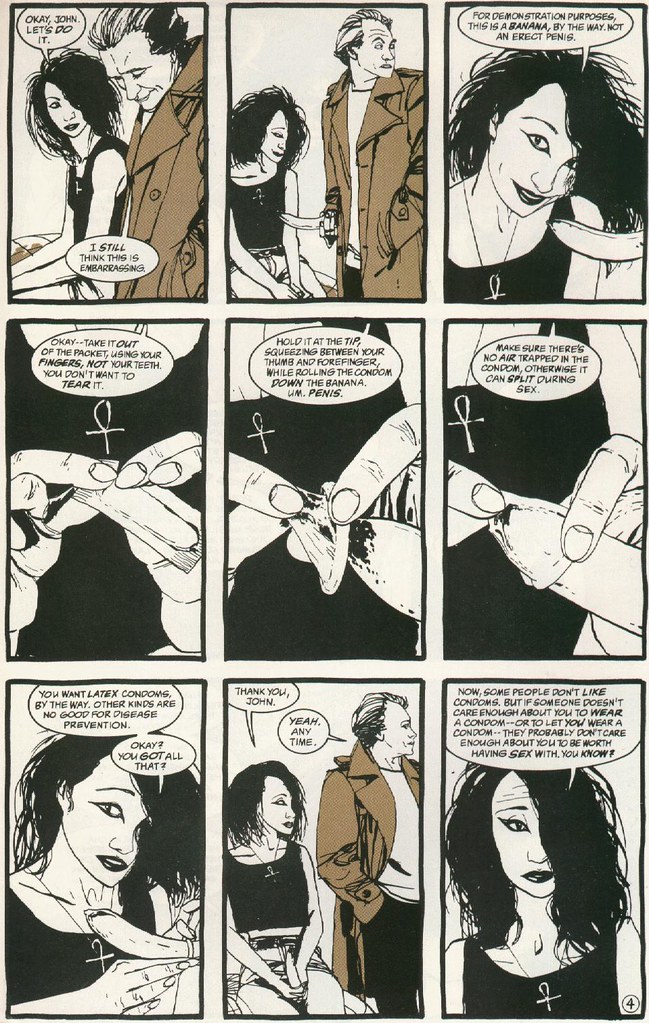
This is from Neil Gaiman's "Death Talks About Life," a PSA comic about HIV and condom use, from 1994. It's out of print now, but was collected in Death: The High Cost of Living, which was one of the first comics I ever bought. Or you can read the whole thing at that link. (Also will soon be in an Absolute Death from Vertigo, so for those of you who are fangirls like me, rejoice!)
While I'm referencing holidays and comics writers, it is my duty to repost the sentiments of the wicked Warren Ellis:
Happy Valentine’s Day to all. And to those who hate the day, I say this: Valentine’s Day is a Christian corruption of a pagan festival involving werewolves, blood and fucking. So wish people a happy Horny Werewolf Day and see what happens.
I'm still recovering from driving home for the holidays, and am drowning a bit in things I need to get done, but I have a few things up at other places that I wanted to cross-post here in case anyone was interested.
My piece on Gaza, at GlobalComment, which took me far too long and far too much agonizing to write.
I’m an American Jew, and when I state that fact, I invite a wealth of assumptions, not all of them anti-Semitic in nature. Renee Martin recently addressed the conflation of criticism of Israel with anti-Semitism, so I don’t have to (though I would like to note that Modern Mitzvot has a very good point too).
Daniele Archibugi pointed out that upcoming elections in Israel and Palestine most likely have something to do with the timing and force of the Israeli attack. But being in the U.S., I have to see it through the lens of the election we just had, here, and one of the Republican party’s favorite anti-Obama attacks.
I picked up DMZ #1 way back in 2005 and reviewed it for Best Shots (wow, I’ve been doing this way too long). Since then, I’ve read and dropped many other monthly comics, but DMZ has stayed on my pull list. I’ve given it as a gift, made my professors read it, and flogged it mercilessly on this very site.
But aside from being an excellent story, it’s a story that at its core is about all the major questions of the Bush era.
DMZ picks all of us up and drops us into the middle of a war zone. But Brian Wood and Riccardo Burchielli (and some excellent guest artists) transfer that war back home, to a place we all know. New York City is the most familiar landscape in America even to people who haven’t been there, and it was the central point of the crises we’ve dealt with in the last eight years...
DMZ holds us all responsible for the failures of our government under Bush. No one gets a free pass. Each time you think you know who Wood is pointing the finger at, you find it twisting around to point squarely back at you.

Or maybe business just hasn't changed since 1993.
Via Clusterstock.
Calvin & Hobbes almost has to be the greatest comic strip ever.
The line about worker salary and benefits kind of grates though.
Note that the image is much larger if you click on it. Also, I wish I knew how to make images bigger when I upload them.

Dave, showing why he might be the best historian-blogger in the universe, today uncovered a 1960 comic produced by George Wallace's successful campaign for Alabama governor. The site has numerous other links to comics with social issues. Some of the labeling is not good, particularly on the early ones. But they are mostly pretty awesome. See for instance this 1956 comic from Planned Parenthood. Or this one about the dangers of huffing chemicals. It's really pretty freaking mind-blowing. In fact, the whole site is a great archive of teaching material, not just the comics.
In the comments on Dave's post, Morinao points us to this 1970 Superman comic when Lois Lane becomes a black woman in order to fight racism.
My mind is totally blown.
Frequent commenter Bob has turned me on to Dinosaur Comics. Good stuff.
Meanwhile, Joe Mathlete again demonstrates why his discussions of Marmaduke are about 1 million times funnier than the actual thing.
Comics may be a dead art form in the newspapers, but it still has potential on the internet.
I haven't been a Peanuts (the comic strip) fan since I was about 7. However, Charles McGrath's book review of David Michaelis' biography of Charles Schulz is fascinating. Apparently (I at least never knew this), Schulz was moody, often depressed, and seemed like less than a cheerful person a majority of the time, and I never realized that the male characters of Peanuts were bits and pieces of Schulz himself, while the female characters were based on women in his life. To wit:
"Peanuts” was almost transparently autobiographical. There really was anunattainable Little Red-Haired Girl. Her name was Donna Mae Johnson, and shejilted Schulz in July 1950; he nursed the rejection, along with all the other slights he suffered from wished-for girlfriends, for the rest of his life.Charlie Brown, wishy-washy, disillusioned, but also secretly ambitious, was theartist himself, of course; and so were Linus, the oddball; Schroeder, meticulousand gifted; and, above all, Snoopy, with his daydreams, his fantasies, his senseof being undervalued and misunderstood. Violet, with her mean streak; and Lucy,bossy, impatient and sarcastic, were all the controlling, withholding women inSchulz’s life, especially his mother and his first wife, Joyce."
As with at least two of my co-bloggers, I have long been disgusted at the un-funny nature of modern comics. Here are two related links I find hilarious.
If you've never seen Marmaduke Explained, check it out. Writing with two basic premises in mind--a) Marmaduke is an asshole and b) Marmaduke is a shitty cartoon, Joe Mathlete explains each day's edition.
Second is The Nietzsche Family Circus which randomly matches up a Family Circus cartoon with a Nietzsche quote. Just hit refresh for more. It's quite entertaining.


