Historical Image of the Day
This week's images will explore the the suffrage movement in the late 19th century.

Broadside for Elizabeth Cady Stanton lecture, Massilon, Ohio, 1875.
This week's images will explore the the suffrage movement in the late 19th century.
It's Blog for Choice Day. And this year, a year many of us thought might actually be a good one for sexual and reproductive rights, has turned out to be a very lousy one indeed. We saw Democrats force the Stupak amendment into an otherwise fairly decent House health care reform bill, and do nearly the same thing in the Senate onto an already-pretty-crappy health care reform bill.
We saw the murder of Dr. George Tiller, abortion provider, in cold blood.
We like to talk about choice. We fight over terminology. But what have we really done, in the years since Roe v. Wade, other than hold the line and nervously try not to lose what we've won?
We criticize Democrats for not supporting us, we who put them in office. But what are we pushing for? When my Democrat Congresswoman from my quite Democratic district (BROOKLYN, people) sends me a form letter in response to my calls and emails about Stupak, reassuring ME that there won't be any federal money spent on abortion, what does that mean for us? Even the Democrats are more worried about antichoice arguments than they are about people like me bailing on them. Where are we going to go, after all, right?
Well, I'm tired of it. It's 2010. We need to be fighting for more gains, not hiding in a defensive crouch and praying we get to hold on to what we've got. Rights are not granted, they are taken.
Right after Stupak, I wrote:
Not enough. I want positives. I want to use this moment to affirm our right to a healthy, joyful sexuality and to talk about how we can achieve that. A messy, unruly sexuality—hell, part of the beauty of it is that it’s not clean and neat. It is like eating a peach, in the last lines of Prufrock, juices running down your chin, sweet and tangy. Those decisions that happen in a minute are sometimes wrong, and sometimes unplanned things come out of them, but we don’t need to be saved from it, we need to have resources and support to deal with it, from a relationship gone sour to unfortunate STIs or Plan B for a birth control failure—or, whether Congress likes it or not, safe, legal, insurance-covered abortion.
You know, over and over, lefties and liberals have told feminists that they have to look beyond sexism and abortion rights. Hell, I've been one of them. I criticized feminists during the primaries who seemed to excuse blatant racism from the Clinton campaign while freaking out about Obama calling a reporter "Sweetie." I've noted that historical feminism was a white middle-class movement with white middle-class goals.
But right now, I'm really, really pissed about this Stupak amendment (as if you couldn't tell). And yes, this is an issue that is personal for me: I'm a cisgender woman, heterosexual and of childbearing age, and I have no desire for kids.
And I'm sick and tired of hearing that I should look at the broader picture, that there are worse issues than sexism, blah blah blah.
I've heard this from well-meaning "liberal" men, but I've also heard it from activists I admire, who are usually RIGHT when they point out the myopia of much of the feminist movement (such as it is).
But this is the thing: millions of poor women, many of them women of color, will be hurt badly if this amendment stays in the bill. Shit, it'll affect me, but I can probably still get an abortion if I need one. This isn't a bourgeois issue and we're not being myopic or selfish assholes to be righteously, ferociously angry and ready to fight this tooth and nail.
This is women's lives. I care about race and class issues, poverty and health care and immigration and transgender people's rights.
There are lots of lines in the sand that I'll draw. One of them has been crossed right now, and yes, it's personal. Because over and over again our issues get written off as things that should be compromised for the greater good, or we're made to feel guilty because we're worrying about something silly when there are worse oppressions out there.
I'm not going to play oppression olympics or other such bullshit. I'm just going to keep fighting this with every breath I've got, and I don't care who you are, if you tell me I'm wrong for that, you can kiss my ass.
I don't even have much to say about this: Malalai Joya is 31. A year an a half-ish older than I am. She's already been a delegate to the Afghan Loya Jirga, the convention that wrote the post-invasion constitution, been elected to her country's parliament, and escaped five assassination attempts.
She's friggin' amazing.
Watch it.
So I got a call the other day asking if I'd like to appear on a labor-oriented radio program to talk about the Employee Free Choice Act and women. Of course I said yes, and if you're interested, you can listen to the whole program here.
I meant to blog this earlier, but today is Blog for Equal Pay Day. Specter kind of took over the news cycle, but I do have a few things to say about this.
Women still make only 78 cents to every dollar men make. From the National Women's Law Center via Change.org:
Women are far more likely to live in poverty than men. Women working full-time, year-round are paid only about 78 cents for every dollar earned by men. African-American women earn 69 cents and Latinas earn 59 cents for every dollar paid to men. This wage gap cannot be dismissed as the result of "women's choices" in career and family matters. In fact, authoritative studies show that even when all relevant career and family attributes are taken into account, there is still a significant, unexplained gap in men's and women's earnings. Thus, even when women make the same career choices as men and work the same hours, they still earn less.
*”On average, unionization raised women’s wages by 11.2 percent – about $2.00 per hour – compared to non-union women with similar characteristics.”
I'm about out of good teabag jokes and I have a Very Important Interview in the morning (cross your fingers for me, OK?). I've spent a bit of time pissing off conservatives on Twitter by posting very good reasons to pay taxes, but honestly, there was a far more significant political protest today, far from the bloated white folks who don't want to pay taxes don't want their tax money going to brown folks want to secede from the union. 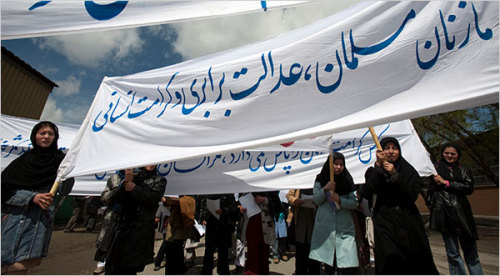
It was in Afghanistan, and these are women protesting their repressive treatment.
The New York Times reported:
The young women stepped off the bus and moved toward the protest march just beginning on the other side of the street when they were spotted by a mob of men.
“Get out of here, you whores!” the men shouted. “Get out!”
The women scattered as the men moved in.
“We want our rights!” one of the women shouted, turning to face them. “We want equality!”
The women ran to the bus and dived inside as it rumbled away, with the men smashing the taillights and banging on the sides.
“Whores!”
But the march continued anyway. About 300 Afghan women, facing an angry throng three times larger than their own, walked the streets of the capital on Wednesday to demand that Parliament repeal a new law that introduces a range of Taliban-like restrictions on women, and permits, among other things, marital rape.
Amazon.com apparently hasn't gotten the memo that the culture wars are dead.
They've stripped the sales rankings--and therefore, the search ratings--of books that deal with gay, lesbian, bisexual and transgender issues, as well as feminist books like Full Frontal Feminism.
It affects the search rankings for books. For small authors who depend on Amazon reviews and sales rankings, this is disastrous. Of course, it's also terrible for freedom of expression. When I searched BY TITLE for Full Frontal Feminism it didn't even come up on the first page of the search, which means that many people may erroneously assume that Amazon doesn't have the book. (Interestingly, Jessica Valenti's other book, "He's a Stud, She's a Slut" DOES come up first on a search for Full Frontal Feminism.) Julia Serano's Whipping Girl does appear, but only the Kindle edition, pointing out the randomness of this move.
Author Nicola Griffeth, whose books lost their rankings, said:
I am tired of being the low-hanging fruit that cretins pluck when they need to pander to Moral America. This time, I hope some people choke on their soft fruit.
Jill at Feministe was kind enough to run a guest post from yours truly on the Employee Free Choice Act, unions, and why they're feminist issues. I'm going to give you the beginning here, but ask you nicely to read the rest over there since she gave me the platform.
So our economy is falling apart, right? And the government keeps bailing out these massive financial firms while talking Very Sternly to the auto company CEOs about how they need to restructure and cut costs. Of course, the number one cost CEOs and reporters love to talk about is the “labor cost,” all the while nicely avoiding mentioning that “labor cost” is what real people make in wages and other benefits.
Unions, in other words, are a convenient bogeyman, yet they do and have done more to improve the living standards of American workers than anything else. And 44% of union workers are women. According to the Center for Economic and Policy Research:
“If the share of women in unions continues to grow at the same rate as it has over the last 25 years, women will be the majority of the unionized workforce by 2020.”
There’s a bill in Congress right now that you’ve probably heard of called the Employee Free Choice Act. Briefly, the bill would allow three things: it would allow workers to form a union simply by signing a card—the so-called “card check” provision; it would provide binding arbitration for employers and workers when they cannot agree on a contract; and it would strengthen penalties against employers who seek to intimidate workers trying to form a union.
And I believe it should be a feminist issue.
Hi Alterdestinians. I'm off at the WAM! Conference in Cambridge this weekend and I'm livetweeting the panels I'm attending, if you're interested in following along.
You can also check out the #wam09 feed for everyone tweeting from the conference.
Sylvia/m has a great post up on digital colonialism--not of the recent femisphere explosion type, but of a more insidious type.
See, I was annoyed this morning by this Columbia Journalism Review piece about the joys of "pro-am" journalism. Karthika's the resident expert on crowdsourcing and the like, but I think (as I wrote before) that there are a lot of problems with this model. One of them is what Sylvia focuses on in her piece--the slant of the blogosphere and new media in general toward middle-class, white US or Western interests. This is a question of access, but also of which voices are privileged.
Then in comments on Trend's wonderful breakdown of the coup in Chile and the overthrow of Allende, boz noted that the notion that many Americans on the left have that we (meaning the US government and the CIA, specifically) are responsible for the overthrow of so many governments in the world is a bit narrow and colonialist, itself.
And then Sylvia's piece about the blogosphere--feminists in particular, but the lessons apply to the left blogosphere in general--kind of summed up a lot of what I was thinking about.
It is not simply an international problem; it happens here in America as well. There are countless people without access to the internet, and who find themselves at the mercy of those who do have access to speak their truths to power. How often do the voices of feminism or the voices of Main Street, for example, reach the ears of the people behind the keyboards? Do people who write and use this medium for contributing to transformative change have an obligation to work for broader internet access and broader outreach?
There is also a broader presence of cyber-discovery, as seen in the recent hoaxes of finding new “tribes” or tracking “dead’ or “dying” languages using digital tools. There’s a distinct Western, anthropological gaze at work that reminds me personally of something out of the 19th century. How is the internet changing how we relate to each other geographically and politically, beyond the idea of having more people to date? How do we address these ways of relating?
Slumdog Millionaire was the best movie I saw all year until I got to The Wrestler, which was far better (and Mickey Rourke was robbed, but that's another post).
Anyway, I've read lots of criticisms of the film, and a lot of the backlash seems to me to miss some of the point. I certainly find it problematic that it's a movie written and directed by white men telling an Indian story, but more than that, I disagree with a lot of the critiques.
M. Leblanc at Bitch, Ph.D. had a good post up about it yesterday.
On the one hand, the film is so clearly a fantasy story, that I don't know that it's trying to convey a "message," about social justice or anything else. It's unrealistic. It does not attempt authenticity. It employs flashbacks and shifts in time to create a wonderland-effect which is at odds with the gritty realism of some of the images (not, mind you, the cinematography, which is very polished and cinematic). I think people make the mistake of assuming it's trying to present something "real" because movies don't usually feature or address poverty, especially third-world poverty, unless they're trying to convey something "real" and convey a "message."
I guess I have more questions than I have answers. And the questions I ask were certainly not the ones considered by the Academy in choosing this film. To be clear, I loved this movie and I saw it twice. The second time I brought my family, and my father a staunch Indian nationalist, hated it. He didn't like the way it portrayed India. I do not hold the same politics as my father and I felt that it actually held more truth about poverty and corruption in India than we would like to admit. But once you sift through the amazing imagery, adorable kids and soundtrack you are left with a coming of age story, only the story is not really for Indian audiences.
Well, I'm certainly not going to try to create it.
Having drinks with Karthika and Trend last night, as well as our buddy Scott from LGM, I noted an interesting pattern. The drama that's been blowing up the feminist blogosphere for the past week or so has not spilled over almost at all into the larger liberal blogosphere. (At least, in my highly unrepresentative sample of blog-nerds.)
This makes me wonder a few things. First of all, there are a few feminist blogs that are almost always blogrolled at the larger lib blogs--Feministing, Feministe, Pandagon and Bitch, Ph.D. Yeah, they're on our blogroll too, but I've tried to spread the wealth and include feminist bloggers of color, of diverse viewpoints and backgrounds. (Please do read our blogroll.)
But a lot of the drama that's happened in the last couple of weeks seems to devolve fairly quickly from an argument about ideas--you're not really going to make me link that Professor What If post again, are you?--into personality conflict. I'm just wondering what that says about the feminist blogosphere itself.
I decided recently, after having been blogging here for a while now, that I ought to be doing all my work over here. The personal is political and all that, right? Also, there are two competing tendencies I see among feminist blogs. One is to reach out, get bigger, engage, expand, write for external outlets, what have you. I don't see any problem with that--in fact, I do so myself.
The other tendency is to narrow one's focus and one's circle down, to shut out, to disengage. And I can sympathize with that feeling, too. Some days I don't want to explain why something is racist for the hundredth time, or try to argue that yes, this IS a feminist issue, or whatever.
But when I noticed that issues simply are not spreading past a small circle, it makes me wonder. Have we done this to ourselves? Why did I feel for a while that I couldn't or shouldn't post my sparklepony feminist defense of lipstick here at Alterdestiny? It certainly wasn't anything that Erik said to me or did.
It seems that every so often in the femisphere there's a similar sort of blowup. And we do it all over again. We talk about sex and sexuality, and a whole bunch of people feel qualified to pass judgment on a whole bunch of other people. We talk about race, and women of color get told who and what they are by a bunch of white women. (Bonus points there for the erasure of and condescension to transgender women--and men.) We talk about class, and the term "jealous" gets tossed around like it's an answer.
And meanwhile, the world goes on. And even in the larger left-leaning blogosphere, people who aren't intimately involved in the conflicts aren't even aware that they're occurring.
And I wonder why this all happens. Why we have the same circular arguments every few months, and nothing gets solved, and we splinter off into our little factions. Someone will declare that they're not calling themselves feminist anymore, and it makes me sad because I think feminism needs a bigger tent, not a smaller one. I think that we here at Alterdestiny ARE a feminist blog, as well as many other things, I think that you can't call yourself a progressive without embracing feminist principles (as well as anti-racist principles, and in general civil rights principles FOR ALL).
And I want solutions, not the same old conflicts. Yet I have none to offer for this. I don't know why this happens. I choose, at this point, not to get into these arguments on various comment threads, and I haven't really posted about any of this until now. I don't know what the solutions are. And once again I was tempted to post this at my own little space, but I don't think that's the answer. I don't think getting smaller is the answer.
I do know that while one side of the blogosphere was exploding, I was having fabulous conversations about books and music and movies, and most of all about politics and action, over here on this blog. With relatively little drama.
(Also, Shock Doctrine post later today. This sort of grew into a monster. Sorry.)
I know I'm going to get some shit for this, but I have to ask how we can
consider something truly feminist that has NO CLASS or RACE ANALYSIS. I enjoy
it. I'm down to watch it. But do we have to call it feminist?
It's a mouthful, but it's also important.
Millions of women around the world make their living through sex work. Some do it by choice, some do it because they have no choice, and some are forced into it.
In any case, supporting laws that allow more harm to come to women whether they be trafficked or willing participants, does no good. A policy of harm reduction, outlined by Renegade Evolution at Feministe a while back, is a far better way to make sure that women are safe and supported.
I want for sex workers what I want for every woman and man on the planet--safe working conditions, fair wages, and the ability to choose what kind of work they will do to support themselves and their family. I don't believe that sex work is fundamentally dirty, wrong, or exploitative, but that just like working at Wal-Mart or a meatpacking plant or waiting tables, it damn well can be.
Whatever your stance, though, on sex work, I hope we can all agree that allowing violence against sex workers to continue, that a sentence of one day for murdering a "hooker" (yes, that's from an actual headline) and allowing the rape of sex workers to be written off as "theft of services" has to end.
Check Bound, Not Gagged for much more today. And thanks to Amber Rhea for reminding me to write about this.
From TNR. (h/t Feministe)
In the Democratic primaries, Barack Obama first distinguished himself in the area of foreign policy; criticizing an atrophied approach to international affairs in both parties, he promised a new approach to diplomacy and national security. As the country waits impatiently for inauguration day, his appointments in those areas indicate that change is indeed on the agenda: In a major adjustment for the realms of foreign policy and national security, his new approach will be led by women.
. . . The diversity of their paths to power is also an encouraging sign of future egalitarianism in the national security establishment. At least a few of the major players, including [Susan] Rice, Power, and Sewall, studied issues and areas that were not traditionally perceived as primary in national security, such as conflict resolution, failed states, and post-conflict management. Rice, for example, is an Africa expert succeeding a long line of predecessors who were mostly students of the Cold War and of European politics. Sewall and Power have devoted great energy to humanitarian issues, with Power's rise to prominence sparked by her Pulitzer-winning book on genocide. Under a Cold War model, these focuses might not have been paths to prominence; but in an era of international terrorism, counter-insurgency, and failed states as a major security problem, they are vital areas of expertise.
. . .Obama's appointments are an extremely positive indication of the direction of his administration--not only for women, but for capable management and thought in vital areas of policy. The combination of generational change, different perspectives and backgrounds, and solidification of opportunity for people who have been shut out of these areas is good news for all of us. Best of all, this is just the beginning.
Via hilzoy at Obsidian Wings:
"Transition advisers to President-elect Barack Obama have compiled a list of about 200 Bush administration actions and executive orders that could be swiftly undone to reverse White House policies on climate change, stem cell research, reproductive rights and other issues, according to congressional Democrats, campaign aides and experts working with the transition team." (from WashPost)
The specific changes said to be under consideration include lifting limits on embryonic stem cell research, lifting the ban on international family planning groups counseling women on abortion, "the Bush administration's decision last December to deny California the authority to regulate carbon dioxide emissions from automobiles", and "declaring that carbon dioxide emissions are endangering human welfare, following an EPA task force recommendation last December that Bush and his aides shunned in order to protect the utility and auto industries."
These are wonderful changes. After the last eight years, the very idea that they might occur not as the result of a long drawn-out battle, but just like that, is amazing.

So I'm used to feminist complaints about overly retouched, unrealistic photos in fashion magazines. I've even indulged in a bit of this myself (even while I photoshop zits out of my own pictures on Flickr.)
But now apparently there's some controversy (granted, this is from FOX NEWS) about an UNretouched photo of Sarah Palin gracing the cover of Newsweek.
I found this ridiculous sentence while searching: "The cover photo is a very close-up picture, which drew controversy because many people say that a close-up picture of a woman is meant to be unflattering."
To me, among many, many other things, this proves the fact that Republicans chose Palin because she was pretty, not because of any other qualities she brought to the ticket. I've seen hundreds of unflattering photos of Obama and McCain this election cycle, not to mention insulting and racist cartoons. Yet we're supposed to be up in arms because she was NOT photoshopped?
First off, from what I know of photojournalism (and I do TA in the photojournalism department of my university), altering the photo is a breach of ethics. Now, granted, that usually has more to do with adding people into events where they weren't, or making someone look worse (whoops, Fox), or, perhaps, making a black man look blacker?
So apparently I'm supposed to be up in arms because a close-up photo of a very attractive 44-year-old woman with more money than average and better skin than I've got shows what, her pores? That she's got a few fine lines?
This is ridiculous.
I write in defense of beauty rituals and makeup, glitter and sparkle and high heels and femininity. And I don't pick on Sarah Palin for using any of the above. I don't even pick on her for being "Caribou Barbie" or "Bible Spice." She's allowed to be a pretty woman and to make herself even prettier.
But what the hell is wrong with us that a simple unretouched photo is enough to set the right wing howling that it's unfair coverage? What's wrong with showing a 44-year-old woman's skin? Do they honestly think someone's going to decide not to vote for her because they can see her laugh lines?
After debates over Biden's possible Botox, and comments that Palin could wink so she clearly hasn't had it (used to imply elitism on the part of the Democrats), this whole tempest in a teapot seems forced at best. At worst, it's profoundly insulting to the woman's intelligence--and to all of ours.
But then, presidential campaigns in general are an insult to our intelligence. And the more we harp on issues like this, the more they really do seem like a beauty contest.
Ok, so I'm cross-cross-posting, but my full piece is up at GlobalComment, thanks to Natalia.
John McCain waited until after Barack Obama’s speech to make a superbly-timed announcement of his vice-presidential pick.
Unfortunately for him, he undermined what were his best arguments against Obama with that choice.
Sarah Palin is the first-term governor of Alaska, a large, oil-rich state with a small population, and she’s even younger than Obama. Her only political experience before beating the previous Republican governor, Frank Murkowski, in a primary in 2006 was being mayor of Walsilla.
Palin is a mother of five, including one son who’s off to Iraq and another, just born, with Down syndrome. She is staunchly pro-life and considered a Christian conservative, but, rather obviously, is a high-profile working mother.
She campaigned on ethics reform and is considered (much like McCain) a party maverick. She is also seen as a break from ethically-challenged Alaska Republicans like Senator Ted Stevens. However, Palin is under investigation herself for possibly having abused her office to get her former brother-in-law, Mike Wooten, fired from his job as a state trooper, according to the Wall Street Journal. She supports drilling as energy policy, and her husband is a longtime BP employee, but he’s a blue-collar type. Palin has also threatened to evict ExxonMobil and its partners from their drilling rights to publicly held oilfields.
This woman is quite a contradiction, seen at once as a sop to the religious right who have not quite come around to McCain and as outreach to disaffected Hillary Clinton supporters who value biological sex over a record on the issues. Read the rest
“I say a boring word like woman takes all the fun out of being a girl.” –Foxglove, “Death: The Time of Your Life”
“Sexiness and professionalism are both drag. The problems arise when people confuse them for honest attributes.” –Molly Crabapple


