Showing posts with label Afghanistan. Show all posts

Sunday, May 01, 2011

Bin Laden

Glad the motherfucker is dead, but it really makes no different. People are responding by saying that Republicans are DOA in the 2012 elections. This is completely absurd--it is 18 months until the election and gas prices are likely to have a greater effect on the election as this. Moreover, this will make absolutely no difference on American foreign policy except to check off one box of so, so many.

Not trying to rain on anyone's patriotic parade, but basically, this is nothing more than a nice event. It changes almost nothing.

Wednesday, December 08, 2010

Friday, September 10, 2010

M.R.E.'s Around the World

This is a really  interesting photo essay of what the different nations with troops in Afghanistan feed their soldiers in the field.

I was disappointed by the lack of Cheetos in the American M.R.E.--what's more American than disgusting chips with cheese-like powder on them?

The Best Friend Terrorists Have Ever Had

I've always thought Joe McCarthy was a far better agent of the Soviet Union than whoever was actually spying for them. McCarthy weakened American democracy, undermined the Voice of America, gave the U.S. a horrible international reputation, and made the nation's rhetoric about freedom look like hypocrisy. What actual agent could do more?

Similarly, I don't know who could better advance terrorist aims more than Terry Jones. Who could do more to undermine American foreign policy aims, our relationship with the Islamic world, and to expose everything we say about freedom as complete hypocrisy? No one. The proof is in the increasingly bloody pudding.

Wednesday, October 28, 2009

"I don't fear death, I fear political silence"


I don't even have much to say about this: Malalai Joya is 31. A year an a half-ish older than I am. She's already been a delegate to the Afghan Loya Jirga, the convention that wrote the post-invasion constitution, been elected to her country's parliament, and escaped five assassination attempts.

She's friggin' amazing.

Watch it.

Friday, October 09, 2009

Some Thoughts on Obama's Nobel Prize

No, really, I'm not kidding, he won the Nobel Peace Prize.

I questioned the prize committee's definition of the word "peace" when Al Gore won it for environmental activism, which seemed a wee bit of a stretch for me. This time around, the committee at least seems to be thinking in the general direction of "peace":

The committee praised Obama for his "extraordinary efforts to strengthen international diplomacy and cooperation between peoples" during his nine months in office and singled out for special recognition Obama's call for a world free of nuclear weapons, which he first made in an April speech in Prague.

Heralding Obama as a transformative figure in U.S. and international diplomacy, the committee said: "Only very rarely has a person to the same extent as Obama captured the world's attention and given its people hope for a better future. His diplomacy is founded in the concept that those who are to lead the world must do so on the basis of values and attitudes that are shared by the majority of the world's population."


So. This will, no doubt, make conservatives flip the fuck out. Maybe it'll move his poll numbers among the rest of the population. (Maybe the Nobel committee just wants us to get some decent health care?) But what reaction do I, an American progressive/hippie pinko commie type have to the bestowing of the Peace Prize on the president whom I spent the better part of a year volunteering to get elected?

The snark is flowing fast on Twitter. Melissa Harris-Lacewell: Because he appointed all his electoral adversaries to the cabinet. #ReasonsBHOwonNPP and Because he invited a white policeman over for a beer! #ReasonsBHOwonNPP #BlackMenDontDoThat.

But really, it does seem a little...early? I mean, the man's been president for nine months. The extraordinary goodwill that he's generated around the world? Mostly a result of him so very obviously NOT being George W. Bush. I mean, yes, he's done some things that are impressive. He's given speeches in Muslim countries calling for understanding, he's called for a world without nuclear weapons, he's not behind the coup in Honduras and has actually taken some steps to return the rightful president, etc. He wants to get out of Iraq, though it appears to be going far slower than we'd have hoped.

Let's be clear: we didn't elect Dennis Kucinich. Shit, we KNEW we weren't electing Dennis Kucinich. But I think a lot of us were hoping for more than we've gotten. Pushing for the Patriot Act renewal and more funding for war in Afghanistan harder than he seems to be pushing for a public option on health care is only the latest set of disappointments.

I wonder what's left to give him if he DOES accomplish something major? If he manages to broker peace between Israel and Palestine? Hell, if he actually ends the two wars he inherited? Our own Matt Duss joked: Obama will receive prize on Dec 10. Has until then to end Isr-Pal conflict, get Iran to abandon nukes, end Iraq/Afgh wars. No pressure. (I guess they could always give a prize to Hillary Clinton for all that, and once and for all cause Bill's head to explode: Carter, Gore, Obama and HIS WIFE?)

Others pointed out the massive peaceful protests in Iran this year and how that deserves more of a peace prize than Obama. Mousavi's history with prior Iranian regimes probably discounted him (fairly, I think) but what about acknowledging the people who crowded the streets protesting for change? What about the people in Honduras calling for the return of their president under repressive conditions?

The Nobel Prize and other things like it celebrate individual achievement, but working for peace isn't an individual thing. It requires collective action. It requires solidarity, communication, interaction. It's not like writing a great book (or a great oeuvre). In a way, giving the peace prize to a sitting president while peace protesters are arrested in this country demeans the massive, not-officially-sanctioned peace movement that marched against wars in Iraq and Afghanistan.

Yet a lot of those people worked to put Obama in office as the best way to stop American warmongering, so perhaps blogger Cyn3matic was right when she said: Nobel Peace Prize=GIANT repudiation of W and the misbegotten Bush-Cheney years. This is the world saying, '08 voters, we AGREE. She noted that she felt vindicated in her anti-war marching years ago by this vote, and so perhaps in some way this is an acknowledgment of all the American people.

Spencer Ackerman thinks so:

But turning it down would be a slap in the face to an international community that is showing, in the most generous way possible, that it wants the U.S. back as a leading component of the global order. The issue is not Barack Obama. It’s what the president represents internationally: a symbol of an America that is willing, once again, to drive the international system forward, together, toward the humane positive-sum goals of peace and disarmament. The fact that Obama hasn’t gotten the planet there misses the point entirely. It’s that he’s beginning, slowly, to take the world again down the path.


So while I see what Obama's done so far as a step in the right direction on some issues, perhaps, but mostly just shifting us back to where we were under Clinton (a place that I was not at all happy to be, so we're clear), I guess the rest of the world thinks something bigger is changing here.

Tuesday, September 01, 2009

A Lesson We Won't Learn

Yglesias makes a good point about Karzai's election fraud in Afghanistan:

But I think there’s a lesson here about America’s tendency toward geopolitical self-righteousness. When Russia backs pro-Russian political leaders in countries that are important to Russia (Georgia, Ukraine, etc.) even when they commit election fraud, the tendency is for the United States to enter an orgy of moralistic denunciations. But we, too, have our moments in which we feel strategic interests compel us to keep backing our favorite horse even if he commits some election fraud. We don’t need to embrace it when other countries do it, but it’s worth having some humility.


The chances of us learning this lesson: zero.

Friday, August 14, 2009

Bill Cahir

Back before the Pennsylvania primaries, I interviewed Bill Cahir, then running in the Democratic primary for Pennsylvania's 5th District Congressional seat. He was a thoughtful, eloquent candidate, sharing his positions on media consolidation and making a case for single-payer health care as well as elaborating on the best way for the US to get out of Iraq.

Bill Cahir was killed in Afghanistan on Thursday, according to the Washington Post.

Cahir had to get an age deferment to join up with the Marines after September 11, 2001, but he felt that it was the right thing to do. When we spoke, he was still trying to do the best thing for America, and he died still serving his country. He would have made an excellent congressman, and I truly had hoped that he would run for office again.

Before signing up with the Marines, Cahir was a journalist, and he returned to reporting after his tour of duty in Iraq, before deciding to run for Congress. I stumbled across the news story by accident today while fact-checking a piece for the Nation and it brought me up short: I have several friends who've served in Iraq and Afghanistan, but no one (thank whatever you believe in) has yet been killed. I only spoke to Cahir once, but it brought the war back home to me.

Every death in Afghanistan and Iraq is tragic and unnecessary, and Cahir's is sadly not out of the ordinary. My interview with him is here, if you're interested.

Monday, May 04, 2009

The Mid-Range Consequences of Bush's Foreign Policy Taking Shape in South Asia

Even before his departure, there was plenty of talk from both Bush's supporters and his opponents about what his "legacy" would be. Since Obama's inaugural, we've already seen some of the immediate short-term consequences of Bush's administration - most notably, the economic collapse and the emergence of the issue of torture, but also other matters like Obama having to try to repair the U.S.'s reputation in Latin America after 8 years of arrogance and ignorance.

It seems we can add to that Bush's foreign policy's effects on the return of the Taliban in Afghanistan and Pakistan, with the possibility of the Taliban gaining access to nuclear materials in the case of the latter. By rushing the U.S. to war in Iraq in late 2002 and 2003 under the banner of 9/11 without actually focusing on the country that actually was home to bin Laden is undoubtedly one of Bush's most egregious foreign policy blunders. The issue of whether the war in Afghanistan was "just" or not is not necessarily relative here; the fact is, by prosecuting a half-hearted effort from the White House while putting all the efforts on Iraq and then having to spend the past 6 years trying to clean up the mess, the Bush administration undoubtedly left the door open for the events that we're seeing now in Afghanistan and Pakistan. What is more, the bullying and indefnsible aggression of Bush not just in Iraq, but in talks about Iran, Hamas, and other groups has most likely made us even more enemies in Southern Asia, perhaps aiding the Taliban's efforts and giving it even more support than it would have gained had we actually had an intelligent leader employing actual diplomatic intelligence and reason.

Things are certainly too unclear to attempt to accurately predict what will happen in Afghanistan, and especially Pakistan. But while people's freak out because over 1000 people out of over six billion are sick worldwide, the situation in Afghanistan and Pakistan is becoming more precarious. With over 6 years passed now since the war in Iraq began, it's undeniable that the Iraq War deterred the employment of resources to Afghanistan, while our constant support of Pervez Musharraf even in the face of eroding support endeared us to very few in Pakistan. Thus, while things are still in movement right now, we're already beginning to see the potential long-term damage of the Bush administration's foreign policy.

Wednesday, April 15, 2009

Real Political Protest

I'm about out of good teabag jokes and I have a Very Important Interview in the morning (cross your fingers for me, OK?). I've spent a bit of time pissing off conservatives on Twitter by posting very good reasons to pay taxes, but honestly, there was a far more significant political protest today, far from the bloated white folks who don't want to pay taxes don't want their tax money going to brown folks want to secede from the union.


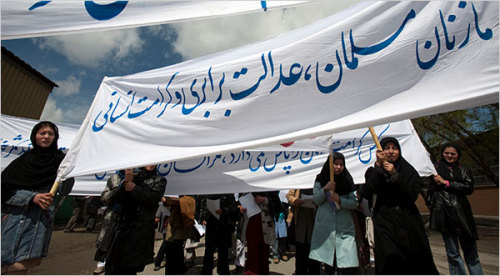
It was in Afghanistan, and these are women protesting their repressive treatment.

The New York Times reported:

The young women stepped off the bus and moved toward the protest march just beginning on the other side of the street when they were spotted by a mob of men.

“Get out of here, you whores!” the men shouted. “Get out!”

The women scattered as the men moved in.

“We want our rights!” one of the women shouted, turning to face them. “We want equality!”

The women ran to the bus and dived inside as it rumbled away, with the men smashing the taillights and banging on the sides.

“Whores!”

But the march continued anyway. About 300 Afghan women, facing an angry throng three times larger than their own, walked the streets of the capital on Wednesday to demand that Parliament repeal a new law that introduces a range of Taliban-like restrictions on women, and permits, among other things, marital rape.


Read the whole article. It'll make you cry, and make your own problems feel very insignificant. There's video, too.

This week's issue of The Nation offers Ten Things you can Do to Oppose the War in Afghanistan, and includes links to women's organizations in Afghanistan that we can support, and I pass them on to you.

Afghan Women's Mission, the Revolutionary Association of the Women of Afghanistan, the Afghan Women's Mission Newswire and MADRE.

I'd like to be able to say that my tax dollars help Afghan women gain freedom, but we're not there yet. So at least a few of my spare dollars will.

Tuesday, March 31, 2009

Legalized Rape in Afghanistan

Hamid Karzai is hopeless.

We've known this for a long time now. While I understand he faces some pretty tough conditions, the corruption of the Afghani government has only emboldened the Taliban. He holds elections, but he clearly has no intention of giving up power. And as the Americans have done at least since the beginning of the Cold War, we continue to back terrible rulers in the name of stability. You'd think that we'd learn our lesson about this by now, but we clearly have not.

Anyway, in an effort to gain support from fundamentalists before the upcoming election, today Karzai signed the "Sharia Family Law." What does this do? Among other things:

In a massive blow for women's rights, the new Shia Family Law negates the need for sexual consent between married couples, tacitly approves child marriage and restricts a woman's right to leave the home, according to UN papers seen by The Independent....

Article 132 requires women to obey their husband's sexual demands and stipulates that a man can expect to have sex with his wife at least "once every four nights" when travelling, unless they are ill. The law also gives men preferential inheritance rights, easier access to divorce, and priority in court.

A report by the United Nations Development Fund for Women, Unifem, warned: "Article 132 legalises the rape of a wife by her husband".

I know we are fighting a war on terror or something. Even if we aren't calling it that anymore. But how can we possibly support a ruler who has no interest in providing even basic human rights for half his people? I know that under Eisenhower or Johnson or Reagan, this law would not affect U.S. support in the least. I think it's really important that Obama break from the past and condemn Karzai for this, even at the risk of costing him the election. Of course, an open U.S. attack would probably be the best thing for his short-term electoral prospects, but the withdrawal of American aid would doom his ability to stay in power. And could his replacement really be that much worse?

Via Amanda
, who no doubt will be attacked from O'Reilly over this post too. I'm sure Bill O would love a law like this in the United States.

Friday, January 25, 2008

The Immorality of American Wars: Vietnam

I cannot recommend highly enough the fantastic Nick Turse article about Vietnamese amputees at Asia Times Online. Turse allows these two amputees, Nguyen Van Tu and Pham Van Chap, to tell their stories of life as amputees. Both had a leg torn off by the Americans or South Vietnamese in the war.

Pham Van Chap asks a basic question of American readers: "Americans caused many losses and much suffering for the Vietnamese during the war, do Americans now feel remorse?"

Turse writes:

I wish I could answer "yes". Instead, I tell him that most Americans are totally ignorant of the pain of the Vietnamese people, and then I think to myself, as I glance at the ample pile of tiny, local potatoes on his floor, about widespread American indifference to civilians killed, maimed, or suffering in other ways in Iraq and Afghanistan.

Precisely. Americans don't care. I don't think they ever did. Just like we don't care today about what happens to the people of Iraq and Afghanistan. This is the fundamental immorality of modern American war. It is one thing to not care about the wounded of your enemies. No one expected us to worry about the wounded of Nazi Germany. They were our enemy. Of course, geopolitical concerns led us to care an awful lot about reconstructing Germany, but that's an issue for another day.

Beginning in the Cold War though, we supposedly fought wars around the world to help the people we were fighting for. Central America, Vietnam, Korea, endless CIA operations around the world. In name at least, these were about protecting the people from some sort of oppression. Yet, not only did we promote oppressive dictatorships on our own, but we showed no interest at all in how our wars affected average people.

One might argue that is not the job of a nation at war. OK, perhaps. But what about when that war is over? Don't we have some kind of obligation to the people we were fighting for? Shouldn't we at least provide them prosthetic legs or arms? Help them eat?

But no, we don't care. Most war supporters sit at home and see the wars through the eyes of America kicking ass. The people on the ground aren't people, they are video game people. The U.S. government is playing a giant video game for them and they love watching it. They don't care any more about an Iraqi, Vietnamese, or Salvadoran than they do about the nameless characters they blew away on their video games.

Nothing is going to change in Iraq and Afghanistan. Even if we win these wars, if we can win such conflicts, does anyone really think there will be the slightest interest in reconstruction? The tiniest amount of money to putting people's lives back together again?

I sure don't believe we will. And that cuts to the fundamental immorality of American wars since 1945.

Let me close by quoting Turse again:

I wish I could tell Nguyen Van Tu that most Americans know something of his country's torture and torment during the war. I wish I could tell him that most Americans care. I wish I could tell him that Americans feel true remorse for the terror visited upon the Vietnamese in their name, or that an apology is forthcoming and reparations on their way. But then I'd be lying.

Tuesday, November 13, 2007

Drug Policy and Afghanistan

Eric Martin reports that the Bush administration has kind of sort of won in their poppy eradication campaign in Afghanistan. What, you say. The Bush administration did something right??? Yes, indeed. Afghani farmers have found another cash crop that can they can survive on instead of opium.

Marijuana.

Awesome.

Of course, the Bush administration and its allies will start eradicating the pot as soon as they can. Because they don't actually care about those farmers. That they will become even more impoverished if they grow chickpeas or whatever means nothing to them. Nor does effective drug policy within the United States that might cut the demand for drugs. I suppose the US could create a policy that would give these farmers subsidies to not grow drugs that would make up the income, something like an Agricultural Adjustment Act for the world. But that makes way too much sense for the United States and its war on some classes of people who make or do drugs.

Thursday, September 13, 2007

Turning Afghanistan Into Colombia

I highly recommend Peter Bergan and Sameer Lalwani's article, "The War on Poppies" about the failure of U.S. opium eradication efforts in Afghanistan.

It's clear that we have learned no lessons from 40 years of failure in Colombia. We could have made a real difference in Afghanistan after we overthrew the Taliban. We chose not to so we could go after Saddam Hussein. In the following years, Afghanistan has remained unstable, the condition of women has barely improved outside Kabul, and the Taliban remain a powerful force in the countryside.

If you are an Afghan farmer, what are you supposed to do other than grow opium? Are they supposed to care that the heroin market in the West is insatiable? Why should they? Particularly when the United States does not develop a realistic alternative for them. Plus, drug eradication efforts have never proved successful. Has the U.S. stopped marijuana farms in southern Oregon and northern California from decades of aerial surveillance? Have even made the slightest indentation in crystal meth? What has our coca eradication policies done to Colombia and the other Andean nations? And now the war on poppies is bringing increased violence to the Afghan countryside and binding closer ties between the Taliban and local farmers.

Bergen and Lalwani write,

"What's more, our policy is not effective. Though the U.S. spends about the same amount on counter-narcotics activities in Afghanistan annually as all Afghan poppy farmers combined take home in a year, our policies have not prevented record-setting poppy crops from springing up with every succeeding year, nor have they prevented Afghanistan from becoming a quasi-narcostate where corruption is rampant. Last week's U.N. report said Afghanistan continues to be the center of the world's heroin trade, accounting for 93% of global opium production. It noted a 17% spike in poppy cultivation in the last year, on the heels of a record 59% rise the year before.

The U.S. government, in short, is deeply committed to an unsuccessful drug policy that helps its enemies. The Taliban derives not only substantial financial benefits from the opium trade, according to U.S. military officials in Afghanistan, but wins political benefits from its supportive stance on poppy growing, masterfully exploiting situations in which U.S.-sponsored eradication forces are pitted against poor farmers."

Good job America!

What could we do differently? How could the United States actually cut into opium production in an effective manner. To start with Bergan and Lalwani suggest

The State Department strategy misses the forest for the trees. The priority of the United States and NATO should be first to thwart the Taliban insurgency while bettering the lives of typical Afghans through significant economic and reconstruction efforts to win hearts and minds. Doing nothing on the poppy front would do more to achieve this goal than the counterproductive eradication path the U.S. currently pursues. The U.S. should adopt a "first do no harm" policy that temporarily suspends eradication while implementing a promising portfolio of new initiatives to build up alternatives for farmers.

To begin with, the U.S. needs to invest in building up the legitimate Afghan economy. Though poppy fetches much higher prices than most other crops, subsidies, price supports and seeds for alternative crops should be offered to offset that price gap. Because other crops often face pitfalls such as the absence of distributors, domestic demand or consistent prices abroad, the international community should help Kabul set up an agency, modeled on the Canadian Wheat Board, that would purchase crops from farmers at consistent prices, and market and distribute them internationally. The U.S. and other NATO countries should open their markets and extend trade preferences to Afghan agricultural products and handicrafts.

They suggest several other possible solutions as well. Read the whole thing.