Showing posts with label Labor Unions. Show all posts

Tuesday, September 07, 2010

How the Democratic Party Fell Apart

Joan Walsh's excellent discussion of Jefferson Cowie's new book, Stayin' Alive: The 1970s and the Last Days of the Working Class and subsequent interview with Cowie provide an enlightening discussion of the split between the New Left and the American working class that has weakened the Democratic Party for the past 30 years.

Cowie's book just came out today so I haven't read it, though I highly recommend his 2001 book Capital Moves: RCA's 70 Year Quest for Cheap Labor for a brilliant discussion of deindustrialization and globalization.

Cowie spreads plenty of blame around on the fall of the New Deal coalition, including to the AFL-CIO, to the architects of the New Deal itself who left out workplace protections for everyone who wasn't a white man, to American capitalists who moved jobs overseas just as grassroots unionists and the federal government were forcing workplace integration, and, to a lesser extent, the new identity politics intentionally alienating the white working class. Most of all, he blames AFL-CIO President George Meany and Chicago Mayor Richard Daley for refusing to support George McGovern in 1972, thus showing to the New Left that the old racist white establishment would never support them, even in a fair fight. The book sounds fantastic and I can't wait to read if (if I can ever find the time).

I do want to qualify one point from the interview.


You also explain the way the New Deal set up some of this conflict by leaving out service and agricultural workers, largely blacks and women, from a lot of  protections -- Social Security, the Wagner/labor relations act. Then, when we turn to the agenda of individual rights in the '70s, those protections get administered very separately, through the Civil Rights Act. So we created equal opportunity, but there was never an integrated approach to women as workers, or black people mainly in their economic context. The New Deal that we hail now built in that separation and segregation.
 
Definitely. I'm trying to get around this very common problem of pitting some ideal sense of class politics against identity politics, which is often the way the debate goes here. There's probably a little something to upset both sides on this. As this vibrant rights movement takes off, it really does present that zero-sum problem you were talking about. But then there are these ideas that show people were kind of aware of that moment. Like the Humphrey-Hawkins [full employment] Act. Now it just seems like crazy talk: "We can guarantee a job to everybody." But it provided a material foundation for everybody to be able to have economic rights.

If everybody's going to have equal opportunity, you are probably going to have to make sure you also expand opportunities.
 
Exactly right, and when the steel mills are closing, at the same time that blacks are getting positions in the steel mills, that's not going to do any good.

OK--but I think the racial problem is about quite a bit more than the government forcing the all-white unions to allow black people into the workplace. I agree entirely that declining economic opportunities combined with white racism and the civil rights movement's success to make whites believe that black people and a federal government they believed served black people were at the root of their problems. But even in a period of expanding opportunity, racist politics within the white working class moved union members to the Republican Party, at least on the local level.

As the exploding historical literature on conservatism's rise has shown, in cities like Detroit and Chicago during the 1950s, public housing and desegregation of schools moved white working-class people to revolt even as their union victories with the active assistance of Franklin Roosevelt's administration were fresh in their mind. Just because an activist government helped them didn't mean they wanted an activist government to help other people. Race trumped class, as it has through much of American history.

None of this contradicts Cowie's interview, but I think that even without declining economic opportunities and deindustrialization, the white working class probably still more or less abandons the Democratic Party by 1980 over the issue of race and other cultural changes associated with the New Left and identity politics. I'd call deindustrialization more the nail in the coffin than the bullet that killed the New Deal coalition.

Tuesday, April 13, 2010

Andy Stern's Resignation

SEIU President Andy Stern is evidently resigning from his post.

This is big news in the labor world. Much to my surprise, a fair number of progressive writers are covering the issue.

Stern has been the most public and vocal labor leader over the past decade. He helped make SEIU the nation's largest union through his intensive organizing efforts. He took SEIU out of the AFL-CIO when frustrated by the lack of organizing focus by the mainline union. I don't necessarily agree that creating Change to Win was a very useful idea, but I respect the ideas behind it. Moreover, he led a massive union effort to get health care reform passed.

I am curious as to what this means for labor. Can Change to Win survive without Stern? I assume the next SEIU president will continue Stern's organizing emphasis. But will that president have the same leadership role within the labor movement. Tim Fernholz suggests that Anna Burger will take over and that Stern's stepping aside might be a good thing. Stern created a lot of animosity between  himself and other labor leaders, which helped lead to Change to Win in the first place. If Burger takes SEIU back into the AFL-CIO, one has to ask what the point of Change to Win was to begin with. I would have to see this as a black mark on Stern's legacy. Nonetheless, no one can question his leadership, both within the union movement and within American politics, his commitment to rejuvenating the American labor movement and his passion for helping working-class people live better and healthier lives.

Saturday, October 17, 2009

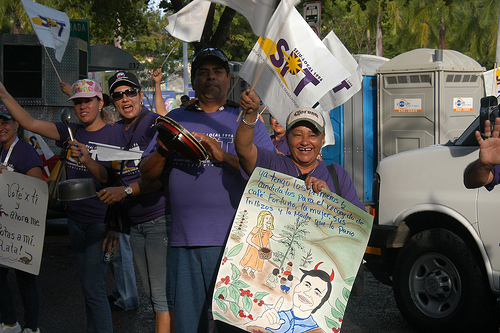
Puerto Rico On Strike


While CNN was obsessing over that damn Balloon Boy (who wasn't actually in the balloon and therefore was an even bigger waste of time than tea party protests), Puerto Rico had a historic general strike. Estimates range between 100,000-200,000 people in the streets marching. Of course, the corporate media ignored it. I wrote about it for Global Comment--as usual, I'll start the piece here and encourage you to read it over there, since they help pay my bills (and there's other stuff worth reading there as well!)

Fortuño’s plans fought: lessons from protest in Puerto Rico

I’ve seen a focus in the United States on mass political action in the past year like nothing I’ve seen in my lifetime. From the huge crowds at Barack Obama’s campaign rallies and the unprecedented amount of donors and volunteers that helped elect the man President to the recent cynical discovery of organized dissent by the Republican party, we’ve watched groups large and small take to the streets.

Whether this is a sign of a newly energized, engaged American body politic will take some time to say. After all, some demonstrations still receive more attention than others, with the right-wing media machine led by FOX News trumpeting the success and inflating the numbers of tea party protests while decrying protests from the left, and the purported liberal media spending a good chunk of time arguing those numbers and attempting to root out the funders behind the right-wing actions—often while genuine grassroots action goes on under their noses, ignored or even punished by those in charge.

Almost completely ignored this week was the one-day general strike in Puerto Rico following the attempted imposition of shock-therapy-style economic reforms by the new governor. Chief among those reforms was a decision to lay off more than 20,000 public employees. The layoffs would drive Puerto Rico’s already-astounding 15 percent unemployment rate to over 17 percent.

More than 100,000 workers took to the streets to protest on October 15–Eliseo Medina, Service Employees International Union Executive Vice President, told me he thought the crowd was over 150,000. “It was tremendous. I’ve been in the labor movement for 44 years and this was the most impressive event I’ve ever seen. It was up there with the immigrant mobilizations of 2006,” Medina said. “It was one of the most diverse events that I’ve ever seen in a society. Lawyers, workers, students, psychologists, priests and minsters and nuns and everyday people. It was truly an amazing sight. It was pretty clear, our rejection of Governor Fortuño’s policies.”


Read the whole thing.

Monday, September 07, 2009

Happy Labor Day!


Guards & supporters rally for a union at the Philadelphia Museum of Art. My article on it here, if you want more info.

Monday, August 17, 2009

Has Labor Been Left Hanging?

At the risk of diving in here when I haven't been posting much to self-promote, my first story is up at the Nation's site. It's about the Philadelphia Museum of Art security guards and their struggles to unionize, and how they're a great example of the need for the Employee Free Choice Act.

There's kind of a dearth of interest in labor issues among the "netroots," as I noticed when Arlen Specter had to bring up EFCA himself while being questioned at Netroots Nation. I've always been proud that this blog tries to address these issues, and while I'm nowhere near as knowledgeable as Erik is when it comes to union history and organizing, I try to do my part. Anyway, here's the beginning and please read the whole piece over there.

The Philadelphia Museum of Art is a recognizable icon even to those who have never set foot in the city. Immortalized in the movie Rocky, when a sweatsuit-clad Sylvester Stallone bounded up the stairs while training for his big fight, the museum became a symbol of the working-class tenacity that Philadelphians are known for.

On September 6, those steps will host a different kind of blue-collar battle: the museum security guards will be holding a rally in support of the Employee Free Choice Act (EFCA) and their right to form a union.

Tuesday, August 04, 2009

Teachers at Charter Schools Beginning to Form Unions

The New York Times had an interesting article last week about charter school teachers beginning to unionize.

I find the arguments against unions here extremely weak. You don't want teachers of terrible quality? Then hire competent teachers, and set up (with the teachers' union) a system of evaluating teaching performances so that truly awful teachers lose their jobs. And I just don't see (nor do opponents of the unions explain) how unionization restricts freedom to innovate (one of the supposed benefits of charter schools) or "raise achievement."

Meanwhile, the benefits seem overwhelmingly important. Not being able to fire teachers at will, regardless of performance (and let's not pretend that some firings are driven by personal conflict or politics)? Fine. Giving charter school teachers better pay, instead of treating them like the adjuncts of primary and secondary education? Great. Reducing turnover rates in schools' faculty? Sounds good. Letting teachers have a little more input in the curriculum? I fail to see how letting the actual pedagogues have a say in the pedagogical experience could be a bad thing.

I hope this is something that can spread across charter schools throughout the country, either through local unions or a national organization. Giving teachers in these schools basic labor rights (like the ability to keep your job and make a decent wage) is a basic right, regardless of the structure of the school. Now, if only adjunct professors could start getting better rights and protection...

Saturday, July 18, 2009

Will Anti-Trust Laws Continue to Apply to Professional Sports Leagues?

That's seems increasingly unlikely. Come August, the Supreme Court will rule on the pending case of American Needle, Inc. v. NFL, and the decision the court very well may end up making in favor of the NFL, frightens me. Lester Munson does a great job breaking it down:

The case began innocuously enough in Chicago in December of 2004 when American Needle, Inc. (ANI), filed an antitrust case against the NFL, claiming that the league was using its monopoly powers illegally to deprive the company of its share of the market for caps and hats bearing logos of NFL teams. ANI had made knit caps and baseball hats bearing NFL logos for decades until the NFL ended the relationship in 2000.

But American Needle didn't give up. It filed a request for review to the U.S. Supreme Court, one of 7,500 or so such requests filed annually. The court takes only 70 or 75 cases for decision each year, and American Needle's quest seemed quixotic at best.

Then, in a stunning development, the NFL told the Supreme Court it endorsed American Needle's request for a hearing and a decision. The league's attorneys announced, in a remarkable understatement, that they "are taking the unusual step of supporting" American Needle's effort to have the case reviewed at the highest level.

The league's action was a legal bombshell. Instead of standing on its lower-court wins over American Needle, the league told the Supreme Court that it wants the justices to consider an issue far beyond the caps-and-hats contract. It wants the court to grant the NFL total immunity from all forms of antitrust scrutiny, an immunity that would then apply to the NBA, the NHL and MLB, as well.

In essence, the NFL agreed with the appeal in the hopes that the Supreme Court will rule that the NFL is a single entity competing with other entities in the entertainment business, rather than 32 competing teams. Ruling that the NFL is a single entity would basically get rid of anti-trust allegations such as collusion, price-fixing, etc., as well as greatly weakening the already-relatively-ineffective NFL Player's Union, whose victories (such as for free agency) have generally come in anti-trust lawsuits.

And the ruling would impact not just the NFL. If the NFL is ruled a single entity, then the NBA, NHL, and MLB may also be ruled as such, and the price-gouging of fans and exploitation of players with relatively weak unions (although it seems baseball is in a slightly better place thanks to a stronger union) can begin. And this isn't paranoia. In his previous legal analysis for ESPN in issues ranging from the Kobe Bryant rape allegations to the SEC investigating Mark Cuban for insider trading, Munson has offered very sound and intelligent analysis for legal experts and legal dummies (like me) alike. Here's Munson's take on what could happen if the Supreme Court rules in favor of the NFL
If the NFL can find five votes for its single-entity concept, it will transform the industry.

Leagues will enjoy unfettered monopoly powers.

Salaries for players and coaches will drop.

Free agency will wither away.

Sponsors will pay more.

Fans will pay more for tickets, television and Internet broadcasts and for paraphernalia.

And owners' profits will soar.

That's about as concise as you could make it, and as bleak as things could be. Sure, if you don't particularly care for football (as I don't), then you don't have to spend the money, and the diehards can spend money the way they like. But this isn't about picking a sport and sticking with it. This would be a vulgar display of abuse and power on the owners' sides, something that has already begun (the year after not renewing its contract with American Needle, Inc., NFL hat prices jumped 50%, from $19.99 to $30). Everyday fans who like to show their support for their teams would have a harder and harder time being able to afford the goods, and would have nowhere (other than the black market, which could really burgeon thanks to things like this) to turn to. Their options would be limited: either shell out a ridiculous amount for an organization you like and an identity you've adopted, and help a multi-millionaire get even richer, or let part of your identity die as you opt not to spend the money. And if you don't like it, there are probably plenty of other suckers whose money those greedy owners will gladly take. It's like trying to buy season tickets at the new Yankee stadium, only on an industry-wide level.

And that only addresses the fans. What the players, coaches, and managers are facing is even bleaker. The MLB union is the strongest of the four unions in professional sports, so maybe it could hold out a bit better. But the fact that the NBA and NFL players' unions usually win their complaints via anti-trust lawsuits effectively means that a ruling in favor of the NFL would strip players in those leagues of any sort of meaningful labor rights. Hell, the NFL was dragged kicking and screaming into allowing free agency, and that didn't even happen until the late-1980s and early-1990s. And the NFLPA's fight to have the NFL take better care of its players in retirement when they suffer the long-term effects of abuse they suffered as athletes, well, that would probably be a dead letter too. And the sports leagues could all collude to keep salaries low for both players and managers. Sure, people get indignant when A-Rod can opt out of the last 3 years of a $252 million contract, just to sign a $275 million 10-year deal, but you can't deny the major pay improvements that players in the MLB have enjoyed, watching the minimum pay go up to $390,000 last year, after the paltry salaries players previously made.

And for those who think, "oh, well, maybe the Supreme Court will rule in favor of American Needle, Inc." Maybe it will. But if anybodh yas paid even the slightest attention to how court decisions under the Roberts court have trended, they almost always end up deciding (usually 5-4) in favor of businesses over labor, and I don't see why Sotomayor's arrival will change that (she's replacing Souter, not Thomas or Scalia). Sure, the Court may rule against single-entity status for the NFL, but it hasn't exactly offered a lot of hope in its previous recent decisions.

Again, I'm far from a legal expert, and so maybe there are alternative solutions (such as Congressional action), but the notion that professional sports should be exempt from all anti-trust monitoring and regulation is bunk. It will absolutely destroy the players' labor rights and organizations. It will force fans to either stop buying products to show support for their team, or to pay ridiculous amounts so the owners can get richer. And we'll be able to watch such fine, upstanding individuals as the Steinbrenners, Donald Sterling, Jerry Jones, Al Davis, and others get richer.

And that's a bleak future for professional sports.

Tuesday, May 12, 2009

The Green Party: Lessons Not Learned

Brian Beutler has an interesting story on unions talking about supporting a Green Party candidate against Blanche Lincoln in the 2010 Arkansas Senate election. The most likely result would be throwing the election to whatever Republican challengers her.

As a progressive Democrat, I am torn by this. Blanche Lincoln sucks. I want her to support the Employee Free Choice Act. I want her to support a lot of things that she doesn't. I also think unions need to show some political muscle and make people suffer who oppose them.

However, I also have pretty clear memories of the last time progressives decided to throw a Democrat under the bus in a protest vote. That didn't work out too well.

Lincoln is from Arkansas. It's amazing the Democrats have 1 senator from Arkansas, not to mention 2. You can't expect her (or Ben Nelson or Mark Begich for example) to vote a liberal line all the time. They come from conservative states and are likely to face tough reelection campaigns even if they don't vote with the leadership on controversial issues. And what is replacing her with a Republican going to do? Is that going to help EFCA pass? No. In fact, it takes a page out of modern Republican tactics which, as we may recall from Arlen Specter's situation, haven't brought them a lot of results in recent years.

Plus, attacking Lincoln avoids the real problem--the filibuster. We don't need Blanche Lincoln or Mark Pryor or Ben Nelson to pass EFCA if we can get it to a vote. Unfortunately, the Senate is an institution where Republicans need 51 votes to pass legislation and Democrats need 60 votes. If unions want to get rid of anyone, it should be tossing Harry Reid from Majority Leader. It's highly unlikely that any even remotely controversial legislation, not to mention pro-union legislation, is ever going to pass with 60 votes, especially in the face of a disclipined minority. So the key is to pass it with 51 votes and to create the change necessary in the Senate to make that happen.

Throwing support to a Green Party candidate in an Arkansas Senate election will accomplish nothing.

Tuesday, April 28, 2009

Fair Pay Day

I meant to blog this earlier, but today is Blog for Equal Pay Day. Specter kind of took over the news cycle, but I do have a few things to say about this.

Women still make only 78 cents to every dollar men make. From the National Women's Law Center via Change.org:

Women are far more likely to live in poverty than men. Women working full-time, year-round are paid only about 78 cents for every dollar earned by men. African-American women earn 69 cents and Latinas earn 59 cents for every dollar paid to men. This wage gap cannot be dismissed as the result of "women's choices" in career and family matters. In fact, authoritative studies show that even when all relevant career and family attributes are taken into account, there is still a significant, unexplained gap in men's and women's earnings. Thus, even when women make the same career choices as men and work the same hours, they still earn less.


You can sign the petition for the Paycheck Fairness Act, blog about this, call your congresscritters, do whatever. You can also remember that unions are one of the best ways to raise the wages and benefits of working people, and that, as I wrote not long ago, the Employee Free Choice Act is a feminist issue.

From the Center for Economic and Policy Research:
*”On average, unionization raised women’s wages by 11.2 percent – about $2.00 per hour – compared to non-union women with similar characteristics.”


Finally, to tie all this back in with Specter and breaking news, even though Specter said his vote on cloture for EFCA would not change, in reality, winning a Democratic primary in Pennsylvania without union support will be tough--and apparently Specter had a meeting with Teamsters President Hoffa yesterday before deciding his party switch...

So. Support paycheck fairness for women, particularly women of color, and support the Employee Free Choice Act. Damnit.

Wednesday, April 08, 2009

Labor and the Employee Free Choice Act

It certainly feels that the Employee Free Choice Act faces an uphill battle for passage. With Democratic senators such as Blanche Lincoln coming out against it and even Dianne Feinstein expressing doubts, it's hard to see where the 60 votes comes from to break the filibuster.

Of course, the sensible policy would be to nuke the filibuster and have the Senate return to something approximating a democratic institution. Given that Harry Reid is Majority Leader, the chances of this remain low, although growing Democratic frustration is going to build pressure to change Senate rules.

The other way EFCA might pass is if Obama makes it a top priority. And while he's talked about passing the legislation, it's clearly not first on his agenda. He's kind of given short shrift to the unions ever since his election. Naming a Secretary of Labor was low on his appointment list and no representative of labor was at his introductory press conference where he announced his financial team. He then allowed Hilda Solis' nomination to languish in committee for way too long. For quite fair reasons, Afghainstan, health care, and energy are clearly higher priorities. If the question is how much political capital will Obama spend of EFCA, the answer is probably some but not too much.

When I heard that Democrats were going to push EFCA this year, I was surprised and a bit skeptical of its chances for passage. It's a great piece of legislation, but unions have hardly prepared the public for it, shown that they can pressure doubting politicians into voting for it or kicking out of office those who don't, or played a major public role in American life over the last couple of decades. Of course there are many reasons for this--globalization and outsourcing being the primary culprit. But labor's own ineffective leadership also deserves a great deal of the blame.

In order for major labor legislation to pass, labor has to be united and ready to fight. Right now they are neither. Labor has to overcome long-time anti-union bias in the United States. It's important to remember that there's really one been one period of labor dominance in the United States, 1935-47, or from the passage of the National Labor Relations Act to the passage of the Taft-Hartley Act. In the early 1930s, at the height of American liberalism with millions of workers desperately wanting to join a union and willing to go on strike to do so, with Franklin Roosevelt as president, and with the Republican party completely discredited, the NLRA was quite controversial, with significant resistance from both Republicans and southern Democrats. Twelve years later, much of America was ready to roll it back and did so with Taft-Hartley. Since then, while unions remained a strong aspect of American life until the 1980s, anti-union sentiment has grown. Labor, kicking out their radicals in the face of Taft-Hartley and the anticommunist atmosphere of postwar America, became increasingly reticent to organize and to strike. Focusing on benefits was great for their members and great for America, but it did not create an institution ready to fight when employees backed out of the tacit agreement made during and immediately after World War II that in exchange for those benefits and a good standard of living, unions would crack down on radicalism and become part of the employer-dominated capitalist system.

Even today, labor is having tremendously difficulty moving out of this mentality.

It's my belief that in order for EFCA to pass with a filibuster-proof majority, unions have to work toward becoming a powerful voice in American life. They see EFCA as the solution to that problem, which is fine except that unlike in the 1930s, they are viewing this as primarily a political problem with a political solution. They are treating the problem from the perspective of a deserving part of the Democratic coalition who needs to be paid back rather than demanding passage regardless of political consideration.

What are the unions to do? I think the first thing that needs to happen is reunification. Harold Meyerson reports that AFL-CIO, Change to Win, and the National Education Association are coming together in a new coalition to fight for change. That's fine, but I have to wonder what the point of Change to Win was in the first place. Led by SEIU president Andy Stern, Change to Win formed in 2005 as an alternative to the AFL-CIO that was going to put more emphasis on organizing. Sounds great, but it seems to have made virtually no difference in labor's role in American life. And now we're back to square one.

I think the unions also have to task some risks. They have to put not only their money where their mouths are, but bodies too. It's hard to believe unions will be able to create change without some mass actions. The successes of the 1930s came because millions of workers were ready and willing to put their jobs and even their lives on the line through direct action. Where is that today? Just being another player at the political table is not enough, not when you have such strong neoliberal beliefs and anti-union hostility in Congress. And that's just the Democratic party. It's a huge risk. For 60 years, all Americans have heard about unions is negative. Today, the UAW is considered to be part of the problem at GM and Chrysler. This is an absurd charge, but for another post. What would the public response be to mass union actions? At first, almost certainly negative. The right-wing media would be up in arms and the mainstream media tisk-tisking. But with a good strategy that includes a media blitz with representatives on every available show, locally-based efforts that allow locals to target individual politicians, employers, or areas of town, and an organizing effort to go along with it that gets word out to Americans what unions can do for you and how they can help save the economy, the potential is high for an effective result. Of course, you'd have to be willing to back it up by threatening political careers, but that should be part of union strategy anyway.

Political lobbying is not enough. But according to Meyerson, that's where the new coalition, possibly headed by David Bonior, is heading: "The union presidents have largely agreed to focus the federation (its name is still up in the air) on the political and lobbying operations at which the AFL-CIO has excelled." Have they really excelled at this? I don't know about that. If they can push EFCA though, I'll be a believer. But right now, their attempts at lobbying Congress are failing. Again. Something new has to come from labor to see EFCA and other necessary legislation pass and to create a pro-labor and pro-organizing atmosphere in this country. Otherwise, I see labor's decline only continuing.

Friday, April 03, 2009

Unions, Women and Fair Labor Practices

Jill at Feministe was kind enough to run a guest post from yours truly on the Employee Free Choice Act, unions, and why they're feminist issues. I'm going to give you the beginning here, but ask you nicely to read the rest over there since she gave me the platform.

So our economy is falling apart, right? And the government keeps bailing out these massive financial firms while talking Very Sternly to the auto company CEOs about how they need to restructure and cut costs. Of course, the number one cost CEOs and reporters love to talk about is the “labor cost,” all the while nicely avoiding mentioning that “labor cost” is what real people make in wages and other benefits.

Unions, in other words, are a convenient bogeyman, yet they do and have done more to improve the living standards of American workers than anything else. And 44% of union workers are women. According to the Center for Economic and Policy Research:

“If the share of women in unions continues to grow at the same rate as it has over the last 25 years, women will be the majority of the unionized workforce by 2020.”

There’s a bill in Congress right now that you’ve probably heard of called the Employee Free Choice Act. Briefly, the bill would allow three things: it would allow workers to form a union simply by signing a card—the so-called “card check” provision; it would provide binding arbitration for employers and workers when they cannot agree on a contract; and it would strengthen penalties against employers who seek to intimidate workers trying to form a union.

And I believe it should be a feminist issue.


Read the whole damn thing.

Friday, March 27, 2009

Shameless Self-promotion blogging: EFCA style.

My EFCA piece over at Global Comment.

In his press conference Tuesday night, Barack Obama took pains to emphasize that comprehensive solutions were needed to the economic crisis, and that working families were suffering and needed help to create real wealth.

Congress has before it a bill that would help lessen the inequality in America and support those working families by helping workers organize into unions. That bill is the Employee Free Choice Act, H.R. 1409, introduced on March 10 by George Miller of California, with a who’s who of congresspeople as cosponsors.

Economist Mark Price of the Keystone Research Center in Pennsylvania says,

“Unions make sure that as productivity rises the wealth which this increased productivity creates shows up in the paychecks of workers. Unions do this because they give workers more bargaining power and that bargaining power translates into higher wages.”

Price also notes that a stronger labor movement is key in creating a sustainable economy once the crisis is stabilized. “Like the need for increased financial regulation, a stronger union movement is critical to making sure that when the economy does recover that recovery produces widely shared gains.”

EFCA, as it is known, is shaping up to be the biggest battle over organized labor since 1947, and big business is pouring millions into advertising and lobbying against the bill—including Citigroup and other bailed-out businesses. The irony of using taxpayer dollars from working people to defeat a bill that aims to help working people is not lost on EFCA supporters.


Read on.

Wednesday, March 25, 2009

Stimulus Saves Jobs, Tennessee Higher Education

Thanks in part to pressure applied by the United Campus Workers (a union of University of Tennessee employees), Tennessee Governor Phil Bredesen is using the state's share of stimulus money to eliminate all planned cuts in higher education. This not only saves hundreds, if not thousands, of jobs, but also goes a long way to ensuring decent education for Tennessee's citizens.

This is a great example both of how Obama's stimulus plan is making positive improvements in the country and of the necessity of unions as a force for good in public life. As the union itself said in a press release:

Since last fall UCW-CWA has been clear: the Governor must use any available federal assistance, the rainy day fund and other available resources as a bridge to better economic times instead of implementing the steep budget cuts proposed for higher education. During a time of economic recession the state's public colleges and universities are the last place we should look to for budget reductions. Instead, higher education is one of the best job creation programs our state has; public higher education is an economic engine that benefits all residents of Tennessee.

While many of our colleagues enjoyed the winter break, our members actively reached out to the Tennessee Congressional delegation asking for federal aid for higher education. During the week of Christmas our leadership continued to plan our legislative campaign. While many around us descended into hopelessness and the ere of inevitability, our members rallied in support of federal aid and pressured Congress to pass the American Recovery and Reinvestment Act with its State Fiscal Stabilization Fund. When many talked of pink slips soon to be arriving in the mailboxes of campus employees we, at points by ourselves, boldly spoke up that these cuts would not have to take place now given the aid on its way to states. Our members spent Spring Breaks lobbying our elected leaders in Nashville, many of them using their annual leave in order to attend.

Last night this work finally began to come to fruition. In his Budget Address to a joint session of the Tennessee General Assembly Governor Bredesen announced that due to the federal economic stimulus bill's State Fiscal Stabilization Fund higher education, "not only won't have to make cuts [this year], but cuts they have already taken here in Tennessee have been restored."

It is important that our coworkers, our colleagues, and our communities know that these sorts of developments do not simply drop from the sky. Average people can make positive change in our own lives, these development are proof positives of this fact. The struggles to see our jobs respected and secure, higher education well funded and positioned for the future, and our state, national and world economies back on track are all far from over. But good news is always welcome news.


Indeed.

Saturday, March 07, 2009

Historical Image of the Day


Ralph De Toledano presenting his book "Let Our Cities Burn" to Jesse Helms, 1975. This book was a screed against public sector unions.

Saturday, December 13, 2008

Ron Carey, RIP

It's been a crazy news week. There's so much I want to talk about. But in the limited time I have right now, I want to mention the death of former Teamsters president Ron Carey.

Carey was the reformer who threatened to bring the Teamsters into the progressive movement during the 1990s. The head of the union from 1992 to 1998, Carey was a sharp contrast to the staid, corrupt Hoffa years, Carey centered organizing and supporting progressive causes in his program to reform America's most corrupt union. During my labor organizing days of the late 90s, I knew a Teamster who was a big Carey supporter. If this was the kind of person who a revived Teamsters was going to push forward, Carey was a great man.

Sadly, Carey was done in by corruption charges of his own. These were somewhat hazy charges, but people in power loathed Carey because of his reforms, including the Hoffa wing of the union. He was kicked out of office, and out of the union for that matter, not for doing anything wrong or being corrupt, but for not detecting a campaign finance scheme. His replacement--Jimmy Hoffa, Jr., a figurehead hoisted by the old corrupt elements of the Teamsters, who remains in power today.

Meanwhile, unions become less relevant to American political life every day.

Sunday, November 16, 2008

A Big Three Bailout? Hell yes (kind of)

Congressional Republicans seem to be taking a stand against the proposed bailout of American auto companies. They supported, albeit reluctantly and far from unanimously, the previous bailouts, and seemingly still have confidence in Henry Paulson. But U.S. automobile manufacturers? That is just beyond the pale. Free market capitalism for some, but not all. Bailing out some people, but not others. What’s the difference? I think it has a lot to do with the union. Republicans would love to see the Detroit-centered, unionized domestic auto industry fail. For all of their flag-lapel wearing and American flag-self-wrapping, they would love to see a country full of Nissan, Honda and Toyota plants—all are non-union and have plants primarily in the South.

For a moment, I’ll pretend this kind of Reagan-esque union industry targeting isn’t going on. The argument for the finance industry bailout hinged on the assertion that a collapse in the financial services sector would have wide-spread, top-to-bottom repercussions on the economy. A bailout was needed in order to fend off the economic Apocalypse. The argument is based on the scope of the effect.
The Big Three employ upwards of half a million people combined. But these employees are just the very tip of the iceberg. There are thousands of other businesses (even whole cities) that depend on the industry. Already small manufacturers that supply parts to the Big Three are feeling pinched. Orders are down; and when orders are down in factory work, you get laid off indefinitely (like my mother did on Wednesday—she’ll be out of work until at least February). This AP story outlines the extent of the problem for allied industries, after-market suppliers, part suppliers, etc. A failure of U.S. automakers won’t just affect the failing businesses—even foreign manufactures will suffer. Dave Andrea, a trade association VP, explains:

"We need to be talking about this at the U.S. level, not talking about the Detroit Three and then putting the other automakers in another bucket," he said. "If we have major failures of suppliers, the foreign automakers are going to be affected as well."

The scope is indeed large.

It’s not just Republicans that have voiced their opposition to this bailout; at the G20 summit, British Prime Minister Gordon Brown denounced the bailout, and the EU is prepared to “take action against the US at the World Trade Organization if aid for the stricken US car industry was judged by the European Commission as illegal”. Brown and others are crying protectionism—but I don’t buy it. The Big Three have significant labor costs related to healthcare. In countries with cheaper, government-provided healthcare, the business sector is not saddled with providing health care for employees. Because even large companies are not as big as governments, the price of covering GM’s 250,000 workers is much higher per person than Britain’s 60.7 million citizens. It’s not an even playing field. What would letting one of the largest, most iconic, most powerful unionized industries fail do? It think it would send a strong message to corporations that if you pay good wages, healthcare, pensions, and get into trouble… well, you are on your own. What an incentive for good corporate citizenship.

Don’t get me wrong—I’m in no way claiming the good virtues or pure motives of the auto industry. They haven’t provided wages and benefits out of the kindness of their hearts—these wages and benefits were fought for, hard, over many years in the labor movement. The Big Three are horribly managed, manipulative, unimaginative, greedy, and reactive. The operative phrase here is horribly managed. It isn’t the workers’ fault management has run one of the most important American industries into the ground. It isn’t the fault of suppliers and after-market manufacturers, it isn’t the fault of dealerships, banks, and the huge number of allied businesses. This is a failure of leadership and regulation.

This is why I’m not proposing a bailout—good money after bad isn’t the way to fix the situation. Nor am I siding with Republican Richard Shelby, who has called the industry a “dinosaur”. I think the government ought to infuse the companies with enough cash to remain solvent and retool, sack the leadership, and claim a stake in the industry. You know, nationalize the automobile industry. Think about this—if we don’t spend the money here, who is going to be on the hook for 500,000 pensions? The U.S. taxpayers. The money is going to be spent on way or another; why not do it in a way that gives the taxpayers control, saves an industry, and allows us to start creating the cars we need here in the U.S., with good, high paying union jobs?

Tuesday, December 18, 2007

Craft vs. Industrial Unionism

The impending return to the air of Jay Leno and Conan O'Brien without their writers demonstrates the inherent problem with craft unionism. Although there has been good solidarity among Hollywood workers, there are also a ton of working people without a stake in this strike who are suffering. Not the big actors or celebrities of course, but the middle-class people who work hard for a living and can't handle several months without a paycheck. The late-night hosts have done a good job of keeping their employees on salary, but you can't do that for months on end without receiving some kind of salary of your own. Even millionaries feel it when they pay out hundreds of thousands of dollars a week.

Hollywood is still on the old craft-union system. Rather than an entertainment-wide union fighting for the rights of all workers, it is made up of a maze of individual organizations. When one goes on strike, everyone suffers. But not everyone gains when the strike is won.

This reminds me of the decades before the CIO's founding in 1935 when the American Federation of Labor ruled the national labor movement. Not only did the AFL refuse to organize blacks, women, children, immigrants, or most industrial laborers, they split everyone up into crafts rather organizing them around industry. Thus the pipefitters in a steel mill might go out on strike. But the rest of the steel mill would either continue to work or be unemployed for no reason. This was such an ineffective organizing method that the CIO formed to revolutionize labor, which it did during the next two decades. Unfortunately, the CIO could never break the AFL's back and the two organizations combined in 1955. More relevant to the topic of this post, the CIO's failure meant that a lot of industries remained organized on craft lines, thus helping to set the stage for the writers' exploitation by entertainment executives and the situation where shows are returning to work, even without their writers.

On the other hand, there is some talk of Jon Stewart and Stephen Colbert making temporary agreements with the Writers' Guild to allow those writers to return to work. If they gave the writers a good deal, they might force the industry to crack. That would be good. Maybe they could help create a positive end to the strike.

Tuesday, September 25, 2007

An Inside Look at Union-Busting Seminars

Art Levine got inside a union-busting seminar. He produces a fascinating must-read out of it. If you haven't been exposed to evil lately, I highly recommend it.

Union busting has a long history in this nation and it has only become more intense in the last thirty years as American companies decided to break the long-term compact between themselves and workers in the name of higher profits.

Perhaps the most telling thing about Levine's story is the Jackson Lewis law firm, which specialize in union busting, telling companies they can lie about anything concerning unions:

"The labor board doesn’t really care if people are lying."

At this point, the National Labor Relations Board is a joke. Even under in Clinton is was unfriendly to workers. Now it is an active tool of industry and only forces to follow the law in a very open-ended and broad way. Lying? Not a problem in the least! I guess so long as you don't actually murder a union organizer, it's all good.