While I understand the technicality of the legal term, could you please refrain from portraying victims of natural disasters as criminals by highlighting their "looting?" It was offensive in 2005, when African-Americans were "looting" while white people were "salvaging" in New Orleans, and it's offensive in 2010 when Chileans are "looting." What do you want? That people remain hungry and without water for an indefinite period of time until the infrastructure is developed enough for the Chilean government to give these things out? That would be fine, except that the infrastructure has just been demolished, and aid wouldn't exactly arrive quickly anywhere that just endured an 8.8 earthquake. People need supplies to survive, and the expectation that capitalism cannot be disturbed, even in the event of a massive natural and human disaster, is absolutely absurd. I would hope perhaps you media outlets could focus on more useful narratives than "let's portray the criminality of everyday individuals who are merely trying to survive," but apparently, I'd be wrong. This was a devastating event, and we're still only learning about how horrible it will be. Chile is facing a long road here; it doesn't need you portraying people trying to survive as base criminals. Please focus on other things.
I don't know if this is true, or if this is Harwood's own phrasing on something that a "White House source" said, but I'm going to take a few seconds to play with it in any case.
First off, the corporate media has far more reason to dismiss bloggers as the "Internet left fringe" than staffers of a president who was put in office on the backs of millions of "Internet left fringe" donors and volunteers. Yet it seems that Obama's staff, headed of course by one Rahm Emanuel, he of the "fuck the 50-state strategy, take the corporate money" thought process, has bought into the "Church of the Savvy" position that bloggers are a sad, silly minority of people online who will never be satisfied with anything.
Sure, I've seen people on the Internet whining that Obama is no different than Bush. It shouldn't have taken a Nobel Peace Prize for us to know that that line is objectively false. That doesn't mean that we don't get to be pissed when Obama's not living up to his promises. And as Jane Hamsher and the others who raised hundreds of thousands of dollars for candidates to support a public option could tell you, the "internet left fringe" can move dollars and poll numbers and support.
As for the National Equality March, like other protests for social justice, it gets written off as "fringe" by the same mainstream media that fetishized the tea parties. It seems they don't have enough corporate sponsorship to be taken seriously. As usual, real grassroots is threatening to those in power, whether their power is corporate media or political insiderdom.
It's too bad, though, for Rahm and his cohorts and for Harwood and the rest of the media. The netroots got a taste of its own power (ironically, starting with its ability to put Obama in the White House) and it's not going away, it's growing. And more and more of us are leaving the basement, taking off the pajamas, and going to an office for a media job--to which we bring the same political ideas, the same social justice values, and the same drive to get the job done that we did when blogging was something we squeezed in in our spare time because we just cared so damn much.
(In other news, today's my first official day at the new job. Wish me luck!)
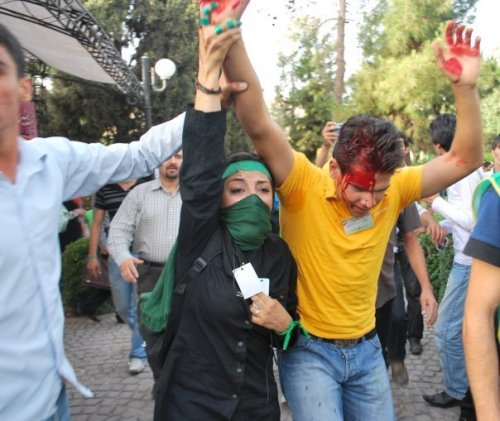
I've been following the story on Twitter all day, as U.S. news outlets are really not covering it at all. People livetweeting from Iran as the country explodes at the election results, information being passed on as it is received and people attempt to verify it in real time...
Nico Pitney at the Huffington Post has been liveblogging and collecting info as it happens, but watching the story come in over Twitter is really exciting--and frightening. We place a certain amount of trust in news that comes to us from mainstream outlets, while here we just assume that people are who they say the are and that they are where they say they are. Or we desperately try to verify, a task that would be much easier if news outlets had nearly the amount of reporters on the ground that they should have.
Video, however, is worth a thousand words.
Live video shot by amateurs and uploaded to YouTube has an even more visceral effect than the glossy photos taken by professionals. It feels real, immediate, frightening, and exhilarating. No doubt the repression is coming, but these people are willing to face it.
Yes - five whole people, and the latter two fatalities had "underlying health issues." There's a lot one could say here - the obvious complete freakout spurred by the media not being worth 10 seconds of the attention it got being the most obvious one, but also the characterizations of Mexico and Mexicans in the wake of the disease's spread, or the bizarre faux-sensitivity of some orthodox Jews who felt that they were being prejudiced against by calling it swine flu and felt that it would be totally acceptable to slander Mexico rather than Israel by calling it "Mexico flu."
Instead of spending time on that, though, and snarking away, it's worth being serious. While I have no doubt that a decent percentage of people will eternally be spooked out by these stories, one can't help but think we're being set up for some instance down the road where it really is a serious and threatening disease that spreads quickly, and yet when the media says "wash your hands, protect yourselves, etc. etc.," a lot of people will just say, "yeah, yeah, I've heard it before - bird flu, swine flu, whatever." I know I'm asking for the impossible, but it would be nice if, at least on health issues, media took a calm, rational, informed approach, instead of the "OH MY GOD WE'RE GONNA DIE!!!" narrative that just ends up leading to another instance of the media crying "wolf!"
You know, I stopped reading the Inquirer after they hired Rick "Man-On_Dog" Santorum as a columnist. I kind of wish right now that I had a subscription that I could cancel in disgust, though, because the Inky just hired John Yoo, Philadelphia native and torture memo author, as an Op-Ed columnist.
Philadelphia is a pretty heavily Democratic city, so I can only wonder who the Inky is targeting with this new hire. Are they counting on Web hits going up when liberal bloggers link to Yoo's columns in outrage, or do they think there's a secret market for Republican pro-torture propaganda in a city so liberal that they only have Republicans in the city council because it's mandated in the city charter that the minority party have representation?
Thankfully, I'm moving at the end of the month (NYC, baby) so I won't even nominally be represented in Newspaperland by a paper willing to pay for the opinions of a man whose opinions may soon get him disbarred.
But while promoting public discourse is a goal of newspaper commentary, it should not be the main objective. The higher calling for an American newspaper should be promoting and maintaining our sometimes fragile democracy, the very thing that Yoo and his band of torture advocates very nearly shredded in a few short years. Quite simply, by handing Yoo a regularly scheduled platform for his viewpoint, the Inquirer is telling its readers that Yoo's ideas -- especially that torture is not a crime against the very essence of America -- are acceptable.
This is exactly the kind of "on one hand, on the other hand" cowardly practice that has become a cancer destroying the moral DNA of America's newsrooms. "On one hand, torture is not only immoral but a violation of international and even U.S. law, but on the other hand, check out our 'provocative' new columnist, John Yoo, who can't travel to Europe because he might be arrested for war crimes!" This is wrong -- horribly so. For more than five years, American newsrooms have helped to normalize the inhumane practice of torture, giving into the government's Orwellian terms like "enhanced interrogation" and failing to call for accountability of those responsible for these crimes, including -- but not stopping at -- John Yoo. For a much-honored newspaper like the Inquirer to pay someone like Yoo to write a regular column is surely the exclamation point on a dark period in which most of my profession flunked its greatest moral test.
Yep. "He said, she said" at its absolute worst. I might suggest, if the Inquirer is looking for opposing viewpoints, hiring Mumia Abu-Jamal to write a column to run alongside Michael Smerconish, or perhaps hiring some of the "let newspapers die" crowd to write a column about how the Inquirer has outlived its usefulness.
So this morning I heard NPR quote without argument the idea that the tea bag protests were "populist outrage" at government spending. And of course, I dispute that idea--if there was so much populist outrage at government spending, where were these people back in 2004 when Howard Dean ran on a platform of among other things, returning to a balanced budget, while Bush was racking up record deficits?
The populist anger welled up because people who are struggling to pay the rent were watching their governments pay billions of dollars to the same companies that caused the recession that was making it hard for people to pay the rent.
The press has a long history of simply ignoring protests or, when they do cover them, making them sound like they're a few nut jobs who hate America. So when Fox News decided to cover the tea bag protests and legitimize them, the other news stations responded--even the hosts, like Olbermann and Maddow, who live to discount the junk spewing from Fox wound up oddly legitimizing the protests by talking about them. People who were pissed about bailouts suddenly heard their anger reflected--but deflected from the plutocrats who richly deserved it onto Obama's budget, which would, among other things, give those people struggling to pay the rent a tax CUT.
Where does balance come in? Well, as Jay Rosen pointed out, "he said/she said" has long been a substitute for actually finding out which side is telling the truth. And Digby noted that the press also uses the lack of official voices making an argument as an excuse not to cover the argument--hence the usual coverage of political protests not legitimated by an Establishment political figure.
So when Republican Congresscritters jumped onto the tea parties as a way to seem in touch with the people, the protests gained even more legitimacy, and news stations were "forced" to cover them. Now they're news! Politicians are there! Look, Rick Perry wants to secede!
And so suddenly protests that were populated mostly by John Birchers and Ron Paulies and people generally opposed to the very existence of government are being covered as if they're seriously representative of the opinions of half the American people. "Balance," right? We have to cover all the people's opinions!
Except the relative loudness (and in many cases, well-fundedness) of certain voices doesn't mean they actually represent large portions of American people.
But if you have enough money and elected officials, you can get any view into the sphere of legitimate debate (to cite Rosen again). Meanwhile, the actual left-wing equivalent of the tea party protesters are more like the few anarchists in any crowd of protesters, and protest movements full of average people (and far larger than the tea parties) are ignored or only covered when violence breaks out.
Basically, this is a perfect storm of the problems with the press: pack coverage leads mainstream journalists to follow the lead of Fox News, of all ridiculous outlets. Ideals of "balance" lead journalists to cover these protests far more than they actually deserve relative to how many people actually attended them. "Official" voices serve to legitimate wild, outlandish ideas. (Secession! Could you imagine if Deval Patrick suggested that Massachusetts secede?) And of course, money talks. Left-wing anti-government types tend to also be opposed to corporatism, while right-wing anti-government types seem to have no problem with mass corporate rule.
And so we have a situation in which a very narrowly held view suddenly is being discussed constantly, while very widely held views (like the idea that we should actually investigate the torture regime of the Bush administration) get ignored.
I've already linked this post at Twitter and I'm going to recommend it here too because it's absolutely right on. Please read it, from Echidne of the Snakes.
By “we” I mean us, the ones who are supposed to really own the United States and its government. That our government puts our needs behind the insatiable greed of the economic elite is the clearest of all signs that our legal and governmental system is entirely gone awry. That our clearest needs and our ability to force our government to address those needs are constantly undermined by the mass media is the fact that they are the servants of that economic elite. The judiciary and legal orthodoxy which enforces a system that protects both a lying, propagandistic media and the direct theft of our money is another basic aspect of the ruin of our country and our lives.
This is such an amazing, killer post that points out exactly what's wrong right now. It's much longer, so please click through and read.
Yes, I know, as a feminist blogger I'm supposed to be OUTRAGED at Eliot Spitzer, right?
Yeah, F that.
When the man is right, he's RIGHT. And he is absolutely right on on the financial crisis, and I wish he hadn't been stupid enough to be caught with his pants down acting like a hypocrite. My views on sex work (decriminalize, harm reduction) aside, the point is that Spitzer's voice is an important one that is simply not getting heard on this issue.
Today, he appeared on Fareed Zakaria, for my money the only person on CNN worth watching (I know Karthika agrees with me on this subject). In his first interview since resigning from office, Spitzer, who went after AIG when he was NY Attorney General, called out executives, regulators, and congresspeople alike. He denounced false populism from legislators who had plenty of authority to enforce regulation (:cough: Chuck Schumer) and noted that the SEC and other regulatory agencies had plenty of authority to do what they needed--like I wrote here, they simply didn't do it.
Then there's a novel idea. Why not bring in the man who took on Wall Street and AIG long before it was trendy? Elliot Spitzer. Call me crazy. But he foresaw the bubbles and disasters resulting from deregulatory frenzy and the financial service industry's creation of toxic credit default swaps and derivatives. As the Sherriff of Wall Street, Spitzer launched investigations and lawsuits deploying the creative cudgel of the previously-obscure 1921 Martin Act. Yes, he acted miserably toward his wife and family and he should pay the price for that. But some believe Spitzer was taken down by certain "masters of the universe" seeking vengeance for his aggressive policing of their financial fraud and corruption.
"The search for villains is emotionally satisfying, but...it does not solve the problem," Spitzer said, and he's right. And whatever you think of his past screwups, he's right the hell on and has EVERY moral authority to speak out on AIG and Wall Street, and far more than most.
After Spitzer, Fareed lost a whole bunch of credit with me by convening a "panel of experts" to talk about populist rage. His panel? Megan McArdle, Henry Blodget (formerly investigated by Spitzer on fraud charges from his tenure at Merrill Lynch, now a "journalist"), and Roy Smith (formerly of Goldman Sachs). A bunch of experts on populism, in-fuckin-deed.
Or absolutely not. Fareed's had Barbara Ehrenreich on before--he knows where to find actual populists and outside voices, if he wanted them. Instead, he chose a bunch of the very same vapid insiders who both caused the current crisis, and failed to see it coming--or made excuses for it. One of his "experts" is banned from ever working in securities again after fraud charges. Seriously?
This is exactly what's wrong with the media. The reliance on insider voices, a circle of consensus and a very, very narrow sphere of legitimate debate. You're talking about public rage without a single voice of public rage? People are organizing a march on Wall Street--where are they? Where are the labor voices, the people? How about William Greider, with a great op-ed in the Washington Post today?
How about our own Erik, whose study is actually relevant? How about historians, organizers, anyone who is actually used to dealing with "the great unwashed"? (Y'know, us?)
This isn't helping. Following Spitzer's great interview with this panel of so-called experts is insulting--or maybe a failed attempt at balance?
I was starting to have a little faith in the media for a second. But by the end of that, I just wanted my pitchfork again.
Maybe that was what Fareed was going for? Stoking the populist rage rather than understanding and explaining it?
Well, The Nation and other media outlets (but really, The Nation is the only one that matters, right?) have teamed up to bring us a site that will, we hope, generate citizen questions to be asked of President Obama at his press conferences.
We are calling on Obama to start a new tradition to open up the White House: invite new and independent voices into the East Room by pledging to take a citizen-generated question at every prime-time press conference.
I wrote a few weeks ago about the way people were using the Internet to organize and push for their own priorities in the wake of Obama's election. The Obama campaign trained a whole bunch of people in skills they'd never had before--not just old-fashioned boots-on-the-ground organizing, but using the Web and social networking tools to find like-minded folks and pull together networks.
While the Ask The President site isn't perfect (multiple duplicate questions could create problems for accurate voting tallies) its interface is extremely simple. All you have to do is click a thumbs-up or thumbs-down, you can search for questions on a topic you want (and I recommend you do so before submitting--there are hundreds of questions already). The site even has video questions, though this actually makes the process slower.
Still, if Obama would actually commit to taking citizen questions, this would not only be a major step forward for open government, but it would be a check on the gatekeepers at the mainstream media. Certain questions simply never make it through the gates to be asked, even though they may have significant popular support.
Obama's already shown himself willing to attend town hall meetings that at least appear less stage-managed than Bush's, but taking regular questions from citizens would be a great step, and this site has taken away one more excuse why not. It's being promoted on Twitter and elsewhere, and you can even follow @AskThePresident on Twitter.
The way the site is designed, it can privilege questions that have outside promotion, so I'll do my part on that level, too. Since they're embeddable, here's my recommendations for promotion:
Well, I know I'm supposed to be working on my comps. But I added my favorite media critic, NYU's Jay Rosen, to my Twitter feed since I was using him as a source for my paper, and the constant links of awesomeness just keep flowing. (If you're on twitter, follow @jayrosen_nyu)
Today, he commented:
Dozens of subjects I converse with pro journalists easily about, despite large disagreements. Two where it breaks down: "hype" and... Bush.
For in the minds of most pro journalists, "hype" is their opponent. They battle it. To me hype is their industry. They produce cycles of it.
With Bush and the press I'm on the other side of the moon from (many, not all) pro journalists for reasons Greenwald cites http://is.gd/nckA
Greenwald points out that Jon Stewart's critique of Cramer and CNBC (videos posted below) is nothing new, and that Cramer's response was basically the same one that much of the media has given in the last few years.
My papers this week have of course been focused on critiquing journalism and discussing the role that the Web serves in journalism. And one of those points is that Greenwald is absolutely effing right. This is BASIC journalism.
My first course in j-school drilled into my head that journalism is about verification. In blog-land, we verify by posting links. In the mainstream media, where most of our primary sources come from, they verify by quoting someone. If you think that your job ends when you've regurgitated Hank Paulson or Dick Cheney or "Sir" Allen Stanford's words, then you're not alone in mainstream journalism--Greenwald's post proves that.
But we demand more. We want interviewers who press the point, and why do we only get that from a guy whose show is on Comedy Central, and why is this being pointed out to us by bloggers?
Greenwald says:
It's fine to praise Jon Stewart for the great interview he conducted and to mock and scoff at Jim Cramer and CNBC. That's absolutely warranted. But just as was true for Judy Miller (and her still-celebrated cohort, Michael Gordon), Jim Cramer isn't an aberration. What he did and the excuses he offered are ones that are embraced as gospel to this day by most of our establishment press corps, and to know that this is true, just look at what they do and say about their roles. But at least Cramer wants to appear to be contrite for the complicit role he played in disseminating incredibly destructive and false claims from the politically powerful. That stands in stark contrast to David Gregory, Charlie Gibson, Brian Williams, David Ignatius and most of their friends, who continue to be defiantly and pompously proud of the exact same role they play.
Read his whole post, it's an excellent overview of what was wrong with the coverage leading up to the war, and what is wrong with the media still. I don't want the coverage to be uncritical of Obama any more than I wanted it to be uncritical of Bush.
Our problem so often is that we individualize. It was Judy Miller, not the norms and routines of professional journalism. It was Bernie Madoff, not a culture of capitalism that encouraged greed and dodging rules and said that so long as you're making money, anything you do is right. It was a few prison guards, not a culture that dehumanized the enemy.
When are we going to realize that these problems are systemic and cultural, not individual? There aren't a few "bad guys" who can be punished and the system returned to order.
In the car a few minutes ago, I caught the tail end of an NPR story about Obama's budget and the plan to raise taxes on the top earners.
Publius already mentioned that the brilliance of Obama's tax plan is that it separates tax cuts for most of America--those of us earning under $200,000 a year--from tax cuts for the rich. By proposing to cut taxes for most of America while raising taxes on the rich, Obama is splitting Reagan's coalition.
Publius referenced this excellent NYT Magazine piece, and I'll requote:
Dating back to Reagan, Republicans have packaged tax cuts on high earners with more modest middle-class tax cuts and then maneuvered the Democrats into an unwinnable choice: are you for tax cuts or against them? Obama, however, argues that this is the moment when the politics of taxes can be changed.
To do this, he is proposing tax cuts for most families that are significantly larger than those McCain is offering, along with major tax increases for families making more than $250,000 a year. “That’s essentially a major part of our economic plan,” Obama said. “But it’s also a political message.” Economically, he is trying to use the tax code to spread the bounty from the market-based American economy to a far wider group of families. Politically, he is trying to drive a wedge through the great Reagan tax gambit.
Anyway, the mainstream media--even the publicly funded mainstream media--is used to treating every political move as one part of a binary. Obama debuts a budget, automatically the Republicans get to respond. This, I'm used to. It's not quite the Fairness Doctrine, but it's what passes for "balance," which is the closest we can get to "objectivity." (Never mind verifying the facts, that's way too hard).
But this story crossed a line. In addition to noting that the Republicans plan to "torpedo" the budget, NPR followed up by saying that nonprofits are concerned with Obama's tax increase because it will impact, and this is a quote, "high net-worth individuals," who are the ones who donate to nonprofits.
See, we shouldn't raise taxes on those "high net-worth individuals" because they'll donate money to the nonprofits that are going to take care of the soup lines we'll be having in the not-too-distant future.
The kicker, of course, is that they then have to admit that donations are already down just now when they're needed the most. Because even though those "high net-worth individuals" still have plenty of cash around (it's the economy! Really! it's sooo hard to buy less caviar!) they're not donating as much. With the Bush tax cuts in place.
The answer to all this is fairly bloody obvious, really. You cannot rely on rich people--even "progressive" rich people--to take care of poor people in an economic downturn (or any other time). When it's panic time, everyone takes care of herself first. The only entity that doesn't is the government.
But you know, even NPR has to recycle Reagan-era arguments that have long been disproved.
I'm cross-posting here a piece that I put up at the Newsarama blog (comics website, for the uninitiated). I blog over there daily, and invite you all to come play, but this one seemed relevant to the AD audience, so I'm posting it here as well:
Wednesday’s New York Post cartoon has sparked a national conversation about the role of race in cartooning. On Monday - two days before the Post cartoon came out - three editorial cartoonists shared their views on race in cartoons in a forum at the JKF Museum. We hear a piece of their conversation and then check in with one of the cartoonists, Joel Pett, to see if his opinion has changed in the light of the Post cartoon.
The audio is available on the site, and the segment on the cartoons comes in at 29:25. Pett notes that part of the reason to interpret the cartoon in a negative light is, frankly, the reputation of Delonas, the cartoonist.
"The guy was either so insensitive as to not be able to anticipate this reaction or he anticipated it and just didn't care. Either way it's a terrible cartoon."
"There's a difference between free speech--you can draw a stupid racist cartoon and walk around the streets showing it to people. But that doesn't mean that you necessarily get a place in the profession and get paid for it. If you do that, you gotta expect to be held to some kind of standard of decency."
Eugene Robinson of the Washington Post said on MSNBC (at about 3:55 of the video) that the problem might've been caught if there was better diversity in the workplace. For example, I'd be willing to bet that many of the people who defended the cartoon on Caleb's post were white. I'm not trying to beat up on anyone for being white--I'm white. But the thing is, being white, we simply don't deal with racism the same way. This is what diversity does: it provides multiple viewpoints, multiple frames of reference for the same subject. This doesn't mean controversial subjects should be avoided at all costs, but that fraught images like this one can be examined from different perspectives, and that perhaps a better critique of the stimulus package could've been produced.
Not to be too much of an academic wanker, but Judith Butler, one of my favorite theorists, wrote that “The speaker who utters the racial slur is thus citing the slur, making linguistic community with a history of speakers,” (The Judith Butler Reader, p 221). Her point is that insults draw on a vast history in order to have their power. Perhaps Sean Delonas really wasn't aware that there is a long history in this country of comparing African-Americans to apes. But the people protesting in the street with Al Sharpton (whatever you may think of Sharpton) certainly were.
The New York Post is hardly a newspaper of record, and I'm not suggesting censorship. One of the best things about free speech is it tells us a lot about the speaker, and in this case, those giving him a platform. I've defended the free speech rights of offensive political cartoonists in the past in this very blog. But you cannot cry "free speech!" and then complain that people speak out against you. As Colleen Doran noted in a panel at NYCC, it's not censorship to choose what you will and will not support.
Also, New York Times? "Diverse" doesn't mean "brown skinned." Way to be othering. When the Republicans are considering two black men to be party chairman, that's not "diverse" options, that's "Oh shit, we got beat by a black guy, maybe if we get our own black guy some of Them will vote for us too."
This is the thing. Bush had quite a "diverse" cabinet. He had Colin Powell and Condoleezza Rice, Elaine Chao and Alberto Gonzalez. It didn't make him a friend to people of color.
Alan Keyes ran against Obama once upon a time. It didn't exactly split the black vote down the middle.