Historical Image of the Day

Sign warning U.S. soldiers of dangers of venereal disease, Camp Amirabad, Iran, 1943. More excellent images from the same World War II public health book here.

Today, the House Foreign Relations Committee passed (by a vote of 23-22) a non-binding resolution classifying as "genocide" the Turkish massacre of over one million Armenians during World War I. While I agree that we need to call a spade a spade in this circumstance, I'm also sympathetic to Obama's protestations on the timing of the resolution, as the administration has made progress in reconciling relations between Turkey and Armenia (one of those little diplomatic successes of the administration that get drowned out by health care and other domestic issues). Basically, I agree with committee chairman Howard Berman that this probably won't affect U.S.-Turkey relations, but at the same time, I think Clinton and Obama are more than reasonable in their concern for their efforts on Turkey-Armenia relations.
However, Republicans were opposed to the measure (shocking, I know), and in their opposition, they once again revealed their true colors:
Republican Congressman Dan Burton opposed the resolution, pointing out that a U.S. Air Force base in Turkey is vital to American military operations in Iraq and Afghanistan.Aside from the risible fact that Republicans are suddenly worried about having "friends" in that part of the world, there's the standout issue of who we might go to war with. That's right - Republicans still have war on Iran on their agenda. It couldn't be any clearer here. The inclusion of "maybe even Iran" is about as subtle as saying "that's a nice car you got there-it'd be a shame if something were to happen to it..."
"Knowing that we may have to take some kind of military action down the road against maybe even Iran, we need to have as many friends in that part of the world as possible," said Dan Burton. [my emphasis]
One of the refrains I've heard from some in Latin American and in the U.S. is that Obama is no different than Bush in terms of policies. These claims are clearly laughable at face value, and every value beyond that. Still, some still make those claims, based mostly on a "reasoning" that (and I paraphrase) "Obama hasn't stopped the wars, and Obama's a leader of an empire, just like Bush was." Again, stupid and simplistic arguments, but they exist.
In the face of such baseless and unrealistic accusations, this week offered yet another reminder of just how different the two administrations are:
President Obama sent a letter on Sunday to President Luiz Inácio Lula da Silva of Brazil reiterating the American position on Iran’s nuclear program, a day before Iran’s president made his first state visit to Brazil, an aide to Mr. da Silva said Tuesday.The differences between Bush and Obama should be fairly clear here. In Bush's black-and-white, with-me-or-against-me vision of foreign relations, I just don't see how he would have been nearly as nuanced in his letter-writing (if he even bothered to write a letter). Instead, we probably would have gotten some tired mashup of the "axis of evil" rhetoric, with no efforts to use Ahmadinejad's trip to Brazil to try to emphasize the policy we felt should be taken (which, to be fair, called for war against Iran during the Bush years - not exactly a policy to push at any time).Mr. Obama did not explicitly criticize Mr. da Silva for hosting President Mahmoud Ahmadinejad of Iran, implying instead that he hoped Mr. da Silva would use the occasion to express support for the international effort to forge a compromise on Iran’s nuclear ambitions, according to two American officials.
In the three-page letter, Mr. Obama restated his support for a proposal by the International Atomic Energy Agency that would try to steer Iran into developing nuclear energy for peaceful, civilian purposes. The proposed accord calls for Iran to export most of its enriched uranium for additional processing into a form that could be used in a medical reactor in Tehran.
Lula enjoys considerable respect internationally, and the incorrigible talker believes problems can be resolved through dialogue. Before Ahmadinejad arrived, Lula pointedly declared, "It is important that someone sits down with Iran, talks with Iran and tries to establish a balance so we can get back to a kind of normality in the Middle East."Exactly. Treating Iran's trip to Brazil as some isolated incident totally misses the point. Lula isn't meeting with Iran to thumb his nose at the U.S., or to show his support for "terrorism," or any such matter. The Iranian visit is part of a month-long effort to accelerate peace efforts in the Middle East, and Lula is well aware that Iran would be central to any such efforts. And it's not like it was some sycophantic, "best friends forever!" trip:
Of course, Lula has plenty of differences with his guest from Iran. He has made it clear he supports a two-state solution to the Israeli-Palestinian conflict, has made a point of repudiating all acts of intolerance or terrorism, and has subtly criticized Ahmadinejad's denial of the Holocaust and of homosexuality in Iran.
Those are messages that Ahmadinejad needs to hear from friends, notes Anoush Ehteshami, a professor at the Centre for Iranian Studies at Durham University in England. Since Iran does not appear to be listening to the West, especially not the United States, on the issue, the emergence of interlocutors who could help bridge the gap between the two sides ought to be welcomed. "Hearing [these messages] from Lula will be a little bit better received than if it were coming from U.S. President or E.U. leaders," Ehteshami says.
Once again, that's exactly right. This latest trip is just another example of Lula's model of diplomacy throughout his career. Diplomacy depends on talking, on dialogue, and not on rejecting other leaders or countries simply because you disagree with them. And any effort towards peace, no matter who is leading it, is a valuable step. Sometimes, other countries may be in a better position for these kinds of talks than the U.S. is, and this is one of those instances. And anybody who insists Brazil is suddenly "palling around" with terrorists or directly contradicting the U.S. intentionally simply has no understanding of how diplomacy and foreign relations do and should work.
I'm certainly no defender of idiot sports broadcasters who say offensive things. (We can start with Bob Griese, but there's so many). But I'm not sure this from the Los Angeles Clippers announcers (which is depressing it its own right) really deserved a 1 game suspension:
Smith: "Look who's in."
Lawler: "Hamed Haddadi. Where's he from?"
Smith: "He's the first Iranian to play in the NBA." (Smith pronounced Iranian as "Eye-ranian," a pronunciation that offended the viewer who complained.)
Lawler: "There aren't any Iranian players in the NBA," repeating Smith's mispronunciation.
Smith: "He's the only one."
Lawler: "He's from Iran?"
Smith: "I guess so."
Lawler: "That Iran?"
Smith: "Yes."
Lawler: "The real Iran?"
Smith: "Yes."
Lawler: "Wow. Haddadi that's H-A-D-D-A-D-I."
Smith: "You're sure it's not Borat's older brother?"
Smith: "If they ever make a movie about Haddadi, I'm going to get Sacha Baron Cohen to play the part."
Lawler: "Here's Haddadi. Nice little back-door pass. I guess those Iranians can pass the ball."
Smith: "Especially the post players.
Lawler: "I don't know about their guards."
No, really, I'm not kidding, he won the Nobel Peace Prize.
I questioned the prize committee's definition of the word "peace" when Al Gore won it for environmental activism, which seemed a wee bit of a stretch for me. This time around, the committee at least seems to be thinking in the general direction of "peace":
The committee praised Obama for his "extraordinary efforts to strengthen international diplomacy and cooperation between peoples" during his nine months in office and singled out for special recognition Obama's call for a world free of nuclear weapons, which he first made in an April speech in Prague.
Heralding Obama as a transformative figure in U.S. and international diplomacy, the committee said: "Only very rarely has a person to the same extent as Obama captured the world's attention and given its people hope for a better future. His diplomacy is founded in the concept that those who are to lead the world must do so on the basis of values and attitudes that are shared by the majority of the world's population."
But turning it down would be a slap in the face to an international community that is showing, in the most generous way possible, that it wants the U.S. back as a leading component of the global order. The issue is not Barack Obama. It’s what the president represents internationally: a symbol of an America that is willing, once again, to drive the international system forward, together, toward the humane positive-sum goals of peace and disarmament. The fact that Obama hasn’t gotten the planet there misses the point entirely. It’s that he’s beginning, slowly, to take the world again down the path.
Neo-con leader Elliott Abrams of course learned absolutely nothing from Iraq. Here he is on Fox News saying that the Iranian people would welcome a U.S. invasion of their country. Uh-huh. Just like in Iraq and Afghanistan.
FOX: 59 percent of respondents to our Fox News poll say that force should be used. How would Tehran react to that?
ABRAMS: It’s a very big question, Alisyn. My own view is that most Iranians now — after June, after the stealing of the election — would not rally around the flag. People used to say that — that if there’s an attack on Iran, you know the population is going to get patriotic. But that’s what Americans would do. I don’t know that it’s what Iranians are going to do, considering the way that regime is hated in Iran.

Wow, this looks like some great lost music.
Also, it's fantastic that 70s album covers in Iran were as ridiculous as in the U.S.
I haven't touched on this subject for a while, but here goes.
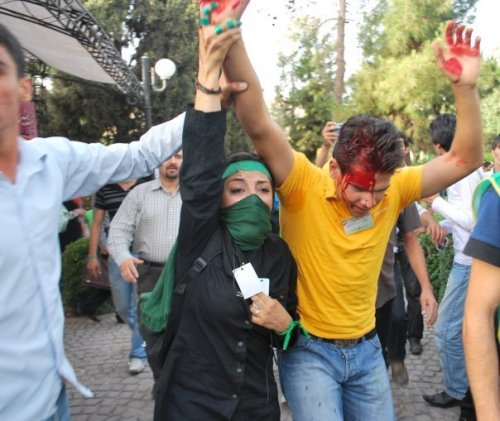
I've been seeing a bit of lefty pushback on Twitter against the overwhelming support for the Iranian "Green" movement. People snarking about whether Americans would be supporting the Iranians if it was Ahmadinejad who had had the election stolen from him, saying they "don't know who the good guys are," etc.
First off, by talking about whether we'd support Ahmadinejad, they miss the point. The regime in power is the only one who has the power to steal the election and then enforce the decision. Maybe the party out of power, the loosely-defined "Reformist" group, could steal a city or two, but they would have no power to send the Revolutionary Guard into an area to consolidate their own power. A revolt in the streets is almost necessarily a revolt against the regime in power. Even after the coup in Venezuela, for instance, the popular rising that put Chavez back in power was against the junta that had already taken control.
The result is a populist revolt in the streets, with thousands and even millions of people pouring out to support their candidate, even though by some accounts it is less about Mousavi than it is about getting rid of Ahmadinejad. Robert Dreyfuss at the Nation notes:
The anti-Ahmadinejad coalition is deep and broad. It includes conservative, Old Guard founders of the Islamic Republic, who view Ahmadinejad with disdain and who resent the coming to power of his coterie of Revolutionary Guard commanders; the large and growing majority of Iranian clerics and senior ayatollahs, many of whom have long viewed the Leader, Ayatatollah Ali Khamenei, as an upstart and usurper since he was elevated to his position 20 years ago; nearly the entirety of Iran's business class, especially those involved in high-tech, aviation, oil and gas, and heavy industry, who blame Ahmadinejad for his catastrophic mismanagement of the economy and for the crippling economic sanctions; the entire class of Iranian reformists, from more liberal-minded clerics like former President Khatami to more centrist ex-officials such as former Prime Minister Mousavi, the presidential candidate; a large contingent of Iranian women, energized by the role of Zahra Rahnavard, Mousavi's wife, who I met in Tehran, who campaigned vigorously for her husband and for women's rights; and of course, the educated elite of Iran, including students, artists, filmmakers, intellectuals, writers, and musicians.
I've been following the story on Twitter all day, as U.S. news outlets are really not covering it at all. People livetweeting from Iran as the country explodes at the election results, information being passed on as it is received and people attempt to verify it in real time...
Nico Pitney at the Huffington Post has been liveblogging and collecting info as it happens, but watching the story come in over Twitter is really exciting--and frightening. We place a certain amount of trust in news that comes to us from mainstream outlets, while here we just assume that people are who they say the are and that they are where they say they are. Or we desperately try to verify, a task that would be much easier if news outlets had nearly the amount of reporters on the ground that they should have.
Video, however, is worth a thousand words.
Live video shot by amateurs and uploaded to YouTube has an even more visceral effect than the glossy photos taken by professionals. It feels real, immediate, frightening, and exhilarating. No doubt the repression is coming, but these people are willing to face it.
This is the eighteenth installment in the 20 part series Rob Farley and I have commenced to review George Herring's From Colony to Superpower: U.S. Foreign Relations since 1776. See the Herring Review tag below for previous entries. Rob's discussion for the week is here.
This week, Herring discusses the Ford and Carter years. Not the greatest period in American history to be sure. Ford had to deal with the problems created by Nixon while Carter's efforts were undermined by the rise of conservatism that led to Reagan's election in 1980.
Ford comes across pretty good here. He started the process of bringing draft evaders home, he continued working toward detente with the Soviets and had a good personal relationship with Brezhnev, he wisely chose to let the South Vietnamese government fall without another U.S. intervention, and he acted decisively in the Mayaguez incident, when the Cambodian government took a U.S. ship and held its crew as hostages.
On the other hand, Ford faced an angry Congress. Conservatives were angry over Vietnam and despised detente. They wanted a tough foreign policy. Ford worried about a primary challenge from Reagan in 1976. The left was upset that Ford didn't do enough on human rights or reducing nuclear arsenals.
Meanwhile, there was Scoop Jackson, the good senator from Boeing. Jackson, a hero to neoconservatives, wanted to ride a wave of anti-Soviet feeling into the White House in 1976. Although a Democrat, he was as hawkish as one could be. He was also a captive of hard-line pro-Israel forces and pushed a pretty racist program for the Middle East. No one in this chapter comes across as more contemptible than Jackson, who would happily oppose a principle he once espoused if it would further his ambitions. Ford faced other challenges from Congress as well. Angry about executive abuses of power after the Gulf of Tonkin Resolution and the secrecy of the Nixon years, Congress looked to reassert itself. Sometimes this was good, such as when Congress stopped Nixon and Kissinger from supporting a covert operation to undermine socialism in Angola. However, the ability of people like Jackson to demagogue foreign policy for their own personal gain certainly shows the downside of Congressional leadership on these issues. Rob also talks about Jackson in great detail.
Oddly, Herring doesn't mention the biggest black mark on the Ford years--East Timor. Ford and Kissinger acquiesced in Indonesia invading the newly freed nation of East Timor and subjecting its residents to terrible horrors. In fact, Indonesia is barely mentioned at all in the book. Given its important strategic location, that it is the largest Muslim country in the world, and its sordid and tangled post-war history with the United States, this is quite surprising.
Carter comes across a bit worse than Ford. To some extent, Herring's criticisms are true--Carter had no foreign policy experience and was very bad at selling tough foreign policy decisions to the American people. On the other hand, Carter also faced some very difficult situations--not only a low opinion of America throughout the world, but the rise of Reagan and conservatism, and the success of the Islamic Revolution in Iran. Carter could have put together a more cohesive foreign policy team to be sure--Cyrus Vance and Zbigniew Brzezinski couldn't stand each other and this led to infighting throughout Carter's term.
Carter did some really good things. Naming Andrew Young as UN ambassador went a long way toward improving US-African relations. Carter continued trying to salvage detente in his early years in office. He rightly gave the Panama Canal back to Panama. His historic negotiations in the Middle East led to Egypt recognizing Israel's right to exist for the first time. He stood up, in the face of conservative opposition in Congress, to the white supremacists ruling Rhodesia and South Africa. He normalized relations with China, building upon Nixon's actions there, to help isolate the Soviet Union.
Looking at Panama, we can see the struggles Carter faced, not in spite of, but because of his accomplishments. The Canal clearly needed to go back to Panama. We stole the land from the nation in 1903 when we hewed it off of Colombia for our purposes. This split the new nation in two, causing consternation and anti-American feeling for decades. By the 1970s, large-scale protests against the United States were taking place in Panama. Controlling the Canal outright was more trouble than it was worth. But for conservatives, it was another example of the U.S. caving to the Third World and Carter was accused of betraying American foreign policy interests. Reagan used this issue as one where he differed from Carter and tapped into much resentment in the country over Panama in his election campaign. The more I read about Carter and America in the late 70s, the more respect I gain for Carter and the more I think he was simply facing a nation sick of anything resembling postwar liberalism. Complaints about Carter's weak leadership and ineffectiveness should properly be interpreted through this framework.
Of course, Carter's great failure was in Iran. Like every president since Eisenhower, Carter supported the Shah. By the mid 70s, it was clear that the Shah's regime was in shambles, but the U.S. didn't know what to do. When the Islamic Revolution succeeded, and especially when dozens of Americans were taken hostage in late 1979, Carter looked weak. Desperate by now to stop the rise of Reagan, Carter eventually decided to look tough. Without even consulting Secretary of State Vance, he ordered an air rescue operation. It completely failed when the planes were spotted, when a sandstorm forced them to turn back, and when a midair collision killed 8 US troops who had to be left behind. Vance resigned on principle. Carter looked weaker than ever and Reagan blew him away in the 1980 elections.
There's a whole lot more to say about these years, including about Afghanistan, Israel's failure to live up to the Camp David agreements, and Carter's relationship with the South American dictatorships, but I'll send it back to Rob for more on that.
Memphis: barbecue, bourbon, blues and 7'2" Iranian.
The Memphis Commercial Appeal (which is the best worst name of a newspaper ever-- take that, Cleveland Plain Dealer) has reported that Hamed Haddadi, the center for Iran's Olympic basketball team in Beijing, has signed with the Memphis Grizzlies. He is the first Iranian player to play in the NBA.
Sports get a lot of attention in this country, and a lot of criticism (much of it deserved and valid, granted); however, something like basketball fans in Tennessee rooting for an Iranian guy is really something only sports can engender. Like it or not, sport is one of the few venues in American culture that can flip people so hard and so fast. Does that mean that just having an Iranian national is going to lessen the broad negative perceptions about Iranians in particular and Middle Eastern people in general? Of course not. Will it help on some level, with some people? Yes.
For me, it comes as a very welcome development; I've been stewing over a recent decision in The Netherlands that bans Iranian nationals from taking courses in nuclear technology. Barring access to education, even if one feels threatened by a particular group having access to certain information, feels wrong to me-- I just can't get behind that.
In any event, the NBA story isn't that big of a deal, but is a small shred of welcome progress related to a topic that is usually just doom and gloom.
Thailand and Cambodia are presently near war over control of an obscure temple on their border. The temple, Preah Vihear, was just named a UNESCO World Heritage Site. Neither nation seems to have cared that much about the site until last week, when UNESCO made this annoucement. But ever since, both nations are ready to fight it out over its control. There are a lot of factors in this weird situation. First, although it really is in Cambodia, it is almost inaccessible from the Cambodian side while Thais can basically drive up to it. So issues of development are central here. Plus, the Thai opposition, which engineered the military coup last summer but which failed to stay in power, is using the situation to embarrass the government. They are playing on militarism and nationalism to press the need for an agressive Thailand that is the dominant power in the region.
But the only way this is possible is to use historical memory for present political advantage. This is something Americans do not understand well, which I will get to in a minute. Southeast Asia has always been an area of shifting political power, with the Thais, Khmers, Laotians, and Vietnamese at various times being the strongest people, and with China always in the background. Right now, Thailand is clearly the strongest nation. Cambodia, though they had their time 700 years ago, has traditionally been pretty weak and certainly is today. But both nations can bring up issues that happened hundreds of years ago to rally support for today. For the Cambodians, the temples remind them of when they were actually important. The Thais have long claimed the area, but the International Court of Justice ruled in favor of the Cambodians in 1962. Ever since then, Thai nationalists have used this issue to rally support. Today, they bring the region to the point of what would be an incredibly absurd war. I don't think it will happen, but the danger is there for shooting to begin, especially given that both sides have pointed weapons at each other. If the present Thai government really begins to fear that the military could take the situation over, I am afraid that they actually could resort to violence as an act of self-preservation.
What is important here is the power that historical memory has for nationalism in today's world. I am seeing the same thing in Bolivia. Today, I saw members of the Bolivian navy (the world's greatest fighting force). Why does Bolivia even have a navy, given it is landlocked? Because they claim they will soon regain the ports they lost to Chile in the 1880s. 125 years ago they lost the few ports they had. Rather then move on, they cling to this as a point of national humilation. Ever since 1978, Bolivia and Chile have not even had formal diplomatic relations, though things have improved with Evo Morales and Michelle Bachelet in power. Frankly, Bolivia has a lot more important things to be worrying about. And I don't think Chile is too scared. But again, it shows the power of historical memory. Events long past can dominate current relations. We have seen this most powerfully perhaps in the former Yugoslavia in the 1990s.
I think this is important for Americans to understand because we essentially don't have a historical memory. Maybe a few people still gripe about the Japanese over what happened at Pearl Harbor, but most young people couldn't care less. This is a good thing, but because we don't have a very good understanding of how our nation's actions affect countries that do have a long historical memory, we don't understand why these nations don't like us. Take Iran for example. If you ask most Americans why Iran seemingly hates us, they don't know. They say it's because they are terrorists or are just crazy or (and this is the worst) because they are Muslim. Yet at the heart of this is the CIA-sponsored coup in 1952 that placed the Shah on the throne, undermined any chance for legitimate political opposition, and turned people toward more radical religion as a way to deal with the regime. Iranians remember this. Americans have never heard of it. For other nations, the past is extremely meaningful. For Americans, it is something boring we have to take at school. Because of this, we suffer from nearsighted vision over our place in the world. The sooner we understand why Thailand, Cambodia, Bolivia, and Iran act in the ways they do, the sooner we can understand our own place in the world and the problems it sometimes causes.
Why? Well, he must be on some kind of first-rate drug. In his analysis of Bush's "Axis of Evil" six years after its announcement, he declares Bush 1 for 3--having succeeded in Iraq!!!!!!!!
Well, I'd hate to see the failures.
Krauthammer is still seething about our inability to invade Iran, claiming "the intelligence bureaucracy, in a spectacularly successful coup, seized control of the policy with a National Intelligence Estimate that very misleadingly trumpeted the claim that Iran had halted its nuclear program."
He also compares George W. Bush to Abraham Lincoln and David Petraeus to Ulysses S. Grant. And he's serious!
The real question here is what do I gain from reading Charles Krauthammer? Nothing of value, for certain. It's a window into the crazy mind of the neoconservative though. And crazy indeed it is.
Iran may be allowing the first western singer to perform in the country since 1979. The singer: Chris De Burgh, singer of "Lady in Red." Why De Burgh? Well, according to this story, bootlegged copies of De Burgh's music were smuggled into Iran during the 1980s. He and his music were seen as somewhat "revolutionary."
Of course, for young Iranians in the 1980s, any western culture had a seriously subversive element to it. But De Burgh? Really? Fascinating how important contact with the outside world is for isolated people, even when the outside world might see those particular contacts as really crappy.
This bit from Peter Galbraith's article on how George W. Bush helped establish Iran as the Middle East's new regional hegemon deserves more attention:
"In May 2003, the Iranian authorities sent a proposal through the Swiss ambassador in Tehran, Tim Guldimann, for negotiations on a package deal in which Iran would freeze its nuclear program in exchange for an end to U.S. hostility. The Iranian paper offered "full transparency for security that there are no Iranian endeavors to develop or possess WMD [and] full cooperation with the IAEA based on Iranian adoption of all relevant instruments." The Iranians also offered support for "the establishment of democratic institutions and a non-religious government" in Iraq; full cooperation against terrorists (including "above all, al-Qaeda"); and an end to material support to Palestinian groups like Hamas. In return, the Iranians asked that their country not be on the terrorism list or designated part of the "axis of evil"; that all sanctions end; that the United States support Iran's claims for reparations for the Iran-Iraq war as part of the overall settlement of the Iraqi debt; that they have access to peaceful nuclear technology; and that the United States pursue anti-Iranian terrorists, including "above all" the MEK. MEK members should, the Iranians said, be repatriated to Iran.
Basking in the glory of "Mission Accomplished" in Iraq, the Bush administration dismissed the Iranian offer and criticized Guldimann for even presenting it. Several years later, the Bush administration's abrupt rejection of the Iranian offer began to look blatantly foolish, and the administration moved to suppress the story. Flynt Leverett, who had handled Iran in 2003 for the National Security Council, tried to write about it in the New York Times and found his Op-Ed crudely censored by the National Security Council, which had to clear it. Guldimann, however, had given the Iranian paper to Rep. Bob Ney, R-Ohio, now remembered both for renaming House cafeteria food and for larceny. (As chairman of the House Administration Committee he renamed French fries "freedom fries" and is now in federal prison for bribery.) I was surprised to learn that Ney had a serious side. He had lived in Iran before the revolution, spoke Farsi, and wanted better relations between the two countries. Trita Parsi, Ney's staffer in 2003, describes in detail the Iranian offer and the Bush administration's high-handed rejection of it in his wonderfully informative account of the triangular relationship among the United States, Iran and Israel, Treacherous Alliance: The Secret Dealings of Israel, Iran, and the United States."
"Parsi said that based on his conversations with the Iranian officials, he believes the failure of the United States to even respond to the offer had an impact on the government...Iranian officials decided that the United States cared not about Iranian policies but about Iranian power.
The incident "strengthened the hands of those in Iran who believe the only way to compel the United States to talk or deal with Iran is not by sending peace offers but by being a nuisance," Parsi said."
People are outraged that Mahmoud Ahmadinejad gave a speech today at Columbia University. I suspect that virtually no one would care if Ahmadinejad hadn't made his horrible remarks about Jews and the Holocaust, but that's another issue. The New York Times is featuring this comment by angry Columbia alum Dr. Stephen Steinlight:
"As a 1970 graduate of Columbia College, Columbia University, I’m profoundly ashamed of the University for extending this invitation to an exemplar of monstrous evil and a practitioner of torture and a supporter of terrorism.”
I am very sad to note that if I didn't know Ahmadinejad wasn't speaking today, I could easily have mistaken this statement as Steinlight objecting to a George W. Bush speech. And the sad thing is that I have every reason to believe that the statement fits Bush to a tee.
On a related note, check out this Philip Roth video. Roth talks about contemporary politics and compares Bush and Ahmadinejad.

Reporting from Iraq, Michael Totten writes about how Muqtada al-Sadr's Jaysh al-Mahdi have infiltrated the Iraqi security services. Totten makes some interesting observations, talks to some Iraqis, but then gives us this:
The Mahdi Army is Iran’s major proxy in Iraq. It is, in effect, the Iraqi branch of Hezbollah.
The Iranians know what they’re doing. Lebanon was their proving ground. The Revolutionary Guards built Hezbollah from scratch along the border with Israel and in the suburbs south of Beirut during the chaos of civil war and Israeli occupation. In Iraq they’re simply repeating the formula, only this time more violently.
Michael Rubin calls Matt Yglesias a liar for, um, linking to this takedown of Michael Rubin's tiresome, transparent warmongering.
The item in question,, in which Rubin essentially condemns as a Khomeinist stooge anyone who doesn't hew to the AEI line, is a classic. I found this bit of autowriting particularly fun:
What should Washington do? It should not engage. Diplomacy absent Iranian sincerity is dangerous. Between 2000 and 2005, the height of Iran's reformist period, European Union trade with Tehran tripled. Rather than reform, the regime invested the hard currency into its ballistic missile and covert nuclear program. Today, Iran uses engagement to spin its centrifuges and run the clock.


