Showing posts with label Brazilian history. Show all posts

Sunday, March 07, 2010

Facial Hair of the Weekend

José Maria da Silva Paranhos Júnior, known as the Baron of Rio Branco, is perhaps Brazil's most famous diplomat (as well as its most famous mustache, one which could easily whip John Bolton's mustache in a fight). The son of the Viscount of Rio Branco, Paranhos was a monarchist who received his title (Barão do Rio Branco, by which he is most commony referred) just days before the end of the Brazilian empire in 1889. Although a monarchist himself, the Barão was the leading diplomat of the new Brazilian republic (1889-1930). In the early-1900s, issues of national territory were still fairly poorly defined in South America, as many countries simply did not have the institutional or financial ability (not to mention the population) required to establish a strong state-presence in its frontier regions. Serving as Minister of Foreign Affairs from 1902-1912 (when he died, leading to Carnaval coming to a halt, a rather remarkable event itself), the Barão settled all of the border disputes involving Brazil.

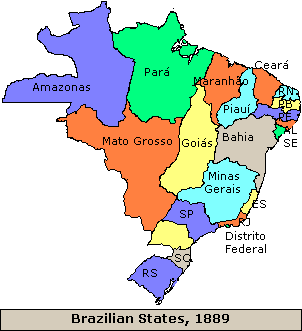
While this seems relatively unremarkable, it is worth keeping in mind that Brazil is larger than the United States without Alaska, and Brazil borders every country in South America except two (Chile and Ecuador). Thus, through the Barão's efforts, the territorial borders not just of Brazil, but of almost all of South America, were defined through the Barão's efforts. As part of these efforts, he signed a treaty with Bolivia in 1903 that gave Brazil the modern Amazonian state of Acre, which had been settled by Brazilians but which Bolivia had tried to lease to American rubber companies. He also obtained the northern state of Amapá in a dispute with France regarding the Guianas, The treaty finalized Brazil's modern boundaries, which remain to this day. Indeed, to understand the effect of Rio Branco's efforts, one only has to compare the map of Brazil in 1889, when the Republic was formed, and a 1990 map; all of those states were a part of Brazil (albeit often in territorial form) by the 1910s.

In addition to these feats, the Barão was involved in negotiating an end to disputes between the United States and various European countries, always believing in the power of diplomacy. Thus, for his role in defining borders and for setting a tradition of excellence in diplomacy that remains in Brazil to this day, the Barão Rio Branco is one of the most famous and respected Brazilian politicians ever.

(And I apologize for the light blogging and dearth of facial hair - dissertation deadlines and some other unfortunate events have really distracted me, but hopefully by next weekend, facial hair and other blogging will be a little more regular on my part. Thanks to Erik for picking up the slack for me).

Saturday, January 30, 2010

Facial Hair of the Weekend


This weekend, we'll be starting a series of Brazilian politicians with facial hair. Above is José Maria da Silva Paranhos (1819-1880), the Viscount of Rio Branco. Paranhos is more frequently referred to as the Visconde do Rio Branco, and is one of the earliest and most important diplomats in Brazilian history. He helped mediate boundary demarcations for Brazil in the mid-1800s, including defining the Uruguay-Brazil border, and many of his efforts finalized the boundaries of Brazil as they remain to this date, with some regional exceptions. He also organized the provisionary government that Brazil established in Paraguay in the wake of the devastating War of the Triple Alliance. Paranhos is also famous for playing a role in the slavery debate in Brazil. Brazil was the last country in the Western Hemisphere to abolish slavery (only in 1888). However, sentiment against slavery increased in the second half of the 1800s, and in 1871, Paranhos established the "free womb" law, which declared that any children born to slave women were automatically free. This was the first in a series of laws that led to the gradual and peaceful abolition of slavery (though complicated racial and social structures remained in place and are visible to this day). He played a major role in infrastructural development in Brazil, including developing railroads, creating taxes on imports in order to spur national development, overseeing the first telegraph line between Brazil and Europe, and launching Brazil's first national census in 1872. While perhaps not Brazil's most important diplomat and politician, he was a major figure in establishing the rich diplomatic history that Brazil has embodied from the 1830s to the 2010s.

Monday, September 07, 2009

Brazilian Independence

In addition to being Labor Day here in the U.S. today, September 7 also marks Brazil's Independence Day. 187 years ago today, Dom Pedro I declared independence, liberating Brazil from Portugal once and for all (although, in good old colonialist fashion, Brazil's independence wasn't recognized for another 3 years).

Throughout the colonial period Portugal had basically allowed Brazil to remain a colonial backwater. For the first 50 years of Portuguese control (1500-1550), Portugal barely gave any attention to Brazil, focusing instead on its spice- and slave-trade exploits in Africa and India, which were the major sources of income for the Portuguese empire. As the French and Dutch threatened Portugal's holdings in Brazil in the mid-16th century, Portugal finally began focusing a bit more heavily on populating and defending its lone holding in the Americas. At first, Portugal Exploited the pau-brasil (a tree with a red trunk used to make dye in the 16th century) for its income; however, as indigenous people died and the trees became scarcer, the Portuguese colony switched to producing sugar, and, later, mining diamonds and gold found in Minas Gerais and São Paulo, relying heavily on African slave labor in both cases. For centuries, the Portuguese Crown's presence in Brazil was limited, particularly compared to the complex hierarchies of power in Spanish America. The Crown mostly manifested itself via extraction of resources for profit and in heavy-handed attempts to control the colony through decrees; for example, Brazil wasn't allowed so much as a printing press under Portuguese rule (though, paradoxically, the colonial state did not have nearly the presence in Brazil that it had in Spanish America). In an effort to make sure that all the profit to be wrought from the Brazilian colony went straight to Portugal, the Crown also forbade trade with any foreign power (especially England) other than Portugal.

However, with Napoleon's invasion of the Iberian Peninsula in 1808, regent João VI (acting as regent for his mother until 1816, when he became king of Portugal), the Portuguese court picked up and relocated to Rio de Janeiro, making Brazil the seat of the Portuguese Empire. It was a remarkable shift for Brazil, during which the printing industry boomed (it would be hard for the Portuguese crown to outlaw printing presses in its own country), education began to flourish, and cultural production blossomed. The Rio de Janeiro merchants, businessmen, and politicians (and much of the Brazilian elites) were thrilled and proud, and not without reason - never before had an Eurpoean monarch visited a colony in the Americas, much less make it his or her home. (And this re-location no doubt is one of the several factors as to why Brazil would gain its independence peacefully, in comparison to the Spanish-American countries).

As we all know, eventually, Napoleon was defeated, returned, was defeated again, and it was OK for the Portuguese court to return to Portugal. Only, a funny thing happened. João VI liked it so much in Brazil, he didn't really want to go back to Portugal. Only in 1821, under threat of de-throning, did he return to Portugal, leaving his son, Dom Pedro I, to serve as regent in Brazil. However, after 13 years of serving as a political center, Brazilian elites and politicians did not want to return to being a colony. Thus, in 1822, Pedro I formally broke with Portugal, creating the Empire of Brazil (it's most likely he did so after being pressured by Brazilians interested in breaking with Portugal, though some biographers insist he did it of his own free will and his love of freedom - either way, the thought of being emperor of Brazil instead of waiting for his dad to die and Pedro's ascension to the Portuguese thrown must have seemed like a pretty nice idea).

And so it went. Brazil remained an empire until 1889, with Pedro I serving as emperor until his abdication (in the wake of political and economic crises) in 1831, and his son, Pedro II, all of five years old at the time, became emperor (with regents ruling for him until 1840). Brazil would abolish slavery in 1888 (the last country in the Western Hemisphere to do so), and would declare the end of the Empire and the beginning of the Republic on 15 November 1889 (another national holiday). But none of it would have happened (except maybe the very-late slavery abolition) without Pedro I's "Grita de Ipiranga" (Cry of Ipiranga), declaring Brazil a sovereign nation on 7 September 1822, a day that will be marked today, as usual, as a federal holiday, with military parades in Brasília, Rio, and elsewhere.

(For those interested in the Portuguese Court's time in Brazil, see Kirsten Schultz's Tropical Versailles: Empire, Monarchy, and the Portuguese Royal Court in Rio de Janeiro, 1808-1821.For some good essays on independence, see A.J.R. Russell-Wood's From Colony to Nation: Essays on the Independence of Brazil.)

(Mildly updated from this.)

Tuesday, September 02, 2008

Did Brazil Have an Urban Civilization Prior to European Colonization?

For the first time ever, the answer would seem to be, "most likely, yes." In an article published in Science this week, a team of archeologists makes the first strong argument for the existence of an indigenous Amazonian urban network prior to European arrival in Brazil.

This really is big news to scholars' understanding of the pre-European history of Brazil, about which we know virtually nothing. While we have learned much about the Nahuas (of which the Aztecs were but one part) and Mayas of Mexico and the Incas of Peru through their large, concentrated civilizations and their writing systems, we know very little of Brazilian indigenous peoples prior to 1500 beyond the fact that they had four basic language groups, they operated in small nomadic groups that would occasionally battle other groups, and we have a slight familiarity with their religious beliefs and worldviews, passed down from when the Portuguese first arrived in Brazil in 1500. However, even our knowledge of these groups is based mostly on coastal indigenous groups, and not those from the Amazonian basin. While scholars have imagined for awhile that there might have been larger, more concentrated indigenous groups within the Amazon, there was little evidence forthcoming on this beyond some archeological finds of ceramics that raised twice as many questions as they answered. So the fact that there is now evidence of an organized urban civilization in the Amazon prior to European arrival is indeed huge news for Brazilian and Latin American history, archeology, and anthropology.

Still, as amazing and fascinating as this new evidence is, and for as many questions as it raises about pre-European history in Brazil, it isn't so revolutionary as to change the general history (vs. archeology) of Brazil compared to the rest of Americas. Scholars often say that one of the reasons (and I strongly stress that it is only one of several) that Portuguese colonization of Brazil was so different from the Spanish colonization of the Americas was the fact that the Spaniards ran into civilizations like the Inca, Nahua, and Maya, the likes of which the Portuguese never had to contend with.This remains the case; for decades and decades, the Portuguese did not bother to really colonize deep into Brazil, preferring to remain on the coast and only going in as the resources demanded (as in the case of Sao Paulo and Minas Gerais, where gold and diamonds were found). While the Spanish Crown set up its basic governmental institutions, such as the viceroyalty and churches, to subject and convert the large concentrations of indigenous peoples to its rule, the Portuguese continued throughout their colonial period to have limited contact with indigenous peoples, both as the latter were affected by disease and as they retreated further inland while the Portuguese established themselves on the coast. In one of the better ironies of Brazil's history, the Portuguese crown was far more hands-off with its Brazilian territory than the Spanish crown was with its colonies, up to the moment in 1808 when the Portuguese crown became the first European royal family to ever visit one of its own colonies when Dom Joao was displaced by the Napoleonic Wars. Thus, the concentrated efforts to force conversion and submission of the indigenous in Brazil was never as strong as it was in Spanish America because the Portuguese simply never had to deal with those large urban civilizaitons directly. (And that's not to say that the Portuguese weren't brutal in their treatment of indigenous peoples like the Spanish; they, too, were an awful group. They just had fewer indigenous people in toto than the Spanish did.)

So is this find going to completely transform and destroy our previous understanding of Brazilian history from 1500 onward? Most likely not. Still, the fact that we are for the first time getting evidence of any type of urban civilizations in the Amazon is major and exciting news (and I am a dork, so it's really exciting).