Showing posts with label Brazil. Show all posts

Wednesday, May 11, 2011

"Pra Ingles Ver": Brazil, Favelas, and the Preparations for the World Cup

A spate of stories on Rio de Janeiro has recently emerged, focusing on the preparation for the 2014 World Cup and 2016 Olympics, focusing on the forced removal of people from favelas (shanty towns). The media has focused on Rio de Janeiro, historically the city most closely tied to favelas in the public imagination. The reports started in late-April, as The Guardian reported on the removal of favelas to prepare infrastructure (car parks, roads, etc.) for the tourists who will visit Rio in 2014 and 2016. More recently, Reuters has published a similar report, and even ESPN had the story as its main feature yesterday afternoon.
The story is fairly simple: favelas historically have sprung up on the hillsides and marginalized areas of Rio de Janeiro, often within eyeshot of some of Rio's wealthiest neighborhoods. As the city prepares for the massive tourist influx of the 2014 World Cup (where the final will be held) and the 2016 Olympics, it has begun to work on infrastructural improvements that center around tourism and "modernization" at the expense of the poor. As a result, favela residents are forced out of their homes and their homes are torn down so that streets can be widened, subway stations can be built, car parks can be constructed, etc. The city of Rio, in charge of these efforts, has promised the residents that new homes will be constructed for them elsewhere, but thus far, there is little evidence the city will actually follow through with these promises, prompting both Amnesty International and the United Nations to express concerns that the government of Rio (and other cities) is violating the basic rights of the Brazilian poor.
This criticism is more than valid and fair. It's not just that the poor are being marginalized, "removed" from places where they might serve as an uncomfortable reminder to the rest of the world of the terrible inequalities in income in Brazil. As the ESPN article points out, the poor are also being discursively rendered invisible:
This is Rio in the imagination of the 2016 Olympic planners: a 19-page brochure full of coloro photographs and grand statements outlining their bid. The opening spread shows children dancing on a beach beneath an enormous Brazilian flag, and, above a photo of wind surfers riding waves with a backdrop of Christ the Redeemer. The pages proclaim a new birth. "It is driven by sport, with athletes and the entire sports community looking forward to the lasting benefits the games will bring."
The brochure promises to change the economy, to educate children and even to protect the world's largest "urban forest." The obligatory quote from Pele is included. The document is full of maps and photos and plans, but there's no mention of the war on the hill that overlooks Maracana Stadium, where the opening ceremonies will be held.
The word "favela" never appears.
Of course, the promoters of the projects deny that this is about class or the effort to marginalize the poor. The Reuters article cites a city official in Rio:
"The city is absolutely not trying to gentrify and push the poor away," said Jorge Bittar, Rio's housing secretary and a member of Rousseff's leftist Workers Party*. "These new routes are meeting a demand that's been there for decades in Rio...the people who will use the buses are the poor, not the rich."
[*This association between Bittar and Rousseff is more than problematic itself. City governments and the federal government have to collaborate, but they are also nearly completely independent of one another as outlined in Brazil's constitution. There is a good amount of political science scholarship out there that shows how the PT [the Workers Party] at the local level operates independently of the national party, and often has different approaches, policies, and even ideologies. What unites the two is a general concern for social programs and a more even distribution of wealth in Brazil; obviously, though, how that takes place in policy at the national level and the local level can be and is very different. For that reason, directly associating Bittar to Rousseff is problematic, because it makes ties between the president and local officials that simply don't exist. A comparative example would be to tie Obama directly to something that a Democratic official in the New York City government said. - CS]
Bittar's comment is problematic in and of itself: the fact that the subways and cars are costly enough that they are for the "rich;" the fact that subway lines don't even go to many the many areas of Rio that are poor/marginalized; the fact that the government failed to provide this infrastructure "for decades" and that it took the international events of the Olympics and World Cup to finally address the needs of the poor. Yet it also cuts at the heart of the issue: while the government of Rio feels it is adequately addressing the needs of the poor even as it prepares for a massive influx of tourists (even more than usual), it is also pretty clear that the rights of many of Brazil's poor are not only being ignored; the government is directly violating these rights and needs.
Certainly, this is depressing news, and it is good that the media is highlighting this story. It serves as yet another reminder that the outsiders' view of Brazil as a beach-haven of glamor and beauty has a very high cost. Yet the media reports this story as if it is a recent development, when in reality that could not be further from the truth.
The entire history of the favelas, from their creation in the late-1800s and early-1900s to the present, hinges on the forced removal, relocation, and marginalization of Rio's poor. Indeed, the original creation of the favelas took place in the early-1900s as the city of Rio "renovated" what is now down-town Rio de Janeiro by tearing down the Castelo mountain in order to build better roads and forcing many poor residents to the margins of the city. In the late-1910s, Brazil prepared for the visit of members of the Belgian royal family, Rio once again underwent a "beautification" project designed to show Europeans that Brazil was "civilized;" once again the poor were relocated, creating a ring of favelas around the newly-elite downtown areas. As the rates of urbanization rapidly increased in the twentieth century (in 1930, 70 percent of Brazil's population lived in rural areas, and only 30% in urban centers; by 1980, those numbers were reversed), favelas expanded along the margins of the city, not just in Rio but in places like Sao Paulo, Bahia, and elsewhere. Throughout the twentieth-century and into the twenty-first, the story of favelas has been one of creation, development, and relocation in the face of ongoing "modernization" efforts for the wealthier parts of Brazilian cities.
To be clear, this is not intended to defend the current forced removal of favela residents as just another phase in history. What they are going through is depressing not just for the process, but for its familiarity, as once again, Brazil's poor are forced aside "pra ingles ver" ("for the English to see," an old phrase that goes back over a century and captures the preoccupation to appear "civilized"/"modern"/"developed" to other countries). As Brazil prepares for the World Cup and the Olympics, the government of Rio is violating basic human rights. Saddest of all, however, is the fact that the story of what is happening in no way surprising or new.

Sunday, April 17, 2011

Around Latin America

-Uruguay has successfully overturned the amnesty law that pardoned military torturers and assassains during the military regime of 1973-1985, making prosecution of military officials possible. The congressional overturn was made possible in 2009, when Uruguay's Supreme Court declared the "Expiry Law" unconstitutional.
-In another case of military regime leaders finally paying for their blatant human rights violations, Erwin C. has a good write-up of the case of Reynaldo Bignone, the last president of the military regime of 1976-1983, which oversaw the murder of at least 30,000 of its own citizens during the so-called "Dirty War." Bignone had originally gone to trial early last year, and was convicted and given a life sentence for his role in the military regime.
-It is not just military leaders who are increasingly facing pressure for their ties to human rights violations. A Rio de Janeiro politician has been arrested under suspicion of leading a paramilitary group responsible for murdering citizens in Brazil's second-largest city.
-Chiquita is also under scrutiny for its ties to paramilitary groups. New court documents reveal that the banana producer voluntarily paid Colombian paramilitary and guerrilla groups for "protection," suggesting the company's claims that they were "extorted" are hollow. Families in both Colombia and Panama already sued Chiquita for its involvement in violence in the two countries, and these court documents seem to suggest that Chiquita's economic contribution to violent movements was more voluntary than the company had suggested.
-The Brazilian government continues to try to move forward with the Belo Monte dam. The dam, which would be the world's third largest if it were to go through (behind China's Three Gorges dam and Brazil's/Paraguay's Itaipu dam), would also flood hundreds of square miles of Amazonian forest and displace indigenous peoples. However, in spite of the government's determination, a broad coalition of forces is forming (including high-profile supporters like James Cameron) to oppose the dam's construction, and human rights groups have now gotten involved, making the dam's completion far from a certainty still, in spite of recent governmental victories in the court system.
-The Belo Monte dam isn't the only environmental concern in Brazil, as a new report suggests that farming to fuel the meat industry is causing catastrophic damage to Brazil's cerrado, or savannah.
-As today marks the 50th anniversary of the Bay of Pigs invasion and Raul Castro's recent proposals of limited reforms in Cuba, Boz has an interesting piece up regarding the bureaucracy of authoritarian regimes. The nuance he suggests between top-most positions (in this case the Castros) and the bureaucracy beneath them is an important and oft-overlooked component of military goverments, especially those in places like Chile or Egypt, where dictatorial rule is associated with a particular name/face (Pinochet, Mubarak, etc.). Although his post is just a brief reminder of the complexities of rule, rather than an intense analysis of how such relations between technocrats and autocrats work, it's always worth keeping in mind when discussing modern military regimes, be it in Latin America or elsewhere.
-Finally, there is an article up on the progress of scientific research and study in Brazil that is fascinating for many reasons. The growth of scientific R&D in Brazil is yet another indicator that Brazil's ascension in the international arena most likely is not fleeting.

Monday, March 21, 2011

Obama, Brazil, and the Arab World

Between the involvement of European and American air forces in Libya and the ongoing news coming out of Japan this weekend, Obama's trip to Brazil was a distant third in news coverage this weekend. Yet the trip is important for a number of reasons, not least of which is that Brazil seems to be heading in the opposite direction of the U.S. in terms of international political and economic prestige. Additionally, two years into his administration, this is Obama's first trip to Brazil, and it comes on the heels of the January inauguration of Dilma Rousseff, whose election may give Lula's Workers Party (PT) the legs to remain powerful in a post-Lula context.

Although the world events made Obama's trip tertiary in the news cycle this weekend, the president wasn't in a tropical bubble in Rio de Janeiro. In a speech yesterday, he used the recent unrest in Egypt, Libya, Tunisia, Bahrain, Yemen, and elsewhere to suggest that Brazil is a model for democracy to the Middle East and the rest of the world. In the speech (transcript here), he praised Brazil's successful transition from a military dictatorship in the 1960s-80s to a thriving democracy today. In tying Brazil to the events in the Middle East, he specifically highlighted the role protestors and street movements had played in bringing down the Brazilian dictatorship. And he was right - to a degree. As Obama himself commented:
Decades ago, it was directly outside of this theater, in Cinelandia Square, where the call for change was heard in Brazil. Students and artists and political leaders of all stripes would gather with banners that said, “Down with the dictatorship. The people in power.” Their democratic aspirations would not be fulfilled until years later, but one of the young Brazilians in that generation’s movement would go on to forever change the history of this country.
It's understandable what Obama is doing here. With the wave of popular protests against autocratic and dictatorial governments in the Arab world and Iran, Obama used the trip to Brazil to highlight how important popular movements can be in effecting political change, and in the case of Brazil, he's generally right.
When he refers to students and artists and political leaders gathering in Cinelandia square, he's referring to one of two moments: 1968, or 1984. I believe it's the first, when over 100,000 people in Rio marched against the dictatorship. The student movement was at the forefront of the rally, but artists like Chico Buarque, Caetano Veloso, Gilberto Gil joined students, parents, white-collar professionals, and others to protest the increasing brutality of the military government of the 1960s. Rio's "March of 100,000" was but one of many rallies throughout the country that year, yet it did not mark the beginning of a new era of democracy. The other reason I suspect he's referring to 1968 over 1984 is the fact that he then comments that the return to democracy was "not fulfilled until years later." Brazil's military officially stepped down in 1985. More importantly, the 1984 rallies (which reached one million people in both Rio and Sao Paulo) focused on direct elections for president in 1985, rather than an end to the dictatorship itself.
But, as cheerful and encouraging a model as Brazil may be for the Middle East, it may not be the right model. The reason is simple: there is a lot going on in that "not fulfilled until years later." While the marches in Rio and elsewhere in 1968 were unprecedented in Brazilian history (until the marches of 1984, at least), by the end of 1968, the military regime ushered in its most repressive phase, witnessing increased use of torture, political assassinations, and "disappearances." Though nowhere on the level of Chile or Argentina in terms of murders, hundreds died at the hands of the state, and the military tortured thousands more. Many of the student leaders and those who opposed the regime went into underground guerrilla movements; many more went into exile. Throughout the 1970s, students had to find new ways to challenge military politics in the face of increasing repression and the military governments' efforts to deny students any political voice or activity. While students (and, by the late 1970s and early 1980s, workers, white-collar professionals, and opposition politicians) increasingly mobilized against the military dictatorship, the military played no small role in its own departure. After the "hard-liner" rule of presidents Artur Costa e Silva (1967-1969) and Emiliio Garrastazu Medici (1969-1974), "moderate" Ernesto Geisel began the process of "reopening." He was determined that the military would step out of power, but it would do so on its own schedule and through its own processes. In this way, the top-down control of the return to democracy was important in ways that do not apply to the Arab World. Hosni Mubarak had not determined that he would leave once he thought ideological differences had been overcome; Gaddafi isn't planning on staying in power until Libya's economy is corrected; Bahrain's King al Khalifa isn't going to step down when he decides that politics is ruining the military institutions. This is not to say popular voices in Brazil were not important to the transition to democracy; they were vital. But the role they played in 1984 was much different than the moment Obama referred to in 1968. By 1984, millions gathered to make clear they wanted direct elections for president, rather than an electoral college that did not answer to popular vote. Ultimately, the movement was both a failure and a success. While Brazilians did not vote directly in the 1985 election (direct elections for president were only held in 1989). Yet their support in these rallies for opposition candidate Tancredo Neves made clear to Brazilian senators who were popularly elected that they had better select Neves in the electoral college instead of pro-dictatorship party candidate Paulo Maluf, a civilian who represented the economic and social policies of the military regime. But in the case of Brazil, military leaders, particularly Geisel and Figueiredo, played a not-insignificant role in the transition to democracy.
It's not that Obama got his history wrong; indeed, the entire speech shows a familiarity with history and culture of another country that is remarkable, and even if it was a crash course, Obama displayed a breadth of familiarity with another country's past and present rarely seen in recent presidents. The people of Brazil did play a major role in the transition to democracy throughout the military regime, and clearly, democracy after 1985 could not have flourished without popular participation and involvement. It's simply that that "years later" part carries a lot of lessons that do not necessarily apply to the Middle East. Brazil's success has been remarkable, especially in the last 10 years, and that's due in no small part to the way democracy has functioned in Brazil. But I think that's where there are lessons to be learned from Brazil. Brazil isn't necessarily a model because of its transition to democracy itself, which does not resemble conditions in the Arab world. Rather, I think Brazil could be a model (and a very general one at that) of how societies can function and succeed in a post-dictatorial democratic system where people have a greater role in determining their country's path.

Tuesday, March 08, 2011

Carnival in Rio (II) - The Second Night's Festivities in the Sambadrome

Porto da Pedra, Grande Rio, Mocidade, Salgueiro, Beija-Flor, and Uniao da Ilha, which overcame the fire from last month to win the Gold Standard prize for its theme "The Mystery of Life," about Charles Darwin and evolution. The images are spectacular as usual, and the songs this year were pretty strong as well (each school has its own song that it writes and performs during their 90-minute parades). For those interested in the music, here are the links for each school's samba, composed just for this year's Carnival (just scroll down a bit and click the little "play" icon in the center of the screen):


Monday, March 07, 2011

Carnival in Rio (I) - The First Night's Festivities in the Sambadrome

Last night was the first of the major two-night spectacle of Carnival in Rio (although people have been marching in blocos, or informal parades, all weekend), and as usual, here's a great collection of photos for each of the schools that marched last night. The first round included the samba schools of Sao Clemente, Imperatriz Leopoldinense, Portela, Unidos da Tijuca, Vila Isabel, and Mangueira. Portela was one of the schools most affected last month by the fire in the warehouse storing Carnival floats and costumes, and it showed in their parade. That said, they did an excellent job recovering enough to march, and it's good that they can't face punishment in the "rebaixamento," or dropping to the second level, this year.

Wednesday, February 09, 2011

Racism Among European Soccer Fans? No!

I'd like to say this story about the racism Brazilian Dani Alves faces from his own team's supporters surprises me, but it's probably the least surprising thing I'll read all week. Many countries in Europe have been known for lobbing racist chants (and more serious acts of violence) towards players from Africa, South America, and the U.S. for years, so it's not exactly like racism in football/soccer is anything new. That said, it seems that it's not exactly going away, either, in spite of football associations' efforts to punish teams whose fans use racial epithets.

Monday, February 07, 2011

Fire in Rio - Carnaval Threatened?

This morning, a massive fire tore through the public building in the heart of Rio de Janeiro where Rio's samba schools keep their costumes, floats, and displays in the month leading up to Carnaval. As the photos here indicate, this was no small fire. The damage has been catastrophic for at least four of the samba schools; Portela, one of the oldest and best samba schools, lost over 2,800 costumes, floats, and props, while Grande Rio lost over 4,000 (at a cost of $10 million reais, or roughly 6 million U.S. dollars).

The cost should indicate just how ornate, elaborate, and important Carnaval is to Rio and to the communities that compete in the event. Worse, just as in football (the global version, not the American one), the poorest-ranked schools drop to the "second division," while the second divisions winners rise up to the main event. With four schools already eliminated by the sheer lack of materials to compete, Carnaval in Rio is suddenly facing major questions. Liesa, the organization that runs Rio's Carnaval, is meeting tonight; the mayor has already proposed not having the "eliminations" this year, since the four schools that would naturally dropped cannot be blamed for the building catching on fire. Initial suggestions that Carnaval be cancelled seem to have died down, and cancelling is a terrible idea; Carnaval is one of Rio's biggest events, and it brings in millions of dollars not only from corporate sponsors, but from tourism and more quotidian sources of income (like beers purchased). And the schools are keeping a strong and unified front in the face of this tragedy; the other samba schools that were not affected by the fire have offered to help those that were, and Grande Rio, which lost 90% of its props and costumes, said it will still march in Carnaval, even without the costumes or floats; after all, at the end of the day, the samba school is its members and community, not its flashy appearance.
Interestingly (and potentially even more tragically), somebody else may be responsible. When I spoke to a Brazilian this morning who had not heard the news, she immediately responded, "this was a criminal act," implying that a supporter (or member?) of another competing school had set the fire to remove the competition. While I certainly hope that was not the case, it makes sense - after soccer teams, the samba school you support is one of your most important identities in Rio.
Some (including myself) have been critical of how "commercial" Carnaval in Rio has become, but at the end of the day, it is still one of the most impressive and organic cultural expressions in Brazil, and it is egalitarian (and even reversing of traditional class- and race-based hierarchies) in ways that few other events in Brazil are. Hopefully, the schools that suffered losses can regroup, and nobody is punished for this fire (unless it was arson; in that case, may the arsonist be punished). As it is, this will be one of the more somber Carnavals in some years, as Brazil and the world are denied the cultural expressions and beauty of four different schools' participation.

Thursday, December 02, 2010

Brazilian Drug Lords ♥ Justin Bieber


Huh.


Police who fought their way into a Rio slum to raid the luxury triplex of a Brazilian drug lord found themselves staring at a huge homemade mural of Justin Bieber on one wall.
And on another wall, amidst the Jacuzzis and flat-screen TVs, was a three-foot psychedelic scrawl of Bieber’s name.
The mural had two holes knocked into it during the raid, which found six tonnes of drugs and a huge cache of weapons. Drug lord Pezao, known as Bigfoot, hid his loot in the walls. Who would think to look behind Bieber?
A kind of Modigliani rendition of the Stratford-born superstar, it reads: Justin Bieber. One Time.

Sunday, September 26, 2010

Caetano Veloso

Even putting aside the politics, his basic misunderstanding of what constitutes a "coup" and how elections function reveal one thing: he's still a hack.

Wednesday, August 04, 2010

Today in Specious Arguments: Lula's Absence at the G20 Destroyed Brazil's Economic Power!

Although editorials like this are all too common and don't surprise, their absurdity never ceases to amaze me. I always marvel at how far some will stretch in order to attack Lula, even when all other evidence suggests their arguments are wrong. Are there good reasons to criticize Lula? Absolutely. It's completely fair to say that his environmental record is at best "not good." Although I wouldn't fully agree, you could also suggest that he did not go far enough with his social programs, and that he compromised too many of his ideals to become president.

But to go after Lula because he skipped June's G-20 to deal with domestic disaster is facile and ridiculous. First, there is the fact that there is very little concrete evidence to suggest that Lula's absence has doomed Brazil. The author provides a lot of conjecture, but no actual evidence of damage. Could Lula's absence possibly be a problem down the line? Theoretically, I suppose so; but the idea that missing deals that could have taken place at one meeting across two days in June will reduce Brazil's economy and political presence globally is not only ridiculous; it's insulting to the expert diplomats Brazil has throughout the world to suggest that their efforts are undone just because a president missed a meeting due to issues at home. And there is absolutely no reason, politically, economically, or historically, to believe that the window that was open for opportunity for economic deals on June 26-27 will magically be closed on October 22-23, when the G20 meets again. Arguing that Lula's absence has caused irreparable damage to Brazil's standing in the global economy and politics is not just specious; it's patently absurd.
And on those issues at home...it's not like Lula dodged the meeting to vacation, or get some fake honorary title or something. There were horrible floods in Brazil; dozens were killed, and thousands more displaced. And this was almost simultaneous with the G-20 meeting. It's not like Lula waited to respond until it was too late. What is more, I just don't buy the "he skipped the G-20 for a few more votes at home argument," for several reasons. First, being president isn't the same as being head of the national bank; Lula has other duties besides economic deal-making. Taking care of his constituents is arguably at the top of the list of presidential duties. Surveying the damage and trying to help alleviate Brazilians' suffering through executive decision-making is probably more important than economic deals that can come later. I imagine most presidents or prime ministers would agree that domestic disasters take precedence over international meetings; you are elected by and serve your country's civilians, not the leaders and deal-makers of other countries.
Finally, this idea that Lula skipped the meetings for "a few more votes at home" is absurd. A) He's not running for re-election. Sure, you could suggest he did it to garner support for the PT's candidate, Dilma Rousseff; certainly, he's been very present in drumming up support for her. But the flooding happened in Brazil's Northeast, an area where Lula got 66% of the vote in 2006 (nearly propelling him to a first-round victory), an area where the PT has traditionally done very well. It's not like this was some opportunity to try to shore up support where Lula and the PT had traditionally lacked it, and to suggest as much is to effectively ignore both regional politics and the social conditions in the Northeast.
In short, this is one of the worst types of editorializing, relying not only on doom-and-gloom predictions based on hypotheses with no grounding in historical realities and gross simplifications of complex negotiations, but also turning to conjecture that ignores social realities and political practicality (who is the president supposed to serve?) in order to launch yet another smear campaign.

Monday, August 02, 2010

On Brazil's Presidential Campaign

I've been terribly remiss at dealing with this topic, in no small part because, while Brazil prepares to head to the polls again, I continue to try to finish a dissertation. However, with the campaign having really picked up steam once Brazil exited the World Cup, now seems as good a time as any to dive into the debates and discussions on the impending election.


Shortly after Dilma Rousseff's nomination, the PSDB, the main political party of the right, once again launched Jose Serra as its presidential candidate, later selecting relatively young Indio da Costa, of the far-right Democratas (Democrats) party as its vice-presidential candidate. Serra had been the candidate against Lula in 2002, when the PT and Lula finally won the election on their fourth try (having lost in 1989, 1994, 1998). Although Serra was seen in retrospect as relatively progressive for the PSDB (especially after the PSDB nominated extreme conservative Geraldo Alckmin in 2006), the 2002 loss apparently has still left him embittered, while the PSDB has continued to futilely and baselessly rail and rant against Lula, taking any chance they can to smear him. Indeed, in an effort to denigrate the PT, da Costa even baselessly claimed that the PT is connected to the FARC and narco-traficantes, in a moment that resembled Sarah Palin suggesting Obama "palled around with terrorists." It is clear that the PSDB and Serra do not want the PT's presence in Brasilia to continue, and while their efforts to do anything to prevent that from happening are fairly disgusting, it's also understandable, for two reasons: first, Lula has seemed to invoke an almost irrational hatred among many in the PSDB and its supporters (especially Rio's middle class); this is often based on classism as well as political jealousy and (to a lesser extent) ideology. Secondly, the PT was and is Lula's party, and the PSDB is Fernando Henrique Cardoso's party. Many have questioned whether the PT could survive beyond a Lula presidency, or whether it would disappear the way the National Reconstruction Party disappeared when Fernando Collor had to resign amidst allegations of extreme corruption. If Dilma wins, it will do much for the PT's ability to remain a strong and vibrant party beyond Lula. With Rousseff having taken the lead in polls after a statistical tie for much of the campaign, these tactics are likely to continue.

What would a Rousseff presidency look like vs. a Serra presidency, though? Many intelligent and respected scholars say there won't be much difference [sorry for the rough translation - Google's Portuguese-English translator isn't the best], and that a PT and PSDB presidency at this point would really vary only in shade, rather than in real policy. They point to what they perceive to be Lula's "continuist" policies following Fernando Henrique in terms of views on the market. This M.O. of Lula as "continuist" has been the main narrative since about 2004, and it clearly hasn't shifted as historians, political scientists, and others consider this year's elections.

However, I think this has always been a bit of a misnomer. If your idea of "continuist" is "a not-sudden and extreme ideological shift," a la from socialism to neoliberalism or from a dictatorship to a parliamentary democracy, then yes, Lula has been continuist, and either Dilma or Serra would be similar. However, this strikes me as a rather facile and useless way to view the two main presidential parties in Brazil right now. There were subtle but important differences between Lula and Cardoso. For example:

-The PSDB under FHC pushed privatization to extremes, trying to privatize everything (and succeeding with just about everything except Brazil's public university system and Petrobras; on both, the Brazilian people drew the line, and FHC had to step back a bit). While some say this did improve services, it also raised prices (when a French company bought out Brazil's public phone system, for example, phone prices in Brazil immediately went up 30%, even as they dropped 30% in France); what is more, as Lula demonstrated, investing in state-run companies and improving efficiency are not mutually exclusive terms, and when both are executed, can make an even stronger company than privatization could, all while offering greater benefits to your own citizens.

-In addition to adhering strongly to neoliberalism, FHC kept his economic relations connected almost strictly to the European Union and the United States, meaning Brazil's economy was by and large dependent on the fluxes of the American and European markets (no small irony, given that, in the 1970s, FHC was a leading theorist in dependency theory). While Lula did not shed the mercantilist policies of his predecessor, he did extend them to all of the world. Trade with Africa; deals with Arab countries in the Middle East; agreements with China; partnerships with India; collaborations with the United States - all were fair game, and Lula fostered these agreements in all parts of the world. This was beneficial both economically and politically; on the economic front, it diversified Brazil's trade, making it less susceptible to one country's or region's economic decline and strengthening its own economy (indeed, it was one of the last countries to enter the 2008 global recession, entering into recession in June 2009 and emerging from it just one quarter later.) Politically, Brazil was able to strengthen its role as a global player, working with everybody but dependent on nobody. Thus, Brazil enjoyed a level of both political and economic autonomy it had never witnessed before. The old joke used to be "Brazil - the country of tomorrow, forever." Yet Lula seems to have guided it very close to being the country of tomorrow today.

-Thirdly, there has been Lula's emphasis on state programs. A sort of flip-side to neoliberalism, Lula proposed a greater state presence and higher government spending on programs like Zero Hunger and the Bolsa Familia, which provided money to poor families for food or for their children to attend school longer. These programs have by all accounts been massively successful, and thanks in no small part to them, more people are joining Brazil's middle class than had ever taken place before. These policies ran directly counter to FHC's emphasis on "trickle-down" economics, something that Serra also emphasizes. While there are still enormous gaps between the wealthiest and the poorest in Brazil, the middle seems to be growing, and has done so through increased state spending (something the U.S. could learn from), and not from privatization and hopes for a trickle-down effect.
This is why describing Lula as "continuist" is not wholly accurate. Sure, he didn't radically alter the political or economic system, but there are major and important differences between Lula/PT and FHC/PSDB, and these differences I think in large part explain why Brazil has become such a major player in the global community in the 2000s, and not in the 1990s. And these differences continue between Rousseff on the one hand and Serra on the other. The election of either will not be the same thing (in much the same way that Bush and Gore were not the same thing in 2000); the election will determine whether Brazil continues down the path that garnered so much success in the first decade of the 2000s, or if it returns to the path of the 1990s that continued to perpetuate social and economic inequalities and sent the country spiralling into debt in the 1990s and inflation and recession after 1998 (when the exchange rate of the real to the dollar doubled overnight, immediately after FHC's re-election).

We are already getting good examples of these differences in Rousseff's pledges to continue those social programs, even while Serra denigrates of Mercosur and Brazil's relationship with Paraguay (fostered under Lula), while expressing his desire to return to policies focusing on neoliberalism and partnerships with the EU and the US. That type of policy is pure PSDB, and I think explains in no small part why Brazil did not take off under FHC but did under Lula. Lula did indeed continue to focus on market policies, but he did so with everybody, rather than just the EU and US; in doing so, he was able to expand Brazil's market even while retaining autonomy, rather than becoming dependent on one or two major economies. That success explains in no small part some of that hatred for Lula among the PSDB and its supporters - he succeeded where they failed, and did so by pointing out the weaknesses in their own policies. That these university-educated politicians were schooled by a laborer who never went to college particularly stung.

For these reasons, to suggest that Brazil will be the same whether Rousseff or Serra wins overlooks some very important distinctions. Yes, an overall mercantilist worldview will continue, but the differences between Serra and Rousseff are not just the differences between believing in privatization vs. a strong state with social programs for the poorer sectors, or partnerships with the U.S. vs. partnerships with the whole world. They are the differences between Brazil in the 1990s and Brazil in the 2000s; ask any Brazilian, and those differences are enormous and almost uniformly better in the 2000s. And that is why this year's election is so important and worth watching.

Tuesday, June 29, 2010

Things That I Should Probably Read That I Dread Reading

This.


I'm going to try to give it a fair shake when it comes out, but I'm already curious about how Rohter, who made much of his career in Brazil by unashamedly and partisanly bashing Lula (including calling him a "drunk" with no evidence whatsover) is going to provide a narrative that praises the growth under Lula's watch (I'm going to guess he goes with the "it happened in spite of Lula" meme, though I'm willing to be proven wrong). Additionally, the publisher's description of the book may be inaccurate, but it sure sounds like Rohter's still up to his shallow analysis and borderline-stereotyping, based on that description (though hopefully it was a publisher's decision).

Monday, April 26, 2010

Around Latin America

-Many are aware that Colombia has been in a civil war for 40+ years, but the ongoing process of electoral processes sometimes obscures just how violent Colombia still is. In the last 8 years (2002-2010), 20,915 people in Colombia have died as a direct result of its ongoing war. Stop and think about that: 20,915 people. That's nearly 18,000 more than those the Pinochet regime killed in 17 years; that's 10,000 more than the number of people killed in Brazil's favelas in twelve years. That's a depressing but important reminder that the war in Colombia is ongoing, it is real, and is still extremely violent.
-In Uruguay, former foreign minister Juan Carlos Blanco (who served during Uruguay's dictatorship in the 1970s and 1980s) was sentenced to twenty years in prison for his role in the disappearance of a Venezuelan teacher in 1976, marking yet another victory against dictatorship-era officials in Uruguay.

-In neighboring Paraguay, the government has imposed a 30-day state of emergency to combat an armed leftist group operating out of the country's north. The group, Ejército del Pueblo Paraguayo, has launched attacks on government buildings and police stations, and a recent attack left four people dead. Among other things, the 30-day state of emergency will allow the Paraguayan government todetain suspects and ban public meetings in the five provinces affected.
-Paraguay is not alone in facing a governmental crisis. In Nicaragua, a showdown between the judiciary and Daniel Ortega is intensifying, after two judges refused to resign in the face of Daniel Ortega's questionable use of an allegedly-expired law, leading to an increasingly uncertain situation in Nicaragua. As Greg points out, it's not a question of leftism; many view Ortega's move as an increasing tendency towards dictatorship, with one critic going so far as to declare that Nicaragua had gone "From Somocismo without Somoza to Somocismo with Ortega."
-Honduras has established a truth commission to look into the coup of last June. However, the commission is already off to a rocky start, with criticisms coming from all sides (including the suggestion of an "alternative truth commission" from non-pro-government individuals). Among the more problematic aspects of the commission: a leading member of the commission's formation declared the report would be archived for 10 years upon completion, meaning nobody would see the commission's findings for ten years. As the good folks over at Honduras Culture and Politics put it, this is effectively an effort to "hide the truth for ten years."
-Evo Morales has offended Brazilian farmers after the Bolivian president declared that eating chicken reduced masculinity and could lead to homosexuality. The claims are silly but fairly unimportant in terms of evaluating Morales's political agenda (though it does say something about societal views of homosexuality and homophobia in Bolivia). Still, given how much agriculture Brazil produces and supplies to the rest of Latin America, including Bolivia, I wouldn't really want to actively alienate any major food producer in Brazil.
-Finally, in doubly-depressing daily news out of Brazil: a 24-year-old housewife was lynched in Rio de Janeiro state yesterday after she ran over a pregnant woman while driving drunk. While the pregnant woman survived, the baby was lost, and in anger, a crowd gathered and shot the housewife. Certainly, drunk driving is not acceptable, but the crowd's response is far more unacceptable.

Wednesday, April 21, 2010

Happy 50th Birthday, Brasilia

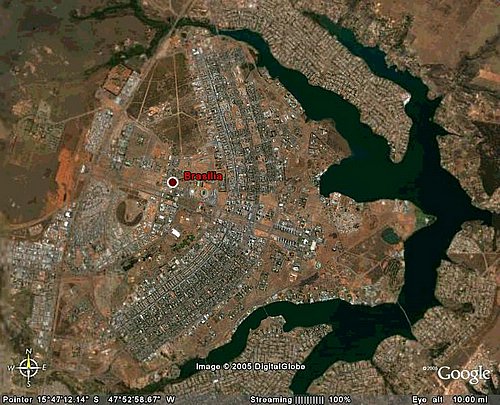
Today marks the fiftieth birthday of Brasilia, the high-modernist capital of Brazil that was built out of nothing in the plains of Brazil across 41 months in the late-1950s before its inauguration on April 21, 1960.

There's a lot to say here. The history of Brasilia itself is unique. the myth of the city goes back to a Catholic official who had a vision of a great city in Brazil's interior (and the largest cathedral in the city, Catedral Dom Bosco, is named after him). A plan early in the 1820s during Pedro I's empire suggested relocating the capital to the interior of Brazil someday, though it was never enacted. Brazil's constitution had declared for years that eventually the capital would relocate from Rio (which had been the capital from 1763 until 1960). As story goes, while campaigning for president in 1954, Juscelino Kubitschek met a boy who asked when he was going to fulfill the constitution and relocate the capital to the interior. True or not, Kubitschek made Brasilia his primary goal during his administration. The city would simultaneously fulfill a part of the constitution, yes, but more importantly to Kubitschek, it would symbolize the developmental push his administration would oversee ("50 years in 5"), serving as a physical proof to the world that Brazil was truly modern. Planning by Lucio Costa and architecture by (still-alive) Oscar Niemeyer only reinforced this image.
Of course, the city itself is a little more complicated than the official story of its creation. While Kubitschek is inextricably tied to the city's image (and rightfully so), he did more during his administration, include establish development and fiscal policies that ultimately led to increasing inflation that would be a major problem for Joao Goulart, ultimately factoring into his downfall to a military coup. And while the airplane-design remains intact, the city has grown much more quickly than anybody had anticipated, reaching 2.5 million people by the 2000s. The result has been suburbs that are a good 20-25 minute drive away (again, so as to keep the airplane shape in tact).
Brazil projected an image of Brasilia as harmonious and peaceful to the international community, using the city as a perfect symbol of Brazilian society in general. And the politicians and publicists were right: Brasilia is a perfect symbol of Brazil, but not necessarily for the reasons they intended. Poor Northeasterners were brought in to build a city that was explicitly designed not for them, but for the middle class and political elite. The result was a beautiful, modern city for the elite, constructed by poor workers who were then forced to live in shantytowns in neighboring parts of the countryside. Even today, it is simultaneously defined by a society polarized between political elites and the middle class on the one hand, and the extremely poor on the other, living together in the same city yet worlds apart socio-economically. That image that still summarizes much of the socio-economic relations in Brazil even today.
Nonetheless, it truly was a remarkable feat - the fact that it went from literally middle-of-nowhere farmland to a city in name and fact in 5 years was simply amazing, Of course, the transferral of government took a little longer - many politicians were slow to leave Rio for the interior, and many government offices (such as the Ministry of Education) couldn't simply transplant overnight. Indeed, even the first president of Brazil's military dictatorship, Humberto Castello Branco (1964-1967), spent as much time in Rio as in Brasilia. Nonetheless, the federal authority was increasingly concentrated in the city throughout the 1960s, and remains there to this day.
As for the city itself...people love it or hate it. It is an anomaly in Brazil, in that it's almost essential to have a car. Even today, the subway system is incomplete; as you go from the suburbs to the city, you can see the hollowed out concrete stops where there will one day be a station, but not yet. I actually kind of like the city, having been there several times. The architecture isn't to everybody's tastes, but I really liked it, and it's nice seeing a city that has simultaneous uniformity and innovation in its design. I've also never gotten over the fact that it is the only place like it in the world - nowhere else has anybody said, "we're building a new capital right here, in the middle of nowhere," and pulled it off so successfully in such a short time.
As for the reputation of Brasilia as cold, impossible to navigate, and impersonal...I can't agree. Certainly, knowing people there helps in getting around (they'll almost inevitably have a car to help you), but it's not essential. I spent a couple of weeks researching there, with no access to cars, and was still able to get from one of the suburbs into the city and catch a bus to the archive. Sure, I spent a decent amount of time commuting (about 45 minutes each way), but it's not much wore than what many Americans do each day (and I'd spend more time commuting without ever leaving the island of Manhattan when I lived in New York).
I think even scholars who have written on Brasilia (and there aren't many) have often misinterpreted it. Most notably, while I would agree with James Scott's general observations on high modernism, I think he doesn't even misinterpret so much as abuse his evidence drawing on Brasilia. You can in fact walk around the city; more importantly, it absolutely has been home to mass mobilizations and protests, from anti-dictatorship protests in the 1960s to the movement to impeach corrupt president Fernando Collor in 1992 to anti-government protests in the 2000s. The images Scott uses to suggest that Brasilia is inhospitable to mass-protests are deceptive and historically inaccurate. Is it Sao Paulo or Rio? Of course not, but then again, Brasilia isn't nearly as big (2.5 million people) as either of the two main hubs of Brazil (20 million and 11 million people in the respective metropolitan areas).
Many today sort of ignore Brasilia or take it for granted, and I think over time the luster of the city has worn off for many, either due to normalcy or to mere generational differences. That said, as Brasilia turns 50 today, it is worth remembering how remarkable it was and still is, as an artistic achievement, as a declaration of purpose, and for all it represented and represents for Brazil, both in the dreams and the realities.

Wednesday, April 14, 2010

Around Latin America

-One of the top officials of the Stroessner regime has died, and with him, hopes at getting answers for some victims' families have died as well. Alberto Cantero, who spent 10 years in prison for his role in "disappearances," passed away at the age of 75 this week, taking with him to the grave secrets of how victims of the 35-year-dictatorship were tortured and killed and where they are buried.
-In Argentina, former detention centers are facing disrepair as the Buenos Aires government has not paid for their upkeep. These centers, while no longer in use, still serve as powerful sites in retaining the memory of the horrors of the 7-year dictatorship that left upwards of 30,000 Argentines dead.
-The trial of former Costa Rican president Miguel Angel Rodriguez has begun in Costa Rica. Rodriguez is charged with corruption after he allegedly accepted bribes from a French telecommunications company while in office.
-PBS aired "Worse than War" tonight. In it, Daniel Goldhagen confronted former Guatemalan dictator Efrain Rios Montt, who led the government during some of the most brutal massacres of Guatemala's decades-long civil war. You can see the Rios Montt footage from the documentary here.
-In Brazil, the poor continue to be disproportionately affected by last week's floods and landslides. The Rio state government has begun destroying favelas on lands deemed unsafe, dislocating hundreds of poor cariocas. The flood has also indefinitely shut down trips to the Christ Redeemer statue, as workers try to dig the railway and roads to Brazil's iconic statue out from all of the mud.
-Speaking of the favelas, I highly recommend this article, which details the relations between favela residents and the police who often occupy the favelas for long periods of time in the "war on drugs."
-In more bad news out of Brazil, the country is in shock after a 40-year-old worker confessed to the rape-murder of six teenage boys near Brasilia. The story comes in the wake of scandal within the Church after a Catholic priest was videotaped having sex with a 19-year-old former altar boy while others alleged they had also been abused by the priest.
-Finally, on a more lighthearted note, this is absolutely a battle I can support 100%:
The growing presence of alien spirits in the Brazilian caipirinha has led enthusiasts to attempt to "rescue" their national drink. The Save the Caipirinha campaign was launched last month with an online petition that has attracted 10,000 signatures from cachaca fans, chefs, and celebrities.
"We formally declare that we no longer wish to see our caipirinha being made with vodka or sake instead of cachaca," reads the campaign manifesto, the brainchild of the Cachaca Leblon brand. "We do not accept that this drink, which is famous and respected around the world, be disrespected in Brazil."
I couldn't agree more. When I first arrived in Brazil, "caipivodkas" were huge among young drinkers, and I was horrified. It wasn't just that it was flavorless alcohol with fruit in it; cachaca is so good as it is in Brazil that substituting it with vodka made about as much sense to me as substituting Brazilian beef with a hot pocket. I none-too-politely pointed out that I failed to understand why on earth I would consume a flavorless drink, much less one I could make in the United States, when they had such amazing cachacas that were unavailable to me in the United States. I'm glad to see the battle against caipivodkas (and caipi-sakis) gaining traction in Brazil, and will make it a point to consume many caipirinhas as a political statement next time I'm there.

Tuesday, April 13, 2010

Vitalmiro Bastos de Moura Convicted (Again) in Dorothy Stang's Murder

Excellent news:

A jury in the Brazilian city of Belém has sentenced a rancher to 30 years in prison for the murder of an American-born nun, news agencies reported.

The rancher, Vitalmiro Bastos de Moura, was convicted of ordering the murder in 2005 of Sister Dorothy Stang, from Dayton, Ohio, a longtime organizer of rural settlers and the poor in their efforts to protect their land from seizures by cattle ranchers and timber merchants.

Globo News, in Sao Paulo, reported Tuesday that the jury reached its verdict late Monday night after 15 hours of deliberations. The trial was the second appeal in the case, and the decision on Monday upheld the original conviction from 2007.

After being found guilty in 2007, Bastos de Moura, or "Bita," was acquitted in a second trial in 2008 (and for those wondering about double jeopardy, in Brazil, first-time convicts sentenced to more than 20 years are automatically given a re-trial). The third Trial took place after the state of Para's top court ruled that video evidence that Bita's defense used in the second trial was inadmissable, effectively rendering this third trial his "second" after Brazil's Supreme Court upheld the Para court's ruling. Now, it appears that Moura will actually serve time for contracting the murder of Dorothy Stang.

The conviction itself is huge, as it is one of the first times that a powerful rancher has been found guilty for his role in the murder of a land rights activist. Of course, Para sees many such murders, including just last week, and it is often commonly accepted that the wealthy landowners are often behind those murders but never see trial due to their power in the region. Certainly, Stang's case is particularly high-profile, but it is still extremely encouraging to see at least one landowner has been punished for his deeds, offering tentative hope that perhaps ranchers involved in future contracted murders will also be punished within the Brazilian courts (or at least deterred from hiring killers in the wake of Bita's sentencing). As Rebecca Spires put it, the only real chance at ending the murders in the Amazon is to go after the contractors; otherwise, the killings will most likely never cease. This is a good step in that direction, and if nothing else, Stang's case alone is an encouraging case of elites in Para not being protected by their money or status.

Friday, April 09, 2010

The Social Effects of the Rains in Rio

By now, you may have heard of the devastation in Rio de Janeiro and Niteroi (across the bay from Rio de Janeiro). On Tuesday,the city received 288 millimeters (11.3 inches) of rain in a 24-hour period. Stop and think about that - nearly a foot of rain in 24 hours. The results were devastating. Well over 100 were dead before Wednesday, and that was before more mudslides in the mountainous areas buried hundreds more alive, leaving Niteroi to declare a state of emergency while Rio declared three days of mourning and dealt with destruction in the storm's wake as well. Overall, news sites and blogs alike have done a good job covering the story, and I have little to add to them in terms of the basic facts of the immediate story.

However, the deaths point directly to the social inequalities of Brazil and remind us once again how class, race, and environment are inherently tied together in this type of disaster. In Rio, the poor and marginalized were most directly impacted. This is because of the simple arrangement of urban space in Rio de Janeiro. And this isn't a recent project - state-led efforts to displace the poor from the best land in the city date back to the late-1800s. While the government has tried to improve infrastructure in the favelas (notably during Leonel Brizola's terms as governor from 1983-1987 and 1991-1994), that hasn't prevented the elites over the 20th century from buying up and developing the best land, flat and near the beach, within the city, forcing the poor to the outskirts of the city or to build the favelas along the side of the region's mountains. And when rains like this happen, what would have been a landslide that perhaps affected few suddenly turns into a catastrophe that leaves hundreds dead.

And it's really hard to blame the favelados for this. Certainly, where they build had and has very real environmental consequences, but to place the blame for this on their shoulders is to ignore the broader socio-economic realities and history of Rio for well over 100 years. Due to the enormous gap in wealth (which only increased in Brazil in the last 30 years of the 20th century), as well as increasing urbanization throughout the 20th century (the country went from 70% rural/30% urban in the early-20th century to 70% urban/30% rural by the 1980s, even as the population grew), Rio's poor have constantly found them forced to live and get by in the geographically and environmentally worst places available (the landslide in Niteroi that buried 200 was built on top of an old landfill, not exactly prime real-estate). Indeed, it's quite common to see luxurious apartment buildings in places like Sao Conrado, Tijuca, Ipanema, Botafogo, and elsewhere within direct eyeshot of a favela, making the tragedy only that much more painful for the poor. Those with the least in Rio were stripped of everything they had, within eyesight of apartment buildings housing Rio's middle- and upper-classes, resting safely on flat, solid ground.

Certainly, the rains in Rio and the loss of life are horrible and sad, no matter how you cut it. But this isn't an isolated incident, or a once-in-a-lifetime kind of disaster; it's a direct result of issues revolving around poverty and urban space. Virtually none of the dead from these rains are middle- or upper-class. They were safe in land and buildings that have been their province for generations, even while the poor were excluded, isolated, and forced to make do with the options available to them, which by and large happened to be mountainsides that could erode in heavy rainfall. Obviously, favelas do lead to environmental degradation that can result in loss of hundreds of lives; at same time, city has adopted policies since late-1800s that have forced poor to the "marginal" parts of Rio, either on outskirts and/or forcing poor to build fragile housing along moutains; thus, when there is plenty of rain, favelas suffer disproportionately while middle-class and upper-class housing is safe. And while certainly the nearly-foot of rain has led to a very high death count, these kinds of landslides are not infrequent on a smaller scale when Rio sees even moderate rainfall (which happens annually), affecting both people's lives and basic infrastructure in the city. And thanks to climate change, some climatologists predict Rio (and Brazil) can expect with much greater frequency the kind of rainfall they saw Tuesday, which will undoubtedly lead to the deaths of more of Rio's poor, all while the wealthy and well-off can look out their windows, click their tongues at the tragedy, and never think about the broader social processes that have led to such a loss of life.

Monday, April 05, 2010

Movie Review: They Killed Sister Dorothy

Taking Lyrad's suggestion, I sat down and watched They Killed Sister Dorothy last night. The documentary traces the murder of American nun Dorothy Stang in the Brazilian Amazon, and is subtly divided into three parts: the first deals with her efforts to create a new type of sustainable land-holding for the poor in the Amazon in the face of local opposition, culminating in her murder; the second part focuses on the trial of the poor gunmen accused in the murder; and the third (and longest) part focuses on the trial of a ranch-owner accused of hiring the gunmen to kill Stang. However, the documentary is far from blocky; the directors and editors do a spectacular job threading the three stories together so that it flows seamlessly, even while the three acts play out.


The background is fairly straightforward: Stang had begun mission work in Brazil in the 1960s, and had developed a plan of sustainable development in which the landless were given land to own. They could farm and clear 20% of this land as they deemed appropriate, but the other 80% (composed of rainforest) was to remain untouched. The program, or "PDS" (Sustainable Development Plan) would thus simultaneously allow landless to gain access to their own plots and prevent the destruction of the Amazonian rainforest. Stang's program received nominal support from the federal government, but also met with widespread opposition in the state of Para, as both ranchers and poor farmers were openly antagonistic to Stang and to her plan, ultimately leading to her murder.

The two gunmen involved in the murder are quickly arrested, as is a middle-man who allegedly set up the murder, and they are quickly found guilty. This is unsurprising, as anybody who studies any part of Brazil knows that the legal system is really two systems in one; a legal system for the poor, who are unable to afford wealthy lawyers, lack political connections, and are quickly condemned; and the wealthy, who are often connected to political elites (especially in states like Para), can afford elite lawyers, and who usually walk. What is curious in the Stang case is that the lawyers for Vitalmiro Bastos Moura ("Bita"), the ranch owner accused of contracting the murder, also offered his services to the poor gunmen who could not begin to pay for his services. Both gunmen refuse the lawyer's services in the 11th hour, though, suspecting they're being set up as fall guys by the lawyer so that Bita can walk free. Both gunmen admit to the killing and are sentenced, but not before implicating Bita in the murder of Stang.

This situation sets up the last half of the documentary, which focuses on Bita's trial. After admitting in their own trials that Bita had contracted the gunmen, they then say in Bita's trial that he never contracted them, and that they had acted on their own, thereby contradicting their own admissions in the earlier trial (apparently, perjury charges either do not exist in Brazil's legal system, or operate differently, I'm not sure). As the trial proceeds, Bita's conviction looks increasingly unlikely, as his lawyers raise numerous issues, including allegations (which seem patently absurd by this point in the narrative) that Dorothy had contracted murders of people in the region herself, the arrival of the FBI in questioning the gunmen, and perhaps most importantly, the defense lawyer appealing to Brazilian nationalism by portraying Stang as part of an American imperialist project that wanted to colonize its own state in the Amazon and deny Brazilians the right to their own land and to use it as they want. This aspect of the argument was particularly brilliant (if offensive), because it very well could have worked; Brazilians of all political stripes are extremely suspicious of foreign groups trying to save the Amazon, be they NGOs, government organizations, or individuals. Even the most politically astute and aware will often fly into blind suspicions and accuse NGOs of just working for the government so that the "First World" can further exploit Brazil. These arguments sometimes are nearly sensible ("why does the rest of the world get to tell us how to use our land when we can't tell the United States, or Russia, or China, how to use theirs?"), but they are often illogical or inconsistent. Nonetheless, it is one of the ways in which national identity affects Brazilians throughout the political spectrum, and by appealing to that nationalism and suspicion of the U.S., the defense lawyers were making a very astute move. I don't want to give too much away, but I'll say this: as the trial continues, I couldn't help but be wrapped up by the suspense the film-makers create, actually feeling my blood rush a bit faster as it reached the climax, even though I knew the outcome. To me, that speaks of the highest ability to weave a story and get viewers invested, and in that regard, the film was a magnificent success.

One of the more interesting aspects to me was seeing just how Brazil's criminal legal system functions in trials. I had my own extensive experience with the Brazilian legal system, but it was much different than the one the movie documents. It was noticably different, ranging from the ways in which witnesses were addressed to the set-up of the court itself (the charged sits isolated in the middle of the floor in front of the tribunal, separated from his defense, though apparently they can still consult him during the trial). It offered a fascinating insight into how different legal systems function, raising as many questions in my mind about how the U.S. system functions as how Brazil's does.

I had a hard time finding any flaws with the film. Certainly, as a specialist (of the dictatorship, no less), I was very curious about what Para was like in the 1960s, and how the military dictatorship might have responded to Stang's (or others like her) arrival (if they were even aware of it). I also would have liked more individual interviews with the poor in the area, both in favor of and against Stang, to get a more diverse understanding of why they viewed her the way they did, but admittedly, that's not the film's focus, and we do get a decent sampling of those voices in the first part of the film; I was just interested in getting to even more of those voices (though perhaps it will just have to wait for my own or somebody else's research).

But these are hardly serious "complaints" that undermine the quality of the film. It speaks highly of the depth and lucidity of the documentary that there are many aspects of the film I haven't even begun to go into: the legal roadblocks that Stang's friends and family encounter in their search for justice; the living conditions, hopes, and fears of those poor families who are a part of the PDS; the sheer sliminess of Bita's lawyers, who clearly overwhelm the poorly-paid prosecutors as representative of how the wealthy benefit in Brazil's justice system; and many other aspects. The movie manages to cram a lot of detail and information into the narrative while never overloading the senses or overwhelming the viewer with information, making it an excellent documentary for specialists on Brazil even while being completely accessible to everyday viewers. I cannot recommend this film strongly enough, whether you're interested in the environment, social justice, Latin America, legal suspense (the story outdoes anything most authors of crime/legal suspense novels could ever offer, even when you know the outcome), or just the documentary format.

Thursday, April 01, 2010

Bad News for Environment and Environmentalists in the Amazonian Basin

There have been some pretty terrible news stories regarding the Amazonian basin over the last few days that are worth pointing out.

First, a leading Amazon activist was shot and killed yesterday in the state of Para, just hours after a court delayed the retrial for the murder of Dorothy Stang. Pedro Alcantara de Souza was the leader of landless farmers in the rural state of Para, and two men on motorcycles apparently shot Souza 5 times in the head while Souza was riding his bicycle. While authorities are sending a team from Belem (the capital of Para) to investigate, the murderers have not been taken into custody. I usually hate to jump to conclusions, but given the strength of elite landowners in the region, combined with Souza's opposition to what are often illegal land-grabs on the part of those same elites, this was almost certainly a contract murder. Such is the way it often works when individuals fight for greater land reform and more equal distribution in the Amazon; it happened with Stang, it happened with Chico Mendes, and it most likely has happened again with Souza.

Additionally, foreign industry is also taking a toll on the environment, with the government's help. I've commented before that environmental policy may be one of, if not the single, deficiencies historians may find in Lula's government. These problems are not always limited to the Amazon, either; a hydroelectric dam that the Brazilian government contracted out to a Canadian company is wreaking havoc on both the environment and citizens in rural Minas Gerais. The dams are one of Lula's pet projects, and he's pushed heavily for hydroelectric power to supply Brazil's growing population with energy. In doing so, he's been nearly blinded by the highly-problematic use of dams, even while ignoring less destructive options like sun- and wind-power (and with well over 4500 miles of coastline, Brazil could easily take advantage of both). Instead, people in the interior are forced to witness dislocation and destruction in the name of hydroelectric power. Certainly, as he gets ready to leave office, Lula is enjoying some of the highest approval ratings he's ever had. However, it's worth repeating: his administration has been far from perfect, and as we begin to assess it historically, environmental policy will mostly likely be a dark stain on what has probably been one of the greatest administrations Brazilian history has seen.

Of course, Brazil isn't the only one facing these issues from foreign investment. This week, a court ruled in favor of Chevron in an arbitration case between the oil giant and Ecuador. Chad has commented before on the role of petroleum companies in the Spanish Amazon. Certainly, oil companies didn't need any more encouragement to degrade the environment and the residents of the Amazonian basin, but the court's ruling in this case certainly strengthens Chevron's arguments that it has done nothing wrong in spite of overwhelming evidence otherwise.

Friday, March 19, 2010

Around Latin America

I apologize for light blogging from me - professional and personal issues have been taking a lot of time. Fortunately, with regards to Latin America, several excellent posts around the webernets have covered a lot of great stuff for me.

-Plan Colombia breaks down the recent Congressional elections in Colombia, where parties allied to Alvaro Uribe won a massive number of seats, possibly indicating how the presidential election in May could go, while the Latin Americanist looks into the way the elections represent some of the more corrupt aspects of Colombia politics.

-For all the furor over Texan schoolbooks eliminating Thomas Jefferson, he's not the only casualty; Oscar Romero was also removed from the textbooks, and the Daily Show had the perfect takedown of Texas over the issue. Money line? "This is how Oscar Romero got disappeared by right wingers for the second time."

-I've talked about cotton subsidies and Brazil's efforts to take on the U.S.'s unfair practices before, and Randy has a great quick post on what Brazil's doing about it now. Suffice to say, the U.S. can't really just push Brazil around anymore like it once did.

-Two Weeks' Notice's Greg Weeks appears in a relatively good article (improved in no part by Weeks's informed participation) by Larry Rohter on how Chile's perception of the military has shifted in recent years.

-Speaking of Rohter, he spoke in New York last week, and he's still a grade-A idiot. He suggested (among other things) that Brazil is in its strong position now entirely because of Fernando Henrique Cardoso's administration, and that Lula has done nothing but sit idly by and let things work out (which is hardly connected to the reality of Brazil's current global status). And when somebody commented that Lula is leaving office as one of the most popular politicians in Brazil ever, while Cardoso's ratings were (and are) in the dumps, Rohter's response was that Brazilians could identify with Lula because he's illiterate, uncultured, and a drunk, while Cardoso is too cultured and learned for Brazilians to identify with him. Nevermind the complete and total disconnect from and bias towards reality in those comments, it's worth pointing out that Rohter straight-up implied through those comments that Brazilians themselves were uncultured, illiterate, alcoholic, lazy - all your good old-fashioned racist stereotypes. How this man has ever been employed by the New York Times, much less as a bureau chief for the country he has antagonized again and again, is beyond me.

-Finally, I for the life of me cannot figure out why on earth the U.S. (natch, U.N.) would find a total ban on the trade of polar bears' products objectionable, but apparently, it does.