Showing posts with label Drug Trade in Brazil. Show all posts

Sunday, November 29, 2009

An Outstanding Journalistic Report on the Favelas

Jon Lee Anderson (he of the definitive biography of Che Guevara) has an absolutely outstanding article up in the Guardian on life in one of Rio's favelas. It's fairly comprehensive - Anderson spoke with politicians, police, members of the drug network, and even the head of a gang in one of Rio's favelas. It's a very long article, and I may have more to say on it later (I don't always agree with some of Anderson's phrasings or some of the items he excludes), but overall, it's extremely good, and really provides a lot of insights into the social nuances and complexities of life in the favelas while simultaneously describing but not glorifying or simplifying the violence. Again, I cannot overstate how good the article is, and highly recommend anybody and everybody spend the half hour or so reading it.

Saturday, October 24, 2009

Understanding the Complexities of the Drug Trade in Rio's Favelas


Randy points us to this article in The Economist. The article does a great job explaining succinctly why A) there appears to be so much violence in Rio, and B) why it's in the favelas, and not a city-wide event:

"A further reason for Rio’s spectacular violence is that it has three large, competing drug factions, whereas in other big cities (including the largest, São Paulo) one gang is dominant. A recent study from Rio de Janeiro state’s government on the economics of the local drug business suggests that, because of this competition, far from living like characters in an MTV hip-hop video, Rio’s dealers are operating at “close to break-even”.

Using a conservative estimate for total annual drugs sales in the city, of R$316m ($182m), the study reckons that after buying the product from wholesalers, employing a sales force and investing in capital (guns, mainly), Rio’s dealers make combined annual profits of R$27m ($15m). The wage structure within the factions appears to be surprisingly flat, far more so than in the American gang analysed in 2000 by two academics, Steven Levitt and Sudhir Venkatesh. Rio’s dealers seem to be an exception to Brazil’s national picture of unequal income distribution."

It's a quick run-down, and does a good job distributing the blame. While many uninformed non-Brazilians, many racist/classist (no matter how much they deny it) Brazilians, and foreign media reports place the blame solely on the drug gangs (and the favelados more generally), the economist reminds us that there's a long legacy miscues (to put it euphemistically) from other groups as well, including governmental policy-making:

Past mistakes include making accommodations with drug-dealing factions in the hope of keeping them peaceful. Rio’s police force is also part of the problem. Some of the weapons used by drug dealers are sold to them by the police, and officers still execute too many people on the spot rather than bother with prosecuting suspects, making favela-dwellers regard them as no more a source of justice than the drugs gangs.

The article also mentions the existence of militias in the favelas and around them, though it doesn't mention that these militias are often composed of former and current members of the police. Nonetheless, the (brief) article is the first I've seen in the foreign press that really understands the complexities of the violence and drug economy in Brazil. These complexities are why last week's violence was not initially an attack on police forces in Rio (as many headlines and reports tacitly or explictly framed it), and are why the Olympics are not in any grave danger from these types of incidents. And if the media, both in Brazil and abroad, would take better care to understand and report on these complexities, then maybe bringing an end to the violence could be a more realistic possibility than it is when media reports simply frame the city as a place of extreme violence and treats all the urban poor and favelados as criminals. Maybe then, images like the one above will become more uncommon.

Monday, October 19, 2009

On the Weekend Violence in Rio de Janeiro

This past weekend, violence in Rio's favelas flared up, with ugly results:

Some 2,000 police officers patrolled the streets of Rio de Janeiro Sunday after a bloody confrontation between rival drug gangs and authorities that killed 14 over the weekend, including two police officers. [A third died this morning, according to reports in Brazil - Trend].

Two suspected drug traffickers were killed and four were arrested in Sunday's operations by Rio de Janeiro's military police, the official news agency Agencia Brasil reported.

Of course, these events have led many in both Brazil and abroad to comment on what this means in light of Brazil recently being awarded the 2016 Olympics. Boz broached this subject earlier today:

It's not credible to think that Rio's drug gangs have a unified grand plan of Olympic disruption that they're implementing. However, their ability to create a climate in insecurity and harm Rio's reputation is certainly a greater factor with the Olympic announcement. I expect them to continue to challenge the security forces and attempt some more high-profile attacks in the coming year.

I absolutely agree with that first part of the paragraph. This wasn't some coordinated response to the Olympics; hell, it wasn't even an uncoordinated response to the Olympics. Some of the news stories have insinuated this clearly indicates that this is a threat to Olympic athletes, as the favela in question (Morro dos Macacos) is "only five miles" from where one of the villages will be, not taking into account that that's five miles by air, not five miles through mountains, lakes, buildings, and the world's largest urban forest. In grand terms, this means pretty much nothing in terms of the Olympics or the athletes.

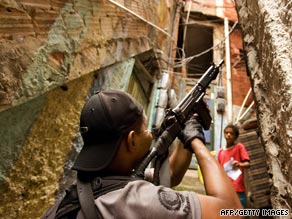
I find Boz's final sentence more interesting. I certainly think the drug gangs will challenge the police, but it's not like this is the first time that they've challenged police,given the military tactics used against civilians in the favelas, where it's not uncommon to see images like this one (from the CNN story):

A policeman advances through an alley of Rio on March 25, 2009, during an anti-drug operation.

Indeed, I once ended up on a city bus that passed through a favela in downtown Rio, and while it was as uneventful as most bus rides (and less eventful than some that never went near a favela), I was still alarmed to see military men with assault rifles poised just hanging out on street corners, alert but not in battle. You want to know the dynamics of the favelas? That picture hits it perfectly - a small kid who probably has nothing to do with the drug trade, a very well-armed individual from the military police, and somewhere unseen, actual drug lords. And kids like the one in this picture, along with old women and plenty of others untouched by the drug trade, are often killed (with some estimates hitting the thousands of innocent civilians dead).

But back to Boz's comments. Yes, they will challenge the police, and they have in the past, but, in spite of the major framing of this story, that's not what this event was. Yes, a police helicopter was shot down. But this wasn't even a case of police raiding a favela and violence erupting. This was a battle between drug gangs. The helicopter was shot down when flying over the favela to see what was going on, and as Boz himself points out, the helicopter getting shot down wasn't even intentional; according to reports, the bullets that hit the helicopter were basically stray bullets, and they weren't even from .30 caliber machine guns (though I agree with Randy that it's disturbing the gangs have this kind of weaponry, though again, it's not like the police haven't shown a propensity to murderous actions, too). With all due respect to Boz, he mistranslates that passage of the article, which reads [and I translate], "the helicopter was hit by light fire - nothing that was fired from a .30 caliber machine gun or that could have been caused by a rocket-propelled grenade found in gangs' arsenals."

So while some pitch a fit over Brazil getting the Olympics over Chicago in light of this weekend's events, they're completely out of touch with what the history, the context, and the meaning of this weekend's events. As Boz says, it wasn't some coordinated (or even uncoordinated) response to the Olympics; it wasn't even an attack initially launched on the police. It was gang warfare located away from the sites of the future Olympics that ultimately included the deaths of 3 police officers as well as at least 14 "traficantes" (though, as always, that title and/or figure is questionable). Is it a threat to the Olympics? No more so than every other incident of favela violence has been a threat to the Olympics, which is to say, not at all. The favela violence is kept to the favelas, and regardless of what you think of that, it does not mean anything to the Olympics yet. And the Brazilian government is not just ignoring this problem - today Lula pledged an extra $60 million to Rio to help combat violence in the city. This wasn't an internal "protest" to the Olympics, and it wasn't an event that should make anybody reconsider awarding Rio the Olympics. It simply was what all the other incidents of favela violence have been - sad episodes of violence, with plenty of blame to go around.


Monday, March 02, 2009

Brazil's Drug War Also Targeting Privileged

About a year and a half ago, I wrote about the growing ecstasy drug trade among middle- and upper-class kids in Rio de Janeiro. At the time, I was relatively pleased to see the cops were moving beyond just targeting the poor in the favelas in their "drug war," though I had my doubts that such a war on middle- and upper-class drugs would continue in Brazil.

Apparently, my doubts were misplaced:

Drug trafficking in Brazil has become increasingly demonized in the eyes of the law — to the point where drug financiers can now receive stiffer prison sentences than murderers — and the country’s elite is not being spared.

Just last week, federal police officers arrested 55 people, many of them in Rio de Janeiro, in a nationwide investigation focused on upper-middle-class youths who the police said were smuggling Ecstasy, LSD and other synthetic drugs into Brazil from Europe.


This does strike me as good news overall in terms of realities in Brazil right now. For years, the police have launched extremely repressive measures to fight the drug trade in the favelas, using military occupations and indiscriminate killings (as well as entering militias to control the drug trade and gain profits for themselves), all while middle- and upper-class drug usage has been relatively untouched. Unfortunately, as with corruption among police in the drug wars in the favelas, the ecstasy cases are also rife for police corruption:
Ecstasy’s emergence as the drug of Brazil’s wealthy has opened the door even wider for corrupt police officers to seize upon users and their families. Now that Brazil has eliminated prison sentences for drug users, sending them to treatment or community service instead, the police are extracting sometimes hundreds of thousands of dollars in bribes in exchange for not charging those caught with Ecstasy as drug dealers, according to defense lawyers and three convicted drug dealers now out of prison.

This is both unfortunate and unsurprising. But again, within the realities of the drug trade and law in Brazil, at least the same attitudes and mechanisms are increasingly being applied relatively equally across the social spectrum.

Of course, many of the middle- and upper-class youths who have been busted for dealing ecstasy feel they are being treated horribly unfairly and extremely. However, it's hard for me to feel too much sympathy for people like Lucas, a middle-class kid busted for bringing drugs into the country, when he complains “I was treated like a hardcore criminal and put in jail together with killers, kidnappers, you name it.” Two-and-a-half years may seem severe for what many might consider a "youthful mistake," but Lucas deserves no better treatment than the drug dealers caught in the favelas. Indeed, he might think he was dealt with brutally, but at least he was arrested at the airport when he tried to smuggle drugs into the country, rather than having the police come into his neighborhood with guns blazing, leaving a couple dozen dead in their wake. After all, the Brazilian "war on drugs" may be levelling the field somewhat by going after the non-poor sectors of dealers, too, but even then, the poor in the favelas still face more adverse conditions than Lucas did. And at least he lived to go to jail, rather than ending up another one of the dead traficantes on the streets of a favela.

That said, regardless of whether you are in favor or against increasing the efforts to combat drug use in any country, it's really encouraging to see Brazil going after drug production, dealing, and usage regardless of the drug or the socio-economic classes with which a particular drug is associated. And the fact that the story is based in São Paulo (and not Rio) indicates that the drug war is no longer something just for Rio's favelas, even if the gap in treatment of wealthier drug users and dealers and the poorer dealers and users still exists.

Friday, December 12, 2008

Challenges Facing Indigenous Peoples in Brazil

There were a couple of articles of note in the New York Times recently on indigenous issues in Brazil. The first deals with the growing struggles an indigneous group is having with drugs in the western-most part of the country in the Amazonian basin, where Brazil shares a border with Colombia and Peru. With the drug trade in the region growing, and with a non-indigenous town where drugs and alcohol are legal (they are illegal on the reserve) only a few miles away, growing numbers of Tikunas are getting involved in both the supply and demand sides of the drug trade: some are helping to smuggle the drugs across the border from Colombia and Peru into Brazil, while a growing number of Tikuna youths are becoming addicted to cocaine.

At a loss of what to do as traditional tribal authority has eroded, the Tikunas are turning to the government for assistance:
“We want government officials to help us save our children, so they don’t take part in these ruinous practices,” said Oswaldo Honorato Mendes, a deep-voiced Mariaçu chief. “Every day the situation gets worse. The younger generation does not obey. They do not show respect for our authority as chiefs. They need to learn respect.”
This is a rather new and interesting (albeit sad) portal into indigenous-state relations in Brazil. In Brazil, indigenous groups are not subject to most Brazilian laws, and the police are not allowed to enter reserves. The fact that the Tikunas (and maybe other groups in the region, now or in the future) are at such a loss as to be willing to cede at least some of that independence to the police in order to get a grip on the drug problem shows how bad things have gotten.

However, I'm not really sure what the police could do from either a theoretical or practical standpoint. The police themselves, after listening to the Tikuna's case, are unwilling to do much, simply because they feel the law doesn't really let them, even if the Tikunas themselves are soliciting help. They may be right, and it's definitely a murky legal issue. What is more, though, I'm not sure what the police could do. It's not like they don't have jurisdiction over Tabatinga, the neighboring non-reserve city, and the drug trade is absolutely flourishing there. Although I don't mean to question the decency of the police, I find it hard to believe that at least a few corrupt cops in what is far from a "metropolitan" part of Brazil are not at least implicitly involved with the burgeoning trade, even if it's just payoffs to look the other way (though I do not doubt, either, that many police in the area do want to do all they can to combat the problems in Tabatinga). Finally, given the police's record in places like Rio when it comes to the drug trade, I'm not even sure a stronger police presence is really the answer (though, to be fair, dealing with a very poor Amazonian border city is far different from dealing with the favelas in Rio).

And then there's the way in which Brazil deals with drug abusers. Unlike in the U.S., where drug abuse is a crime, in Brazil, it's treated as a social problem, as the article also points out:
Brazil treats drug users as victims who require treatment, not as criminals. They are usually sentenced to receiving drug-addiction treatment and performing community service in lieu of serving prison time.
I realize that's an extremely novel approach to drug abuse, but it also means that the police realyl aren't supposed to be involved with problems of drug abuse (and that's an important distinction between the indigenous reserve and the favelas - in the latter, they aren't combatting drug abuse, but drug trafficking).

And, if that weren't enough, there's the simple difficulty in patrolling the border. Brazil has historically had a very weak presence in the Amazon and its borders with Colombia and Peru (the dictatorship actually used the simple creation of a highway through the Amazon as a marker of Brazil's "progress"; it was never completed, fortunately). Brazil is enormous (larger than the United States if you take out Alaska), and it simply doesn't have the infrastructure, with police or other governmental agencies, to put the kind of strong state presence in the region that might deter the growing drug trade.

Finally, there's the fact that this isn't just Brazil's problem. Being so close to the borders of Peru and Colombia, those countries have to patrol their borders, too. Despite all of his talk, Uribe hasn't really done nearly as much as he claims in the anti-drug battle; it has simply shifted some, and is increasingly turning towards Brazil, Argentina, and even Europe. This just reinforces how un-winnable the "War on Drugs" is, and I may sound like a broken record player, but until countries like the United States deals with this issue on the demand side rather than the supply side (something Brazil has already done a much better job of addressing simply by recognizing drug addiction is a social, not a criminal, problem), then these issues will never go away.

In much more positive news, Brazilian courts have cleared the way for the federal government to establish an indigenous reserve "larger than Connecticut" in the Amazon basin. This is absolutely huge (and not just in terms of land-size). The court found that Lula's establishment of the Raposa Serra do Sol reserve, near the Venezuelan border, is legal, culminating a long-fought process:
The reserve would be one of the largest protected indigenous areas in the world. It has set off a sharp controversy over property rights, the limits of government authority and the rights of Indians to their original lands.
The reserve was decreed by Mr. da Silva’s government in 2005 after a legal battle of more more than 20 years. At more than four million acres, it encompasses about 42 percent of Roraima State and is 11 times bigger than the city of São Paulo.
If this does go through (and, at least from a legal standpoint, I don't think there are too many roads left available to challenge Lula's decision - but more on that in a second), it will be enormously important both for indigenous policy and environmental policy in Brazil.

The legal declaration is all well and good; however, I can't help but believe that actually enforcing this decree is going to take more effort from the government. According to the report, the area is inhabited by rice farmers, cattle ranchers, and even the remnants of an old gold mining industry. None of those groups is terribly interested in leaving, and each has a powerful voice in national and local politics. Lula's administration absolutely cannot just rest on the legal declaration of the court. I have little doubt that it will take a significant governmental presence, particularly military forces and national bureaucrats (local politicians simply cannot be trusted in cases like these, as they have absolutely no interest in protecting indigenous rights over the wealthy landowners - the latter, not the former, helped those local politicians arrive in office in the first place), as well as NGOs for indigenous rights and environmental protection. Fortunately, the government has shown a willingness to have this involvement, having already begun dispatching federal police to the area to evict farmers. The farmers are resisting, but it's still good that the government has begun establishing a strong state presence to enforce the decree and court decision, and one can only hope this will go through and set a new precedent for indigenous rights throughout Brazil.

Thursday, November 29, 2007

Risk, Carioca Style

For those who weren't sufficiently offended by "be an illegal immigrant" events and favela tours, a designer from Rio's Zona Sul has something new to offer: "Risk", Rio-style. Updating the old global-conquest game in which the players tried to use their armies to take over the 6 inhabited continents, 29-year-old designer Fábio Lopez has created "War in Rio", in which you can try to be any number of factions of drug gangs or Rio's corrupt police, trying to gain control of the city. Lopez has created a map of the city of Rio, divided like "Risk" into 6 major sections, but beyond that, the rules and idea are the same. Lopez apparently felt this was a good idea after he was robbed, an event which he apparently felt was "enlightening" enough to come up with this "game".

Lopez claims "The idea isn't to incite violence. What I want to provoke with the game is a discussion about the discomforts of living in a city at war with itself." Unfortunately, Lopez, like too many people here, only considers the violence in a one-way direction. He wasn't terribly worried about the violence within the city when police invaded Alemão and put it under a state of de facto martial law, nor did he seem to really consider the violence when the police were dismembering corpses of regular residents fighting for their rights in the faveals. Yet he gets robbed in the Zona Sul (one of the safest and richest parts of the city), and suddenly, he's worried about the violence in the city. It only pops into his head once it affects him directly, and given the fact that he's included the BOPE as one of the "factions" you can be, I suspect strongly that he falls into that category of middle class residents who believe that BOPE and other police forces are totally justified in any and all measures employed against the poor in the favelas. The fact that he could now stand to make money off this idea just adds to the repulsion of this.

Hopefully, the actual creators and producers of Risk will make sure any mass-production of this game gets halted on legal grounds. Still, the fact that it even reached this point is just one more example not jsut of how unwilling many people are to actually consider the real causes and effects of violence; it shows just how far from the reality of poverty, police brutality, and the favelas most residents of Rio are.

Thursday, November 08, 2007

Rio's OTHER Drug War

Brazil's own "war on drugs" has almost always focused on the poor and the favelas. The police go after the traficantes only in the favelas, ignoring white-collar drug use (such as cocaine, ecstasy, etc.). There is almost never any execution of arrests against anybody from the middle- or upper-classes for their involvement in the drug trade, be it as user or dealer (indeed, the elites often go into the favelas to buy their drugs, yet are almost never arrested or prosecuted). However, this seems to have changed (at least temporarily). Between Wednesday and yesterday, they arrested 10 ecstasy dealers (I could only find the story in Portuguese - apologies).

However, these arrests are nothing like the campaigns against traficantes in the favelas. Ecstasy is a middle-class drug here in Rio, and its dealers are middle-class. The biggest catch for the police yesterday was Marcel Dias Fernandes, who was arrested Wednesday and is allegedly the biggest ecstasy dealer in the Zona Sul. The Zona Sul ("South Zone") is where the middle- and upper-classes reside; its neighborhoods are much nicer, the police presence isn't as strong, and the political views are much more conservative. Every single young man and woman arrested yesterday and today lives in this area, and traffics in the Zona Sul, and one of the individuals was even arrested at his university (an area which, while not totally off-limits to the poor, is much more easily accessible to the middle-classes).

These arrests are a moderate victory from the standpoint of equality in the law. This campaign, the first of its kind, is the first time that the police have actively gone after drug dealers regardless of class. This isn't a case of going after traficantes in the favelas, or the poor who buy drugs - ecstasy is sold, bought, and used by the carioca middle class, period. So in that regard, it is a positive development, for it hints at the possibility of equality of treatment - all drug dealers, regardless of the drug, class, or neighborhood, will be pursued.

However, the emphasis here should fall on "hints at". There's no indicator that this campaign is anything more (or, to be fair, less) than a flash-in-the-pan effort, and the police may (or may not) very quickly abandon such efforts to arrest middle-class drug dealers, using this campaign to show their "accomplishments" and then going back to the favelas. However, the favelas will almost doubtlessly continue to bear the brunt of police force. Additionally, these students were calmly arrested - there was no police-takeover of the neighborhoods of Barra da Tijuca, Jardim Botanico, or Botafogo, and no imposition of de facto martial law, as is frequently the case in the favelas (the occupation of Alemão favela a few months back being only the most recent example of this). Finally, there is the question of prosecution. While many drug lords in the favelas never reach the courts because they are simply killed, those who do come to trial find themselves sentenced to heavy sentences and sent to unsanitary, overcrowded prisons in Brazil's backlands. This almost certainly will not happen to the middle-class dealers. At worst, they will get a few years and a slap on the wrist (and it's not unheard of here to have middle-class drug dealers serve their sentence outside of jail - not even house arrest).

I'm not the biggest fan of the drug war on the supply side without ever addressing the demand side (while Brazil isn't nearly as terrible as this as the U.S. is, it's still the basic thrust of its anti-drug campaign - go after the dealers, don't try to aid the users). However, that is the system as it operates right now. Given that, despite all of the caveats mentioned, it is definitely a positive thing that the police are trying at least somewhat to go after dealers regardless of class or place of residence. Hopefully, it will mark one more way in which special legal privileges for the better-off will disappear.

Wednesday, September 19, 2007

Over 50 Rio de Janeiro Police Arrested

Monday, 56 cops from Duque de Caxias were arrested for their involvement in the drug trade (Duque de Caxias is a part of greater Rio de Janeiro), providing yet another example in which the police are as much (if not moreso) a source of the violence in the favelas as the actual drug lords are. The media is (of course) swarming all over this story, but failing to provide any real analysis, instead relying on the straightforward "X-number cops charged with Y crimes" without asking why they would turn to such activities (despite the arrest of over 120 officers in Rio alone this year, it's just some "rogue" elements, instead of a broader issue of low pay, poverty, and power coming together).

I previously commented on my skepticism that any authorities in Rio (the city or the state) would ever really do anything important about this issue, yet once again, governor Sergio Cabral has come out, saying this will not stand and future cases will also be dealt with harshly. I'm still not sure that this is going to amount to much in the way of policy-change in how Rio uses its police in the favelas, but given that this arrest of 53 officers follows the arrest of another 70+ in January is at least giving some evidence that the government has the will to combat corruption and violence within the police force. Of course, it's still just rhetoric, and any real policy has yet to come out. Likewise, the efforts to curb police violence thus far have only involved those involved in the drug trade, or those committing such heinous violence that it can't go unnoticed (as was the case with the dismemberment of José Silva last week, or when it became clear in June that two cops unprovokedly punched an unarmed guy in the face and then shot him dead in February) - they haven't extended to punishment for the shooting of civilians in gun-battles in the favelas.

I still agree with one commenter on Globo's webpage, who said the problem is at the top of the police force, not the bottom, and that these arrests were just "For the English to see" ("pra inglês ver"). Still, if Cabral (or other leaders of the government) start implementing policy that affects change throughout the police force on top of these arrests, things may start changing here. I remain skeptical, but the picture is different than it was just 10 months ago.