Showing posts with label 2016 Olympics. Show all posts

Wednesday, May 11, 2011

"Pra Ingles Ver": Brazil, Favelas, and the Preparations for the World Cup

A spate of stories on Rio de Janeiro has recently emerged, focusing on the preparation for the 2014 World Cup and 2016 Olympics, focusing on the forced removal of people from favelas (shanty towns). The media has focused on Rio de Janeiro, historically the city most closely tied to favelas in the public imagination. The reports started in late-April, as The Guardian reported on the removal of favelas to prepare infrastructure (car parks, roads, etc.) for the tourists who will visit Rio in 2014 and 2016. More recently, Reuters has published a similar report, and even ESPN had the story as its main feature yesterday afternoon.
The story is fairly simple: favelas historically have sprung up on the hillsides and marginalized areas of Rio de Janeiro, often within eyeshot of some of Rio's wealthiest neighborhoods. As the city prepares for the massive tourist influx of the 2014 World Cup (where the final will be held) and the 2016 Olympics, it has begun to work on infrastructural improvements that center around tourism and "modernization" at the expense of the poor. As a result, favela residents are forced out of their homes and their homes are torn down so that streets can be widened, subway stations can be built, car parks can be constructed, etc. The city of Rio, in charge of these efforts, has promised the residents that new homes will be constructed for them elsewhere, but thus far, there is little evidence the city will actually follow through with these promises, prompting both Amnesty International and the United Nations to express concerns that the government of Rio (and other cities) is violating the basic rights of the Brazilian poor.
This criticism is more than valid and fair. It's not just that the poor are being marginalized, "removed" from places where they might serve as an uncomfortable reminder to the rest of the world of the terrible inequalities in income in Brazil. As the ESPN article points out, the poor are also being discursively rendered invisible:
This is Rio in the imagination of the 2016 Olympic planners: a 19-page brochure full of coloro photographs and grand statements outlining their bid. The opening spread shows children dancing on a beach beneath an enormous Brazilian flag, and, above a photo of wind surfers riding waves with a backdrop of Christ the Redeemer. The pages proclaim a new birth. "It is driven by sport, with athletes and the entire sports community looking forward to the lasting benefits the games will bring."
The brochure promises to change the economy, to educate children and even to protect the world's largest "urban forest." The obligatory quote from Pele is included. The document is full of maps and photos and plans, but there's no mention of the war on the hill that overlooks Maracana Stadium, where the opening ceremonies will be held.
The word "favela" never appears.
Of course, the promoters of the projects deny that this is about class or the effort to marginalize the poor. The Reuters article cites a city official in Rio:
"The city is absolutely not trying to gentrify and push the poor away," said Jorge Bittar, Rio's housing secretary and a member of Rousseff's leftist Workers Party*. "These new routes are meeting a demand that's been there for decades in Rio...the people who will use the buses are the poor, not the rich."
[*This association between Bittar and Rousseff is more than problematic itself. City governments and the federal government have to collaborate, but they are also nearly completely independent of one another as outlined in Brazil's constitution. There is a good amount of political science scholarship out there that shows how the PT [the Workers Party] at the local level operates independently of the national party, and often has different approaches, policies, and even ideologies. What unites the two is a general concern for social programs and a more even distribution of wealth in Brazil; obviously, though, how that takes place in policy at the national level and the local level can be and is very different. For that reason, directly associating Bittar to Rousseff is problematic, because it makes ties between the president and local officials that simply don't exist. A comparative example would be to tie Obama directly to something that a Democratic official in the New York City government said. - CS]
Bittar's comment is problematic in and of itself: the fact that the subways and cars are costly enough that they are for the "rich;" the fact that subway lines don't even go to many the many areas of Rio that are poor/marginalized; the fact that the government failed to provide this infrastructure "for decades" and that it took the international events of the Olympics and World Cup to finally address the needs of the poor. Yet it also cuts at the heart of the issue: while the government of Rio feels it is adequately addressing the needs of the poor even as it prepares for a massive influx of tourists (even more than usual), it is also pretty clear that the rights of many of Brazil's poor are not only being ignored; the government is directly violating these rights and needs.
Certainly, this is depressing news, and it is good that the media is highlighting this story. It serves as yet another reminder that the outsiders' view of Brazil as a beach-haven of glamor and beauty has a very high cost. Yet the media reports this story as if it is a recent development, when in reality that could not be further from the truth.
The entire history of the favelas, from their creation in the late-1800s and early-1900s to the present, hinges on the forced removal, relocation, and marginalization of Rio's poor. Indeed, the original creation of the favelas took place in the early-1900s as the city of Rio "renovated" what is now down-town Rio de Janeiro by tearing down the Castelo mountain in order to build better roads and forcing many poor residents to the margins of the city. In the late-1910s, Brazil prepared for the visit of members of the Belgian royal family, Rio once again underwent a "beautification" project designed to show Europeans that Brazil was "civilized;" once again the poor were relocated, creating a ring of favelas around the newly-elite downtown areas. As the rates of urbanization rapidly increased in the twentieth century (in 1930, 70 percent of Brazil's population lived in rural areas, and only 30% in urban centers; by 1980, those numbers were reversed), favelas expanded along the margins of the city, not just in Rio but in places like Sao Paulo, Bahia, and elsewhere. Throughout the twentieth-century and into the twenty-first, the story of favelas has been one of creation, development, and relocation in the face of ongoing "modernization" efforts for the wealthier parts of Brazilian cities.
To be clear, this is not intended to defend the current forced removal of favela residents as just another phase in history. What they are going through is depressing not just for the process, but for its familiarity, as once again, Brazil's poor are forced aside "pra ingles ver" ("for the English to see," an old phrase that goes back over a century and captures the preoccupation to appear "civilized"/"modern"/"developed" to other countries). As Brazil prepares for the World Cup and the Olympics, the government of Rio is violating basic human rights. Saddest of all, however, is the fact that the story of what is happening in no way surprising or new.

Saturday, December 05, 2009

Things That Seem Like Useless Ideas: Giuliani to Serve as "Security Advisor" for Rio 2016 Olympics

I really don't understand what Brazil hopes to get out of an ex-mayor who A) wasn't terribly competent or able before or in the wake of 9/11 (the one thing that would give him any claim to "legitimacy" on security matters); B) has an appalling record in dealing with poverty (something that is a characteristic of Rio's favelas, and Brazil in general, which has one of the highest income gaps in the world); and C) wasn't exactly connected to the most ethical police leaders (and Rio certainly has its own problems with corrupt police). Still, Rio has apparently contracted Rudy Giuliani and his "security" firm, to help the city prepare for the Olympics in 2016. I guess if there's any silver lining in this, it's that some analysts in the story seem to think this may indicate Giuliani will not run for the Senate next year. Still, I hate to see Rio hire a man whose reputation far outpaces his actual policies, just so New York state can be spared.

Saturday, October 24, 2009

Understanding the Complexities of the Drug Trade in Rio's Favelas


Randy points us to this article in The Economist. The article does a great job explaining succinctly why A) there appears to be so much violence in Rio, and B) why it's in the favelas, and not a city-wide event:

"A further reason for Rio’s spectacular violence is that it has three large, competing drug factions, whereas in other big cities (including the largest, São Paulo) one gang is dominant. A recent study from Rio de Janeiro state’s government on the economics of the local drug business suggests that, because of this competition, far from living like characters in an MTV hip-hop video, Rio’s dealers are operating at “close to break-even”.

Using a conservative estimate for total annual drugs sales in the city, of R$316m ($182m), the study reckons that after buying the product from wholesalers, employing a sales force and investing in capital (guns, mainly), Rio’s dealers make combined annual profits of R$27m ($15m). The wage structure within the factions appears to be surprisingly flat, far more so than in the American gang analysed in 2000 by two academics, Steven Levitt and Sudhir Venkatesh. Rio’s dealers seem to be an exception to Brazil’s national picture of unequal income distribution."

It's a quick run-down, and does a good job distributing the blame. While many uninformed non-Brazilians, many racist/classist (no matter how much they deny it) Brazilians, and foreign media reports place the blame solely on the drug gangs (and the favelados more generally), the economist reminds us that there's a long legacy miscues (to put it euphemistically) from other groups as well, including governmental policy-making:

Past mistakes include making accommodations with drug-dealing factions in the hope of keeping them peaceful. Rio’s police force is also part of the problem. Some of the weapons used by drug dealers are sold to them by the police, and officers still execute too many people on the spot rather than bother with prosecuting suspects, making favela-dwellers regard them as no more a source of justice than the drugs gangs.

The article also mentions the existence of militias in the favelas and around them, though it doesn't mention that these militias are often composed of former and current members of the police. Nonetheless, the (brief) article is the first I've seen in the foreign press that really understands the complexities of the violence and drug economy in Brazil. These complexities are why last week's violence was not initially an attack on police forces in Rio (as many headlines and reports tacitly or explictly framed it), and are why the Olympics are not in any grave danger from these types of incidents. And if the media, both in Brazil and abroad, would take better care to understand and report on these complexities, then maybe bringing an end to the violence could be a more realistic possibility than it is when media reports simply frame the city as a place of extreme violence and treats all the urban poor and favelados as criminals. Maybe then, images like the one above will become more uncommon.

Monday, October 19, 2009

On the Weekend Violence in Rio de Janeiro

This past weekend, violence in Rio's favelas flared up, with ugly results:

Some 2,000 police officers patrolled the streets of Rio de Janeiro Sunday after a bloody confrontation between rival drug gangs and authorities that killed 14 over the weekend, including two police officers. [A third died this morning, according to reports in Brazil - Trend].

Two suspected drug traffickers were killed and four were arrested in Sunday's operations by Rio de Janeiro's military police, the official news agency Agencia Brasil reported.

Of course, these events have led many in both Brazil and abroad to comment on what this means in light of Brazil recently being awarded the 2016 Olympics. Boz broached this subject earlier today:

It's not credible to think that Rio's drug gangs have a unified grand plan of Olympic disruption that they're implementing. However, their ability to create a climate in insecurity and harm Rio's reputation is certainly a greater factor with the Olympic announcement. I expect them to continue to challenge the security forces and attempt some more high-profile attacks in the coming year.

I absolutely agree with that first part of the paragraph. This wasn't some coordinated response to the Olympics; hell, it wasn't even an uncoordinated response to the Olympics. Some of the news stories have insinuated this clearly indicates that this is a threat to Olympic athletes, as the favela in question (Morro dos Macacos) is "only five miles" from where one of the villages will be, not taking into account that that's five miles by air, not five miles through mountains, lakes, buildings, and the world's largest urban forest. In grand terms, this means pretty much nothing in terms of the Olympics or the athletes.

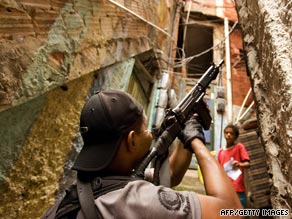
I find Boz's final sentence more interesting. I certainly think the drug gangs will challenge the police, but it's not like this is the first time that they've challenged police,given the military tactics used against civilians in the favelas, where it's not uncommon to see images like this one (from the CNN story):

A policeman advances through an alley of Rio on March 25, 2009, during an anti-drug operation.

Indeed, I once ended up on a city bus that passed through a favela in downtown Rio, and while it was as uneventful as most bus rides (and less eventful than some that never went near a favela), I was still alarmed to see military men with assault rifles poised just hanging out on street corners, alert but not in battle. You want to know the dynamics of the favelas? That picture hits it perfectly - a small kid who probably has nothing to do with the drug trade, a very well-armed individual from the military police, and somewhere unseen, actual drug lords. And kids like the one in this picture, along with old women and plenty of others untouched by the drug trade, are often killed (with some estimates hitting the thousands of innocent civilians dead).

But back to Boz's comments. Yes, they will challenge the police, and they have in the past, but, in spite of the major framing of this story, that's not what this event was. Yes, a police helicopter was shot down. But this wasn't even a case of police raiding a favela and violence erupting. This was a battle between drug gangs. The helicopter was shot down when flying over the favela to see what was going on, and as Boz himself points out, the helicopter getting shot down wasn't even intentional; according to reports, the bullets that hit the helicopter were basically stray bullets, and they weren't even from .30 caliber machine guns (though I agree with Randy that it's disturbing the gangs have this kind of weaponry, though again, it's not like the police haven't shown a propensity to murderous actions, too). With all due respect to Boz, he mistranslates that passage of the article, which reads [and I translate], "the helicopter was hit by light fire - nothing that was fired from a .30 caliber machine gun or that could have been caused by a rocket-propelled grenade found in gangs' arsenals."

So while some pitch a fit over Brazil getting the Olympics over Chicago in light of this weekend's events, they're completely out of touch with what the history, the context, and the meaning of this weekend's events. As Boz says, it wasn't some coordinated (or even uncoordinated) response to the Olympics; it wasn't even an attack initially launched on the police. It was gang warfare located away from the sites of the future Olympics that ultimately included the deaths of 3 police officers as well as at least 14 "traficantes" (though, as always, that title and/or figure is questionable). Is it a threat to the Olympics? No more so than every other incident of favela violence has been a threat to the Olympics, which is to say, not at all. The favela violence is kept to the favelas, and regardless of what you think of that, it does not mean anything to the Olympics yet. And the Brazilian government is not just ignoring this problem - today Lula pledged an extra $60 million to Rio to help combat violence in the city. This wasn't an internal "protest" to the Olympics, and it wasn't an event that should make anybody reconsider awarding Rio the Olympics. It simply was what all the other incidents of favela violence have been - sad episodes of violence, with plenty of blame to go around.


Saturday, October 03, 2009

Some (Lengthy) Thoughts on Brazil Winning the 2016 Olympics

Words don't express how much this means to Brazil. As Erik noted, there's a particular sense of pride about Brazil, and I think it's safe to say that this is based in no small part on the fact that Brazilians feel their country is often overlooked in the name of the "developed" world. In many regards, they're right - people in the U.S. are stunned when I explain to them that Brazil would be larger than the U.S. if the U.S. didn't have Alaska (which is almost three times bigger than Texas, the second largest state). Brazil is also somewhere between the eighth and tenth largest economy in the world (depending on how you measure it), and is projected to be the fifth largest by 2016. And it's pretty depressing the number of times that, when I've explained I'm going to Brazil, I've been met with the responses "How's your Spanish?" or "Oh, where - Buenos Aires?" Brazil's a massive, rapidly developing country that's taking a major place on the national level, and yet its grandness and growing importance is often overlooked. So this really means a lot to Brazilians on multiple levels.

How much? Well, this should give you a sense of the expectation and anticipation that was building yesterday. It is so huge, I have yet to see or hear any of the vaunted O Globo commentators (some of Brazil's most jaded and cynical citizens) say anything bad. As one reader put it, "For the 190 million Brazilians, this is more than a prize." And O Globo has offered nothing but praise for Lula on this, which, to my memory, is an unprecedented event since his election in 2002.

And speaking of Lula.....crazies on the right are already celebrating that the elimination of Chicago was some great loss for Obama. Even if you accept this premise (which I don't - disappointment, perhaps, but not some major repudiation of the Obama administration), it's nothing compared to the loss it would have been to Lula, which would have been more substantial and personal. While Obama recently decided to go to Copenhagen to lobby for his home city, Lula has been involved in Brazil's efforts to get the Olympics for years. He was quickly involved in the process, keeping up to date on the proceedings and meeting with officials, when he was elected, and when Brazil lost the bid to host the 2012 Olympics four years ago, Lula ratcheted up his involvement. Some may have think Obama has a little egg on his face now, but Lula would have been covered with a chicken-farm's worth of yolks had Brazil not won.

But it was about much more than personal pride, to Lula and to Brazilians. A lot of countries are still positivists at their core, thinking that their "nation's" history is a tale of constant progress. However, positivism has been particularly heavy-handed in Brazilian history since the 1800s. French positivism played a major role in the hand-wringing over Brazil's ethnic identities in the late-1800s and early-1900s, as they feared they were "inferior." Indeed, while bringing settlers from Switzerland, Germany, and other parts of Northern Europe had its economic reasons (the gradual decline in slavery leading up to abolition in 1888 meant that a new labor force was needed), Brazilian economic, political, and intellectual elites could have tried to target any group; they targeted Northern Europeans not just because they seemed like good workers, but because their "work ethic" and whiteness could help Brazil "improve itself" via Comtean eugenics. Since Brazil's post-colonial history, the country's politics and nation's identity has always been closely concerned with the notion that Brazil "progress" enough to join the "developed" world, a place many Brazilians have for generations felt Brazil deserved due to its size, beauty, productivity, uniqueness, etc.

This may seem like I'm overstating things on the positivist/"progress" front, but there are historical examples of this from 1821 onwards. Ever see Brazil's flag? Those two words translate as "Order and Progress," and it's been there since the establishment of the Republic in 1889. Up until the 1930s, Brazilian intellectuals, academics, and elites struggled with the fact that they weren't as "white" as other developed nations, so when Gilberto Freyre suggested that the mixture of indigenous, Afro-descendant, and Portuguese actually made Brazil better and stronger by combining the best elements of all three groups (and we are dealing with anthropology and sociology as they functioned in the 1930s, to be fair), Brazil suddenly embraced its ethnic background as a benefit for the first time, as if saying, "finally, we have a way to be proud of ourselves and we've overcome a major racial obstacle to progress!" It may sound silly, and I am simplifying some rather complex processes for the sake of space, but it is one of the main reasons Brazilians today still deny that there is racism in Brazil.

And as for development projects - Brasilia in 1960; Juscelino Kubitschek's pledge to help Brazil develop "50 years in 5" upon his election in 1955; the (failed) Trans-Amazonian highway, the pet project of the Medici administration during Brazil's dictatorship; all of these, and many many more, were projects adopted in no small part to prove Brazil was finally "developed." You see the language everywhere in the documents from their respective times; some of these policies were practical, while others were really adopted just to show the world what Brazil could do (Brasilia and the Transamazonia, especially).

In the last few years, however, all of Brazil's claims to "progress" seem to have been finally coming to more accurately reflect reality, rather than what Brazilian elites (and many Brazilians themselves) wanted to believe. After the economic troubles brought on by neo-liberal policies in the 1990s, Brazil has seen a remarkable level of economic growth that may be unprecedented in its history. Purchasing power is reaching social classes that had previously been shut out. While the American, European, and Asian markets have been struggling for over a year with the financial collapse of 2008, Brazil entered into an official recession this June, and exited it one quarter later. Nor is it restricted to economics; Brazil has become a major player in international politics in a way it never has been before, serving as a leader not only in South America, but joining China and India as one of the major emerging global powers alongside (possibly declining) powers like the U.S. and western Europe. Much of this has been due in no small part to Lula's government, yes, but these processes have been in play for hundreds of years, with accompanying hopes and disappointment regarding the status of Brazil in the world. Yet it finally seems like, more than ever before, Brazil is perched on (if not already entering) a phase as a global power that many elites and non-elites alike have dreamed about for nearly two hundred years.

Are there critics? I imagine so - there's no way 190 million people all feel exactly the same. But the depth this pride reaches is really foreign to jaded Americans who had to deal with Vietnam, Nixon, Bush, etc. As one final example, some of my most politically-cynical Brazilian friends couldn't contain their joy. When I logged on to facebook, one was proudly declaring (in French) that Brazil would be ready to her friends in France, fully proud of her country; another simply wrote, "Who said national pride is a thing of the past?" And these are some of the most jaded, cynical people I know in Brazil.

All of this is a very long way of saying, this means a lot more to Brazilians than it would have meant to those in Chicago, or Tokyo, or even Madrid, and it means a lot more than one can easily say. Between the World Cup and the Olympics, I think it's safe to say Brazilians are finally getting the international stage that they've wanted for generations in order to prove themselves to the world once and for all.

And prove itself, Brazil will. I've already started hearing codgery statements from some Americans that this was the wrong choice. The arguments are as tired as they are uninspired, as uninformed as they are offensive. Brazil is too "Latin," too "corrupt," underprepared, too "dangerous." All of these arguments could be easily brushed aside if people weren't so bigoted. Yes, Brazil struggled with getting the Pan-American games ready on time in 2007 - I was there. They promised things they (or anybody else) never could have achieved (like a third subway line in a few years) just to get the games. The federal government had to step in 4 months before the games and put construction on a 24-7 schedule to be ready. But you know what? The games were ready, and they went off perfectly. And Brazil learned from them. Just this past week I was reading an article (that I now can't find to link to) in a Brazilian journal in which an official admitted Brazil over-pledged itself in the Pan-American Games bid, and this time, instead of making a couple of grand claims, they had focused on making many achievable claims, ones they could fulfill.

How ready will Brazil be? Well, I would argue they're better prepared than any country that's hosted the Olympics in recent history. While many places have had to build new stadiums and facilities out of nothing, Brazil already has more than half of the facilities it needs for the Olympics, thanks to the Pan-American games and the World Cup coming to Brazil in 2014. But it's about more than just facilities. Rio has done an amazing job in expanding its travel options, relying on express bus lines as much as subways, and expanding those lines in the last few years (and again, I was there and saw the dramatic changes). Environmentally, too, it's already much better off than Beijing, and will be in 2016. If nothing else, there won't be that pollution. And you don't think the World Cup will be a good trial run for running things in Brazil? Please. Even if things don't go perfectly in 2014, Brazil's has two full years to focus on improvements. Did Beijing get that same chance? Or Sydney? Or Atlanta? No.

Which of course, leads to "safety." The violence in Brazil is real, but it's also overblown to the level of borderline-racist/classist paranoia. Yes, the favela violence is appalling. But do you think the police are going to be going into the Olympic village with guns blazing? And do tourists get mugged? Sure. Is it because they drew too much attention to themselves and went to places they never should have gone? Absolutely. I have known Brazilian and non-Brazilian mugging victims in Brazil, and in every single case, without exception, they said, "it was my fault - what I did was stupid." Whether it was pulling out a really obviously expensive camera in a poor neighborhood, or walking down the street with lots of cash in their hands, it was dumb, and they knew it. And it's not like Chicago, or Tokyo, or Madrid wouldn't have similar issues. And as one final point, last time I checked, Brazil didn't have any anti-abortion terrorists running around threatening the games. So Americans really don't have a lot of room to complain about "violence" or "danger" to me. As for corruption? Again, it's not like that hasn't happened outside of Latin America.

At the end of the day (and a very long post), I see this as nothing but good for Brazil and for the world. There's the pride issue, certainly. And while I wouldn't overstate the economic boon this will be, it certainly will help. In response to questions about Olympic stadiums, well....Maracana will be the big stadium, and I guarantee it isn't going anywhere after the Olympics. And as for other facilities, like pools, tracks, etc. - they're already there from the Pan-American games. They'll be updated, but they won't be destroyed afterwards. Just as in 2007, once the Olympics end, they will revert to public places where there are programs for children, physically disabled people, and others from all social groups who can swim, play basketball, track, and other events. This will help everyday Brazilians in the long-run, simply because it has already begun to help them in the wake of the 2006 Pan-American games (when not even the World Cup was a guarantee, to say nothing of the Olympics).

As one final addendum, I want to say that I'm actually proud of the IOC. It really is inexcusable that it has taken so long to have an Olympic games in South America; likewise, the fact that it's only been in a Latin American country once (in 1968), and in the southern hemisphere twice (both times in Australia) shows how Eurocentric the system is. While I found it unlikely, the possibility of Madrid following London infuriated me yesterday, especially since, if it were to win, it would have been due in no small part to the appeal of Spaniard and former Olympic chair Juan Antonio Samarach said it should be in Madrid because he is 89 and "I am near the end of my time." At the risk of seeming like a jerk, this infuriated me - "Oh, I'm sorry, you were chair for 21 years, until 2001? And you'd like to see the Olympics in Spain? Oh, where were you in 1992? And you're 89? So, how likely will you be around to 96?" While I don't begrudge Samarach his feelings and pride, Spain has had its chance, and will again.

Right now, it's Brazil's time.

Thursday, October 01, 2009

Give the Olympics to Rio

Can we just give the 2016 Olympics to Rio already. I know Obama is in Copenhagen to sell Chicago's bid. Maybe that makes a difference. At the end of his 2nd term, it would be a cap to his presidency I guess.

At the same time, who cares. Does anyone outside of Chicago really care if the United States hosts the Olympics ever again?

Meanwhile, getting the Olympics would be a huge boon to Rio's pride. I've spent a good bit of time in modernizing nations on the verge on international prestige. When I was in Rio in 2007, there was an international vote on what the Seven Wonders of the World would be. Do you remember this? I wouldn't have either. Because what American would care? But Brazil put on an enormous campaign to get the Jesus statue above Rio listed. Ads were everywhere, commercials flooded the airwaves. It won and a huge celebration followed.

Similarly, my time in South Korea, which followed the Olympics, was a period of huge national pride for the Koreans. They had just won the World Cup, though they hated sharing it with the Japanese. Every year they waited for the Nobel Prizes to be named in hopes that a Korean would finally win. This stuff meant a LOT to them.

The Olympics would mean far more to Brazilians than to Americans. Rio can clearly handle the event. It's a pretty cut and dried choice as far as I'm concerned.

Randy has more.

Tuesday, June 23, 2009

Back from Brazil

As my flurry of posts last weekend probably indicated, I'm back from Brazil. Although I'd only been gone for 15 months, I was really surprised at the changes that had happened, in Brazil and abroad.

The change was evident immediately upon arriving at the airport. Thanks to the H1N1 scare ("influenza suina"), all the travelers on the plane (Brazilian and foreign) had to fill out a sheet saying whether they had had a cough and/or fever in the last 10 days in addition to the regular Customs paperwork. And just to be safe, the officials at the gate and at customs who gave us the papers and took them back all wore masks. I suppose precautions are OK, but it still seems a bit extreme of a response to a disease that a couple thousand people have gotten out of more than 6 billion in the world.

Also at the airport, it was very obvious that Rio is pushing very hard to get the 2016 Olympics. Rio's airport has two terminals; one is new, but one was built in the 1970s, and it shows, not so much in deterioration as in design and lighting. However, the (in my opinion, relatively ugly) walls were all covered with materials indicating that the aiprort is undergoing a major overhaul in its appearance, and there were signs all over showing how the aiport will look with the new walls and better lighting. If it looks half as good as the design looked, it will be a marked improvement. And just in case you weren't sure it was for the Olympics, there were signs all over with comments on getting ready for 2016, boasting of Brazil's ability to host, the changes their making to infrastructure, etc.

While we're on the subject of airports, Sao Paulo has demonstrated it may quite possibly have the stupidest airport security policy outside of the U.S. I have now flown into both airports in Sao Paulo from both airports in Rio, and every time you make a connecting flight, you get off the plane and immediately stand in line. For what. To go through security. Again. You of course go through when you're in Rio, and yet when you get in Sao Paulo, you have to do it all over again. I just don't understand this - it's not like Rio says, "meh, security, smecurity" - it's the same metal detector, the same "remove your laptop," the same time waiting in lines. And I just can't figure out the logic for this - it's not like Brazil has had to deal with a rich legacy of (often-deserved) mistrust from the rest of the world, and there isn't exactly a history of terrorist attacks on Brazil via airports. Even in the U.S., which is way too paranoid in terms of security, you don't have to go through security to make a connection. Maybe there's some logic in Sao Paulo, but I'll be damned if I can figure out what it is.

I will want to deal with the visible effects of Rio's new mayoral administration in another post, but in political news, the PSDB is already gearing up against the PT for the 2010 elections. The commercials I saw weren't actually going after Dilma Rousseff herself, nor after Lula; rather, they were simply critical of the PT in the vaguest of terms, basically trying to frame next year's elections as "PT vs. PSDB." I don't know yet if this is smart or foolish politics; on the one hand, getting people to think just in terms of parties could help the PSDB, but on the other, relying on vague condemnations and showing a lack of any good candidate or policy alternative could backfire. Suffice to say, the content of the commercials themselves was appalling, relying on innuendos, non-controversies, and other baseless vague accusations against the PT. While one can level charges of corruption against all parties in Brazil right now (and for generations back), including the PSDB, the PT is not exactly mired in any scandal - the biggest challenge is facing the centrist-PMDB, whose Jose Sarney (president of Brazil from 1985-1990 and current president of the Senate) is embroiled in an expenses scandal. The PSDB commercial tried to say that the PT was directly involved in that, but most Brazilians (at least, those outside of the middle-class Zona Sul in Rio) are smart enough to understand that Brazil is a parliamentary presidential system, and just because Lula and the PT have to collaborate with the PMDB (and many other parties) in the legislative branch, does not mean that Lula or the PT are giving orders to Sarney.

Finally, in cultural news, O Globo has come out with what is quite possibly the Worst Novela Ever. Called "Caminho das Indias" (Road from Indias - yes, it's pluralized, and no, I don't know why), it has some of the most ridiculous exoticism and historical/cultural innacuracies I've ever seen in any country. The basic plot immediately reveals the ridiculousness - an Indian woman who loved a member of the "untouchable" caste in India is now married to a wealthy businessman, and the "untouchable" has also become a successful businessman, and (of course) the two are competitors not just in the business world, but for the woman's attention as well. There are numerous other ridiculous aspects to the plot that are too convoluted to go into here. However, it should be fairly obvious the ridiculous premise that "love can conquer all," including the caste system. Equally risible is the notion of an "untouchable" becoming a major business leader. While I understand that the caste system is nowhere near as rigid as it once was, it certainly is nowhere near as lax as the Novela makes it out to be. And the good times keep coming. While the main female protagonist passes for an Indian, her character's name is absurd: Maya. Yes, a Brazilian actress playing an Indian named after a Mexican indigenous group. But at least she kind of looks the part, which is more than I can say for either of the two main male characters (the latter of whom played an Italian, with much more success, in his previous novela). And the theme song is the worst mish-mash of an "interpretation" of Indian music and culture ever (keep your eyes open for the Russian-like dancer at about 33 seconds in). I was horrified, but having never been to India, thought I was perhaps overreacting. However, last night I showed the clip to an Indian colleague of mine at work, and she was even more horrified and offended than I was. Well done, O Globo - well done indeed.