Showing posts with label Rio de Janeiro. Show all posts

Wednesday, May 11, 2011

"Pra Ingles Ver": Brazil, Favelas, and the Preparations for the World Cup

A spate of stories on Rio de Janeiro has recently emerged, focusing on the preparation for the 2014 World Cup and 2016 Olympics, focusing on the forced removal of people from favelas (shanty towns). The media has focused on Rio de Janeiro, historically the city most closely tied to favelas in the public imagination. The reports started in late-April, as The Guardian reported on the removal of favelas to prepare infrastructure (car parks, roads, etc.) for the tourists who will visit Rio in 2014 and 2016. More recently, Reuters has published a similar report, and even ESPN had the story as its main feature yesterday afternoon.
The story is fairly simple: favelas historically have sprung up on the hillsides and marginalized areas of Rio de Janeiro, often within eyeshot of some of Rio's wealthiest neighborhoods. As the city prepares for the massive tourist influx of the 2014 World Cup (where the final will be held) and the 2016 Olympics, it has begun to work on infrastructural improvements that center around tourism and "modernization" at the expense of the poor. As a result, favela residents are forced out of their homes and their homes are torn down so that streets can be widened, subway stations can be built, car parks can be constructed, etc. The city of Rio, in charge of these efforts, has promised the residents that new homes will be constructed for them elsewhere, but thus far, there is little evidence the city will actually follow through with these promises, prompting both Amnesty International and the United Nations to express concerns that the government of Rio (and other cities) is violating the basic rights of the Brazilian poor.
This criticism is more than valid and fair. It's not just that the poor are being marginalized, "removed" from places where they might serve as an uncomfortable reminder to the rest of the world of the terrible inequalities in income in Brazil. As the ESPN article points out, the poor are also being discursively rendered invisible:
This is Rio in the imagination of the 2016 Olympic planners: a 19-page brochure full of coloro photographs and grand statements outlining their bid. The opening spread shows children dancing on a beach beneath an enormous Brazilian flag, and, above a photo of wind surfers riding waves with a backdrop of Christ the Redeemer. The pages proclaim a new birth. "It is driven by sport, with athletes and the entire sports community looking forward to the lasting benefits the games will bring."
The brochure promises to change the economy, to educate children and even to protect the world's largest "urban forest." The obligatory quote from Pele is included. The document is full of maps and photos and plans, but there's no mention of the war on the hill that overlooks Maracana Stadium, where the opening ceremonies will be held.
The word "favela" never appears.
Of course, the promoters of the projects deny that this is about class or the effort to marginalize the poor. The Reuters article cites a city official in Rio:
"The city is absolutely not trying to gentrify and push the poor away," said Jorge Bittar, Rio's housing secretary and a member of Rousseff's leftist Workers Party*. "These new routes are meeting a demand that's been there for decades in Rio...the people who will use the buses are the poor, not the rich."
[*This association between Bittar and Rousseff is more than problematic itself. City governments and the federal government have to collaborate, but they are also nearly completely independent of one another as outlined in Brazil's constitution. There is a good amount of political science scholarship out there that shows how the PT [the Workers Party] at the local level operates independently of the national party, and often has different approaches, policies, and even ideologies. What unites the two is a general concern for social programs and a more even distribution of wealth in Brazil; obviously, though, how that takes place in policy at the national level and the local level can be and is very different. For that reason, directly associating Bittar to Rousseff is problematic, because it makes ties between the president and local officials that simply don't exist. A comparative example would be to tie Obama directly to something that a Democratic official in the New York City government said. - CS]
Bittar's comment is problematic in and of itself: the fact that the subways and cars are costly enough that they are for the "rich;" the fact that subway lines don't even go to many the many areas of Rio that are poor/marginalized; the fact that the government failed to provide this infrastructure "for decades" and that it took the international events of the Olympics and World Cup to finally address the needs of the poor. Yet it also cuts at the heart of the issue: while the government of Rio feels it is adequately addressing the needs of the poor even as it prepares for a massive influx of tourists (even more than usual), it is also pretty clear that the rights of many of Brazil's poor are not only being ignored; the government is directly violating these rights and needs.
Certainly, this is depressing news, and it is good that the media is highlighting this story. It serves as yet another reminder that the outsiders' view of Brazil as a beach-haven of glamor and beauty has a very high cost. Yet the media reports this story as if it is a recent development, when in reality that could not be further from the truth.
The entire history of the favelas, from their creation in the late-1800s and early-1900s to the present, hinges on the forced removal, relocation, and marginalization of Rio's poor. Indeed, the original creation of the favelas took place in the early-1900s as the city of Rio "renovated" what is now down-town Rio de Janeiro by tearing down the Castelo mountain in order to build better roads and forcing many poor residents to the margins of the city. In the late-1910s, Brazil prepared for the visit of members of the Belgian royal family, Rio once again underwent a "beautification" project designed to show Europeans that Brazil was "civilized;" once again the poor were relocated, creating a ring of favelas around the newly-elite downtown areas. As the rates of urbanization rapidly increased in the twentieth century (in 1930, 70 percent of Brazil's population lived in rural areas, and only 30% in urban centers; by 1980, those numbers were reversed), favelas expanded along the margins of the city, not just in Rio but in places like Sao Paulo, Bahia, and elsewhere. Throughout the twentieth-century and into the twenty-first, the story of favelas has been one of creation, development, and relocation in the face of ongoing "modernization" efforts for the wealthier parts of Brazilian cities.
To be clear, this is not intended to defend the current forced removal of favela residents as just another phase in history. What they are going through is depressing not just for the process, but for its familiarity, as once again, Brazil's poor are forced aside "pra ingles ver" ("for the English to see," an old phrase that goes back over a century and captures the preoccupation to appear "civilized"/"modern"/"developed" to other countries). As Brazil prepares for the World Cup and the Olympics, the government of Rio is violating basic human rights. Saddest of all, however, is the fact that the story of what is happening in no way surprising or new.

Tuesday, March 08, 2011

Carnival in Rio (II) - The Second Night's Festivities in the Sambadrome

Porto da Pedra, Grande Rio, Mocidade, Salgueiro, Beija-Flor, and Uniao da Ilha, which overcame the fire from last month to win the Gold Standard prize for its theme "The Mystery of Life," about Charles Darwin and evolution. The images are spectacular as usual, and the songs this year were pretty strong as well (each school has its own song that it writes and performs during their 90-minute parades). For those interested in the music, here are the links for each school's samba, composed just for this year's Carnival (just scroll down a bit and click the little "play" icon in the center of the screen):


Monday, March 07, 2011

Carnival in Rio (I) - The First Night's Festivities in the Sambadrome

Last night was the first of the major two-night spectacle of Carnival in Rio (although people have been marching in blocos, or informal parades, all weekend), and as usual, here's a great collection of photos for each of the schools that marched last night. The first round included the samba schools of Sao Clemente, Imperatriz Leopoldinense, Portela, Unidos da Tijuca, Vila Isabel, and Mangueira. Portela was one of the schools most affected last month by the fire in the warehouse storing Carnival floats and costumes, and it showed in their parade. That said, they did an excellent job recovering enough to march, and it's good that they can't face punishment in the "rebaixamento," or dropping to the second level, this year.

Monday, February 07, 2011

Fire in Rio - Carnaval Threatened?

This morning, a massive fire tore through the public building in the heart of Rio de Janeiro where Rio's samba schools keep their costumes, floats, and displays in the month leading up to Carnaval. As the photos here indicate, this was no small fire. The damage has been catastrophic for at least four of the samba schools; Portela, one of the oldest and best samba schools, lost over 2,800 costumes, floats, and props, while Grande Rio lost over 4,000 (at a cost of $10 million reais, or roughly 6 million U.S. dollars).

The cost should indicate just how ornate, elaborate, and important Carnaval is to Rio and to the communities that compete in the event. Worse, just as in football (the global version, not the American one), the poorest-ranked schools drop to the "second division," while the second divisions winners rise up to the main event. With four schools already eliminated by the sheer lack of materials to compete, Carnaval in Rio is suddenly facing major questions. Liesa, the organization that runs Rio's Carnaval, is meeting tonight; the mayor has already proposed not having the "eliminations" this year, since the four schools that would naturally dropped cannot be blamed for the building catching on fire. Initial suggestions that Carnaval be cancelled seem to have died down, and cancelling is a terrible idea; Carnaval is one of Rio's biggest events, and it brings in millions of dollars not only from corporate sponsors, but from tourism and more quotidian sources of income (like beers purchased). And the schools are keeping a strong and unified front in the face of this tragedy; the other samba schools that were not affected by the fire have offered to help those that were, and Grande Rio, which lost 90% of its props and costumes, said it will still march in Carnaval, even without the costumes or floats; after all, at the end of the day, the samba school is its members and community, not its flashy appearance.
Interestingly (and potentially even more tragically), somebody else may be responsible. When I spoke to a Brazilian this morning who had not heard the news, she immediately responded, "this was a criminal act," implying that a supporter (or member?) of another competing school had set the fire to remove the competition. While I certainly hope that was not the case, it makes sense - after soccer teams, the samba school you support is one of your most important identities in Rio.
Some (including myself) have been critical of how "commercial" Carnaval in Rio has become, but at the end of the day, it is still one of the most impressive and organic cultural expressions in Brazil, and it is egalitarian (and even reversing of traditional class- and race-based hierarchies) in ways that few other events in Brazil are. Hopefully, the schools that suffered losses can regroup, and nobody is punished for this fire (unless it was arson; in that case, may the arsonist be punished). As it is, this will be one of the more somber Carnavals in some years, as Brazil and the world are denied the cultural expressions and beauty of four different schools' participation.

Thursday, February 18, 2010

Carnaval in Brazil 2010 (VI) - Carnaval Wrap-Up

Carnaval has officially ended - the blocos on the streets have come to an end, the massive parades are over, and a winner has been announced. The samba school of Unidos da Tijuca, with their theme of "It's Secret!," ended up being this year's champion in Rio. Meanwhile, placing a 7-year-old as its Rainha may have cost Viradouro dearly. Julia Lira got stage fright, which is more than understandable given the pressure of being the head of a parade at 7 and having cameras shoved in your face, and ultimately, Viradouro fell out of the first division for their performance, and really, it wasn't even that close.

Carnaval had other interesting moments, as well. It was very well attended, including by the likes of the two leading candidates for the Brazilian presidency, as well as Madonna, who was in Rio alongside Rio de Janeiro Governor Sergio Cabral and PT candidate Dilma Rousseff for the event (and the accompanying video gives you a sense of the size and spectacle of Rio's Carnaval). And Geisy Arruda, who had been expelled from a school after her dress was declared "too short" and students brutally mocked her, was able to take part in the parades. (The second link is an interview in Portuguese, but again gives the sense of the sound and sights of Carnaval).

As I mentioned before, there were record-setting heats, making Carnaval particularly uncomfortable this year. Therefore, one of the regional expressions of Carnaval must have felt wonderful, as hundreds gathered in the colonial city of Paraty to partake in the annual mud-fest that marks Carnaval in that city.

Overall, this year's Carnaval looked as spectacular as it usually does, and made me wish to be back in Rio (though the heat reminded me why I was glad I wasn't). For those interested, here are some more semi-offensive, mostly-lascivious, and barely-SFW photos from the events this year.

Tuesday, February 16, 2010

Caranval in Brazil 2010 (V) - Photos from the Second Night in Rio

I should have my recap of Carnaval this year later this week, For now, here are photos from the schools that participated in the second night of parades in Rio (only made available online this afternoon). The schools that participated in the second day included some of the most famous and oldest samba schools, including Mangueira, Portela, Vila Isabel, Porto da Pedra, Mocidade, and Grande Rio. And once again, if you'd like to hear this year's samba songs from each school's second night, you can hear the songs from Mangueira, Portela, Vila Isabel, Porto da Pedra, Mocidade, and Grande Rio.

I'll have more tomorrow as Carnaval activities wind down and official winners are announced.

Monday, February 15, 2010

Carnaval in Brazil 2010 (IV) - Photos from Rio on the First Night

I may have more later today or tomorrow, but the first night of the official Carnaval parades in Rio occurred last night. Here are photos from the parades of the samba schools of Salgueiro, Beija-Flor, Viradouro, Imperatriz Leopoldense, União da Ilha, and Unidos da Tijuca. As you can see, the parades themselves are much more than scanitly clad women, with remarkably complex floats and impeccable choreography (though the pictures have a harder time conveying that).

And for those who are interested, each samba school has its own song each year. For the first time, you can hear those songs by clicking the "play" button near the top of each school's page (União da Ilha, Imperatriz, Unidos da Tijuca, Viradouro, Salgueiro, and Beija-Flor).

Sunday, February 14, 2010

Carnaval in Brazil 2010 (III) - Stereotypes in Narratives of Brazil

Certainly, Carnaval is renowned for its sexualized atmosphere and the sense of partying going on, something that reflects more the puritanical attitudes of much of the English-speaking media than it does Brazilian society. Each year, reports on Carnaval manage to fall to base stereotypes of Brazil, as if this is the only time the country matters and it is simply as a land of sexual abandon. It happened last year, and probably every other year, and this year is no exception.

There is, of course, the understanding of Brazilians as only being serious about partying. Economics, social policy, education...none of that matters to Brazilians like partying.

Even stories that begin to delve into the very-real negative economic and social effects of Paes's policies can't help but close on the trope of Rio as site of forbidden sexual activity and sexual tourism. You do occasionally get decent stories that focus simply on Paes's policies and how they aren't as easily enforced as he would like, but these stories of what is effectively grassroots resistance are the exception that prove the rule on journalism during Carnaval.

Then there are stories that don't even bother to pretend to be serious, instead chronicling how many people kiss on the streets. Because really, that's what matters to all Brazilians.

Of course, some of the reports don't actually focus strictly on sexuality. This report on Eduardo Paes' obviously wrong-headed policies decided it would be nice to throw in a random, uncontextualized murder statistic, relating that "there were 4694 murders in Rio in the 10 months to October 2008." Of course, nothing in the report had been even remotely related to violent crimes; plus, while 4694 deaths is depressing no matter what, there's absolutely no mention of police violence, or even the fact that a majority of those murders are concentrated in the favelas. And nevermind the fact that the one incident of violence against a tourist this year didn't even result in his death, and that officials are worried about it. Nope - Rio is just a a den of sexualized sin and murder, and is to be portrayed as such.

Sure, some of these images reflect some aspects of Carnaval, but they're problematic for so many reasons. They rely on a very stereotypical exoticism of one city to equate it to all Brazilians (when there is Carnaval throughout the country, often with major regional differences). It treats Brazil as if this is the atmosphere all the time, rather than for one week a year. And by focusing on the party/sex/murder meme, it doesn't even begin to delve into the positive aspects of Brazil, nor the complexities of the society.

Why do research, when stereotypes are so easy?

Saturday, February 13, 2010

Carnaval in Brazil 2010 (II) - Racism and Class Warfare, in Rio and Beyond

So, Caranaval in Brazil has begun, even while Rio endures one of its most brutal heat-waves in decades (though Rio's most famous parades, which serve as the images and symbols of Carnaval worldwide, will not begin until tomorrow night, carrying on Monday night). It should be interesting to watch both during and after, for many reasons (including the fact that a judge this week OK'd 7-year-old Julia Lira serving as Rainha for the Viradouro samba school).

Of course, some are trying to denude Carnaval of some of the popular forms of expression and fun. Last year, I mentioned how Eduardo Paes was effectively launching class warfare in his efforts to limit beer sales during Carnaval (as part of his broader effort to strip Rio of much of its informal sector and street-life). Well, Rio Mayor Eduardo Paes is at it again this year. While I have absolutely no problem in prohibiting people from pissing in the gutter or seeing the transformation of a brothel into a museum, I still believe the absolutist effort to clamp down on items like sales of snacks on the beach and prohibiting playing soccer before 5PM is not only ridiculous; it strips Rio not just of some of its vivacity, but also is directly trying to clamp down on popular forms of culture, expression, and leisure. The snacks and the soccer on the beach hurt absolutely nobody; they're simply ways for people to enjoy themselves in what is a public space. Paes's efforts to limit those legitimate and harmless forms of popular expression (which I dealt with in greater detail here) are appalling and ridiculous at all times of the year, but especially at Carnaval.

Nor is Paes alone this year on trying to counter cultural forms of expression. A mayor of a town in Minas Gerais has banned Brazilian funk and hip-hop from being played during Carnaval. Of course, this measure is offensively authoritarian - it's not just that you can't listen to it in public places, but that people caught listening to it anywhere "during the Carnival period would have to turn it off or face arrest and up to six months in prison." However, I know that some in Brazil, especially from the upper- and middle-classes, probably support this measure, as they believe it to be "noise" and "crass." Certainly, the lyrics are often offensive, but funk and hip-hop both come from the favelas of Rio and Sao Paulo, and are closely associated with the culture, social life, and struggles of the poor in Brazil (not coincidentally, they are also seen as music that reflects the "darker brown" segment of society). So any ban on these types of music is not only classist in trying to impose more-elite forms of popular culture on the ceremonies; it is also racist. And blaming the music for "inciting violence," rather than blaming more deep-seated problems like racism and the enormous gap between rich and poor in Brazil, only further reifies the mayor's authoritarianism, ignorance, classism, and racism.

Sunday, February 07, 2010

Carnaval in Brazil 2010 (I) - Pre-Carnaval

Next week marks the official start of Carnaval, though informal street celebrations began this weekend in Rio, as well as in other parts of Brazil. As always, even the informal blocos (street parades and musical groups) had a "theme," and this year, they apparently were promoting keeping Rio clean (text is Portuguese only, though the pictures are universal).

While the official Carnaval events haven't begun yet, there are always controversies leading up to and during the celebration, and this year is no different. The government is gearing up to hand out 55 million free condoms to citizens throughout the country as part of its ongoing campaign to promote safe sex and combat the spread of AIDS. Though the Catholic Church has condemned the government in the past for this program, the Church has remained fairly quiet this year.

Additionally, judges have eliminated a ban on religious symbols during the events of Carnaval, ruling that the ban impinged upon free speech. Officials originally established the ban in 2007, believing it to be "imprudent" to have crosses and saints alongside the, shall we say, not-so-saintly clad women and men in the parades. This story is amusing not only because it features people being uptight about the religious implications of having scantily-clad individuals in the vicinity of crosses and saints (rather than being uptight about the scantily-clad individuals); there's also the fact that, well, Carnaval is (nominally) a religious event, celebrating debauchery and gluttony in the days leading up to Ash Wednesday, which begins the religious season of Lent and the accompanying sacrifices many make in that season. So the fact that religious symbols had been banned from an ostensibly religious commemoration is more than a little amusing.

On a far more serious note, the Viradouro samba school (they of the banned Holocaust float a few years ago) is stirring up a much different kind of controversy by picking Julia Lira, a 7-year-old girl, to serve as its Queen of the Drum Corps (Rainha). As the article points out, the role is usually reserved for women in their early-20s due to the fact that the Rainhas are often among the most scantily-clad (and, subsequently, most famous) participants in Carnaval. The symbol of the Rainha has come to be equated with the sexuality and beauty that many associate with Carnaval. Thus, the selection of a Lira for a position that is usually associated with sex and nudity is causing quite a stir, and a judge is considering even blocking the girl's participation. While I agree with the girl's father (who is also president of the samba school) that anybody thinking sex when they look at a 7-year-old has a real problem, that doesn't stop some people from looking at 7-year-olds and "feeling excitment," as Lira's father puts it, and I think the concern over the fallout of viewing children as sexual objects in a country that has struggled with childhood prostitution is a legitimate concern. Ultimately, while it is completely in Viradouro's rights to pick who they want for their Rainha, it's pretty clear that they like to make controversial decisions. It's not that they couldn't have gotten some young model or starlet; it's that they deliberately chose not to do so. In the end, I think it will actually be disappointing if Lira walks as a Rainha; after all, there are real, negative effects that her participation in this particular role could have on cultural and social attitudes. I think it would be preferable if Lira waited until she actually was in her late-teens/early-twenties to serve as Rainha; she can still participate in the samba parades before then, in a less sexualized-role. We'll just have to wait until later this week, though, to see just what happens.

Thursday, January 07, 2010

Around Latin America

-A public prosecutor in Honduras has filed charges against the Honduran military for illegally removing Manuel Zelaya from Honduras forcibly when it overthrew him on June 28. The file charges the military with "abuse of authority." Meanwhile, Roberto Micheletti announced that he would not resign before the inauguration, staying on until January 27, but neither will he be attending the inauguration, which will certainly make the ceremony even more interesting.

-Argentine President Cristina Kirchner issued a decree this week that will open Argentina's military archives, declassifying thousands of documents from the period of Argentina's military dictatorship/"Dirty War" between 1976 and 1983. Upon issuing the decree, Kirchner declared, "The classified information and/or documentation which was not made public was not designed to protect the legitimate interests of a democratic State, but, on the contrary, served as a means of hiding the illegal actions of a de facto government." Now, if only Brazil could follow suit and open its military archives...

-A couple of cases and events in Brazil have stirred some concerns over freedom of the press in Brazil. The Supreme Court upheld a court ruling from July that barred one of Brazil's major newspapers, O Estado de Sao Paulo, from using legally-obtained information regarding a corruption investigation into former president and current president of the Senate Jose Sarney. That ruling alone would have set some media outlets and critics of the government on edge, but has in no way been aided by statements Lula made at the opening of the National Conference on Communications in Brazil, where he criticized Brazilian media, which he claimed "commits 'excesses', publishes 'lies', fabricates news and gets involved in campaigns that disseminate 'slander and abuse.'" While he's often right, particularly when one looks at O Globo or some of the more salacious and ridiculous daily newspapers that adorn kiosks throughout the country, he also insisted that he has "a sacred commitment to freedom of the press." While Lula's contempt for the media is well-known (and understandable), there's no reason to believe he's launching an attack on free speech; even if he were interested in doing so, why he would begin with just 10 months left in an 8-year presidency stretches logic and credibility. Still, these two events back-to-back have many of his most vocal critics speaking out, and has left even some traditionally-responsible news sources on edge.

-Suriname's first president, Johan Ferrier, has died at 99. Ferrier played an important role in Suriname gaining its independence from the Netherlands in 1975, and was rewarded with the presidency. While his arrival to office seemed like a major accomplishment, his departure was much darker; Ferrier resigned and relocated his family to the Netherlands as a military dictatorship established itself.

-Hopes for finding survivors in mudslides in Rio de Janeiro state are fading fast, in the wake of torrential rainfalls that hit the state and city over the New Year's holiday. At least 75 are reported to have died already, but that number could go up as the count and search continue. Meanwhile, the mudslides have prompted calls for shutting down Brazil's nuclear power plant. The plant is located near Angra dos Reis, where many of the mudslides have occurred.

-Finally, in the mildly salacious department: four Mexican priests have been defrocked for violating their vows of celibacy. The Church's position on celibacy is pretty hard to defend, but I guess if you're going to lose your job for something, that's a pretty good cause for job dismissal.

Friday, December 18, 2009

Eduardo Paes Determined to Destroy Rio de Janeiro through Useless Policies and Class Warfare

This past February, Rio de Janeiro's mayor, Eduardo Paes, launched the first step in his efforts to "clean up" Rio by banning beer vendors on the streets during Carnaval, a drastic and useless move that I hoped would be temporary. When I went to Brazil in June, I had a chance to see just how ugly and damaging Paes's clean-up efforts had become, undoing much of the harmless and enjoyable street life in Rio. Apparently, it has officially become Paes's goal to strip Rio of all of the harmless activities that one finds in public spaces, as he now has launched his assault on the most sacred sites in Rio: the beaches.

Under rules aimed at bringing order to Rio's famous beaches, ball games are among the undesirable activities being curtailed or banned as the city that will host a World Cup and Olympics within seven years seeks to clean up its act. [...]

The beach is just the latest target of a city-wide campaign to bring order to Rio, where traffic and other rules are often seen as optional. Though in place for nearly a year, the effort gained urgency with Rio's selection as 2016 Olympic host.

Rio state this month hired former New York Mayor Rudy Giuliani, who takes credit for cleaning up the Big Apple, to help advise it on the Brazilian city's crime problems. Rio Mayor Eduardo Paes recently told Cariocas, as Rio residents are known, to stop being such "pigs," referring to their habit of leaving piles of garbage on the beach.

The man in charge of carrying out the new policy, public order secretary Rodrigo Bethlam, said the beach's central place in Rio life made the battle for order there crucial.

"The beach is an emblematic place. If we can succeed in organizing the beach, it means we can organize the city," he told Reuters

This is just ridiculous in so many ways (and keep in mind - we're talking about soccer in Brazil - this isn't just some passing hobby among a handful). Firstly, the beaches are in fact public spaces, meaning they are for use by the public. The notion that playing soccer on the beach (in areas that are informally designated as athletic areas) is somehow "disorderly" and cutting into the power of the state is absurd. Secondly, the idea that if you can organize the beach, you "can organize the city" is stupid beyond description. The beach is in no way representative of all of the non-beach aspects of the city - it is a place of leisure for most, and business for an handful. It is not the financial district. It is not the favelas. True, you do get to see the wide income gap play out on the beach, but solving the "problem" of people playing soccer or volleyball on the beach does nothing to address that income gap, nor to address the issues of murderous police, the drug trade, the enormous gap in wealth, or the troublesome and often disgusting racism and classism of Rio's elites and middle class. Cleaning up the pollution on the beaches is a great idea, but again, has nothing to do with pick-up games of soccer. And it's not like there's an absence of space - while the beaches do get crowded on hot weekends, Copacabana and Ipanema alone are 9 km (about 6 miles) long, and Rio has over 50 miles of beaches.

In other words, this is yet another effort on Paes' part to A) "clean up" the city through absolutely useless gestures that accomplish no real good and detract much from the quotidian in Rio, and B) are specifically targeted towards the middle- and upper-class cariocas who lament how the beaches have become so "dirty" in the last decade or so, as the poor from the northern zone had increasing access to the richer southern neighborhoods in Copacabana and Ipanema. It's the worst kind of "high-modernism" one can find - the state's efforts to control everything end up stripping daily life of all of its harmless joys, all so the state can impose its presence in an obvious way that does nothing to deal with the actual substantial economic, social, and political problems facing a city (or country). Paes could use his office to try to improve the social conditions in the favelas and build up a beneficial state structure; instead, he makes sales of beer on the streets illegal at Carnaval. He could try to end the impunity police face as they enter favelas and kill indiscriminately; instead, he wages a war on beach-front soccer. The uselessness and stupidity of this is just mind-boggling.

And the useless enforcement goes beyond just soccer, touching everything that makes beach life enjoyable in Rio:

Among other cherished beach freedoms being withdrawn are sales of food on skewers such as shrimp and cheese that are hawked by entrepreneurs plying the sands. No longer will beach-goers, known here as "banhistas," be able to bring coolers for drinks or play music on stereos.

The main targets of the new policy are the hundreds of "barracas," or huts, that dot Rio's beaches, renting out deck chairs and selling everything from beer to barbecued meat.

Often emblazoned with their owner's name, they are colorful, if chaotic, fixtures of beach life that laugh in the face of sanitation rules but have their own loyal following.

Under the new rules, names or advertisements are out and they must accept being outfitted with all-white tents and equipment that, while smart-looking, are somewhat bland.

You want to eat on the beach? Sorry - that's no longer an option. You'll have to go to one of the high-end restaurants on the beach-front (restaurants that, not coincidentally, the poorer segments of Rio's population who come from the northern part of the city cannot afford). You want to rent a chair to sit on? Sorry - the guy who has a little tent and rents them out isn't allowed to do that anymore. Bring your own (which won't fit on the buses, again meaning that if you're not from that neighborhood, you're out of luck). Are you gay, and do you want to join other gay individuals in their own section of the beach? Sorry - the tents and flags that the gay community set up so others know where to find them aren't allowed, either. In short, Paes, in his increasingly ego-maniacal effort to control Rio, has launched blatant open class and cultural warfare, all in an effort to strip Rio of its vibrancy in the name of "order."

Fortunately, the people have begun overrule Paes on this one.

They are putting in place their own law, but it's wrong," said Marcel Damasceno de Matos, a 39-year-old who said he has worked his patch of Ipanema beach for 10 years.

"I have customers from the United States and other countries who come back year after year and look for my name. Now there's going to be a lot of confusion."

Still, in a country with no shortage of laws but a glaring lack of enforcement, not everyone on the beach is convinced that the shock of order will end up being so shocking.

"The law exists, but you're in Brazil," said Bernardo Braga, a 26-year-old model and student who was playing "keep up" on the Ipanema seafront.

"You just have to walk along here to see all the rules being ignored."

I already hope cariocas elect him out of office at the end of his term (which, unfortunately, is not for another 3 years). He has made it clear that important changes in the social and economic landscape meant to actually better the lives and existence of cariocas is not on his agenda. Instead, he is intent on imposing the state on the most mundane and harmless aspects of life, driving many out of their livelihoods, while issues like police violence, the drug trade, and disparities in wealth continue to plague Rio.

Thursday, December 10, 2009

The Favelas, Infra-Structural Development, and the Eco-Wall: Good and Bad Manifestations of the Brazilian State

To build on Erik's post below, I wanted to add a little more on the so-called "eco-wall" put up around a favela in Rio. In addition to the report that CNN put up (it was actually the major story on cnn.com when I woke up yesterday morning, much to my shock and satisfaction, as stories about the favelas, and particularly the repression they face, are usually buried deep within CNN's site), there was another report that involved eyewitness journalistic accounts of the favela, which was not too far from where I lived in Rio (within 10 minutes, I could see the favela, and within 20 minutes, I could be in it).

For all of the talk of how "violent" the favelas and their residents are, I thought this part of the journalist's account was worth highlighting:
According to officials it’s an “ecobarrier” built to protect the surrounding rainforest, but a lot of people we talked to were offended.

They felt they were being caged in and saw it as an attempt to further separate the crime-ridden slums from the affluent condos on the beaches below.

But what struck me was just how safe Santa Marta was.

When I lived in Rio eight years earlier it was unthinkable to enter any favela without a police escort.

At night you could hear shoot-outs between rival drug gangs and nearby neighborhoods complained of “lost bullets” that tore through their homes while they slept.

That’s changed with Rio’s “pacification” plan. Santa Marta is one of the favelas that’s been occupied by police. They built a permanent headquarters in the community and have set up checkpoints where gangs used to sell drugs.

We actually saw very few police when we hiked along the winding paths, but the sense of security was palpable.

I commented on this "'pacification' plan" a couple of days ago. I don't know how "accurate" this journalist's report is - it is possible that it was just a particularly peaceful time when he was there, or that this was "pra ingles ver" ["for the English to see"], as they say. Still, I think there's a very real chance that his sentiment reflects the broader atmosphere in Santa Marta, and if what he saw and felt were the permanent conditions in Santa Marta, then I think the new approaches of the police may actually be working, at least in this favela. I've long said that infrastructural development in the favelas would be central to a shift in the policy towards Brazil's poor and marginalized; it seems that Santa Marta has only reinforced that suggestion.

That said, I think the eco-wall is absolutely the wrong kind of infrastructure to establish in the favelas. As I said in comments to Erik's post, I think the problems with the eco-wall are twofold. It was nearly impossible for Santa Marta to spread into the forest due to its location - the mountains around it are simply too steep. While the favela did manage to creep into a part of the mountains, the settled area is already steep enough that they have to have a tram to take residents from the bottom of the hill to the top. In that part of Rio (Botafogo), the mountains simply are unable to even support favelas, so deforestation for settlement is near impossible. My second problem (as much with the article Erik originally commented on, as well as the broader question at hand) is that it treats eco-protection and segregation as an "either/or" proposition, when it's not. It's absolutely possible (and, in this case, likely) that you could do eco-protection while (further) marginalizing sectors of society. Ultimately, this to me is segregation, plain and simple: where Santa Marta is located butts up against the federally protected forest of Tijuca, which is the largest urban forest in the world. What is more, Santa Marta simply cannot expand, and really hasn't - it was the same this past summer when I went to Brazil as it had been when I was first there in 2005. If this were an earnest effort to protect the environment without segregating the poor, it would have happened elsewhere in the city - not Botafogo.

Given the new tactics in São Paulo and the apparent success (though I'd like to see more reports) of the new tactics in Santa Marta, I feel that for the first time, there is a not-illegitimate hope that the violence in the favelas may have a real chance to decline. To re-state my original skepticism, the fact that Santa Marta is one of over 1000 favelas in Rio alone means there is a very long way to go. Still, these efforts indicate that, for the first time ever, the federal state and state government of Rio may actually be taking measures to establish infrastructural improvements that could decrease the violence. But eco-walls like the one in Santa Marta are counterproductive, as they produce no real benefits and antagonize residents that the state is trying to win over.

Tuesday, December 08, 2009

Report: Police Killed 11,000 People in Favelas in Last Six Years

At the beginning of the year, I commented on reports that Rio's police were trying new tactics in the favelas in an attempt to reduce the power of drug gangs in the favelas. However, I expressed skepticism of how well it would work broadly, since the program was for two favelas, and not the 1000+ favelas of Rio (a concern that Rio's police chief also expressed in the excellent Jon Lee Anderson article). Last week, NPR also highlighted the program in the Santa Marta favela, basically updating the report on which I had commented in January. In some ways, I'm encouraged by the fact that, after almost a full year, the police have not abandoned this program. If you're going to establish infrastructure and a relationship with people who live in the favelas in order to undermine the drug lords, then you need to have a long-term presence of a benevolent state (rather than lightning-flash attacks and retreats of repressive forces), and NPR's report suggests that the program is getting that support. At the micro-level, this is encouraging, even if some officers still believe "a heavy hand is necessary in violent slums."

Unfortunately, that heavy hand has been devastating in the favelas, as a new report suggests that the police have killed over 11,000 people in the favelas in the last six years, with many of those killings being execution-style murders. Even if many of those killed were involved with violent crime, they should receive a trial and sentencing. Brazil's prison system may be bleak (another issue too complicated to get into here), but it's still better than summary executions. Certainly, Santa Marta is a point of light in police tactics, but the overall picture is still extremely bleak, and until Brazil (and not just Rio) launches major programs in the style of the Santa Marta program and completely eliminates impunity for police involved in extrajudicial killings, the murder of innocent civilians, and participation in militias, then conditions in the favelas are unlikely to get any better.

Saturday, December 05, 2009

Things That Seem Like Useless Ideas: Giuliani to Serve as "Security Advisor" for Rio 2016 Olympics

I really don't understand what Brazil hopes to get out of an ex-mayor who A) wasn't terribly competent or able before or in the wake of 9/11 (the one thing that would give him any claim to "legitimacy" on security matters); B) has an appalling record in dealing with poverty (something that is a characteristic of Rio's favelas, and Brazil in general, which has one of the highest income gaps in the world); and C) wasn't exactly connected to the most ethical police leaders (and Rio certainly has its own problems with corrupt police). Still, Rio has apparently contracted Rudy Giuliani and his "security" firm, to help the city prepare for the Olympics in 2016. I guess if there's any silver lining in this, it's that some analysts in the story seem to think this may indicate Giuliani will not run for the Senate next year. Still, I hate to see Rio hire a man whose reputation far outpaces his actual policies, just so New York state can be spared.

Thursday, November 12, 2009

How the Repression in the Favelas Goes Beyond Simple Police Violence

For those who think that I may overstate the police violence in Rio's favelas, here is an article that touches upon many of the issues I've discussed in the past.

A dispute over drug trafficking territory in Rio de Janeiro has intensified lately, leaving in its wake unprecedented acts of violence, such as the downing of a police helicopter in the northern zone of the city on October 17. Three policemen died and another two were injured. This event has drawn the attention of the international media, who are raising the issue of public security for the 2016 Olympics to be held in Rio.

Police response to the attack has been predictable: more repressive, violent force in the favelas (shantytowns). In this war between the police and the drug traffickers, 24 people have been killed. Among the dead are police, drug traffickers, and, as the city government has just admitted, three innocent bystanders.

The mainstream media's coverage of the helicopter attack seems to have given the police the green light for the use of excessive violence, such as the practices of "exterminations" and the invasion of houses without any warrants.

That last sentence gets at something very important. The police occupations of favelas goes well beyond the murder of innocent civilians alongside drug dealers. Residents in the favelas are often confronted with scenes like this and this, and face daily violations of basic right. "Police invasions" may sound sanitized, but stop and ask yourself: how would you like it if the police periodically just raided your home, threw things around, and violated your home and your privacy, with absolutely no warrant or no cause whatsoever? You'd probably be pretty outraged; after all, the police would have violated the 4th amendment of the Bill of Rights (if you're a U.S. resident), and that's a pretty serious offense. And that still doesn't deal with the strip searches that police employ. It's not like Brazil is so different; it's constitution may only date back to 1988, but it still prevents the entering and searching of a home without a warrant. Yet police constantly violate this provision in the favelas.

And the violence still continues, as well, getting uglier and uglier all the time. To wit:

An independent study in Brazil suggests that the soaring number of police killings of suspected criminals in Rio's war on drugs is linked to bonuses now paid to 'courageous' police officers, according to a newspaper report Monday.

The group that conducted the study - the Institute for Studies on Religion (ISER) - tallied the deaths of 10,216 people from 1995 to 2007 in police raids on the favelas, or slums, and other places inhabited by drug gangs, according to the daily O Estado de Sao Paulo.

It found that the ratio of dead to wounded climbed significantly after the city started offering bonuses to police in 1995 to particularly courageous officers.


All of this really gets at the crux of the problem: it's not just that favelados are subject to arbitrary acts of violence from the forces allegedly designed to "protect" Brazilians. It's that one of their most basic constitutional rights is constantly ignored, as police ignore with impunity the constitution when they enter favelas. Many uninformed reports in the international media worry about the Olympics in Rio in 2016, but they have nothing to worry about. It's the favelados who face this indiscriminate violence and repression of basic rights on a daily basis who have to worry.

Saturday, October 24, 2009

Understanding the Complexities of the Drug Trade in Rio's Favelas


Randy points us to this article in The Economist. The article does a great job explaining succinctly why A) there appears to be so much violence in Rio, and B) why it's in the favelas, and not a city-wide event:

"A further reason for Rio’s spectacular violence is that it has three large, competing drug factions, whereas in other big cities (including the largest, São Paulo) one gang is dominant. A recent study from Rio de Janeiro state’s government on the economics of the local drug business suggests that, because of this competition, far from living like characters in an MTV hip-hop video, Rio’s dealers are operating at “close to break-even”.

Using a conservative estimate for total annual drugs sales in the city, of R$316m ($182m), the study reckons that after buying the product from wholesalers, employing a sales force and investing in capital (guns, mainly), Rio’s dealers make combined annual profits of R$27m ($15m). The wage structure within the factions appears to be surprisingly flat, far more so than in the American gang analysed in 2000 by two academics, Steven Levitt and Sudhir Venkatesh. Rio’s dealers seem to be an exception to Brazil’s national picture of unequal income distribution."

It's a quick run-down, and does a good job distributing the blame. While many uninformed non-Brazilians, many racist/classist (no matter how much they deny it) Brazilians, and foreign media reports place the blame solely on the drug gangs (and the favelados more generally), the economist reminds us that there's a long legacy miscues (to put it euphemistically) from other groups as well, including governmental policy-making:

Past mistakes include making accommodations with drug-dealing factions in the hope of keeping them peaceful. Rio’s police force is also part of the problem. Some of the weapons used by drug dealers are sold to them by the police, and officers still execute too many people on the spot rather than bother with prosecuting suspects, making favela-dwellers regard them as no more a source of justice than the drugs gangs.

The article also mentions the existence of militias in the favelas and around them, though it doesn't mention that these militias are often composed of former and current members of the police. Nonetheless, the (brief) article is the first I've seen in the foreign press that really understands the complexities of the violence and drug economy in Brazil. These complexities are why last week's violence was not initially an attack on police forces in Rio (as many headlines and reports tacitly or explictly framed it), and are why the Olympics are not in any grave danger from these types of incidents. And if the media, both in Brazil and abroad, would take better care to understand and report on these complexities, then maybe bringing an end to the violence could be a more realistic possibility than it is when media reports simply frame the city as a place of extreme violence and treats all the urban poor and favelados as criminals. Maybe then, images like the one above will become more uncommon.

Monday, October 19, 2009

On the Weekend Violence in Rio de Janeiro

This past weekend, violence in Rio's favelas flared up, with ugly results:

Some 2,000 police officers patrolled the streets of Rio de Janeiro Sunday after a bloody confrontation between rival drug gangs and authorities that killed 14 over the weekend, including two police officers. [A third died this morning, according to reports in Brazil - Trend].

Two suspected drug traffickers were killed and four were arrested in Sunday's operations by Rio de Janeiro's military police, the official news agency Agencia Brasil reported.

Of course, these events have led many in both Brazil and abroad to comment on what this means in light of Brazil recently being awarded the 2016 Olympics. Boz broached this subject earlier today:

It's not credible to think that Rio's drug gangs have a unified grand plan of Olympic disruption that they're implementing. However, their ability to create a climate in insecurity and harm Rio's reputation is certainly a greater factor with the Olympic announcement. I expect them to continue to challenge the security forces and attempt some more high-profile attacks in the coming year.

I absolutely agree with that first part of the paragraph. This wasn't some coordinated response to the Olympics; hell, it wasn't even an uncoordinated response to the Olympics. Some of the news stories have insinuated this clearly indicates that this is a threat to Olympic athletes, as the favela in question (Morro dos Macacos) is "only five miles" from where one of the villages will be, not taking into account that that's five miles by air, not five miles through mountains, lakes, buildings, and the world's largest urban forest. In grand terms, this means pretty much nothing in terms of the Olympics or the athletes.

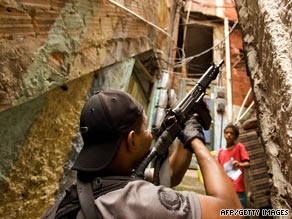
I find Boz's final sentence more interesting. I certainly think the drug gangs will challenge the police, but it's not like this is the first time that they've challenged police,given the military tactics used against civilians in the favelas, where it's not uncommon to see images like this one (from the CNN story):

A policeman advances through an alley of Rio on March 25, 2009, during an anti-drug operation.

Indeed, I once ended up on a city bus that passed through a favela in downtown Rio, and while it was as uneventful as most bus rides (and less eventful than some that never went near a favela), I was still alarmed to see military men with assault rifles poised just hanging out on street corners, alert but not in battle. You want to know the dynamics of the favelas? That picture hits it perfectly - a small kid who probably has nothing to do with the drug trade, a very well-armed individual from the military police, and somewhere unseen, actual drug lords. And kids like the one in this picture, along with old women and plenty of others untouched by the drug trade, are often killed (with some estimates hitting the thousands of innocent civilians dead).

But back to Boz's comments. Yes, they will challenge the police, and they have in the past, but, in spite of the major framing of this story, that's not what this event was. Yes, a police helicopter was shot down. But this wasn't even a case of police raiding a favela and violence erupting. This was a battle between drug gangs. The helicopter was shot down when flying over the favela to see what was going on, and as Boz himself points out, the helicopter getting shot down wasn't even intentional; according to reports, the bullets that hit the helicopter were basically stray bullets, and they weren't even from .30 caliber machine guns (though I agree with Randy that it's disturbing the gangs have this kind of weaponry, though again, it's not like the police haven't shown a propensity to murderous actions, too). With all due respect to Boz, he mistranslates that passage of the article, which reads [and I translate], "the helicopter was hit by light fire - nothing that was fired from a .30 caliber machine gun or that could have been caused by a rocket-propelled grenade found in gangs' arsenals."

So while some pitch a fit over Brazil getting the Olympics over Chicago in light of this weekend's events, they're completely out of touch with what the history, the context, and the meaning of this weekend's events. As Boz says, it wasn't some coordinated (or even uncoordinated) response to the Olympics; it wasn't even an attack initially launched on the police. It was gang warfare located away from the sites of the future Olympics that ultimately included the deaths of 3 police officers as well as at least 14 "traficantes" (though, as always, that title and/or figure is questionable). Is it a threat to the Olympics? No more so than every other incident of favela violence has been a threat to the Olympics, which is to say, not at all. The favela violence is kept to the favelas, and regardless of what you think of that, it does not mean anything to the Olympics yet. And the Brazilian government is not just ignoring this problem - today Lula pledged an extra $60 million to Rio to help combat violence in the city. This wasn't an internal "protest" to the Olympics, and it wasn't an event that should make anybody reconsider awarding Rio the Olympics. It simply was what all the other incidents of favela violence have been - sad episodes of violence, with plenty of blame to go around.


Sunday, September 20, 2009

Another Small Step in the Fight to Reign in Police Violence in Rio de Janeiro

It took four years, but this week, two former Rio de Janeiro police officers were sentenced to 500 years in prison for their roles in the massacre of 29 people in one of Rio's suburbs in 2005.

The ex-police officers joined three other former colleagues already sentenced to long terms in the case, which was dubbed the Baixada massacre after Rio de Janeiro's poor northern outskirts where prosecutors say a group of police officers fired on pedestrians, bar patrons and a crowd in a public square in 2005.
As the report also points out, nobody in Brazil can serve more than 30 years in prison, so the sentences for the two men (of 483 and 540 years) are obviously symbolic. Still, the fact that another case involving police killing innocents has resulted in prison is a small step in the right direction. Hopefully such cases will become more frequent, especially for those who kill innocents in the favelas.

Monday, July 27, 2009

Will Rio de Janeiro Be Held Responsible for the Violent Acts of Its Own Police Force?

In a ruling that could have major consequences on police violence and urban violence in Brazil, a court ruled that Rio de Janeiro was responsible for the stray bullet that hit Ana Maria Mendonça while she waited for a bus, and that the city must pay her $15,000 in damages. Judge Marco Antonio Ibrahim commented in the ruling:

"The city of Rio de Janeiro is caught up in a whirlpool of violence," Judge Marco Antonio Ibrahim said in his summation. "People are being assassinated by stray bullets in their homes, at bus stops, in schools, on beaches, and at football stadiums. Saying the state is not responsible is, in practice, blaming the victim."

Of course, the city has appealed the ruling, saying that "it cannot be held responsible for the 'omissions' of police officers." I have no idea how the appeal may play out, but it already seems that the judge's ruling is already on much stronger legal ground than the city's. If the police force is a part of the city's state apparatus, claiming that the city is not responsible for its own mechanisms is pretty ridiculous.

This may be one of the best ways to combat police impunity in Rio de Janeiro. While the state of Rio de Janeiro has recently taken several small steps in the effort to combat police violence, the city government has generally done little on its part to combat police violence; indeed mayors often win by appealing to the basest political rhetoric and policy that simplistically paints the favelas and the poor of Rio as the culprits of Rio's poverty and violence, rather than as victims. However, if the city is constantly having to defend itself against lawsuits alleging injury due to police carelessness, it could quickly force the city to start actively taking on a greater role in combatting police abuses, too.

With the appeal, the case could be overturned; again, it's hard to explain how the city is not responsible for its own security apparatus, but the ruling could also open the city to numerous lawsuits that it doesn't always deserve (after all, it isn't just the police who are armed in the favelas). Nonetheless, I think a member of Brazil's Lawyer's Association (the OAB, Organização dos Advogados do Brasil), Margarida Pressburger, hit the ruling's importance on the head:

Ms. Pressburger notes that the case ins [sic] not closed, and could well go all the way to the Supreme Court. But at the least, she says, authorities have been given a wakeup call."Finally, there is justice," she says. "We pay taxes so the state can guarantee our security. In the past, everyone has avoided taking responsibility. Now, someone has to pay."

Indeed - the innocent poor in the favelas and innocent bystanders nearby have paid enough. It's time for the city to start facing the consequences for its actions, too.