Showing posts with label Latin America. Show all posts

Friday, May 20, 2011

The Latin American Left

This is a very interesting piece on the state of the Latin American left, noting its extreme diversity but also its lack of central principles and its tendency to move toward the center.

My sense is that while a broadly conceived left is stronger in Latin America than anywhere else in the world at this point, and that it has made positive progress in many areas, like elsewhere it represents working people today less than ever before and essentially accepts global free market capitalism as a good thing. Exceptions such as Bolivia and Cuba are seen as outliers by the rest of the world, including other Latin American nations governed by an increasingly moderate "left."

Tuesday, February 01, 2011

Could Tunisia and Egypt Lead to Change in Latin America? Also, What About Food Prices?

Boz has a stimulating essay on the potential for the Middle East protests to spread to Latin America. He absolutely understands the massive differences between the two regions, but also suggests that 2011 could be a "year of crisis" for Latin America due to unstable governments and the inability of leaders to follow through on economic promises. He also rightly notes how a globalized media and access to information can spread tactics and movements around the globe in a short time.

Boz mostly writes about the potential impacts of widespread protests rather than speculate on precisely how they might come about. But he alludes to what I think may be the most important issue in the possibility of 2011 being a year of global instability:

If this is linked to global commodity prices and we think those prices are going to increase this year, then we could be looking at a very tough May or July or October that makes January 2011 look easy.

Bingo. Rising food prices have contributed on an immediate level to the Egyptian crisis. If you are irritated at your government anyway, the inability to feed your family 3 meals a day can be a real catalyst to get you in the streets. I absolutely see food prices being the single most important issue in global instability for 2011 at least and perhaps moving forward. Given that these rising prices are driven as much by speculation and the American need to turn corn into ethanol as actual food shortages, there's going to be good reason for people to be angry.

In a related issue, King Abdullah of Jordan has dismissed his cabinet, responding to protests that have stemmed in part from rising commodity prices. Kevin Drum notes that it makes political sense for leaders to subsidize food in order to ensure their political survival. On the other hand, Drum notes that this is less than ideal:


One of the staples of op-ed page commentary is complaints about third-world governments that subsidize food and fuel to keep prices down. It's inefficient! The market should set prices! And so it should. But events of the past couple of weeks certainly make the decision to subsidize a lot more understandable, don't they? If it's a choice between market efficiency and keeping your head off a pike, market efficiency is going to lose every time.

Really? It drives me crazy to see leading progressive writers accept free-market capitalism as fundamentally a good thing. Isn't it not only politically feasible but morally correct to subsidize food? Isn't ensuring citizens can eat one of the fundamental jobs of a government? We subsidize things all the time. Americans subsidize the oil industry so it can make massive profits. We subsidize farmers to produce as much corn as possible, even though they lose money on the product. In this particular case, the U.S. government is already subsidizing corn and other farm commodities, except that instead of ensuring low prices for consumers, we give the money to producers and to food companies in order to create new (and often disgusting) products out of this excess food.

So it seems to me that Drum is awful naive in stating that the market should set prices. Moreover, it's a legitimate argument that no, the market shouldn't set food prices.

Tuesday, February 09, 2010

U.S. Spending on Latin America

Plan Colombia has a fascinating post detailing the U.S. spending on Latin America generally, and U.S. spending on Latin America when you take Mexico and Colombia out of the equation. While general spending on the region will be almost $2.6 billion in 2010 and nearly $2.1 billion in 2010 (a 15% drop in spending), the non-Mexico/non-Colombia number plummet: $1.3 billion dollars budgeted for the region in 2010, and nearly $1.4 billion for 2011.

This is interesting for a few reasons; first, there's the fact that, apparently, federal spending on Colombia and Mexico constitutes almost half of the budget this year. That's not remarkably surprising, but the figures are still rather stark. I think it's also intriguing that spending on non-Colombia/non-Mexico countries next year actually increases, even while the budget decreases by 15%. Most of that spending is planned for social and economic programs, with almost none of it being military spending; by contrast, almost all of the spending on Colombia and Mexico is military spending (again, no surprise). It would be interesting to see a further breakdown of exactly where that money is going - aid to Central America seems fairly likely, while aid to Brazil may be relatively low, given how well Brazil's economy is doing. Still, it's a pretty interesting breakdown, and says a lot about policy in the region, especially with regard to where our military money is going and who we feel "only" needs social help.

Tuesday, December 15, 2009

Honduras: one bad apple, etc.?

I usually don't wade into the depths of Latin American politics around here, mostly because Trend and Erik do it so much better than I do. So I still don't have a heck of a lot to say on the subject--but I thought I'd share this from my day job.


GRITtv: Will the coup in Honduras create larger problems for Latin America? What will its effects mean for the rest of Latin America, a region trending leftward in recent years? Greg Grandin, Nation contributor, NYU professor, and author of Empire's Workshop and Fordlandia, Roque Planas of Latin American News Dispatch, and Sujatha Fernandes, Queens College professor and author of Cuba Represent! and the upcoming Who Can Stop The Drums: Urban Social Movements in Chavez's Venezuela join us in studio to discuss. We also have updates from inside Honduras from Andres Conteris of Nonviolence International and Democracy Now! and freelance journalist Elyssa Pachico reports from Chile.

Sunday, November 01, 2009

Trying to Explain the Honduran Crisis and Its Resolution

Many (myself included) have wondered what caused the sudden shift in attitudes between Zelaya and Micheletti that resulted in the agreement in Honduras this week, with Zelaya returning to office (pending the legislature's approval) after months of disagreement and strife. While I've yet to see any of the agents involved in the process coming out to explicitly state what the catalyst may have been, some people are offering explanations:

-This newspaper article suggests Micheletti had only wanted to stall the whole time, and that the possibility of tainted elections was a major factor in his finally agreeing to points which he had previously outright rejected over the previous 4 months. Although it doesn't explicitly say so, the suggestion that Micheletti feared the new government would be "tainted" does indicate one of the suggestions I made last week: that global opposition was pretty important here.

-Another argument that this article seems to be tacitly making is that the opposition among many within the Church played a decent role, too, in that he'd lost support among a major non-political (in the strictest sense of the word) group, too.

-Some Costa Rican sources (perhaps unsurprisingly) feel that it was Arias's efforts to craft an agreement all could accept throughout the summer that was important here, as it laid the groundwork for the current agreement.

-Finally, Greg points us to Raj's argument that it was the Honduran people themselves (and Zelaya to an also-important-but-lesser extent) that forced Micheletti's hand.

Each of these has its particular merits, but I think some are more important than others. While Arias's work is important in the grand scale, little has changed between his proposal in July and the current agreement, so while I think it did help lay the groundwork, I don't really see it as a catalyst. Again, little changed in the plan between July, when Micheletti refused to ever acknowledge it, and this week, when Micheletti suddenly had a change of heart. That's not to say Arias's role was unimportant over the entire process, but in terms of the events of this past week, I think it's pretty clear that the agency on this rests more on Micheletti and Zelaya than Arias.

Likewise, while gaining criticisms from the Church is an important factor, and while the timing is interesting (the Church condemns the human rights abuses under Micheletti just as the agreement is being reached), I think the timing is also coincidental.

I think La Opinion and RAJ get closer - Micheletti definitely wanted to stall as long as he could, and I think the growing opposition to any government elected under his regime played a role. Likewise, I think RAJ is on the right track in saying it was the Honduran people who forced the issue. Still, I don't find any one of these reasons compelling in and of itself, for a simple reason that perhaps seems wishy-washy, but that I think history has proven time and again, and that is:

Things are too complex for it to be any "one" factor.

Put another way, I think all of these factors, and numerous others, played a role. Honduras's economy and image has been hit hard with the global opposition to Micheletti, and while he was willing to weather that for 6 months or so, I think the prospect of the next four-year government also being jaundiced in the eyes of the world made Micheletti "change his mind" somewhat. He managed to achieve what he wanted (preventing any real reforms in Honduras under Zelaya, who will now effectively be a 3-month lame duck), and, perhaps perversely figured getting out now was what would be best for Honduras down the line (in what was perhaps the first time Micheletti was actually concerned with what's best for Honduras during this crisis). I wouldn't be remotely surprised to find out that this is effectively what the U.S. negotiators suggested, and that Micheletti, who's proven he isn't a political idiot (even if he's a repressive, semi-authoritarian, power-hungry man), saw the writing on the wall.

But again, that wasn't all. I absolutely think the Honduran people played a major role. In fact, I'd extend this beyond RAJ's argument. Time may prove me wrong, but I don't think it was just the people in opposition to the coup, or Zelaya, or leaders in the church; as I said on Monday, I'm fairly certain that business leaders may have played a role in this. Greg alludes to the power of informal contacts, and while he doesn't really buy into them in the case of Chile, I'm not convinced they didn't play an important part here. Just as Micheletti may have seen the trouble Honduras would face internationally if the elections happened under his regime, I'm sure business leaders also knew that four years of prejudice against Honduras would really hit them hard. This isn't to say the business leaders were more important than the Honduran people; after all business leaders are Honduran people, too. But I think this all gets at just how complex these processes in general (and this one specifically) are. Numerous groups within and outside of Honduras all had their own reasons for wanting to see this crisis finally come to an end, be it the political elites who feared Zelaya's attempted reforms, the people who stood up against Micheletti's repression, the business elites trying to protect their privileges, the international community standing up for democratic processes, or any other number of voices and opinions, and I think all of their voices played a role in the resolution happening, and happening this week (as opposed to July, September, or next January).

It well may take years for us to really understand the events of these past four-plus months in Honduras, though no doubt many explanations and efforts (including this one) will emerge among political scientists, historians, human rights activists, and others. While some will try to give more credit to one group than another, or explain the shift through just one group or catalyzing factor, I think at the end of the day, the answer to the question "why did the resolution happen when it did, and what caused it?" will be the same as the answer to so many other questions: "Well, it's complicated..."

Saturday, October 17, 2009

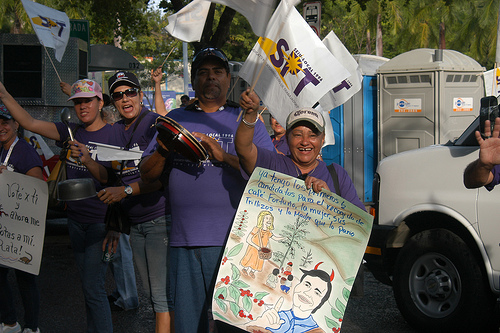
Puerto Rico On Strike


While CNN was obsessing over that damn Balloon Boy (who wasn't actually in the balloon and therefore was an even bigger waste of time than tea party protests), Puerto Rico had a historic general strike. Estimates range between 100,000-200,000 people in the streets marching. Of course, the corporate media ignored it. I wrote about it for Global Comment--as usual, I'll start the piece here and encourage you to read it over there, since they help pay my bills (and there's other stuff worth reading there as well!)

Fortuño’s plans fought: lessons from protest in Puerto Rico

I’ve seen a focus in the United States on mass political action in the past year like nothing I’ve seen in my lifetime. From the huge crowds at Barack Obama’s campaign rallies and the unprecedented amount of donors and volunteers that helped elect the man President to the recent cynical discovery of organized dissent by the Republican party, we’ve watched groups large and small take to the streets.

Whether this is a sign of a newly energized, engaged American body politic will take some time to say. After all, some demonstrations still receive more attention than others, with the right-wing media machine led by FOX News trumpeting the success and inflating the numbers of tea party protests while decrying protests from the left, and the purported liberal media spending a good chunk of time arguing those numbers and attempting to root out the funders behind the right-wing actions—often while genuine grassroots action goes on under their noses, ignored or even punished by those in charge.

Almost completely ignored this week was the one-day general strike in Puerto Rico following the attempted imposition of shock-therapy-style economic reforms by the new governor. Chief among those reforms was a decision to lay off more than 20,000 public employees. The layoffs would drive Puerto Rico’s already-astounding 15 percent unemployment rate to over 17 percent.

More than 100,000 workers took to the streets to protest on October 15–Eliseo Medina, Service Employees International Union Executive Vice President, told me he thought the crowd was over 150,000. “It was tremendous. I’ve been in the labor movement for 44 years and this was the most impressive event I’ve ever seen. It was up there with the immigrant mobilizations of 2006,” Medina said. “It was one of the most diverse events that I’ve ever seen in a society. Lawyers, workers, students, psychologists, priests and minsters and nuns and everyday people. It was truly an amazing sight. It was pretty clear, our rejection of Governor Fortuño’s policies.”


Read the whole thing.

Friday, October 09, 2009

Some More Thoughts on Obama's Nobel Peace Prize

To follow up on what Sarah said regarding the announcement of Obama's Peace Prize, I think a lot of her points are valid. Like the rest of the world, I was initially surprised. In face, my confusion may have outdone most others - I woke up to NPR this morning hearing the following: "Today, the following announcement was made in Sweden [long pause, during which I'm thinking, within the first 30 seconds of waking up, "Please say Philip Roth has finally gotten the Nobel Prize in Literature"]," only to find that Obama has won the Nobel Peace Prize.

Like just about everybody both left and right, my initial reaction (now within the first 60 seconds of waking up) was, "Really?"

However, I apparently seem to think this makes more sense than a lot of people (both left and right). I understand the arguments against it from both sides (well, I don't understand the total vitriol that's already coming from the right, but I expect it): it's too early, it's just a "here's a prize for not being Bush," "what's left if he actually does accomplish something?," "He has two wars going on and is about to escalate Afghanistan - how is that peace?" All of this makes sense to me, and I'd share those feelings, if I thought this was really just about Barack Obama the man's accomplishments.

But I don't. Not exactly, anyways.

This really does seem to be an award for a particular diplomatic approach that embraces more than multi-lateral talks and openness (though it certainly offers that, as well). Maybe others have forgotten, or maybe I've overstated its importance, but Bush's "cowboy diplomacy" approach was so appalling from an international relations standpoint and in terms of all reason and respect to the world, that Obama really does mark a major shift. Sure, he has failed at some important domestic policies (thus far, though to all those saying "a peace prize after only 9 months?? But he's failed at health care and reforms!", I'd remind them, "well, yes - but as you yourself admit, it's only been 9 months"). We have focused on this a lot, and rightfully so. But I think in doing so, there's been a (again logical) focus on the domestic side, what between the health care and the economy and don't ask/don't tell.

But from the international standpoint, I really can't emphasize enough how much a shift Obama is. He hasn't caved to pushes for more aggression against Iran, and even his apparently-possible escalation in Afghanistan seems to be actually well-reasoned and considered; even if you don't agree with it, it's not like he's just diving in, consequences be damned. And let's not forget - America was closer than it likes to think to electing a guy who joked we should "bomb bomb bomb, bomb Iran."

And while you can and should argue that in many ways, Obama's policies reflect a return to Bill Clinton's, I don't think that holds in the case of international relations. Obama has proven himself much more open and reasoned in his policy making than even Clinton did. It's about more than just being willing to talk to Chavez face-to-face at a meeting of the OAS, or have Bill Clinton pull some tricky negotiations to release hostages in North Korea, or find a path that the entire international community is willing to follow in dealing with Iran. Indeed, one simply has to look at Honduras since June. Obama has taken an approach to Latin American coups that the U.S. has never seen before - an open, non-partisan condemnation of what was clearly an illegal removal of a president, combined with a refusal to get directly involved by sending troops in. The U.S. had done this any number of times before, and every time, it was wrong to do so. For once, Obama relied on diplomacy, and even while condemning the actions, has refused to directly interfere in Honduras. Sure, he's had the State department take measures to restrict the aid and cash flow to Honduras from the U.S., but that's within his prerogative as president, all the while respecting Honduran sovereignty.

That sounds simple, unimportant; but from a history where the U.S. basically took every opportunity to meddle in, interfere with, and even directly undo democratic processes in Latin America from 1846 to 2002, this is a major, major shift. And it's representative of Obama's policies thus far - respect, doing what's within his power without overstepping the sovereignty of others, all the while working to maintain global relations. Honduras isn't the reason; it's symptomatic of the broader, subtle, but major shifts in how the U.S. is forging a new path in its diplomatic history under Obama.

In that regard, I think he's more deserving of the award than many. Is it too soon? I think that's a fair argument. Is it confusing? A bit (even after having awakened after a cup of coffee). Is there room for improvement? Of course - show me one person who's already perfect. That said, I think this is in part about Obama, and the (what I think is very real) change he brings to American foreign policy. But to focus on it just being about him is to miss the larger point, I think; it's also about embracing a major change in diplomatic relations between the U.S. and the world at large, a change that the U.S. initiated under the leadership of a particular man. And I'm fine with that.

Friday, July 24, 2009

Around Latin America

-It's been a really busy week. For starters, Manuel Zelaya has apparently returned to Honduras, but what's going to happen next is anybody's guess.

...UPDATE: Apparently he entered briefly, but has returned to Nicaragua to avoid arrest. We'll see what follows...

-Brazil has agreed to allow Paraguay to sell its surplus energy from the Itaipu dam to Brazilian companies other than the state-run Eletrobras. The Itaipu issue has been a stickler for years - Brazil needs more energy as it grows, and Paraguay has had a surplus thanks to the agreement to share power from the dam between the two countries when it was built back in the 1970s. Although Lula had originally said he would not review the contract from the 1970s when Lugo won election, he has since taken a more diplomatic stance (as is characteristic of his administration), and it now seems I was correct in suggesting that this would not be nearly the diplomatic crisis between the two countries that some scholars thought it would be.

-There's also great news on how Brazil has stemmed the spread of AIDS:

Two decades ago, it would have been hard to imagine finding an upside to an HIV crisis of the scope that Brazil had on its hands. The World Bank estimated that 1.2 million Brazilians would be infected by the turn of the century — by far the highest number of any country in the region. But today, there is plenty of good news to go around. Thanks to aggressive intervention, Brazil has only about half as many HIV cases as predicted. And the country's popular President Luiz Inácio Lula da Silva, or Lula for short, has taken the show on the road: HIV/AIDS assistance is becoming a powerful tool in the president's growing diplomatic chest.
The article traces how Brazil's government offered free antiretroviral medicine to victims beginning in 1996 and aggressively launching both treatment and prevention programs (in what is simultaneously a reminder that government health programs can and do work, and that even Fernando Henrique Cardoso got some things right in his administration). It also links those efforts to Brazil's broader diplomatic accomplishments since Lula took office in 2002, and is well worth reading in its (relatively brief) entirety.

-I've commented before on Brazil's efforts to build alliances with African countries. Those efforts have not gone unnoticed, as Mozambique President Armando Guebuza this week called Lula's government "a true ally and partner in the fight against poverty." I've said it before, and I'll say it again: when discussing Brazil's ascendance as a global economic and political actor, one cannot overstate the strides made via Lula's insistence on negotiating with any legitimate government, regardless of ideology, if the other governments had things to offer Brazil and vice versa. By refusing to exclude countries like Venezuela or China or the U.S. over ideological issues, Brazil has greatly strengthened its presence globally, and has made many friends where other countries and regions like the U.S., the EU, and others have been alienating countries. And Lula's focus on Africa has seemed genuine and useful for both Brazil and Africa, and I can only hope (though with baited breath) that the next Brazilian president will continue this trend.

-While things are goign smoothly between Brazil and Paraguay, the same cannot be said for Brazil and Budweiser's owning company, AmBev - the anti-trust organs in Brazil are hitting AmBev with a record-setting fine of $150 million reais ($79 million dollars US) for "anti-competitive practices" dating back to 2004 in Brazil. Although the fine only marked 1% of AmBev's 2003 income, the announcement was enough to make stocks drop in Brazil Wednesday.

-In broader economic terms, Latin America may have gotten some good news this week, as Nouriel Roubini, known as "Dr. Doom" for his depressing-but-ultimately-accurate prediction of the economic crisis the world began to face last year, offered some rare optimism in discussing Latin America's outlook:
Major emerging powers such as China, India and Brazil are among nations that may recover fastest once the global economy picks up, Roubini told reporters at the conference. He also mentioned Chile, Uruguay, Colombia and Peru as countries better- positioned to grow. Countries facing the biggest challenges include emerging markets in Eastern Europe, such as Hungary, Bulgaria and Ukraine, he said.
-In a stomach-churning story of despicable actions, a jury is considering a lawsuit against a Florida hospital that deported a brain-injured illegal immigrant back to Guatemala in 2003.

The lawsuit seeks nearly $1 million to cover the estimated lifetime costs of his care in Guatemala, as well as damages for the hospital's alleged "false imprisonment" and punitive damages to discourage other medical centers from taking similar action.

Jimenez was a Mayan Indian who was sending money home to his wife and young sons when in 2000, a drunken driver plowed into a van he was riding in, leaving him a paraplegic with the mental capability of a fourth grader. Because of his brain injury, his cousin Montejo Gaspar was made his legal guardian.

Jimenez spent nearly three years at Martin Memorial before the hospital, backed by a letter from the Guatemalan government, got a Florida judge to OK the transfer to a facility in that country. Gaspar appealed.

But without telling Jimenez's family - and the day after Gaspar filed an emergency request to stop the hospital's plan - Martin Memorial put Jimenez on a $30,000 charter flight home early on July 10, 2003.

The outcome of the case could play a major role in how hospitals deal with illegal immigrants in the future, making the case of major importance not just to health-care, but to immigration issues, as well as the basic decency of treating any person, regardless of nation, race, or creed, respectfully and tenderly.

-Many people are aware that the Atacama Desert is the driest place on earth; some parts of the desert in Northern Chile have never seen recorded rainfall. It is, suffice to say, extremely dry, and any rainfall can cause major problems. And I mean any rainfall, as this week, .001 inches of rain led to a state of emergency that led to power outages and school closings.

-In the "politically-charged pension awards" category, Argentina is giving a "special pension" to 18 individuals who hijacked a plane with the hopes of gaining control of the Malvinas/Falkland Islands back in 1966. "will grant a special pension to the nationalist group of 18 civilians who in 1966 took command of a commercial flight to Rio Gallegos and had it re-routed to the Falkland Islands with the purpose of taking over the Malvinas for Argentina."

-In the "racial stereotype? or just not funny?" department, apparently the "Yo quiero Taco Bell" chihuaha died this week at the age of 15. And in the funniest pet-news I've heard since learning that the lady-magnet Spuds Mackenzie was female, it turns out that that male-voiced symbol was "Gidget".

-Extinction of any species sucks. Here's hoping that the 90-something year old Galapagos giant tortoise "Lonesome George" is rescuing his breed from the brink of extinction.

-Finally, in touching and sad news, a woman has been arrested for killing twin Mexican midget wrestlers. El Espectrito II and La Parkita, 35, were found dead in a hotel room. Prosecutors suspect the anonymous, 65-year-old suspect and a friend posed as prostitutes and planned to poison the wrestlers to unconsciousness and rob them as part of a broader wave of female gangs robbing men. Unfortunately, the normal dosage of drugs to knock a man unconscious was enough to kill the two wrestlers. The memorials (fans showing up at the funeral in masks) have been touching, and for all the senselessness in so many violent acts, this one seems particularly senseless.

Thursday, July 09, 2009

Around Latin America (Now With Suriname!)

-For all the talk about the (il)legality of Manuel Zelaya trying to get a vote on whether or not Honduras should have two-term presidencies or not, Colombia has fallen by the wayside a bit. Nonetheless, efforts to amend the Colombian constitution to allow Alvaro Uribe to run for a third term continue, and the issue continues to cause some civil-but-intense debate in Colombia. The Catholic Church in Colombia has finally come out strongly against a third consecutive term for Uribe (though it seems open to the possibility of Uribe leaving after two terms and returning for a third later). I find it interesting that people who are so outraged at Zelaya simply trying to get a vote on whether Honduras should have two terms (even if it doesn't include him) are for whatever reason very quiet on the situation in Colombia. I think Lula put it best: "One re-election is understandable but two is monarchy." (And you'd think that, with comments like that, the right in Brazil would stop freaking out about Lula trying for a third term, but they haven't.)

-It happened awhile ago, but I was unable to get to it due to travels and then hosting travelers. The Peruvian Congress overturned President Alan Garcia's decree that would have opened the Peruvian Amazon (including large portions of indigenous reserves) to logging, oil drilling, and the construction of dams. The congressional vote was an overwhelming repudiation of Garcia's move, garnering an 82-14 vote in favor of overtuning the decree. The decree led to protests from Peru's indigenous groups, protests that escalated to violence and the deaths of upwards of 30 people, and even racist charges from within Garcia's administration that the killed Indians were not "victims". Not surprisingly, these events have led to Garcia "enjoying" the lowest poll ratings of his administration and one of the lowest in the world, as only 21% of Peruvians had a "favorable opinion" of Garcia after the clashes and the congressional vote.

-Yesterday, I commented on prosecutors going after human rights abuses within the Military Police in Brazil. Gancho has a similar report for abuses within the Mexican military and the challenges in effecting reform institutionally.

-There is good news on human rights abuses in Argentina, though, as the highest criminal court ruled that Carlos Menem's disgraceful 1990 pardon of the junta leaders during Argentina's "Dirty War" (during which the military government murdered as many as 30,000 civilians) was unconstitutional, and that the life-sentences for Gen. Jorge Videla and Admiral Emilio Massera should stand.

-Speaking of Argentina: Buenos Aires is commonly tourists' (especially European tourists') favorite stops when they go to Latin America. Gringos love it for a number of reasons, and while I'm perhaps too harsh or general in my assessment, those reasons usually have to do with the fact that Buenos Aires is "European," and so it feels more "civilized" (and my charges against tourists aren't baseless: I've honestly heard Europeans (and, to a lesser extent, Americans) describe Buenos Aires as "just like home," "more civilized," "better-built," and "cleaner." Really). I also know some portenos who hate how much Buenos Aires has basically become a playground for European and American tourists, leading to skyrocketing prices that make many of the "finer" parts of Buenos Aires inaccessible to Argentines. Well, a recent study reveals the very ugly side of Buenos Aires, the side tourists don't see/look for: four million people in Buenos Aires live in poverty, with 1.2 million classified as "indigent." Buenos Aires is a complicated place, and there are legitimate reasons to enjoy it and to dislike it. However, I've never seen anywhere that so successfully tried to conceal its racism and poverty so strongly while catering to Europeans. It's definitely one of the most disgusting aspects both of the global tourism industry (including the tourists) and of Buenos Aires itself.

-Just north of Argentina, there is an interesting effort in Brazil to create a second state-owned oil company. The proposed company, Petrosal, would "manage sub-salt oil assets," while Petrobras remained focused more on regular petroleum deposits, supply and demand, and regulation. I don't know if it would radically alter the structure or functioning of Brazil's largest state-owned company, but it is an interesting proposal as much from an infrastructural and developmental standpoint as from an economic standpoint.

-Also in regards to Brazil: in one of the fascinating vagaries of the globalized world, Indian companies are looking to outsource some of their IT centers to Brazil. Who knows - maybe down the line, tech calls for computer help will involve a Brazilian accent.

-I've written before about lawsuits involving banana companies and workers in Latin America before. While it's practically history now (it happened back in 2007), Suriname entered the fray, as former workers who lost their jobs in 2002 when the state-owned banana company Surland closed filed a lawsuit against Suriname's government, alleging they were underpaid on their back-wages. The lawsuit also alleged that the government (which restarted banana production in 2004) was firing employees who are trying to organize a union in the industry. I have no idea how this turned out. But we need more news from Suriname. (Seriously).

-Finally, a belated R.I.P. for Hortensia Bussi, the widow of Salvador Allende, who passed away on June 18 at the age of 94. Far from being a quiet victim, Ms. Bussi had been heavily involved in social justice before Allende's 1970 election, and continued fighting for human rights and social aid after his death.

Wednesday, June 03, 2009

OAS Readmits Cuba

Even small steps are important ones. And while Cuba may not automatically be in quite yet, this is more than a small step.

Two other quick things to note in passing: first, while the U.S. clearly isn't just welcoming Cuba in with open arms right away, I still can't express how exciting it is to see this country finally using sane, reasoned, rhetoric towards Cuba after more than 50 years. It may not be exactly the rhetoric some want to hear, but at least it's finally measured. Second, and more importantly, it's nice to see the OAS isn't a blatant bully-pulpit for the U.S. to demand smaller and "less powerful" states enforce U.S. policy throughout the region. This has been the case for way too long, and it's just amazing to finally be seeing the OAS functioning as a collection of nation-states, in which the U.S. is but one voice of many, some of whom are often at odds, working together to effect policy throughout the hemisphere based on broad interests rather than the sometimes-childish domination of one country.

Monday, May 18, 2009

Lots Going On Around Latin America

Regular writing on my own work has taken up most of my time lately, leaving me unable to comment in depth on some stories from Latin America lately (though I thank Erik for picking up some of my slack). Still, it seems worthwhile just offering another quick pointing to several stories of interest across Latin America recently, and hopefully, I'll be back to regular blogging soon (though it depends how writing elsewhere goes).

-To follow up on Erik's post, indigenous peoples in Peru have responded to Garcia's sending of the military to extract oil from indigenous lands by saying they will return to "ancestral laws" and interpret any invasion as an act of aggression.

-Things have gotten really ugly really quickly in Guatemala in the wake of the murder of lawyer last week. Rodrigo Rosenberg was killed while riding his bike, and a video of Rosenberg was released that said if he were killed, it was because president Alvaro Colom had ordered the killing. In response, mass protests calling for Colom's resignation and supporting Colom have burst out. The UN and the FBI are getting involved to help solve the case, while an individual who, via Twitter, recommended people withdraw their money from one of the banks (currently of major relevance to the events, as the assassination apparently involves Rosenberg, two of his clients who were also murdered, Colom, and charges of corruption) is under house arrest, charged with trying to spark a panic. Meanwhile, both Colom's supporters and his opponents are claiming the other side is propped up by money from drug cartels. I hope to have more analysis on this later, but right now, I fully agree with Boz: if there is any truth to any of these claims, then it means that the drug cartels have entered national politics in Guatemala, and that is nothing but bad news.

-Massive rains and flooding in the northeastern states of Piauí and Maranhão in Brazil have left 300,000 people homeless, and it appears no sign the waters will go down for at least a couple of weeks. Meanwhile, a recent drought in the Center-South has forced Brazil to increase its importation of gasoline from Bolivia for energy needs, as hydroelectric energy production has dropped.

-Chile marked the 50th anniversary of the Torres del Paine national park by increasing its preservation-and-maintenance funding from $60,000 to $800,000/year, and asked UNESCO to put the park on the wildlife heritage list.

-In more environmental news, Argentina has established quota limits for fishing on three types of fish, in an effort to try to stave off over-fishing and eventual extinction of these species.

Monday, April 20, 2009

Some Thoughts in the Wake of the Summit of the Americas

The Summit of the Americas wrapped up yesterday, and I have just a few preliminary thoughts on it right now.

-The meeting seems like a huge success (in the best sense of the word) for U.S. foreign policy and for creating a new form of U.S.-Latin American relations that we haven't ever really seen in our diplomatic history. As of yet, there isn't much talk about policy issues that were accomplished, but in many regards, whatever policy was or wasn't formed is irrelevant. The fact that Obama was pretty much able to talk to everybody and establish excellent, cordial, intelligent, and respectful links with the other leaders is seemingly mundane but amazingly important. After 8 years of non-relations and alienation under Bush, it seems to me that the U.S. is in its best position for Latin America ever; from the Latin American standpoint, it seems that the U.S. under Obama finally gets that the region is to be treated respectfully and equally, and not as some inferior region that the U.S. can impose policy on at will. What is more, Obama seems respectful and understanding of differences between countries, knowing that only one way ("my way") is not the only solution. And Obama's openness to listen to all leaders, be it Alvaro Uribe or Raul Castro, now and down the line, marks a major shift in the U.S.'s vision of Latin America, in which we aren't dividing leaders by "ours" or "not ours," but rather acknowledging that each nation has its own leaders, and even if they disagree with us or we with them, their and our legitimacy as potential collaborators is not diminished. Again, this was all talk this weekend, and policy could derail a lot of things, but U.S.-Latin American relations are in the best position I think they've ever been in. And that alone renders the Summit an unqualified success.

-That said, there's not much to say about the policy. I haven't read the Statement yet, but if Boz's analysis is fair, it's a massive failure (albeit one that can't take too much away from the successes of the weekend).

-The one specific area I've read some about is environmental issues. In dealing with energy issues this year, reports are that Obama listened more than offered his own suggestions, taking in what the regions leaders had to say, whether it was Lula discussing biofuels, or Mexico's Calderon continuing to push for a regional "energy market."

-Republicans still just don't get it, having begun to come out already in condemning Obama for his brief-but-congenial encounter with Chavez and his efforts to thaw relations with Cuba. For over 50 years, from the Cold War to the "war on 'terror'," a "with us or against us" mentality has been destructive diplomatically, economically, socially, and politically, and has often led to the deaths of thousands or hundreds of thousands throug the U.S's positions. While both Democrats and Republicans were guilty in the past, given the previous 8 years, Republicans have absolutely no pot to piss in when it comes to telling Obama how he should be running foreign policy, in Latin America or elsewhere. Until Republicans can prove they can come up with constructive policies (foreign or domestic) that actually take a stance other than "if Obama does it, it's wrong," then they have absolutely no political, moral, or ideological ground to stand on. [Although I didn't see it until after I wrote my own post, it turns out that Randy and I are in virtually complete agreement here.]

-If/As the details of individual meetings and discussions between become more available, I may have more. That said, again, even if the actual declaration was a dud, the Summit was great for the region, and one of the brightest beacons of hope for U.S. foreign policy in some time.

Wednesday, April 15, 2009

In Anticipation of the Fifth Summit of the Americas

The Fifth Summit of the Americas is coming up, and in anticipation of this, Latin American scholar Greg Grandin has an absolutely outstanding article up on how FDR could be a model for Obama in his Latin American foriegn policy, as well as the obstacles Obama is facing and the interest groups that may undermine real change. There are some absolutely fascinating bits in there in terms of little-known policy decisions (like how the anti-imperialist stance of Ernest Gruening, who would eventually be one of only two senators to vote against the Gulf of Tonkin resolution in 1964, came to play a major role in American diplomacy under Roosevelt and beyond), as well as depressing current news, including the role of American private interest groups (like the NRA) in Latin America and the efforts to use failed models like Plan Colombia (whose "success," as the article points out, is dependent upon the use of death squads) in Afghanistan, and even the impact immigration may have on the Summit of the America's.

Obama's behavior, statements, and agreements at the Summit will be of major importance to understanding America's direction - it's his first major (planned) diplomatic mission in terms of policy-making (this weekend's pirate-incident notwithstanding), and will really give us a sense of how much of a change Obama will bring in terms of international relations and foreign policy. What's more, it's his first and only chance to make a "first impression" with many leaders from Latin America, and he has a lot to overcome from the Bush administration, so the Summit is of tantamount importance not just to Latin America, but to Obama's administration and American foreign policy over at least the next four years and beyond.

I hope to have more up on the Summit of the Americas as time allows, but for now, go read Grandin's article - it's just wonderful stuff, and highly informative.

Tuesday, March 24, 2009

One More Example of Neoliberalism's Failures in Latin America

I may have more to say on this later today (though I invite Kim, Yann, Erik, and/or Sarah to join in if they have more to say), but, to go along with Sarah's posts, it should come as no surprise to anybody that neoliberal free trade policies may not be as helpful to Latin America as many people argued they would, and that "Nafta produced results that were exactly the opposite of what was promised." A policy that has effectively helped rich companies get even richer while paying less, ravaging workers' rights and living conditions, with economic, social, and political results that economists naively didn't see coming because the real world didn't actually fit into the model? Shocking, I know, but it does sum up a lot of what has been wrong with U.S. economic policy in Latin America in the last several decades of decades

Monday, March 23, 2009

Why I Study Latin American Dictatorships and Military Politics

There's no big mystery or moral crisis as to why I study Brazil. Through a series of happy accidents that aren't worth recounting in detail here, I discovered early in my graduate career that I really enjoyed Brazilian history, that it made sense to me, and that I was good at it. I opted for Brazil over Chile, and the rest is cheesily history.

But, as Erik pondered here, the explanations not just as to why I study dictatorships, or how I can, is more interesting, and more difficult. And quite honestly, at the end of it, I don't know. A lot of historians are fascinated by the dark, macabre side of history - I suspect that's what draws many environmental historians to their field. Likewise, labor historians probably find labor unrest more interesting than labor rest, and there's a reason that there are so many amateur (in the broadest and worst sense of the word) "military historians" out there. I think we historians generally just like things when they are at their messiest, most complex, most volatile.

But studying dictatorships has a particular oppression looming over it. Environmental destruction, strike-breaking, and war all have really ugly components. Yet, at least to my way of thinking (and I think a lot of people's more generally), dealing with issues like methodical torture, disappearances, and murders in lop-sided "battles" is really, really hard to deal with. I'm pretty sure every Latin Americanist who studies dictatorships (not just Southern Cone) passes through a phase somewhere in their professional path where they seriously worry, "is there something WRONG with me for wanting to study this?" At least for me, it wasn't just some passing question I waived off - it ended up involving some pretty heavy moral and philosophical reflection in my second year of my Master's. And I've known many people who started off wanting to study dictatorships, but once they really got into how awful those governments could be, they opted out, choosing to focus on some other issue either topically or temporally (or both).

Ultimately, those of us who really want to study these things in depth find many ways to deal with it. Partly, you take comfort in the fact that, if those who survived this made it through some of the most brutal tortures you could imagine, then you can too. In part, there's a wish to overcome the frustrations, the horrors, the complete despair in the face of some of the despicable acts humans can perpetrate against other humans, because I (we?) believe that, if we can just teach others about these horrors, then maybe we're taking some small step to preventing their repetition. There is also the fact that you learn and understand the complexities of the issues, so the fact that the French or Americans taught many of these torture techniques leaves plenty of blame to be spread around. And, at least in the case of Latin America, we have other areas we don't study that seem even more horrific. The 30,000 dead in Argentina is terrifying and brutal, but we can still say, "well, at least it's not Stalin, or Pol Pot."

Ultimately, none of this satisfactorily answers the question, "is there something wrong with me?" But at the end of the day, it's much better to be teaching others about the torture and murders that happen in dictatorships than to be perpetrating them in the name of a government.

The Shock Doctrine 6: Entirely Unrelated

(Previous posts here, Matt's posts here, Trend's "How to Overthrow a Government" here.)

Since Klein's chapter here notes how the Nobel Prize for Economics legitimized Friedmanism and cleansed it of its taint of involvement with the horrors of the Pinochet regime (after Amnesty International won the Nobel Peace Prize for its work against Pinochet), I thought it was only right to quote another Nobel Prize-winning economist on Friedman.

Paul Krugman wrote,

"Keynesianism was a great reformation of economic thought. It was followed, inevitably, by a counter-reformation. A number of economists played important roles in the great revival of classical economics between 1950 and 2000, but none was as influential as Milton Friedman. If Keynes was Luther, Friedman was Ignatius of Loyola, founder of the Jesuits. And like the Jesuits, Friedman's followers have acted as a sort of disciplined army of the faithful, spearheading a broad, but incomplete, rollback of Keynesian heresy."


Krugman is a little bit intellectually dishonest in this piece, I think, mentioning Chile briefly and all but ignoring the abuses of the regime while poking at Friedman's failures there, but this shows exactly what Klein is talking about in this chapter. As here:

"Similar questions about the lack of clear evidence that Friedman's ideas actually work in practice can be raised, with even more force, for Latin America. A decade ago it was common to cite the success of the Chilean economy, where Augusto Pinochet's Chicago-educated advisers turned to free-market policies after Pinochet seized power in 1973, as proof that Friedman-inspired policies showed the path to successful economic development. But although other Latin nations, from Mexico to Argentina, have followed Chile's lead in freeing up trade, privatizing industries, and deregulating, Chile's success story has not been replicated.

On the contrary, the perception of most Latin Americans is that "neoliberal" policies have been a failure: the promised takeoff in economic growth never arrived, while income inequality has worsened. I don't mean to blame everything that has gone wrong in Latin America on the Chicago School, or to idealize what went before; but there is a striking contrast between the perception that Friedman was vindicated and the actual results in economies that turned from the interventionist policies of the early postwar decades to laissez-faire."


"Everything that has gone wrong in Latin America" clearly is a euphemism for the abuses of the people, and "what went before" is the developmentalist/socialist state of Allende.

Still, I didn't start this to beat up on Krugman, just to use him to illustrate a point. It's simply not allowed for anyone, even a high-profile progressive who has no problem attacking others (:cough: Obama) to question whether Friedman was "a great man," let alone to imply that he might've been willing to collaborate with disgusting regimes with full awareness of their abuses.

Klein goes on to discuss Amnesty International and the rise of nonpartisan human rights watchdog groups, who were forced to prove their lack of partisanship by only being allowed to critique the abuses, not the governments that perpetrated them and the larger framework under which those governments operated.

This reminds me of nothing so much as the tendency of the US military to blame abuses of detainees on "a few bad apples" and ignore the larger, systemic flaws. And we see this now going on with our own economic policy.

Human rights abuses connect with economic policy abuses very easily: laissez-faire economics favors the rich and its supporters, and writes off as bad in itself the idea that people should care what happens to those poorer than they. If we should not care about what happens to poor people as far as paying bills and feeding kids, why bother worrying if they simply disappear off the streets? (Of course, things went the opposite way in repressive Communist states--those who dissented were counterrevolutionaries who were out to hurt the people and must be reeducated or removed. Either way, the idea they would pollute the whole is significant.)

Klein also notes the involvement of philanthropic groups in this scrubbing of human rights talk from left-right ideologies. The Ford Foundation, she notes, was funding both the programs that trained economists in Friedmanism and the human rights groups arguing against the regime's excesses. It was possible to critique the violence, but never to connect the dots.

Klein writes,
"In a way, what happened in the Southern Cone of Latin America in the seventies is that it was treated as a murder scene when it was, in fact, the site of an extraordinarily violent armed robbery."


It is impossible, she notes, (and cites such voices as Simone de Beauvoir for support) to rule a people against their will without violence. It is impossible too to take away social supports they have grown used to without violence. The violence stems from the ideology that says you do not have to care what happens to the others, you just take care of yourself.

Krugman again:

"When Friedman was beginning his career as a public intellectual, the times were ripe for a counterreformation against Keynesianism and all that went with it. But what the world needs now, I'd argue, is a counter-counterreformation."


He's right. But he does not take it far enough. What we need is not just a counter-counterreformation of economics, but one that links everything in the chain together. An understanding that people have basic needs and rights and that the job of government and economic policy is to provide for those needs and protect those rights for ALL, not just for the people who can afford to have them protected. The anger over bonuses and such is for the first time properly directed: at the rich. Now we have to direct that anger in the right direction and use it to change policy, not just opinion polls.

Tuesday, March 10, 2009

Latin American Photographers Distinguish Themselves Globally with Amazing Photos in 2008

A couple of weeks ago, the Latin Americanist pointed out that several Latin American photographers who first prize for their photos in the World Press Photo contest (I had previously put up one of a sequence of these photos here before). The winners included Luis Vasoconelos of Brazil, for his images of police evicting a woman with child in arms; Lissette Lemus of El Salvador, for her image of schoolchildren in a van passing the body of a dead woman in the street; Argentine Walter Astrada's image of post-election protests in Kenya; Carlos Gutierrez's amazing photo of a volcanic eruption in Chile; and Mexico's Carlos Cazalis, who did a series of remarkable photos of Sao Paulo's homeless. The overall photo of the year went to Anthony Suau for his stunning photo of an armed sherriff in Cuyahoga County (Cleveland's county) going through the home for an eviction.

And you can see all of the photography winners (including non-Latin Americans) from last year here.

Sunday, March 08, 2009

The Shock Doctrine 4: States of Shock


“If that track record qualifies Chile as a miracle for Chicago school economists, perhaps shock treatment was never really about jolting the economy into health. Perhaps it was meant to do exactly what it did—hoover wealth up to the top and shock much of the middle class out of existence.” - The Shock Doctrine, page 105


(Previous posts here, Matt's posts here, here and here.)

Trend gave us an excellent rundown of the events in Chile that led to the Chicago School takeover of its economic policy, so I don't need to sum that up here.

Pinochet embraced the Chicago Boys' prescription for Chile's economy, according to Klein, because he liked the idea of a complete revolution rather than a temporary correction. He drove out the other members of the junta and appointed several of the Friedmanites to high government positions, and privatized, slashed social spending, and deregulated. This, predictably led to...

inflation, unemployment, and poverty. So the solution? MORE privatization, deregulation, and slashing social spending. Oh yes, and a calculated terror campaign in which thousands of people were "disappeared." Argentina, Uruguay, and Brazil followed soon after, though some of them took notes from Pinochet and attempted to conceal their torture and murder under a blanket of plausible deniability--in order to stay open to foreign investment, of course.

Klein points out that for all Friedman's free-market utopianism, what resulted was more corporatism than purist capitalism. The countries were run by repressive regimes with deep ties to the corporations who profited from them. Sound familiar? (Well, minus some of the repression.)

The parallels with Bush's disaster capitalism are easier to see when you phrase it in these terms. Bush didn't need a coup (just a disputed election) when September 11 happened (coincidentally, exactly 28 years after the coup in Chile started radical capitalist experimentation).

Warrantless wiretapping certainly isn't mass disappearances of citizens, but it is a tool that keeps everyone in fear that they are next. It suppresses dissent and keeps people in fear for their basic safety, while around them their economic safety net is dismantled. America hadn't undergone enough of a shock to allow, for instance, Social Security privatization, but in Chile and the other Friedmanite regimes, torture and repression left people unable to fight back.

Roger Cohen in the New York Times (h/t Matt) referred to Obama's "counter-revolution," an interesting choice of words considering that The Economist called the spread of disaster capitalism in Latin America its own "counterrevolution."

Which revolution is Obama countering, then? The Reagan revolution, perhaps, since even Bill Clinton furthered Reaganite principles of deregulation and privatization and slashing social programs (:cough: Welfare reform)?

Friday night, I attended a panel discussion put on by The Nation in New York. It featured Joseph Stiglitz, Barbara Ehrenreich, Bill Fletcher, Jr., Jeff Madrick and Chris Hayes discussing the economic meltdown. Stiglitz referred repeatedly to the economic situation in the 70s in Latin America as what we need to avoid--and what we are in danger of repeating.

Madrick noted as well that "This is not recession as usual. This is not recession-plus as usual," but Ehrenreich reminded us that "It's always folly to say this is the end of capitalism."

She went on to note that "What we have to shake off is the curious religion that is market fundamentalism," and Fletcher referred to "the great crap game that is called capitalism."

The fact that there was a line around the block for this event says something about the times, and the amount of little white note cards with audience questions that Hayes had to sort through was evidence that people are scared right now. I fear what this situation would look like at the moment with McCain in office, and the panelists all agreed that it is hard to criticize Obama because he's so much better than what we've had for the past however many years (Madrick pointed out that the standard of living for most Americans has been declining since 1974--in other words, we were better off under NIXON).

Still, the more I read through The Shock Doctrine, the more I realize the parallels. Naomi Klein was supposed to be at this event, and she would've fit in quite well between the economists and the socialists, diagnosing not only the technical problems with our current situation, but the moral and ideological problems there as well.

But the panel on Friday night gave me hope because it proposed solutions. Because we talked about a return to a living wage, a resurgence in unions (EFCA battle coming to a political theater near you), real health care (ditto), and a change in our banking system--a return to "plain vanilla" lending, Madrick called it.

"What are the social functions which a good financial system should serve?" Stiglitz asked, and Milton Friedman might have rolled over in his grave. Still, these are questions being asked right now, and the people in power for the first time in my lifetime may actually be willing to attempt an answer.

Saturday, February 14, 2009

Have We Seen the End of the Monroe Doctrine?

Foreign Policy In Focus has a fascinating brief editorial up by Philip Brenner and Saul Landau. In the article, the two men recommend Obama declare the official end of the Monroe Doctrine: "Obama could swiftly improve U.S. relations with Latin America by announcing the death of the Monroe Doctrine and then presiding over its funeral. Such a statement would cost him little domestically, and win him praise and appreciation throughout Latin America and much of the world."

This is a really interesting suggestion. Just off the top of my head, it strikes me that the "Monroe Doctrine," and, perhaps more importantly, the "Roosevelt Corollary," has not been less relevant to American Policy has not been this irrelevant and absent in American policy and rhetoric since at least the Great Depression - well before the atomic bombs, the Cold War, Castro, the collapse of the Soviet Union, etc. If Obama were to declare the end of the Monroe Doctrine, it very well may cost him little domestically. I suspect some Republican politicians and advisors would claim that Obama was "sacrificing security" in the "war on terror," but I just don't see how the American electorate could or even would care about this, even if Republicans shouted about how horrible it was until they are blue in the face. Joblessness is up, incomes are down, the economy is in the tank with no sign of improvement in the near future, health insurance is prohibitively expensive - I just can't see people putting this all aside to say, "No! Not the Monroe Doctrine!" And certainly, it would probably garner some goodwill within Latin America, though how much, I'm not sure - there's already a lot of goodwill right now directed towards the new administration, simply for being not-Bush.

I think towards the end, the brief article implies that, in many ways, the Monroe Doctrine is already in many ways dead. As I said above, since 9/11 and the "War on Terror," America's focus has shifted, and the Monroe Doctrine probably hasn't been as insignificant since the 1930s. And, as I've commented before, the Bush administration's focus on the Middle East and the Islamic World has been of great importance in helping Latin America establish its own political and economic autonomy without the U.S.'s interference.

I would go even further than Brenner's and Landau's explanation, though. It's not just that Lula, Hugo Chavez, Evo Morales, Nestor and Christina Kirchner, Fernando Lugo, Daniel Ortega, Rafael Correa, and others have overseen an unprecedented level of non-involvement from the U.S. politically. The development of Latin American economies independently of U.S. involvement has also effectively killed off the Monroe Doctrine. Many times in the past, we have used the Doctrine/Corollary not to defend simple political interests, but economic interests as well (such as the 1954 overthrow of Guatemalan president Jacobo Arbenz to protect in no small part the controlling interests high-ranking members of the Eisenhower administration had in banana production there, or the defense of American industries in Cuba prior to the Cuban Revolution). As Bush sent the U.S. into trillions of dollars of debt with ridiculous tax cuts and obscene spending in futile military involvements, Latin American economies began booming with trade, not just within their own region, but with partners in Africa, Europe, and, probably most importantly, China. All of this helped Latin America as a region to move from its traditional role as an exporter of primary goods to more diversified exporters and importers, giving countries like Brazil and others a stronger and more equitable role in the global economy. In effect, the current economic role Latin America has assumed has played an even greater role in rendering the Monroe Doctrine a dead letter than the elections of this decade.

Just to clarify, I don't think the declaration or actual "death" of the Monroe Doctrine means the U.S. will never ever try to influence the political landscape of a Latin American country again. It takes a pretty naive view of international relations and an enormous ignorance of American history to presume that any powerful nation (which still includes the U.S.) will not try to work for the outcome that's most satisfactory to its interests, including direct or indirect pressure when possible. By that same token, though, it genuinely feels like the era of the U.S. support of any leader (including dictators) who kowtows to our geopolitical and economic visions is over, and I think the Bush administration, the rise of the so-called (and falsely-treated as unified) "left" in Latin America, and economic development in the region have played an enormous role in this shift. Declaring the end of the Monroe Doctrine publicly may be little more than a symbol at this point, but it would be an important symbol that could play an interesting, and perhaps even important, role in re-shaping our relations with Latin American countries. I don't see any evidence that Obama will do it, but it would be a great way to mark the changes that have already happened in U.S.-Latin American relations.

Sunday, February 08, 2009

To Hell with Good Intentions

Sorry I haven't been writing, but I haven't had internet access since last weekend...  On Sunday all the students in my study abroad program traveled to a small rural town called Ixtlilco el Grande, where we stayed until Wednesday.  While we were there we stayed with families, many of whom didn't have running water or refrigerators let alone any luxuries.  Then we moved to an ex-hacienda which had been turned into a resort/hotel, where we stayed for two nights.  At the ex-hacienda, we had various conversations about cultural issues and such, one of which was based on Ivan Illich's article "To Hell with Good Intentions."  

Many of the students in my program are Social Work majors, so they obviously rejected the notion that there is nothing we can do to help other people.  But I also think it's really important to recognize that even trying to help often does damage.  One student told a story about a village where a bunch of do-gooders put in a well for easier access to water, and they probably expected a giant "Thank you, you've saved our lives."  But actually the women were really unhappy with the well because it took away the time that they previously had to bond with the other women in the village when they went to the river for water everyday.  
Similarly, I heard of someone who visited a small rural town (much like Ixtlilco) and noticed that there weren't any recycling bins.  So in her quest to "green" the town, she organized a project to have them collect their recyclable materials, but it took eight months for them to gather enough to make it worth anyone's effort to haul it off to be recycled.  Because the people of the town were forced to make their money stretch as far as possible, they lived by the first two R's of "Reduce, Reuse, Recycle."  And because of that, they most certainly are much "greener" than any city with a shopping mall and a lame-ass recycling program.  
I don't agree with Illich that there is nothing we can do.  I think that there are a lot of really good programs that are doing a lot of good things for the people of Latin America.  But successful programs need to based on the needs of local peoples, not the "needs" that foreigners see.  Solving Latin American problems with U.S. solutions will never work.