Showing posts with label capitalism. Show all posts

Monday, February 07, 2011

Please, Giant Multinational Corporations With No Incentive to Stay in America, Come Back to the U.S.

Obama's plea to the U.S. Chamber of Commerce to be patriotic and bring jobs back to America is a total joke. The government itself has provided every incentive for companies to move jobs to developing nations for at least 40 years. The Obama Administration, with its newfound fear of angering the business world, has done nothing to change this. Playing on the patriotism of people whose only country is called Cash is embarrassing.

I have little doubt that CEOs are presently smoking giant cigars, drinking scotch, and laughing their asses off at Obama's plea in their smoky back rooms as I type this.

As a commenter to the linked piece says: "Perhaps they will grow white fluffy wings and descend to sprinkle us with flowers and distribute heavenly manna."

Indeed.

Tuesday, October 27, 2009

Pro-Capitalist Propaganda, circa 1948


This is absolutely fantastic. Very much worth your 9 minutes. I love Cold War propaganda. There's an excellent set of Soviet animated propaganda on DVD. It's out there in part because people see it as so quaint today that there's a market for it. This is just as bizarre. Really there's little difference except that the artistic merit of the capitalist propaganda is less than the communist stuff.

Via Sociological Images

Saturday, October 17, 2009

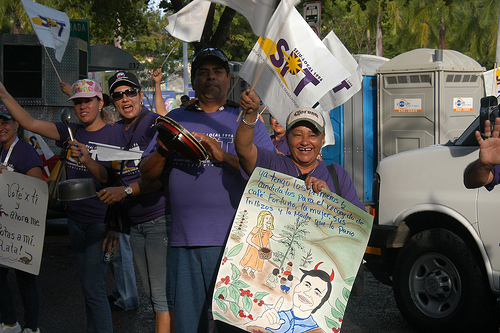
Puerto Rico On Strike


While CNN was obsessing over that damn Balloon Boy (who wasn't actually in the balloon and therefore was an even bigger waste of time than tea party protests), Puerto Rico had a historic general strike. Estimates range between 100,000-200,000 people in the streets marching. Of course, the corporate media ignored it. I wrote about it for Global Comment--as usual, I'll start the piece here and encourage you to read it over there, since they help pay my bills (and there's other stuff worth reading there as well!)

Fortuño’s plans fought: lessons from protest in Puerto Rico

I’ve seen a focus in the United States on mass political action in the past year like nothing I’ve seen in my lifetime. From the huge crowds at Barack Obama’s campaign rallies and the unprecedented amount of donors and volunteers that helped elect the man President to the recent cynical discovery of organized dissent by the Republican party, we’ve watched groups large and small take to the streets.

Whether this is a sign of a newly energized, engaged American body politic will take some time to say. After all, some demonstrations still receive more attention than others, with the right-wing media machine led by FOX News trumpeting the success and inflating the numbers of tea party protests while decrying protests from the left, and the purported liberal media spending a good chunk of time arguing those numbers and attempting to root out the funders behind the right-wing actions—often while genuine grassroots action goes on under their noses, ignored or even punished by those in charge.

Almost completely ignored this week was the one-day general strike in Puerto Rico following the attempted imposition of shock-therapy-style economic reforms by the new governor. Chief among those reforms was a decision to lay off more than 20,000 public employees. The layoffs would drive Puerto Rico’s already-astounding 15 percent unemployment rate to over 17 percent.

More than 100,000 workers took to the streets to protest on October 15–Eliseo Medina, Service Employees International Union Executive Vice President, told me he thought the crowd was over 150,000. “It was tremendous. I’ve been in the labor movement for 44 years and this was the most impressive event I’ve ever seen. It was up there with the immigrant mobilizations of 2006,” Medina said. “It was one of the most diverse events that I’ve ever seen in a society. Lawyers, workers, students, psychologists, priests and minsters and nuns and everyday people. It was truly an amazing sight. It was pretty clear, our rejection of Governor Fortuño’s policies.”


Read the whole thing.

Tuesday, May 26, 2009

The Shock Doctrine 11: Democracy Born in Chains

(Previous posts here, Matt's posts here, Trend's "How to Overthrow a Government" here.)

I know, it's been a while. I've been busy, and while I still am, I had a moment this weekend to relax and read and I caught up on Shock Doctrine so I could post more for all of you. Look grateful.

This week's chapter is about South Africa, and I don't know enough about South African history to really critique Klein's position. However, I know someone who does, and so I asked Shenid Bhayroo, professor of journalism at Temple University, to tell me what he thought of Klein's take on his country.

Here's some of what he told me:

To the analysis of South Africa: I would argue that Klein's "shock" metaphor does not adequately explain the post-1994 political economy of South Africa. First, her analysis, in the book as a whole and for South Africa, begins circa 1970s. This is curious, in the case of South Africa, since this disregards the significant anti-colonial, anti-apartheid history dating back to the post-WWII years. In particular, the role of the independent trade union movement, the socialist left in South Africa, and individuals such as Steve Biko.

Second, the now-ruling party, the ANC, never capitulated to the policies of the IMF and the World Bank. On the contrary, the former liberation movement never advanced a leftist, let alone a socialist, agenda. The ANC (African National Congress, the South African Indian Congress, the Coloured People's Congress) created with popular support in 1955 the "Freedom Charter." This document addressed the many injustices of the Apartheid system and created a set of principles (the Charter) that would form the framework of a "new" South Africa. The Freedom Charter represents a minimum set of demands/principles for a democratic society, with human rights for all citizens. It is a populist document, reflecting the minimal demands/requirements of a "free" society.

More than a "shock doctrine" of SAP's and high interest loans, the current political economics we now have in SA is the consequence of the system of Apartheid, which in turn was a manifestation of rapacious capitalism - as evident by the exploitation of the millions of working class (black) workers. Labor laws, the education system, the health care system, the economics of the system were engineered so as to facilitate the development and entrenchment of a ruling elite--both economic and political. The transition to a post-Apartheid South meant that the ANC could deliver on its promise to build on and expand political power for the "people." This it has done to a large degree. (BTW: In the last two general elections I voted for the ANC). But the government has not done the same for economic freedoms. Hence the scourge of corruption, the emergence of a wealthy black elite, and the lack of real empowerment of the working class.

Thus, I would argue that the shock doctrine thesis oversimplifies the ANC's economic agenda - which from the outset sought to assure foreign investors that a "free market" would prevail in post-Apartheid South Africa. In fact, large scale privatization of public resources took place in the early years of ANC rule in South Africa. The ANC was never substantively critical of the fundamental policies of the "free market," or for that matter critical of the system of capitalism.


As Dr. Bhayroo points out, Klein does stress that apartheid itself was an economic system, but she doesn't make much of an effort to look at the internal critiques of that system. She does mention the boycott strategy, which held corporations accountable for doing business with the apartheid government, but as Rushkoff notes in Life, Inc. this sets up a dichotomy of good corporation/bad corporation, when really the existence of the massive corporations AT ALL is inherently problematic.

In other words, separating corporatism/radical capitalism from human rights violations, as Klein notes in earlier chapters, doesn't work. As long as the post-apartheid government, or the post-Bush government here at home, still believes in "markets" (by which they mean the right of state-subsidized corporations to exist) then the problem will never completely be solved. Corporate capitalism requires an underclass to do the low-paying work it thrives on.

How does this relate to the U.S.? Torture--as in our current discussions of the proper response to Bush Administration torture--is not the main problem. It's a symptom of the sickness. Maybe the most obvious outward one, but a symptom nonetheless. We cannot separate the torture from the rest of the decisions made by the government. It is a symptom of a world in which corporate power is absolute and people don't matter except for what one can get from them. A commission on torture that obsesses over who knew what and when misses the entire point. Of course Pelosi was in some degree complicit--of course Obama is. We still have the same system in control.

"I think when you focus on torture and you don't look at what it was serving, that's when you start to do a revision of the real history."
-Yasmin Sooka, South African Truth and Reconciliation Commission, quoted in The Shock Doctrine

Sunday, April 12, 2009

The Shock Doctrine 9: Crisis Works

(Previous posts here, Matt's posts here, Trend's "How to Overthrow a Government" here.)

"The more the global economy followed [Friedman's] prescriptions, with floating interest rates, deregulated prices and export-oriented economies, the more crisis-prone the system became, producing more and more of precisely the type of meltdowns he had identified as the only circumstances under which governments would take more of his radical advice.

In this way, crisis is built into the Chicago School model. When limitless sums of money are free to travel the globe at great speed, and speculators are able to bet on the value of everything from cocoa to currencies, the result is enormous volatility."


On page 200, Naomi Klein nailed it. Well, the whole book is an exercise in nailing it, really, but these two short, simple paragraphs made me stop and shake my head yet again in amazement that anyone bought the argument Bush, Paulson, and others made that "no one could've seen the current crisis coming."

The Shock Doctrine is many things, and at first it doesn't appear to be a guide to internal U.S. policy, but as I've read on, I keep picking out more and more bits and pieces of the crisis we're facing--Klein could go back and write a history of the current crisis without having to do much new work.

This chapter, for example. Klein starts out noting that hyperinflation crises around the world became excuses for the IMF and World Bank to step in and use the crisis as a reason to push their preferred policies of deregulation, privatization, spending cuts and "free trade."

Friedman did not believe in the IMF or World Bank, but his students used them to carry out his policies. IMF was supposed to stabilize the global economy, yet instead it carried out more shocks, holding loans over countries' heads and forcing them to enact Friedmanite "reforms."

Countries were required to pay the debts of their oppressive governments after liberation--sort of like finally divorcing your abusive spouse only to find out that he's left you in thousands of dollars of credit card debt. I've likened the feeling at Obama's inauguration to finally getting rid of an old abusive relationship and starting a new one. That overwhelming relief and optimism. It must've been hundreds of times stronger for Chile and Argentina when their murderous regimes finally collapsed.

And then? In 1982, Argentina's new government agreed to pay the debts of large multinationals while the companies kept their assets--firms like, um, Citibank. Sound familiar? Scarily so.

And the shocks just kept on coming. Paul Volcker--yes, the one who is one of Obama's advisers--let interest rates skyrocket in the early 80s. Since these countries had been pressed into relying on one export for their entire economies, any time a price shifted, economies went into freefall. And the IMF and World Bank, counter to their original purpose, forced even more volatility down their throats in the disguise of "helping."

Free markets are volatile. That's part of the problem, and why unregulated capitalism just doesn't work. Companies fail. This is part of capitalism. Small businesses fail every day--I watched my family business crash and burn in the 90s. No one bailed us out. The less support and regulation you build into the system, the more likely wild price spikes and drops are going to run people out of business. Rebuilding the system the same way it has been is not enough. "Recovery" isn't going to cut it.

I watched MSNBC's new Ed Schultz show for a while the other night when it replaced Olbermann, and I swear I'm never going to complain about Olbermann being a blowhard again. (OK, I still will, but allow me my hyperbole.) Schultz really was the liberal version of a Fox News show, stocking his segments with radio hosts from both sides of the aisle who shouted at each other like Crossfire had returned, and running a segment on immigration with Al Sharpton and three white people. Seriously.

But aside from my critiques of the program, I was also troubled by Schultz's exultation that Wells Fargo (a company that was never in serious trouble to begin with until it bought up troubled Wachovia) is making a profit and will be able to pay back TARP money.

Only problem is, the TARP was Bush's plan, enacted by Secretary of Goldman Sachs the Treasury Henry Paulson. It was the original absorption of bad debt by the government, while allowing the companies to keep their profits.

So while it's good news, sure, that we might get some of that cash back, it hardly means the crisis is solved, let alone that Obama's (read: Geithner/Summers's) plans are working.

We don't want to sound like Rush Limbaugh, so we don't say that we hope the Geithner plan fails. No, we want it to succeed. We even want the TARP to succeed. We're good progressives and we care about the actual people being hurt by the crisis too much to harp on ideology. But at the same time, will it be enough for our system to just go back to where it was? It requires change. Change that wasn't an original part of the Obama plan (clearly--look at his financial team) but that we must now press for, not least because if we don't see this crisis as an opportunity, the other side will.

Klein's work has clearly taught us that.

Monday, April 06, 2009

The Shock Doctrine 8: The New Doctor Shock

(Previous posts here, Matt's posts here, Trend's "How to Overthrow a Government" here.)

I passed up the chance to see Jeffrey Sachs speak at Temple this weekend and now I'm quite happy I did. After this chapter, anyway. Sure, he's changed his tune lately, but I'm still reminded of the fact that so-called "progressive" economists still pay plenty of fealty to Friedman's ideas.

Anyway, this chapter is about the "New Doctor Shock," and that would be Sachs. It's kind of frightening to think that the man who wrote this so recently:

The great scholars of capitalism, from Adam Smith to John Maynard Keynes, understood full well that a functioning economic system depends not on greed, but on moral sentiments and an acceptable social contract between the rich and the rest of society. The rich can make money, of course, but they must not flaunt it or consume it frivolously. Instead, they must invest their wealth for social benefit, whether in business or in philanthropy, or in both as in the case of history's most celebrated capitalist-philanthropists, from Andrew Carnegie and John D. Rockefeller to Bill Gates and Warren Buffett. It is only the dangerously arrogant rich or the servants of the rich who believe that morals don't matter in the great matters of finance.


made his name enacting Friedman-style shock reforms on Bolivia's drug-war-flattened economy. And Sachs gained even more fame by helping push those reforms on a country with a democratically elected leader, one who years earlier had nationalized the country's tin mines and was considered center-left.

Once again, I'll leave digging up the details of Bolivian history to Trend and Erik and take this as a jumping-off point for some thoughts.

In light of Erik's drug war post, I have to note that it was the drug war that set Bolivia up for these "reforms," after Reagan's intervention sent inflation skyrocketing, and it was drugs that helped people survive when the unemployment rate hit 30% and real wages dropped 40%.

As Erik wrote, the war on drugs was an excuse for the American government to crap on people who couldn't fight back. It was also a way for people to make money. When your government's economic philosophy is essentially that whatever you have to do to make a profit is OK, is it at all shocking (yes, I used that word again) that people turn to drugs to make a living?

Like this article in the Nation today says:
As Professor Francisco E. Gonzalez of Johns Hopkins University suggests in explaining this predicament in Current History magazine, "[I]t goes without saying that conditions of hopelessness and extreme life choices abound in developing countries such as Mexico. As long as these conditions persist, and as long as the system put in place to counter the narcotics trade leads to the generation of exceptional profits, there will continue to be individuals willing to play this lottery."


It's also notable that even though a democratically elected leader enacted the reforms, he did so in complete reversal of what he promised, and that repression was still needed to enforce the reforms. In other words, nobody ever votes for the capitalist revolution, because far more people are harmed by it than are helped. Yet Sachs once again was lauded for his efforts, and little notice taken of the union leaders detained so that the reforms could be pressed on the people without organized resistance. Sachs cured hyperinflation, but real metrics of well-being were left on the sidelines.

Once the elections happened, in other words, the actions of the government were presumed to be legitimate, no matter what they were and how little the people approved of them.

Saturday, April 04, 2009

More Geithner Bullshit

I was in a good mood this morning. I WAS.

Then I read this, from the Washington Post:

The Obama administration is engineering its new bailout initiatives in a way that it believes will allow firms benefiting from the programs to avoid restrictions imposed by Congress, including limits on lavish executive pay, according to government officials...

At first, when the initiative was being developed last year, the Bush administration decided to apply executive-pay limits to firms participating in this program. But Obama officials reversed that decision days before it was unveiled on March 3 and lifted the curbs, according to sources who spoke on condition of anonymity because the discussions were private...

Yet as the Treasury has readied other programs, it has increasingly turned to creating the special entities. Legal experts said the Treasury's plan to bypass the restrictions may be unlawful.

The concerns persisted as the administration crafted other initiatives. Some private investors said, for instance, that they would not help the government buy toxic assets from banks if the congressional restrictions were applied to them. And every major provider of small-business loans has said that it will not participate in the government's program if it has to surrender ownership stakes to the government or submit to executive-pay limits.


I'm friggin' livid. Seriously. The OBAMA administration is so invested in Geithner's stupid fucking plan that it's willing to take possibly-illegal steps to preserve the profits for the same assholes who got us into this mess.

From the Wonk Room:

Last week, reports surfaced showing that bailed-out banks Citigroup and Bank of America were actively speculating on toxic mortgages with taxpayer money, potentially gaming the public-private investment fund that Treasury Secretary Timothy Geithner has created to clean up the banking system.


Eric Martin at Obsidian Wings is good and pissed too. And we all should be.

When I stop being searingly fucking angry, there are other things here to consider. The administration is still pushing, at the same time, for expanded options to nationalize and liquidate "too big to fail" financial institutions.

The U.S. Treasury and FDIC would immediately have the tools need to walk into America’s largest financial institutions, such as Citibank or Bank of America, and liquidate them, or rewrite their contracts and capital structures. Such powers are clearly useful: if the banks are undercapitalized, and private money is not available, then the government could force creditors to swap claims into equity, thus instantly recapitalizing the banks while avoiding use of taxpayer funds. With such steps, the problem of moral hazard, where creditors to banks are bailed out by taxpayers, would at once be forgotten. Shareholders in banks would lose through dilution, some (unsecured?) creditors would lose with debt-equity swaps, while the nation would be better off having a well-capitalized banking system. The banks would remain private but now be controlled by (ex)creditors.


The Treasury doesn't have those powers now, as the piece notes, and Geithner is not exactly the type of weasel that inspires confidence in me (or anyone else) when it comes to properly using them. But Geithner is inextricably tied to the current plan, and if it fails, he's probably out on his ass (I'd say not a moment too soon, but it might be redundant).

But what if this plan is designed to let the fat cats get complacent while the administration moves in for the kill (nationalization)?

I wonder. And yet I think that Obama IS essentially conservative on this--he's invested in keeping the status quo rather than making real change in the system--in this case, Wall Street. He wants to restore "the economy," even though he talks about change. Most of the "changes" he's discussed have simply been restoring the regulations that controlled the financial industry for decades before the deregulation revolution hit.

And I wonder, would the Fair Elections Act help with Congress's willingness to press for systemic change in Wall Street, when less of them have financial investors from Wall Street? It might not help with the president, but if only Connecticut and New York congresscritters could take money from Wall Street, the rest of 'em would be a lot more willing to take drastic action without fear of losing cash.

As always, follow the money.

Thursday, April 02, 2009

G20 Watch: Merkel Gets More Oversight.

From Der Speigel (h/t matttbastard):

On Wednesday, eyebrows were raised when German Chancellor Angela Merkel and French President Nicolas Sarkozy went before the press to demand in no uncertain terms that the G-20 do more to strengthen regulation of global financial markets. On Thursday, the two leaders appeared to be getting everything they asked for...

Now, the G-20 has agreed to the creation of blacklists of tax havens in addition to measures to tighten rules pertaining to hedge funds and credit rating agencies. An oversight body will also be created...

In addition to the increased regulation, the G-20 leaders agreed to pump $1 trillion into the global economy, to be distributed through the International Monetary Fund and the World Bank...

Prior to the summit, a split appeared to develop between the Anglo-American approach, which emphasized economic stimulus measures, and the continental European approach, which demanded tight financial regulation. US President Barack Obama, eager to avoid dissent at his first foray onto the world diplomatic stage, said on Wednesday that the differences had been "vastly overstated."


So why am I quoting all this? Because I find it interesting that the "conservative" leaders of France and Germany are the ones pushing for heavy-handed regulation, while the "liberal" leaders like New Labor's Gordon Brown and our own Barack Obama were not so much in favor.

It strikes me, in reference to all the Shock Doctrine talk lately, that once again I want to poke at the definition of conservative. People are surprised that conservative leaders are pro-regulation, but like I've said several times in Shock Doctrine posts, Friedmanite capitalism was not at all conservative. It was radical, shocking.

For Sarkozy to call for giving capitalism a conscience--well, it underlines the difference between French conservatism and American, but it also points out that state regulation and control over capital markets is not actually a shocking, strange idea, and that the rapid deregulation was actually the revolutionary idea.

Wednesday, April 01, 2009

The Shock Doctrine 7: Saved By A War

(Previous posts here, Matt's posts here, Trend's "How to Overthrow a Government" here.)

Ohhh, Maggie Thatcher. For feminists like me, Thatcher is a conundrum. On the one hand, she's a success story--a leader of a country, a pioneer for women in power, and one that no one ever doubted was tough enough for the job. And yet everything she did makes me cringe and want to deny her any sort of association with women.

This weekend at WAM we started talking about Palin and the new conservative feminism, and I wonder why none of us thought to bring up Thatcher. The question we were asking was whether one has to be prochoice to be feminist, because that's the question the Palin-types have been asking. But Thatcher? Well...

Klein notes that Thatcher and Pinochet became close friends, but that Thatcher knew she couldn't enact Shock Doctrine-style reforms in England without immediately being tossed out on her ass.

Apparently, Friedman and his acolytes had already been disappointed once before, by none other than Richard Nixon. (Interestingly, our buddy Donald "War Crimes" Rumsfeld was named adviser to Nixon through his connections to Friedman). Nixon's "We are all Keynesians now" proclamation stabbed Friedman in his little shriveled heart.

Friedman paid it back with a crack about Nixon being "socialist," which would make me laugh if it wasn't such a common one in this country. I joked yesterday, after being aggravated by people on NPR calling Obama a socialist, that anyone who calls someone else a socialist should have to explain why that's a bad thing. But honestly, I'm tired of the misuse of the word, though I do wonder if overusing it constantly will actually take the scare power out of it--I wrote about this months ago.

Klein notes:

"The University of Chicago professor had built a movement on the equation of capitalism and freedom, yet free people just didn't seem to vote for politicians who followed his advice."


But the turning point for Thatcher was one we should be able to guess: war. War with Argentina (yes, the dictatorship) over the Falklands/Malvinas. Militarized conflict without allowed Thatcher to militarize conflict within Britain, unleashing riot police on striking coal miners--and plenty of domestic surveillance as well. Sound familiar? Like riot police and "protest pens" and warrantless wiretapping? Good. It should.

Thatcher's strike-busting, along with Reagan's, paved the way for radical capitalist reforms. Thatcher's code-name for the Falklands war was even Operation Corporate, whether out of humor or simple honesty.

Allan Meltzer, a colleague of Friedman's, noted "Ideas are alternatives waiting on a crisis to serve as the catalyst of change."

Klein notes that Friedman and his pals weren't looking for military crisis, but economic crisis.

"However, if an economic crisis hits and is severe enough--a currency meltdown, a market crash, a major recession--it blows everything else out of the water, and leaders are liberated to do whatever is necessary (or said to be necessary) in the name of responding to a national emergency.


If this is true, then right now what we have is an excellent opportunity for change. The Republicans are clearly out of ideas--this WSJ article was summed up on Twitter as:

FakeHowardDeanRT @kaiserbrown GOP Plan for Budget. CUT RICH PEPLZ TAXEZ, DIGZ US FOR OIL, ???, PROFIT!$!$!$


Americans aren't about to fall for that right now. Instead, we're seeing anger at the rich along with steady approval ratings for President Obama (I still kind of love typing that) and Paul Krugman's rock star status as he attempts to pull Obama's economic team further left only growing. It's time for ideas again, and this time it's us on the left who have them. Bernie Sanders has introduced a real single-payer health care plan in the Senate, and Sherrod Brown is having hearings discussing the New Deal. We can be the ones with the ideas this time around.

Tuesday, March 17, 2009

The Shock Doctrine 5: Cleaning the Slate

(previous posts here, Matt's posts here. also, Trend's corollary series here.)

"The economic plan has to be enforced, and in the Chilean context that could be done only by the killing of thousands, the establishment of concentration camps all over the country, the jailing of more than 100,000 persons in three years...Regression for the majorities and 'economic freedom' for small privileged groups are in Chile two sides of the same coin." -Orlando Letelier in The Nation, 1974.


Less than a month after writing this, former Chilean defense minister Orlando Letelier was dead, killed in Washington, D.C. when a bomb went off in his car. The assassins were found to have been admitted into the country with the knowledge of the CIA.

Klein points out that public opinion (media opinion, anyway) outside of Latin America voiced approval for the economic policies in Chile, Argentina, and the rest of the countries of Friedman's revolution even while condemning human rights violations. In this chapter, she sets out to prove Letelier right, linking the economic shock policies with the physical torture and shock of the citizenry.

Free markets have been sold to us as a benchmark of a free society--I've harped on this before, with my ever-present joke that when Bush said "Freedom" he meant "Free markets." But in Latin America free markets came with the most abject repression of people imaginable. Klein notes that the regimes' "cleansing" policies focused on the young--in Argentina, 81% of those disappeared were between 16 and 30 years of age. They also focused on uprooting leftist ideologies, in one case going into a Ford factory and pulling out union leaders--with the help of the factory foreman.

The repression included bookburning, punishing musicians and writers, firing professors or imprisoning them--tellingly, Klein says, most were from economics departments.

One thing she noted that I found interesting was that in Chile, gender norms were rigidly enforced. Men could be arrested for having long hair, while women were arrested for wearing pants. Klein doesn't make much of this point, so I want to spin it out a little bit. Again, the association between the radical free-market economists and the cultural conservatives (in this country and elsewhere) often seems strange: I've noted that Friedmanite markets are hardly a "conservative" position. They are as radical and revolutionary as any Communist idea.

Yet we see them again and again coupled with militarism and cultural conservatism, coming in on a wave of torture, death, terror, and strictly enforced gender roles. Klein writes of babies being taken from families that were opposed to the regime (often prisoners who were then killed) and given to proper ideologues to raise in the "right" way.

The whole process was about keeping the people under control. Keeping them from fighting back. Torture was used not to gain information, but simply to break people. And we see the reflection of this in our current debate over it. Though it is widely known that torture is a shitty way to get information, it's an excellent way to break people down.

Klein notes that torturing people until they informed on others or even tortured others to stop themselves from being tortured indoctrinated them into the capitalist mindset: look out for #1.

It's terrifying stuff, this book. It's absolutely horrifying. I'm glad I'm only reading it chapter by chapter, once a week--it allows me breaks in between for movies and comics and other lighthearted things before I delve back into the horrors that have been inflicted if not in our names, with our government's approval.

Still, there are bits of inspiration in here, too. I leave you with a quote from Allende's last public address, as the military closed in on him:

"They have the strength; they can subjugate us, but they cannot halt social processes by either crime or force. History is ours, and the people make it."

Wednesday, March 11, 2009

Your Prescient Quote of the Day

I'm doing research. So I'm mostly off radar, but I had to share this one with you.

"The triumph of capitalism and the increasing power of those with an interest in privatization and market rule have strengthened the grip of market ideology, at least among the elite, so that regardless of evidence, markets are assumed to be benevolent and even democratic ("market populism" in Thomas Frank's phrase) and nonmarket mechanisms are suspect, although exceptions are allowed when private firms need subsidies, bailouts, and government help in doing business abroad."


-Noam Chomsky and Edward Herman, Manufacturing Consent, 2002 edition, updated introduction.

Sunday, March 08, 2009

The Shock Doctrine 4: States of Shock


“If that track record qualifies Chile as a miracle for Chicago school economists, perhaps shock treatment was never really about jolting the economy into health. Perhaps it was meant to do exactly what it did—hoover wealth up to the top and shock much of the middle class out of existence.” - The Shock Doctrine, page 105


(Previous posts here, Matt's posts here, here and here.)

Trend gave us an excellent rundown of the events in Chile that led to the Chicago School takeover of its economic policy, so I don't need to sum that up here.

Pinochet embraced the Chicago Boys' prescription for Chile's economy, according to Klein, because he liked the idea of a complete revolution rather than a temporary correction. He drove out the other members of the junta and appointed several of the Friedmanites to high government positions, and privatized, slashed social spending, and deregulated. This, predictably led to...

inflation, unemployment, and poverty. So the solution? MORE privatization, deregulation, and slashing social spending. Oh yes, and a calculated terror campaign in which thousands of people were "disappeared." Argentina, Uruguay, and Brazil followed soon after, though some of them took notes from Pinochet and attempted to conceal their torture and murder under a blanket of plausible deniability--in order to stay open to foreign investment, of course.

Klein points out that for all Friedman's free-market utopianism, what resulted was more corporatism than purist capitalism. The countries were run by repressive regimes with deep ties to the corporations who profited from them. Sound familiar? (Well, minus some of the repression.)

The parallels with Bush's disaster capitalism are easier to see when you phrase it in these terms. Bush didn't need a coup (just a disputed election) when September 11 happened (coincidentally, exactly 28 years after the coup in Chile started radical capitalist experimentation).

Warrantless wiretapping certainly isn't mass disappearances of citizens, but it is a tool that keeps everyone in fear that they are next. It suppresses dissent and keeps people in fear for their basic safety, while around them their economic safety net is dismantled. America hadn't undergone enough of a shock to allow, for instance, Social Security privatization, but in Chile and the other Friedmanite regimes, torture and repression left people unable to fight back.

Roger Cohen in the New York Times (h/t Matt) referred to Obama's "counter-revolution," an interesting choice of words considering that The Economist called the spread of disaster capitalism in Latin America its own "counterrevolution."

Which revolution is Obama countering, then? The Reagan revolution, perhaps, since even Bill Clinton furthered Reaganite principles of deregulation and privatization and slashing social programs (:cough: Welfare reform)?

Friday night, I attended a panel discussion put on by The Nation in New York. It featured Joseph Stiglitz, Barbara Ehrenreich, Bill Fletcher, Jr., Jeff Madrick and Chris Hayes discussing the economic meltdown. Stiglitz referred repeatedly to the economic situation in the 70s in Latin America as what we need to avoid--and what we are in danger of repeating.

Madrick noted as well that "This is not recession as usual. This is not recession-plus as usual," but Ehrenreich reminded us that "It's always folly to say this is the end of capitalism."

She went on to note that "What we have to shake off is the curious religion that is market fundamentalism," and Fletcher referred to "the great crap game that is called capitalism."

The fact that there was a line around the block for this event says something about the times, and the amount of little white note cards with audience questions that Hayes had to sort through was evidence that people are scared right now. I fear what this situation would look like at the moment with McCain in office, and the panelists all agreed that it is hard to criticize Obama because he's so much better than what we've had for the past however many years (Madrick pointed out that the standard of living for most Americans has been declining since 1974--in other words, we were better off under NIXON).

Still, the more I read through The Shock Doctrine, the more I realize the parallels. Naomi Klein was supposed to be at this event, and she would've fit in quite well between the economists and the socialists, diagnosing not only the technical problems with our current situation, but the moral and ideological problems there as well.

But the panel on Friday night gave me hope because it proposed solutions. Because we talked about a return to a living wage, a resurgence in unions (EFCA battle coming to a political theater near you), real health care (ditto), and a change in our banking system--a return to "plain vanilla" lending, Madrick called it.

"What are the social functions which a good financial system should serve?" Stiglitz asked, and Milton Friedman might have rolled over in his grave. Still, these are questions being asked right now, and the people in power for the first time in my lifetime may actually be willing to attempt an answer.

Sunday, March 01, 2009

The Shock Doctrine 3: The Other Doctor Shock

Edit: Matt's post up for this week here.


(Milton Friedman, talking about greed and how every society in the world runs on it.)

Moving into chapter 2 of The Shock Doctrine, Naomi Klein has taken us from New Orleans to Montreal to Chicago and now from Chicago to Indonesia, Brazil and finally Chile, where we'll see the first real example of radical/disaster capitalism in action. (What's going on here? See the intro here, my posts here and Matt's posts here.)

In my readings of the previous chapters, I've noted that there's a thread of commonality with religion running alongside the development of radical capitalism--not just through the uneasy relationship that the two formed with the rise of the religious right in the Republican party, but in the religious devotion to markets as a good in themselves. In other words, the "doctrine" part is important to remember.

As Klein traces the rise of Milton Friedman, shown above in all his glory, she throws in plenty of religious metaphors to make this clear. A capitalist "Eden," a "prelapsarian" state that the Friedmanites aimed for, a "sacred feature" referred to by economist Frank Knight of the Chicago school. She even notes Friedman's "ecstatic love" of his work and the excitement that rose around him that made him the primary target of her research. He wasn't the first to propose these ideas, but he was good enough to convince lots of people that he was right.

She notes that the dogma requires that:

"It follows ineluctably that if something is wrong within a free-market economy--high inflation or soaring unemployment--it has to be because the market is not truly free."


I might be hammering this point a bit, but it is VERY important to note that this loop is possibly neverending. That simply, people who believe this will always find an excuse to keep believing it, a reason that the market was suffering not from the unregulated greed of the few with little concern for the many, but simply some invisible chains of bondage (the spiritual cousin of the "invisible hand"?)

These true believers aimed their ire not at the Marxism they rose in opposition to, but at Keynesian mixed economies. Klein notes that they wanted a "capitalist Reformation" (again, the religious metaphor) to cleanse capitalism of the taint of social spending and market regulation.

Her discussion of the developmentalist economies of Indonesia and specifically Brazil and Chile would probably be better left to Trend and Erik (maybe you guys can fill in some of the blanks here on the Brazilian junta and its connection to the fall of Allende?) but what I took from the discussion was that the U.S. was willing to export the ideas of the Chicago school economists to developing nations before testing them at home. American people have a nasty habit of protesting when you take away their rights or social support--though as we'll get to, the 9/11 attacks provided a shock that gave the Bush administration some of its leeway to get away with "reforms."

Klein also notes that the corporate sector needed an intellectual like Friedman to spread his gospel--that they could appear to be embracing something proposed by a "scientist" (she mentions the "science is measurement" sign at the University of Chicago) rather than just pushing their own self-interest. But economics is not a science in that it's untestable in a laboratory. Hence, Chile.

The binary logic followed by the Friedmanites and the U.S. government as a whole assumed that the governments in Iran, Indonesia, Brazil and Chile had to be pro-Soviet Communism since they were not in favor of U.S. capitalism. They could not conceive of a third way. I hope I don't have to tell any readers of this blog what our involvement in Mossadegh's Iran has led to. But in case you need it, Klein references Senate hearings and declassified documents to make her case for CIA involvement in all of the above countries.

Though we've associated the Bush administration with a profound anti-intellectualism, it is frightening to see that the expansion of disaster capitalism came from a program that purported to help educate future leaders in Chile--by paying for them to attend the University of Chicago and study economics. Klein calls it intellectual imperialism, and she's right. But it is also heartening to note that it didn't work.

It took the CIA and actual violence to do that. The shocks, in other words, that would shape the philosophy.

Thursday, February 26, 2009

Why Nationalizing the Banks is the Capitalist Thing To Do

I get the giggles every time I hear the term "Zombie Banks," which Krugman in particular likes to use. I've been pissed off about the bank bailout from the beginning, though I figured there wasn't much to do about it.

I've never been anything close to an economist--my studies were always more in political science and critical theory--but I've sure had a crash course since September. So now, I feel qualified to say that nationalizing the banks isn't only the best course, it's actually the proper capitalist thing to do.

Oh yes, I'll explain my thoughts here.

Krugman writes:

Lately the Federal Deposit Insurance Corporation has been seizing banks it deems insolvent at the rate of about two a week. When the F.D.I.C. seizes a bank, it takes over the bank’s bad assets, pays off some of its debt, and resells the cleaned-up institution to private investors. And that’s exactly what advocates of temporary nationalization want to see happen, not just to the small banks the F.D.I.C. has been seizing, but to major banks that are similarly insolvent...

And once again, long-term government ownership isn’t the goal: like the small banks seized by the F.D.I.C. every week, major banks would be returned to private control as soon as possible. The finance blog Calculated Risk suggests that instead of calling the process nationalization, we should call it “preprivatization.”


Handing out wads of cash to Citibank (how about some student loan forgiveness?) and the rest is exactly the type of socialism of which the GOP would've liked to accuse Obama. Those campaign claims sound pretty hollow when money-for-nothing isn't being handed out to poor citizens of color but to massive corporations.

Propping up institutions like these banks isn't the socialism I'd like to see--I'd much prefer health care for all, a public school system that works, public transit that is both greener and more efficient, oh, the list can just keep going. But instead of making tone-deaf arguments that government is always the problem like, er, Governor Bobby Jindal (disparaged in better detail below), I note that the government in this case has a perfectly legitimate rationale for taking over the banks.

Steve Waldman wrote:

But if we are dumb enough to force-feed credit into the economy, let's not hide that behind a bunch of puppet banks. And let's keep it very clear that we are not confiscating private firms in order to make them tools of the state. We nationalize reluctantly, when we have had no choice but to inject public money (or guarantee assets, which amounts to the same thing) in banks that otherwise would have failed. We nationalize because, in a capitalist economy, investors get to keep the profits they endow, even when the investors happen to be taxpayers.


In other words, in a capitalist society, when you shell out money, you get something for it. You don't just give handouts.

Republican opposition to this idea gives us the perfect opportunity to call them what they really are: less free-market idealist and more classist and racist. They don't oppose government handouts; they simply oppose government handouts to the poor.

Monday, February 23, 2009

The Shock Doctrine 2: The Torture Lab

Edit: Go check out Matt's post on this chapter, including some more linkage to the shock experiments Klein wrote of.

(If you have no idea what I'm talking about, click the Shock Doctrine tag below to take you to the first installment and the introduction.)

Chapter 1 of The Shock Doctrine may be one of the hardest things I've ever had to read. Naomi Klein is investigating the ideology of torture, and drawing comparisons with the ideology of radical capitalism.

I call it radical capitalism because in some sense, so far, the point that I've taken from the book is that this type of Chicago-boys disaster capitalism is a revolutionary ideology. And the problem with ALL revolutionary ideologies, whether they be this type of capitalism, the communism in opposition to which it was defined, or even radical feminism, is that they require a blank slate upon which to build. And it is impossible to create that blank slate without utter destruction of what was there before.

(Once again, I will refer to Obama's pragmatism and the quote from his inaugural address, "The question we ask today is not whether our government is too big or too small, but whether it works.")

Erik asked in comments on my first post if capitalism was the last ideology, and I don't know. What I do know is that if news reports like this one are to be believed, the neocons haven't given up yet on their radical capitalism, and are blaming Bush, in fact, for not being ideological enough. And so we still discuss.

Matt noted in his first post that this kind of capitalism was "(Creative) destruction in order to cleanse the world of corruption." And in this chapter Klein delves into literal shock therapy and torture to draw frightening conclusions.

Torture is not incidental to Iraq war policy, Klein shows. Instead, it is an outgrowth of the very same ideology, which Klein sums up so well:

The problem, obvious in retrospect, was the premise on which his entire theory rested, the idea that before healing can happen, everything that existed before needs to be wiped out. (57)


By telling the story of Gail Kastner, a woman experimented upon and broken by CIA-funded experiments at McGill University, Klein brings painfully home what was done to people. Again, she knows how to make the story stick and make it personal. And the most frightening thing that she tells us isn't just that our governments conspired to torture innocent civilians who made the mistake of seeking help for anxiety, but that the people who did this believed they were doing good.

It is easy to write off the neocons as evil. Dick Cheney provides a particularly easy punching bag for those of us on the left. But Klein shows us both that these policies were in effect long before the rise of Cheney and Bush (the shift not being in policy but being in openness about policy), and that these people quite often do think in a strange way that they're helping.

Because yes, capitalism is predicated upon greed and the people who force it on the rest of the world are thinking about their own enrichment. But they are also true believers, and this is what's so scary.

Sunday, February 15, 2009

The Shock Doctrine 1: Blank is Beautiful

The introduction to The Shock Doctrine had my blood boiling by the end of the first page. Naomi Klein quickly drops us in post-Katrina New Orleans, and moves from a young man at a shelter (run by Scientologists, a possibly-irrelevant detail that simply shows off Klein's adept writing) to the churning brains of Republican congressmen and business developers who can't wait to tear down what's left of New Orleans and remake it in their image.

I love New Orleans--lived there for four years during college--and people who fuck with it evoke rage in me much like people who hurt my friends. I want to kill. And this is what Klein is going for. Her book isn't just a history of an economic movement, it's a call to arms, an incitement to engagement and action.

From the developers, she introduces us to Milton Friedman, noting that the famed Chicago free-market theorist called himself a preacher, and indeed his dogmas spread like many religions: winning converts at the top of society and then being forced on those at the bottom whether they liked it or not.

Klein's thesis for the book, laid out so simply in her introduction, is that Friedman's theories of free market capitalism were dependent on disaster for implementation. A major collective trauma (think Katrina) is inflicted on a society, and then quickly the capitalists step in with their prescriptions for help: Privatize, deregulate, and cut social spending.

In New Orleans, the school system, never that great, is now a collection of charter schools, the teacher's union contract gone. Most of the former teachers were fired, and some were rehired by the private charter schools at reduced salaries. And we all know about what happened to the public housing, right?

"Only a crisis--actual or perceived--produces real change," Klein quotes Friedman, and this thought makes me cringe even more watching our economic crisis unfold.

Yes, the stimulus package just passed certainly is not Friedmanite policy, and for that I am thankful, but if it doesn't work and things only get worse, we may well end up with Republican majorities again and then, think of what could be implemented on a shocked and hungry America.

Klein says that the disaster capitalist Friedman disciples were "part of a movement that prays for crisis the way drought-struck farmers pray for rain and the way Christian-Zionist end-timers pray for the Rapture."

That sentence reminds me sharply of Max Weber's connection between capitalism and Calvinism, that Protestant movement that encouraged hard work in this world for a reward in the next. I'm sure there'll be more that will make this connection as I read on, but for now, it bears noting that the reason free market disciples came to power in this country was a marriage of convenience with the religious Right.

I've said before that when Bush and his cronies said "democracy," we should hear "capitalism," and when they said "freedom," we should hear "free markets." Klein also points out that the fight against communism which led to the fetishizing of capitalism in this country among everyday people was never framed as what it was: a fight FOR capitalism.

Klein isn't arguing for socialism, she's arguing for an examination of capitalism, one that is even more important right now. She notes that Friedmanite capitalism had, like many ideologies, a "signature desire for unattainable purity."

We cannot allow ourselves, in dealing with the current economic crisis, to fall prey to the same kind of thinking. Compromises will happen; mistakes will be made. What progressives have that neoconservatives don't is a concern for the welfare of everyone, and we can't let everyone suffer because of a desire for ideological purity.

(Make sure you read Matt's post as well. And please, comment, read along, discuss, point out things you think I missed...let's make this a real dialogue.)

Saturday, February 14, 2009

The Shock Doctrine

We're watching the collapse of capitalism in real time, slow motion.

The economic crisis was largely the result of a vast speculative bubble, one that inevitably had to burst, and those in charge of U.S. and global economic policy knew this, but did nothing to prepare for the impending crisis. The effect was magnified thanks to a deliberate ongoing campaign of ideologically-motivated deregulation for the sake of deregulating. In other words, this didn't just happen in a vacuum. It didn't sneak up. It was very much deliberate.

Naomi Klein's book The Shock Doctrine details exactly how we got to this point. The book came out in 2007, but right now serves as kind of a 'how did we get here,' with 'here' being the new Depression.

It's a fairly well-known and well-read book in progressive circles, and yet neither Matt nor I had read it yet. With the bottom falling out of the economy, and inspired by Erik and Rob's posts on From Colony to Superpower, we decided not just to read the book, but to blog it, reading chapter by chapter, in two places, to see what we each draw from it.

Reading The Shock Doctrine allows us to examine a series of cataclysmic events that have occurred over the past 50 years, so we can hopefully avoid repeating the same mistakes (or allowing the same warped, Utopian ideals to usurp the public debate).

Most importantly, to prevent the same tactics from being applied now, in the wake of the biggest global economic shockwave yet.

Because the more we read, the more imperative we think it is to tie Klein's thesis and investigations into what's happening right now, as Friedmanite ideologues continue to preach the doctrine of deregulation and tax cuts as panacea.

So starting tomorrow, we'll have posts up once a week, mine here, his at his blog. We agree on lots of things, but come from different backgrounds and areas of expertise, so I'm hoping we'll be able to draw different readings of the book. We're inviting all of you, whether you've read the book or not, to join in the discussion, and hope we can cross some of our audiences back and forth and gain some insight into the global economic mess.

Tuesday, January 13, 2009

Commodifying Obama

Once again, at Global Comment.

Obama has become something you have to have a piece of–a commodity for sale, sometimes on eBay to the highest bidder, other times for the bargain price of way too much for whichever tacky design was slapped on some material that will last long enough for your kids to sell it back on eBay twenty years from now.

The similarity to the ubiquitous Che Guevara (himself back in the pop culture spotlight with the new Soderbergh movie) is interesting, but ultimately Obama has become a symbol before even really having the chance to be President. He won’t be sworn in for another week, but his image is being appropriated all over the place. Before the election, no publicity was bad publicity, but the post-election explosion of Obama image-plastering is less about propaganda than it is about profits...

Obama’s opponents often mocked his celebrity, but in our capitalist culture, none of them have shown up to critique the transition of Obama into a good to be sold. Perhaps, after all, that is how some people are most comfortable with Obama. He’s a thing they can control, if they can buy and sell it...


Read the whole thing

Thursday, December 18, 2008

Slumdog Millionaire

(I've tried to keep this as spoiler-free as possible. See the damn movie, will ya?)

If this movie was any indication, it's going to be a good movie season.

I haven't seen a movie in a while that sent me this deep into film-geek heaven. The last one might even have been Eternal Sunshine of the Spotless Mind. From the opening scenes, with cameras behind the rotating cameras of India's "Who Wants to be a Millionaire" and Dev Patel sweating under the lights, I was sucked into a world that Danny Boyle has no right to have created so perfectly.

Boyle might not have grown up in the slums of India, but he understands the streets and feels for the kids and knows how to make you feel for them too. At heart, Danny Boyle is a romantic, which might sound funny for me to say of a man best known for Trainspotting and 28 Days Later. But it's true.

All the gritty realism of those films, the swirling action and heady plunge into an alien world, is here, plus a deeper love of humanity that showed up better in A Life Less Ordinary (and possibly Millions, which I haven't seen but which also revolves around a child). Slumdog Millionaire pulls together all the threads of Boyle's career into a movie that easily tops them all.

So many horrible things happen to Jamal (Patel) but he still manages to hope and love, and that's the deepest message of this film and the one that resonated and left me grinning like an idiot as I walked out of the theater. But it's also a movie about class and capitalism, not so much about the clash of East and West as it is the clash of money with humanity.

Jamal wins 10 million rupees on "Who Wants to be a Millionaire," but since he's a poor kid from the slums, he's arrested for cheating. The movie flashes back through his life, explaining how he knew the answer to each question, and showing a life that would've turned a lesser kid hard and mean. That did turn his brother Salim hard and mean.

Salim as an adult is lanky-sexy and hard as nails, and we see in him all that Jamal could've become. But Jamal had Salim as a barrier against the world, and had Latika to love. So he remains wide-eyed and trusting and awkwardly charming, and with each bit of pain he endures we pull for him a bit more, like the Indian audience that tunes in to cheer for him on "Millionaire." He is, after all, a piece of all of them.

I could talk at length about gorgeous overhead shots--a market, a train, the Taj Mahal--or a scene in which the boys' clambering up a set of bleachers to steal purses is ten times more beautiful than the opera the rich folks are watching. I could talk about the kids from actual slums in India, who do an amazing job carrying much of the movie. There's just so much here that begs to be seen again, and again.

The movie takes on lots of weighty subjects and themes through the lives of the boys. Their mother dies in anti-Muslim violence, they have to learn to fend for themselves, and fight off a gangster who is willing to go to extraordinary lengths to turn kids into better beggars (in one of the movie's most horrific scenes).

And the boys learn to make money. One of the questions that Jamal answers correctly is which U.S. statesman is on the hundred-dollar bill, and Salim crawls into a bathtub filled with money at the film's end. Money is always there, but ultimately it's not what Jamal wants. He wants the girl, and when it comes down to the ending we're all reminded that the money more often than not is what hurt the boys the most (though plenty of other things do as well).

The coolness with which the police officers torture Jamal and then are captivated by his story and become the good guys is chilling, and a commentary on the willingness of good people to do bad things that sets up later events perfectly.

Of course, the obvious theme is that what Jamal learns on the streets sets him up for success more than anything he could've learned in school. That knowledge and wisdom are not things that can be bought and sold with a degree or a fancy house or any other trinket of privilege. What it says that his final question on "Who Wants to be a Millionaire" is one about a classic of Western literature is something I'll have to think more about, and I wonder if it was the same in the novel the story came from. But the question also relates to Jamal's life, his bonds with his brother and the girl he loves, and these are the true meaning of the film.

Because Jamal is willing to throw away the money he's won at every turn, just to stay on TV a bit longer, just in case the girl he loves is watching.

(Cross-posted)