Historical Image of the Day

Newspapers' Row, Washington, DC, 1874. From Harper's.
-Many are aware that Colombia has been in a civil war for 40+ years, but the ongoing process of electoral processes sometimes obscures just how violent Colombia still is. In the last 8 years (2002-2010), 20,915 people in Colombia have died as a direct result of its ongoing war. Stop and think about that: 20,915 people. That's nearly 18,000 more than those the Pinochet regime killed in 17 years; that's 10,000 more than the number of people killed in Brazil's favelas in twelve years. That's a depressing but important reminder that the war in Colombia is ongoing, it is real, and is still extremely violent.
-In Uruguay, former foreign minister Juan Carlos Blanco (who served during Uruguay's dictatorship in the 1970s and 1980s) was sentenced to twenty years in prison for his role in the disappearance of a Venezuelan teacher in 1976, marking yet another victory against dictatorship-era officials in Uruguay.
Rodger has an excellent piece on the horrible damage of toilet paper on the environment. Read the whole thing, but here's one statistic that should alarm all of us:
The Natural Resources Defense Council estimates that toilet paper accounts for about 15% of deforestation worldwide.
Floyd Dominy has died at the age of 100.
Shockingly, major newspapers haven't picked this up. I imagine they will in the next couple of days. No single person did more to reshape the American West in the second half of the twentieth century than Floyd Dominy. As the head of the Bureau of Reclamation from 1959 to 1969, Dominy made it his personal mission to dam every river in the West. He even wanted to dam the Grand Canyon. Famously, writer John McPhee took Dominy and Sierra Club head David Brower on a raft trip through the Grand Canyon, let them argue about the dam, and then wrote about it in Encounters with the Archdruid. Until his dying day, Dominy had no apologies for his attitude of putting rivers to work. He saw no inherent value in an untamed river. Because of Dominy and a handful of others, virtually no rivers in the West run undammed.
Dominy is largely responsible for one of the greatest environmental catastrophes in American history: the Glen Canyon Dam. Despite the unnecessary damage and destruction of some of the nation's most beautiful places, Dominy said, “Glen Canyon Dam and the creation of the most wonderful lake in the world, Lake Powell, is my crowning jewel."
He lost his job in 1969 only because the Nixon Administration got sick of dealing with him. By all accounts, Dominy bullied everyone to get his way, including his own employees. He also had a habit of trying to sleep with every woman around him, which was not overly endearing to the people he met. Still, we cannot overstate Dominy's importance in our history.
In addition, Dominy's death means that 3 people on my 2010 death list have passed.
So Lindsay Graham says he is pulling out of negoitations over a climate bill because President Obama has decided to push for immigration reform. Supposedly this dooms a climate bill.
Does anyone really believe that a climate bill was going to pass anyway? Each and every Republican has no intention on allowing any part of Obama's agenda to pass. Maybe, just maybe, Lindsay Graham was committed to climate change legislation (not committed enough to overcome disdain for brown people of course). But first, he was the only Republican who might theoretically ever vote for a climate bill. Second, in order to do this, he would have watered it down into nothing. Third, Joe Lieberman or Blanche Lincoln would have blown it up anyway. So Graham can complain all he wants to but until Republicans show even a basic willingness to negotiate with Democrats in good faith, he's not worth listening to.
Moreover, immigration reform is precisely what Obama should start pushing for. While the issue scares many conservative Democrats from white states, the issue makes perfect political and moral sense. With states like Arizona openly embracing white supremacy, Obama needs to show that America stands for fairness and at least a semblance of justice. With Latinos the fastest growing demographic in this country, he has the opportunity to lock in much of that vote for a generation, turning states like Arizona and Nevada to the Democrats, as possibly even Texas in another decade.
Besides, whatever lame climate legislation that might have received Lindsay Graham's vote would have been a drop in the bucket in actually stopping this insidious process. I'd rather Democrats fight for something that's actually going to matter.
The Times has a fantastic demonstrating the difference in safety conditions between Massey Energy coal mines, such as the one that recently killed 29 West Virginia miners, and mines owned by companies that actually care about safety. They profile TECO Coal Corporation, also non-union, but a company that is almost accident free. Meanwhile, Massey president Don Blankenship specifically undermines safety precautions.
And the attention to safety — or the lack of it — has had measurable results: Compared with the industry average, TECO’s workers spent much less time away from work because of injury last year; Upper Big Branch workers spent significantly more.
TECO’s mine has had far fewer safety violations over the last five years than Massey’s, and the company has been less inclined than Massey to fight with regulators. Massey has contested 69 percent of the proposed $1.9 million in civil penalties proposed by the mine safety agency since the beginning of 2005, federal records show.
Now, in the wake of a catastrophe that has all of West Virginia in mourning, the trail of federal violations issued to Upper Big Branch, many of them in the weeks leading up to the explosion, seems infused with foreboding.
“The methane and dust control plan is not being followed.”
“The lifeline in the primary escape way” is not being maintained.
“In case of an emergency the men on this section would not have fresh air in the primary escapeway.”
“Management engaged in aggravated conduct constituting more than ordinary negligence, in that production was deemed more important than conducting parameter checks.”
Well before this month’s fatal explosion at Upper Big Branch, the country’s worst mine disaster in 40 years, the lack of proper ventilation had been a continuing concern among its miners. The fear of methane building while oxygen dropped preyed on their minds.
“I have had guys come to me and cry,” said the veteran foreman. “Grown men cried — because they are scared.”
But workers in the mine said they did not dare question the company’s safety practices, even when asked to perform a dubious task
Did Don Blankenship care? Hell no.
“It was all about production,” said Andrew Tyler, 22, an electrician who two years ago worked as a subcontractor on the wiring for the coal conveyer belt and other equipment at Upper Big Branch. “If you worked for them, you didn’t ask questions about whether some step like running a cable around the breaker was a smart idea. You just did it.”
The miner belonged to a crew working in Massey’s Aracoma Alma mine. In a memorandum issued three months before this fire and widely disseminated in 2006, Mr. Blankenship, the company’s chief executive, ordered subordinates to run coal and ignore everything else. A week later he sent a follow-up memo saying that, of course, safety comes first — and that he would “question the membership” of any employee who thought he meant anything other than that.
Now, on the evening of Jan. 19, 2006, just hours after Aracoma officials received yet another handwritten note from Mr. Blankenship — “Stay on coal,” it said in part — a fire had broken out, again, on a misaligned conveyor belt, there was no water, and smoke was thickening.
10:13--EL--A few thoughts about the last third of the round.
1. The Cowboys are incredibly stupid. While I think Dez Bryant could be an excellent receiver, how many resources is Jerry Jones going to spend on WRs? Endlessly evidently. If he thinks the Cowboys are a WR away, he's crazy. Plus, with Miles Austin's emergence last year, this makes no sense.
2. Agreed with Lyrad about the Lions trading up for Jahvid Best. Very strong pick. Team is making the right moves, though they really need a left tackle.
3. I can't believe Jimmy Clausen is still on the board. This makes no sense. Expect Cleveland or Buffalo to trade up for the 1st pick of the 2nd round to grab him. The Rams should be happy to trade that pick given that they just drafted a 1st, there are lots of good players on the board, and they should get good return on the pick.
4. Also, I again want to congratulate Lyrad for the Broncos awesome draft. Tim Tebow, Denver Broncos Quarterback. Maybe Elway will allow him to wear #7!
10:08--LS--Well, that was fun until pick 22. Back tomorrow for 2nd Round action....
9:51--LS--It's kind of funny. I've spent the last thirty minutes in a strange haze of confusion and nausea, but came out just in time to see the Lions make a really strong move. Great trade up, great pick. They're far from complete, but they have quality players all over the field now. They're a far cry from where they were this time two years ago.
9;23--LS--I don't get it at all; we'll see what happens, but I don't see how that's smart at all. Tebow sounds like a doofus and he looks like an idiot, but at least they preemptive strike on Jesus eye-black. If McDaniels has some idea of a Chip Kelly-style Taser position and he's out there doing anything but throwing for half the snaps, I'm fine. Otherwise, why pay this moron to sit on the bench to plat tic-tac-toe with Brady Quinn (news flash: Quinn wins 100% of the time) and pray? I'm holding out judgment, but I have a hard fucking time with this one.
9:11--EL--I just want to say that Tim Tebow going to the Broncos is the greatest moment in draft history. Lyrad has been a Broncos fan for his entire life. He also hates Tim Tebow. I am going to get a laugh out of this for many years. This is awesome. The Broncos are going to suck, they have the greatest douchebag in recent NFL history, and Josh McDaniels never drafts what he needs--front 7 guys. This is awesome. Absolutely freaking awesome. Hahahahahahahahahahahahaha!!!!!!!!!
9:00--LS--What a typical pick for the Cowboys. Watch your necks, Dallas, it's Dez's barber chair now.
8:52--LS--It's late in the 1st, so at least he didn't go top ten, but Bulaga is another Robert Gallery; move him to guard now.
8:48--LS--Thomas is a good player, and huge, but we'll see about this. Receiver is a huge need for Denver, obviously, so that fills the hole. Still don't know what they gave up to move back into the first, but it seems like a strong pick.
8:40--LS--What the fuck?! The Tebows all wear aqua and sport matching faux-hawks; what a bunch of losers.
8:26--LS--It's pretty high to draft Iupatu at 17, but he'll be a good player. On another note, ESPN has to reconsider the five-man commentary booth. They're stepping all over each other like crazy.
8:17--LS--I'm down with JPP, and this was a really strong pick, as long as he's better than Matthias Kiwanuka, the last DE they drafted.
8:07--EL--If I were choosing for Seattle, I probably would have gone with Morgan. But Earl Thomas is a very good player in a real position of need. It's impossible to complain about Thomas. Seattle's secondary was horrible last year; they literally have almost nothing at safety. Were this a team with less needs, I'd be very happy. Given that Seattle is so bad, I probably would have emphasized a pass rusher.
8:06--LS--Thomas should be a really good safety for Seattle. He'd better be; he's going to be on the field for 45 minutes a game.
8:01--EL--In response to Lyrad's comment before about Al Davis buying the Jaguars--that was a terrible pick by Jacksonville. Why do you take maybe the 35th best player in the draft at 10? Even if you are convinced this is your guy, why don't you trade down? You know no one is going to take him at 15. For a franchise already on the ropes, that was a horrible selection.
7:58--EL--Obviously one of the appeals of the draft is the trade tension. What will happen? But some of these trades make no sense. Why did the 49ers trade up from 13 to 11 to get OT Anthony Davis. They know Denver isn't going to make that pick at 13. Miami isn't going to at 12--they need help on defense. Hell, Seattle isn't going to take him at 14--why not trade down? I know they only gave up a 4th, but a 4th round pick is a useful chip.
7:57--EL--This draft is working out great for the Seahawks. They desperately need help at defensive end and safety. Derrick Morgan, Jason Pierre-Paul, and Earl Thomas are all available. They can either trade down or have their choice. They could also take Dez Bryant at WR. Very nice. Don't screw it up Carroll!!!!
7:52--LS--Love it, love it, love it...Josh McDaniels is doing a really good job. The Broncos will be taking center Pouncey at 25. Great stuff.
7:41--LS--I love the trade down, though I wish I knew what the Broncos got for him. The 49ers are clearly going to pick Clausen, but now I wonder if Denver trades back down from 13.
7:39--LS--In other news, Al Davis just bought the Jaguars.
7:33--LS--Yeah, the Raiders can suck it; he's failure with them. CJ Spiller to the Bills is a really stupid pick unless they have a trade in hand for Marshawn Lynch. This pick costs them a ton of money and it makes them no better. What do I expect from Buffalo?
7:30--EL--While I like the Raiders picking McClain because it pissed Daryl off so much, if you are the Raiders, do you really need a linebacker with this pick?
7:25--LS--I sure wish Denver still had that 14 pick. But we have Antonio Smith, so that's pretty good. Nothing very shocking so far; I sure do wish Carroll had done something stupid, but I'll have to wait. You can have Bryant at 14; I just hope that Rolando McLain is there at 11. Raiders are up, so expect somebody you've never heard of...goddamn it. I hate the stupid fucking Raiders. Ok, I still don't want stupid Dez Bryant, now we can definitely trade down into the 20s...fuck....
7:17--EL--Very happy about Okung. The Seahawks need so very much. But they need an OT the most. I feel the #14 pick is also key. The Seahawks have drafted horribly for years. They can hopefully get Jason Pierre-Paul, Dez Bryant, or CJ Spiller at 14, all in areas of need.
7:08--LS--Well, it must be destiny for you Erik. Carroll will probably shock us with a USC player, though.
7:07--EL--I like that Eric Berry pick for the Chiefs. Not only does their secondary suck, but it now gives the Seahawks the choice of offensive tackles. This could be good. Though Carroll will probably blow it.
7:05--LS--If a conference has to have the first five picks for the first time, at least it isn't the SEC. But yes, Stoops is a fucking jerk.
7:00--EL--It's also kind of hard to believe that Oklahoma didn't win a title with that much talent. 3 of the top 4 picks? Crazy. I guess that's what happens when you lose your QB. Also, Bob Stoops is a jerk.
6:59--EL--I like that Trent Williams pick for the Redskins largely because it might open Okung up for the Seahawks. I believe Walter Jones was also the 6th pick in the draft. It's destiny.
6:55--LS--I thought it was like watching your mom.
6:54--EL--I do like that McCoy pick. Tampa has young talent elsewhere. But their run defense was atrocious last year. It was like watching the Broncos.
6:50--LS--Who wants to bet on the first draft pick to be charged with sexual assault? Dibs on Jimmy Clausen!
6:49--LS--I'm mixed on the pick, but I think he'll be a solid player. McCoy going to the Bucs will be the better pick because of the system they already have in place. I'm not sold on Okung, personally.
6:45--EL--While Suh was awesome in college, the number of defensive tackles to bust is very very high. Also, the Lions really need an offensive tackle. Matt Stafford was destroyed last year. If he keeps getting crushed by defenders, how long will he last? The Lions should have taken Russell Okung.
6:41--LS--For the first time in years, I see a highly touted QB as a can't-miss pick. With my skill at projection, that probably means his arm will fall off in training camp.
6:39--Lyrad Simool--Ahem...I'd just like to begin by saying that Big Rape neither represents the number seven nor those who wear the number...those like John Elway.
EL--6:39--So the Rams take Sam Bradford. Could work out, who can tell. However, I want to express what Lyrad told me earlier--it's quite disappointing that Bradford, probably the most prominent Native American football player since Jim Thorpe, didn't go to the Redskins. It would have been an interesting situation.
The NFL draft is now 3 days. Lyrad and I are going to live blog it again. At least the first 2 days I guess. We'll have to see about the 3rd. Anyway, feel free to join us for this most enjoyable waste of time. Will the Steelers draft a QB to potentially replace Ol'Rapey, i.e. Ben Roethlisberger? Who will waste a pick on the loathsome Tim Tebow? How will Pete Carroll destroy my Seahawks for the next decade? How many times will Lyrad reference John Elway?
Join us in comments if you like!
So today is Earth Day. Around the nation, people are recycling and picking up trash.
While that's fine and all, I am disappointed at what Earth Day's become 40 years after it began. In 1970, environmentalism seemed poised to be the next focus of American radicalism. A New York Times article projected that the environment would soon overtake Vietnam as the most important issue leading to protest in the nation.
Didn't happen that way. Why not? I think there are several possible reasons. First was that the environmental movement always relied on federal legislation over mass action as the path to change. That proved amazingly successful during the Johnson and Nixon years, but disastrous under Reagan and the Bushes. Trapped into a legislative strategy, the movement had great difficulty moving to mass action when necessary.
Second, those significant successes in the 60s and 70s took radical energy out of environmentalism. The legislative strategy worked so well, making real and visible changes in people's lives, that for many it didn't seem necessary to take to the streets in support of radical environmentalism. On top of this, by the early 70s, Americans were tiring of radicalism; after Vietnam and the turmoil of 1968, there wasn't a lot of energy left to move on to new foci of radicalism.
Third, corporations quickly realized that they could make good with communities by sponsoring Earth Day activities. This became an early version of the greenwashing we see so frequently today. By giving money, corporations both created good public relations for themselves and ensured the activities would remain nice and polite.
Fourth, and this might be the most important, there were a lot of radical environmentalists in the 1970s of course. But they often rejected mainstream society and went to live in communes, isolated farms, or other remote locations. The separatism of environmentalits and the turn of the movement away from people and toward wilderness made mass-movement radicalism very difficult to engender. How do you get 20,000 people together to fight for clean environments when they are all living on communes in rural Oregon or Tennessee?
All of this helped to suck the potential of Earth Day to start long-term change in America. Particularly as those formerly radical environmentalists aged, left their communes, and went into law or business or whatever, environmentalism became a strongly consumerist movement. Environmentalism became about buying organic vegetables or the right kind of light bulbs or owning a Prius. Meanwhile, Earth Day celebrations became little more than tame gatherings of people picking up trash, showing off the latest organic farm goods, and congratulating each other on how green they were.
Mainstream environmentalism drifted far away from creating radical change in our relationship to nature. I remember coming to realize the corruption of Earth Day when I lived in Knoxville, Tennessee in the late 1990s. I went to the Earth Day celebration--which was held in a park on the far western edge of town, 10-15 miles from the center of town where I lived. No one could go there without driving. It wasn't designed where people gather to make political change, i.e. downtown. It was in a suburban park, filled with SUVs festooned with meaningless liberal slogans.
Things have changed slightly for the better since then. The spectre of climate change combined with a new generation of moderate activists to rejuvenate the environmental movement to some extent. But there's still little radicalism of note. Maybe that's OK. Young people certainly seem solution-oriented, which has its advantages, even if it doesn't really question the root causes of environmental catastrophe.
At the very least, it would be nice if environmentalists could actually influence the president. While Obama talked a big game on environmental issues during the campaign, he hasn't actually done much of anything except open up the Atlantic Coast to oil exploration and support nuclear energy. His choice of Interior Secretary, Ken Salazar, has been mediocre to say the least. His ability to force Republicans to talk seriously about climate change is obviously nonexistent.
Maybe a good start would be to use the Supreme Court nomination to lift another William O. Douglas to the Court. Douglas was the greatest judicial environmentalist in history, an early supporter of Rachel Carson's research, and a reliable liberal. J.P. Green at The Democratic Strategist has a nice piece on Douglas:
Justice Douglas's commitment to the environment would be impossible to match for any nominee. As the longest-serving justice in the history of the High Court, Justice Douglas ruled in favor of the environment at every opportunity. Nominated by FDR, he was also the youngest justice ever to be sworn in -- at the age of forty. He reportedly hiked the entire Appalachian Trail, from Georgia to Maine. In his dissenting opinion in the landmark environmental law case, Sierra Club v. Morton, 405 U.S. 727 (1972), he argued that "inanimate objects," including trees have legal standing in lawsuits. An excerpt:
Inanimate objects are sometimes parties in litigation. A ship has a legal personality, a fiction found useful for maritime purposes. The corporation sole — a creature of ecclesiastical law — is an acceptable adversary and large fortunes ride on its cases.... So it should be as respects valleys, alpine meadows, rivers, lakes, estuaries, beaches, ridges, groves of trees, swampland, or even air that feels the destructive pressures of modern technology and modern life. The river, for example, is the living symbol of all the life it sustains or nourishes — fish, aquatic insects, water ouzels, otter, fisher, deer, elk, bear, and all other animals, including man, who are dependent on it or who enjoy it for its sight, its sound, or its life. The river as plaintiff speaks for the ecological unit of life that is part of it.
It was the leadership of Justice Douglas that saved the Buffalo River in Arkansas and the Chesapeake and Ohio Canal. He also swayed the High Court to preserve the Red River Gorge in eastern Kentucky, which is Holy Ground to folks from that part of the country. A trail in the Gorge is named in his honor, as is The William O. Douglas Wilderness, adjoining Mount Rainier National Park in Washington state, along with Douglas Falls in the Appalachian Mountains of North Carolina. There is a lot more that can be said about the visionary leadership of Douglas on behalf of the environment, but environmentalists would be happy with a justice with half his phenomenal commitment to mother earth.
Via Burnt Orange Report, Newsweek asks readers to describe Texas Governor Rick Perry in 6 words.
My contribution is the title of this post.
Here's a few others:

Massey Energy Company, the owners of the collapsed West Virginia mine that killed 29 people, sure has felt remorse for their actions:
Massey Energy, the Virginia-based coal giant that runs the Upper Big Branch Mine, has denied time off for miners to attend their friends’ funerals; has rejected makeshift memorials outside the mine site; and, in at least one case, required a worker to go on shift even though the fate of a relative — one of the victims of the April 5 disaster — remained unknown at the time, according to some family members and other sources familiar with those episodes. In short, the company might be taking heat for putting profits and efficiency above its workers, but it doesn’t appear to have changed its tune in the wake of the worst mining tragedy in 40 years.

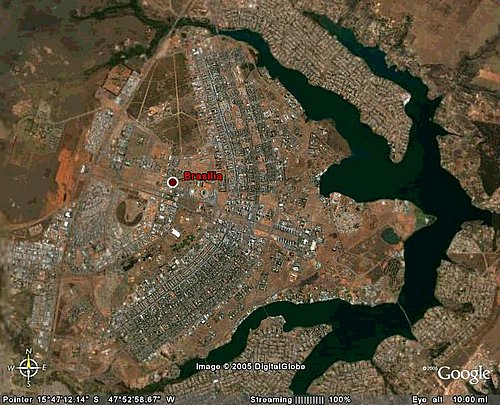
Today marks the fiftieth birthday of Brasilia, the high-modernist capital of Brazil that was built out of nothing in the plains of Brazil across 41 months in the late-1950s before its inauguration on April 21, 1960.
The last leader of Argentina's military dictatorship, Reynaldo Benito Bignone, has been sentenced to 25 years in prison for his role in the kidnapping, murder, and disappearances of Argentines between 1976 and 1978, while he was an officer in the military. Bignone was president of Argentina from Argentina's loss in the Malvinas/Falklands War in 1982 to the end of the dictatorship in 1983, during which time he oversaw the destruction of thousands of documents and the amnesty of war criminals in Argentina. The conviction means that Bignone, who is 82, will die a disgraced man, rightly punished for what he did. In this, he joins Jorge Videla, the first (and longest-lasting) of the Argentine military dictators of the Dirty War period. The third major dictator of the dictatorship, Leopoldo Galtieri (1981-1982), died in 2003, but even he died a disgraced man, after a civil suit had resulted in his house arrest.