Sunday, February 11, 2007

We care what he says because...?

Apparently, Australia's Prime Minister has already come out against Obama. Apparently, he feels that Obama's Iraq stance will lead to "disaster" in the Middle East (because, an Iraq torn asunder by civil war, the U.S. stuck in Iraq, Iran allegedly entering Iraq, Saudi Arabia hovering on the sidelines saying they'll fight for Sunnis if they have to, all while Israel increasingly even further alienates its Arab neighbors and Palestine is torn apart by internal factions, apparently is NOT a "disaster").

And now, from the department of irrelevancy...why does Australia's prime minister have any say in who registered Democrats should vote for in the Democratic primaries? (Short answer: he doesn't).

Saturday, February 10, 2007

Link-a-licious

A few great links for today:

Daniel Nexon at The Duck of Minerva has an excellent post about the plane crash that started the Rwandan violence in 1994. Not a happy story.

Twisty at I Blame the Patriarchy exposes the hideous Vagina Institute, which claims to be the norm in deciding whether a woman's vagina looks good or not. This is some seriously fucked up shit.

Yglesias properly ridicules the lame right-wing attempts to slam Obama now that he has declared his candidacy.

Via Phronesisaical (the hardest to spell name in the blogosphere), Norwegianity puts together an excellent set of Brazilian MP3s. Great music. Check it out.

Tourism in Malaysia

CNN has an interesting article about Malaysia aggressively pursuing tourists. I am of 2 minds on Malaysia. I have written about the negatives of traveling here before, particularly the massive destruction of their forests for palm oil plantations, making riding through the country incredibly dull and depressing. There is much to see in Malaysia--cities such as Malacca and Penang played key roles in world trade as early as the 13th century. Malacca especially has some very cool historical artifacts and museums. The country is quite diverse, with Malays, Chinese, and Indians all living together, at least in the cities. This also means an incredibly variety of amazing food, something that is certainly important to me. And where the jungle hasn't been destroyed, it is amazingly beautiful.

But Malaysia wants to have it both ways. They want to bring in the tourist dollars going to Thailand without actually protecting their environment. They figure that if they can keep tiny areas protected, they can make boatloads of money destroying the rest of their forests. To some extent, maybe they can. But how much money has Thailand made by banning logging? Tons, because the forests are in decent shape. Yes, there is some illegal logging and yes, much of the logging that would have been done in Thailand is now in Burma and Malaysia. But from the long-term perspective of national interest, Thailand made an incredibly smart move. Malaysia isn't looking that far ahead. It's all about the instant cash there and you can't build a tourism industry, especially one with ecotourism at its center by only thinking about the money. Money is central to all tourism projects and that's fine. But it's not enough for long-term success. Malaysia has the potential to be a world-class tourist destination. Malaysia can make a ton of money of tourism for a long time to come. But attracting rich Western tourists will run into a roadblock when they realize how screwed up so much of the country is.

Historical Image of the Day


John Hartford, Merlefest, 2000

Why Fulbright Scholars should be proud of their awards

In another fine post of historical conjunctions, D over at Lawyers, Guns & Money points us to this quote from Senator William Fulbright:

"Power tends to confuse itself with virtue and a great nation is particularly susceptible to the idea that its power is a sign of God's favor, conferring upon it a special responsibility for other nations — to make them richer and happier and wiser, to remake them, that is, in its own shining image. Power confuses itself with virtue and tends also to take itself for omnipotence. Once imbued with the idea of a mission, a great nation easily assumes that it has the means as well as the duty to do God's work."

If only we had senators like this today (or presidents who listened to and were aware of the importance of such notions as those above).

Friday, February 09, 2007

Mr. Trend's Random 10

For once, I'm the last one to post. Here's my random 10 (with more than one blues song, and Sonic Youth to boot - it doesn't get much better than that).

1. "Evenflow" - Pearl Jam
2. "Chris Michaels" - The Fiery Furnaces
3. "Matita PerĂª" - Tom Jobim
4. "Thinking Out Loud" - Emiliana Torrini
5. "Turkey and the Rabbit" - T-Model Ford
6. "Sweet Shine" - Sonic Youth
7. "Sheena Is a Punk Rocker" - The Ramones
8. "Celestial Terrestrial Commuters" - Mahavishnu Orchestra
9. "Reminder" - Radiohead
10. "Search Warrant Blues" - Blind Blake

Lyrad's Random 10

1. Spartanburg Famous Four--Anybody in Heaven that You Know
2. Kurt Weill--Barbara Song
3. Maurizio de Angelis--I corpi delle vittime [Bodies of Victims] (from the soundtrack to Torso)
4. Clutch--Droid
5. Charlie Hayden Quartet West--Lonely Town
6. The Meat Purveyors--What Goes On
7. Beki Bondage--The Boys Are Back in Town
8. Taraful Din Baia--Mai Dorule (Romanian Gypsy traditional)
9. Ennio Morricone--Rag Nuziale [Ultimo Matrimonio] (from the soundtrack to Trio Infernale)
10. Jean Sibelius--Symphony No.2 in D, Op.43; 4. Allegro moderato (Royal PO; William Boughton, cond.)

Why on Earth?

Why is there a memorial to the Nazi occupiers in Tirana? See the pictures from Our Man in Tirana. There's not really any explanation as to why it is there. I don't know a whole lot about the politics of post-war Albania except a bit about Hoxha, but this is more than a bit odd.

Absurd Texts of American History (IV)

I love the history of hunting and guns in the United States. For well over 100 years, it has led to some crazy stuff. So every now and then, I'll be giving you texts from our illustrious hunting history.

Today is an 1897 letter from a Minnesota man named Horace A. Milton to Western Field and Stream, a precursor to the modern Field and Stream. Horace opposes the idea of hunting regulations, something that was gaining momentum at this time because American wildlife larger than squirrels were all about to go extinct.

"I notice a strong tendency in this land of the free to restrict the freedom of "the hunter," and get the working class entirely shut out from the freedom of the woods, field and hills given us by our Creator. Pay $25 or twenty-five cents to hunt in any state in the "Free United States?" I shall hunt in any State I choose to and pay no tax. My father died in Libby Prison to free some of our countrymen. The farmers will charge for the privilege of hunting on their land, and the poor folks will poach on the game preserves as they do in other countries. My Janesville, Wis., paper says: 'No poor man can pay $30 for the privilege of shooting deer in this State, and they buy nothing here, and camp out, so we make nothing off them. But the rich who can pay the tax will spend $30,000 in this state.' During the open season I will hunt deer in Wisconsin and pay no tax. I am poor, and will take my eating stuff along. If arrested, I will serve my time. After released I shall devote my life to exterminating the game of any hog State that restricts the freedom of the poor. Now this is the way I feel about it. And this same sentiment will be raised in others, and the flood will come. I believe no man should be stopped from hunting where he chooses during the open season. The deed for every farm should read: 'After Sept. 1st, each year, this land is thrown open for hunting until season closes. Actual damage to owners' property to be paid by hunter at once. No game preserves or passes allowed to private parties or companies.'"

Erik's Random 10

1. Ibrahim Ferrer, Silencio
2. Karl Shiflett & Big Country Show, Hoss Fly
3. Willie Nelson, The Last Thing I Needed The First Thing This Morning
4. Igor Stravinsky, Firebird Suite, The Princesses' Khorovod (Round Dance); Chicago Symphony Orchestra; Pierre Boulez, Conductor
5. Johnny Cash, The Old Account Was Settled Long Ago
6. Louis Armstrong and His Orchestra, Sweethearts on Parade
7. Glenn Branca, Symphony No. 2
8. Glenn Ohrlin, El Corrido de Kansas
9. The Decemberists, The Bagman's Gambit
10. Merle Haggard, Daddy Frank, The Guitar Man

Historical Image of the Day


Actress Ida Lupino

Crime and Punishment in Brazil

Rather gruesome news from Rio today. In one of the poorer parts of the city, an 18-year-old kid and his 17-year-old friend carjacked a lady in the suburbs. She tried to get her 6-year-old son out of the back seat, but he got tangled in the seatbelt. The 18-year-old proceeded to start the car and gunned it, dragging the 6-year old for 7 kilometers and killing him, presumably by decapitation (the head was found in a separate location than his body).

This has sent shockwaves throughout Rio. The gruesome nature of the boy's death has revolted everybody (even the perpetrator's parents helped to track him down). The boys have been arrested, but there is outrage over the prospective criminal punishment, too. In Brazil, not only is there no death penalty (a good thing); the maximum prison sentence for ANY crime is 30 years (a bad thing). And as for the 17-year-old, he is automatically classified as a delinquent, and is facing a maximum of 3 years in a juvenile detention center.

I'm not a lawyer, but there are a couple things worth discussing. First, there is the maximum jail sentence of 30 years. As I've said, it's great that there is no death penalty here (or anywhere in Latin America, though cases like this have and do create a knee-jerk demand for it sometimes). However, with the 30-year limit, some truly heinous crimes by repeat offenders will still only amount in 30 years of jailtime. There is no way to give a longer sentence, period. Thus, a serial killer who potentially kills 17 people faces the same sentence as somebody who kills one person. Obviously, by many standards of justice, this would ideally be re-adjusted, perhaps (and I draw only on my own knowledge here) akin to a system in the U.S., where crimes like armed assault, armed robbery, or rape can get you in the 30-year range, while murder can get you 30 years or life, depending on your past, your present, etc. However, while I know some Brazilians who think there should be a re-calibration of sentencing, it obviously can't be fixed so quickly, because A) changing the sentencing would require basically reformatting the entire penal code, and B) the jails are already so overflowing, and the police are far from lenient in the number of arrests and treatment of prisoners, so this is rather unlikely anytime soon.

The second issue at hand here is the fact that, in Brazil, there is a hard-and-fast adult/underage age of 18. If you commit a crime at 18 years of age, you're tried as an adult; if you are even one day under 18, you are tried as a juvenile. There is no variation and flexibility like there is in the U.S. To me, this is an idea that may sound decent at first but reveals itself to be rather useless and even offensive at the end of the day. Certainly, by sticking to the hard-and-fast rule, you don't have cases like wrestling death of 1999, where a fourteen year old was sentenced to jail for life (Dave Chappell hit it on the head in his standup, where he related this case to the R.Kelly allegations, in which the public decried allegations that Kelly peed on a 15-year old "child," even while trying a 14-year-old "adult" for murder. As Chappell put it, "If you're old enough to murder, you're old enough to know if you want somebody to pee on you or not"). More recently, we have the Genarlow Wilson case resulting in unfair sentences for youth.

However, once again, by the same token, there are cases like today's in Rio. Because a 17 year old consciously committed a heinous crime but is one year younger than his friend, he will only face 3 years in a juvenile detention center (no walk in the park, certainly, but I think most would take that over 30 years in jail). Certainly, judges and prosecutors in the states can and do abuse the power to decide which young people will be tried as adults, and which will be tried as juveniles. However, given the restrictions of the hard-and-fast rule for 18 in Brazil, one also sees the benefits of some leeway in terms of crime and age. However, such reform is unlikely to arrive anytime soon (if at all).

Good Luck, and Godspeed

My good friend Brad gets shipped off to Iraq today for his second tour of duty. He'll be there for (at least) the next 12 months.

Good luck, Brad. We who know you are thinking of you. Be safe, and come back alive and well.

Thursday, February 08, 2007

Albuquerque Loses A Piece Of Its Soul

I was deeply saddened last night to find out that Alphaville Video is closing. This superb movie store was not only the best in Albuquerque, but one of the finest video stores I've been to outside of a major metropolitan area. The owner of the building wants to do something else with it and the store's owner decided to close down rather than relocate in a less suitable location. Although I have not been in the store in the other half of the building, The Book Stop, I assume it is gone too, something reinforced by all the sale signs in the windows. Sadly, this is Albuquerque best, and perhaps only good, used bookstore. In one fell swoop, we have lost 2 of our finest businesses. Moreover, these 2 stores were in Nob Hill, the always trendy and increasingly yuppified part of town. No doubt, these great businesses will be replaced by a wine bar, an antique store, or something equally unpleasant.

Sigh.

I Love Jerry Jones

Why do I love Jerry Jones? Because he is such a fantastically egostical and incompetent owner. He hired Jimmy Johnson, the one good move he ever made. How do you come to the conclusion that the man ready to take us to the next step, a step the great Bill Parcells was unable to accomplish, is Wade Phillips? I thought Norv Turner would be hilarious too but this takes the cake. Awesome. I can't wait for 3-4 more years of Cowboy mediocrity. Then Phillips gets fired. Who will the next coach be then? Wayne Fontes?

Historical Image of the Day


Ohio St. football coach Woody Hayes with Richard Nixon

Dedicated to Mr. Trend

Wednesday, February 07, 2007

Machismotion

Outside my house as I write are two guys in an argument who sound as though they will come to blows. Undoubtedly, they won't, but I find these kinds of things very interesting, having had personal experience with the phenomenon as well. What are these guys fighting about? It's hard to say. There are a bunch of statements like "Bring it!" "I'll kick your ass!" "Go ahead and try! I'll get up right up and kick your fucking ass right back!" and so on. What I think is really going on, though, is that two frat buddies (which I say because of the heavy use of "bra") got too drunk too early in the day and they drunkenly stumbled over the other's huge penis and it hurt so bad that they had to fight about it. So, after about five minutes of screaming now, there has been a silence. Is the fight over? Have they come to terms? Is one of them dead? No, because here comes the screaming again. This time, though, the noise comes through sniffles. "Bra, don't you see how much I fucking love you, you asshole?!" "I love you too, Bra!" I can only imagine that they just hugged, and I'm about to tear up myself. Jesus, what a couple of morons. Is this what has to pass for emotion in the male mind? Sometimes, I'm ashamed to be part of them.

Historical Image of the Day


Jesse Owens, 1936 Olympics
Too bad Nazi boy's fascist salute doesn't reach higher than Owens' shoulders.

Bourgeois Bowling

Growing up in Ohio, bowling was a very popular activity among the working and middle-classes. From the time I was 5 until about 15, birthday parties were often held at bowling alleys, with bowling AND pizza to follow. It was practically nirvana for kids to be invited to a bowling/pizza party. Even afterwards, through my 20s, bowling was and and is a blast. Thus, I was very excited this past weekend when I had the opportunity to go bowling in Rio. However, I should have known what I was getting into.

For those who have never been bowling (what is wrong with you people?), they are usually extremely…“functional” places. You go. You bowl. Period. No super-nice decorations. No “classy” environment. Some alleys are a bit better than others (particularly in Akron, which is apparently the bowling capital of the world and hosts a few professional bowling events every year); however, the difference between one bowling alley and another are never as different as, say, upstate New York vs. rural Mississippi. Bowling tends to be a working- to mid-middle class event in the states, and the alleys match their clientele.

Not in Rio. I should have known what I was getting into, given that the bowling alley was Barra de Tijuca, one of the (if not the) wealthiest parts of the city. However, this was unlike any bowling I’ve ever seen. The only way to describe it is absolute bougie-bowling.

To begin with, they charged by the hour, and oh, did they charge. It cost 56 reais (roughly 25 bucks) for four people to bowl for ONE hour (roughly two games), and that didn’t include shoes (again, for those who never go bowling, you can usually pay about 15 bucks for four people to bowl for 3 games in the states). Additionally, this was the fanciest bowling alley I’ve ever seen. It was painfully clean (to the point of glaringly white walls), there was no stale smoke smell, there were no stains on the carpet, none of those little machines where you try to grab an ugly stuffed animal with the claw, none of this. There was an honest-to-god liquor bar that served vodka, Johnnie Walker whisky, and other fancy, expensive drinks (no choice between only Miller or Miller Lite here).

As for the clientele, it was CLEARLY wealthy (upper-middle class to upper class), and they dressed like it (this is the first time I have ever seen pumps and jewelry at a bowling alley) and, not surprisingly, as white as the pure driven snow. In contrast, the wait staff (yes, there was wait staff) was noticably brown, were dressed like waiters, and did EVERYTHING for you (whether you wanted them to or not). Thus, they came to your lane and put your names in the computer before you could start, and kept coming by to see if you wanted any drinks, food, etc. This sat rather poorly for me – where I come from, if you don’t know how to operate the computer, you have no right to bowl.

It ended up being enjoyable, save for the obnoxious kid in the lane over who would dance his way into our lane WHILE WE WERE BOWLING, which is one of the greatest sins there is at the bowling alley and which actually affected my score twice (the little bastard was lucky – Walter would have pulled out his piece and shot the kid on the spot). However, as we paid the 78 reais (35 bucks – some of our party got drinks), I remained somewhat amazed at the notion that bowling was a status symbol here. I just kept saying to myself…

“You’d never find the Dude here…”

Tuesday, February 06, 2007

Tuesday Forgotten American Blogging: Martin Luther King, Sr.

Martin Luther King, Sr. isn't entirely forgotten of course. He is remembered for his son. But no one thinks much about the father, who is an interesting guy in his own right. More importantly, King Sr. can help us understand an entire generation of African-American preachers who laid a great deal of the groundwork that allowed the civil rights movement to explode in the 1950s.

Born in 1899 in Stockbridge, Georgia, like many people of his time and race, he was born to poor sharecroppers. The failure of Reconstruction and the rise of Jim Crow policies forced millions of African-Americans into these scenarios of systemic poverty, political and economic disfranchisement, and violence of all forms. King became interested in fighting for the rights of his people and saw the ministry as a prime way to affect change, as did many other young black men of his generation.

King could not read until his late teens, but that didn't stop him. At the age of 15, he started preaching in his home area of Georgia and found himself successful. An ambitious man, King learned to read and attended Morehouse College in Atlanta, beginning in 1926. This was not easy for him--he failed many courses and struggled overall. Why? Not because he was stupid; rather like so many people of his generation, King didn't have any educational advantages at all. Whites claimed that blacks were inferior and lazy. But of course the real problem was racism and the denial of opportunities throughout your life. Soon after his graduation, in 1931, he became the minister at Ebenezer Baptist Church on Auburn Avenue in Atlanta. "Sweet Auburn" was the center of African-American life in Atlanta. It was home to shops, large homes, and Atlanta's version of the vibrant African-American communities that developed across the South in response to Jim Crow laws and violence against them.

Interestingly, Martin Luther King was originally named Michael King. He changed it to Martin in 1934 as a way to show his commitment to the church.

King Sr. played a pretty big role in developing the civil rights movement in Georgia, serving as head of the state NAACP and worked to end Jim Crow laws there. Like many black men of his generation, King was a committed Republican for a very long time. Though many blacks began moving toward the Democratic Party during the New Deal, many others, especially in the South, rightfully connected that party with white supremacy and thus chose the Republicans. Of course, most of them couldn't vote so it didn't matter much. King did not switch his affiliation until 1960 when the Kennedy brothers worked to have King freed after an arrest in Georgia that placed his life in tremendous danger. After his conversion, he played an important role in state politics and did a great service to Jimmy Carter in supporting his presidential nomination in 1976. Many liberals in the party thought Carter was too conservative but King pointed out how much Carter did to end segregation in Georgia and swayed enough votes to give him the nomination. During the civil rights movement proper, King Sr. supported his son, though he was fearful of what might (and of course did) happen to him. He wasn't at the forefront of the movement, much like many preachers of his generation who came of age in the bad days before World War II when any perceived dissent against segregation was met with extreme violence. But he was always there for his son, often filling in for him at Ebenezer when King Jr. had work to do in other places.

Martin Luther King, Sr. was not a particularly exceptional man, except for who his oldest son was. He was certainly a leader in the local black Atlanta community, and Georgia in general, and is a man who deserves more attention than he has received. But really, looking at King is really a way to look at thousands of exceptional African-American men who served as preachers across the South during the long Jim Crow era and who put their prestige and often their lives on the line to protect their churchgoers and community from the onslaught of white violence, be it physical, sexual, or economic.

Ted Haggard--"Completely Heterosexual"

That's right, everyone's favorite Colorado right-wing preacher Ted Haggard has been declared "completely heterosexual" by other preachers. That would make perfect sense except for Haggard's recent sex with a man. That is explained away as, "That is something he discovered. It was the acting-out situations where things took place. Ah. Well then, clearly the fact that he has had consensual homosexual sex means nothing to defining the man's sexuality.

William Walker

Check out this post from gjohnsit, a diarist a Daily Kos. His discussion of William Walker is quite thorough and interesting. I'm not sure if warlord is quite the right word for Walker, but I'm prepared to be convinced. He certainly was one of the great bastards of American history.

Incidentally, I wonder about the diarists over there. Do they get more or less readers than independent bloggers? My guess is less unless they get picked up at the main site. But I really have no idea.

Anyway, check the post out. It's very good.

John Tierney Is Like The Clap

Why? Because when you think you've gotten rid of him, he keeps coming back. I thought would never have to read him again because of Times Select, the greatest invention of the 21st century. But his science blog on the Times is always worth reading.

Four days after proclaiming that global warming will be good for the Arctic because it will bring more economic opportunities to the region, he writes on what is clearly a vitally important story for world science, the astronaut who got charged with attempted murder! Now that's breaking scientific news!!!

Seriously, this is the New York Times. The United States' most important paper. And they have this guy as their science blogger? Are you freaking kidding me? What a joke. What a disaster. What a disservice to readers.

Beaches, Racism, and Classism in Brazil

There's another tantalizing-but-ultimately-frustrating article at New York times on race and class in Rio today. The title "Drawing Lines Across the Sand, Between Classes" hits perfectly on the divisions within Rio, and there are some great examples. Rohter (not the greatest writer on the topic, and that's putting it nicely) does a pretty good job of beginning to delve into how the beaches in Rio are far from democratic, despite Roberto DaMatta's (who loves his stark dichotomies like none other) claims otherwise.

However, the article is also extremely frustrating because it does just that - he only begins to delve into the issue. Thus, we get tantalizing insights into classism (like the poor vendor who says the clients on the beach treat him like he doesn't even exist) and even racism (the wealthy Ipanema resident who complained about the "dark-skinned teenagers with that dyed blonde hair"). However, they are just quotations - Rohter never actually openly points out how indicative this is of the classism and racism that exist in Brazilian society, or that these quotes exist among a large portion of the population even while the citizens protest otherwise (more than once have I heard that America is racist while Brazil is not).

Additionally, there is very little contextualization. For example, while he quotes somebody who claims that "Ipanema is always in the vanguard, but Leblon has more of a family vibe", there's no mention of the fact that Leblon is even wealthier, and far more elitist and snobby (the Leblon woman's complaint about the risks a "defenseless sunbather" faces in such grave threats as the presence of dogs, paddleball, and surfers in the area perfectly hits on the elitism prevalent in Leblon as well, even if there are no surfers in Leblon, something the article itself mentions) than even Ipanema residents (which is saying something).

Even worse, Rohter only focuses on Ipanema and Leblon, which are in and of themselves two of the most elitist beaches (and, to be honest, not coincidentally two of the nicest) there are in Rio (he leaves out Barra de Tijuca). For example, there is no analysis or even inclusion of Copacabana and Flamengo. While these parts of the city are still middle class, there are far more poor people and minorities on these beaches, people who can't afford to go all the way to Ipanema from their homes in the North Zone (the poorer part) of the city. Thus, as somebody who's lived here for the last 5 months, and been here before, it seems rather obvious that Rohter himself never left the Leblon/Ipanema area to explore how the classism and racism spread beyond those two rather-elite beaches.

Despite these complaints, however, Rohter's article is well worth checking out, for it brings up some of the unspoken aspects of beach life in Rio that rarely make their way into the international image of Rio's beach culture.

UPDATE: The story was big enough that it actually made news in O Globo, Brazil's largest newspaper (there is no comparison in the U.S.). I initially saw it on the subway today, in the first section, on page sixteen, in an article titled "NYT overthrows the "myth" of beach-democracy". You can read the article in Portuguese here. Not surprisingly, O Globo goes into absolutely no depth or self-analysis of Brazil, instead just reporting segments of what Rohter wrote (and thus making Rohter's relatively superficial analysis look remarkably deep). It comes as no surprise that Globo doesn't actually ask questions about inequality in Brazil as it plays out on the beach (or anywhere else for that matter), and it is interesting that they put the myth of beach-democracy in quotation marks (perhaps distancing themselves from Rohter's suggestion that the beach isn't a democracy, thus implying Globo's stance that Brazil is egalitarian on the beach and elsewhere, a theme which pops up repeatedly). Finally, it is just interesting that Rohter's article is important enough that it has made national news here, perhaps due to its potential to make Brazilians react against his article or (nod their heads in agreement). Time will tell what (if any) reaction happens here...

Historical Image of the Day


James Buchanan, worst president in U.S. history

Monday, February 05, 2007

Stan Humphries Must Be A Happy Man

Why?

Because Rex Grossman beat him out for worst Super Bowl quarterback ever. I never thought Humphries would lose that honor. Neil O'Donnell gave him a run (and had a worse Super Bowl than Humphries). But after '96, I figured it was all Stan. And it was for a long time. But Rex Grossman--wow. That is a terrible quarterback. When Joey Harrington would be a significant improvement for your team, you know you have a bad quarterback. Grossman simply cannot be the starting QB there next year. He is dreadful.

I wonder who the worst Super Bowl QB was before Humphries. Steve Grogan? Craig Morton? David Woodley?

Also, for those who are questioning the Humphries choice, I think Trent Dilfer and Chris Chandler were significantly better quarterbacks. Todd Collins and Neil O'Donnell were slightly better. As for worst ever performance in the game, Craig Morton going 4-15 for 39 yards and 4 picks in Super Bowl XII must win.

Historical Image of the Day


Rumsfeld and Saddam. 1980s.

Sunday, February 04, 2007

Historical Image of the Day


Texas Independence Day celebration, 2003

Historical Image of the Day


Chastity belts. Time and place unknon, though I would guess very early 20th century.

And what about the living...?

Just when you think the facts about Iraq can't get any more sobering, another horrifying and tragic aspect we fail to consider pops up.

This administration and its defenders are wrong. History won't vindicate anybody in this mess. It will condemn them all.

Super Bowl Sunday

In between getting ready for the big game today (or whatever activities may be on one's table), there are two extremely good and important articles at NY Times today.

The first is a damning breakdown of America's use of contractors to clean up our messes in Iraq and elsewhere, including such startling facts as the number of claims of abuse of contract against contractors. Particularly startling is the fact that one employee at just one of the hundreds of privately-contracted corporations costs taxpayers $104 per hour, and this comes from an administration that claims to care about how government money is spent. Right after the Iraq war, there was some disturbance, even in the mainstream press, that companies like Cheney's former employer Halliburton were getting no-bid contracts. There was consternation once. This article reminds us why we should still be concerned abou this.

The second article is an absolutely outstanding analysis of the language of race, and why Joseph Biden's comments wer actually emblematic of the obstacle of racial stereotypes we as Americans still have to overcome. The author shows how white American society seems to have different expectations when it comes to African-Americans' intelligence and personality, expectations that subtly reinforce hierarchies of race very innocently and, as D.L. Hughley says, "insidiously." Both are well worth checking out in the downtime today.

Saturday, February 03, 2007

Lyrad's Star Turn

A few weeks back, I was selected to be the "equipment spokesperson" for the training videos produced for the company. I, if I haven't previously said, sell beauty chairs and other various salon furnishings to Canadians...mostly. It's pretty glamourous, I know, but it gets even better when you get to talk about your exciting profession on camera. My selection was based on a stellar audition. Well, maybe it wasn't so stellar, but since I was the only person willing to do it, they got this.

I spent the next couple of weeks hearing from people how nervous they were that it wouldn't come off, that the information was right, that the sky was falling. Would I be good enough to do it? Could I be comfortable enough to be convincing? Could I read off a teleprompter? Whatever they could worry about, they did. I assured these doubters that I'd done things like this before (which is marginally true; I did have five lines and two rifle shots in a play in high school) and that everything would be fine. I don't know if I actually convinced anybody of my skills, but it didn't matter; they shut up, which was the important thing.

The one condition to my performance was that I get a haircut. I have been cutting my own hair for about fifteen years now, and had no intention of ever having my head molested by a stylist again, but they sent me anyway to the company stylists who made fun of my hedge-clipped coif. I took it in stride, told them they could do anything they want except for color, and they had a good time making me look like some kind of hip young club rat. They made me promise never to touch my own hair again and, after I finally did, they let me go on my way.

Fast forward a couple of weeks and we film. I was put through hair, makeup, and wardrobe, and was pampered like a queen. Everyone was very professional and we worked as fast as we could. I was on the clock and there were Canadians who needed advice on skin care products (and everyone who's seen my knows my porcelain skin), so they went as quickly as they could. I felt comfortable, I didn't fidget, and I got through my two good takes in about 30 minutes. It was great, until they realized they needed a script change. One word needed to be changed, so we had to start again. Now, because I had more or less memorized my lines, I couldn't seem to adapt and it took about fifteen tries to finally get two more good takes, clocking in at about 2:30. All tolled, I got what I thought I would get: a fun time and an extremely tedious time rolled into one. I will certainly be doing it again (and the final product was good enough for me to be asked back, which was nice), but I've learned my lesson. Do not learn the lines, because they'll assuredly change mid-filming.

A couple of thoughts on the whole experience:

--Male makeup works. I look at least ten years younger on camera than I do in real life. The question remains, however: do men look better when they are younger? In my case, even through the booze veins that have begun to riddle my face, the answer is no. I look a lot better now, but I guess youth sells so, whatever.

--Anybody who takes the production of industrial film seriously is crazy. I realize that this is these people's job, but c'mon. Most everybody who has worked for a large corporation has had a training film forced on them. Tell me how professional these productions look. How good is the acting? How high the production values? Quality is icing on the informational cake and is unneccessary to the final product, the information is paramount. Give me a break: we're talking about salon mats, not filming Giant!

Friday, February 02, 2007

Lyrad's Random 10

Lots of Classical this time. What does that mean? Long listings!!

1. Johannes Brahms--Symphony No. 2 in D, Op.73; 4. Allegro con spirito (perf by Cologne RSO; Rudolf Bashai, cond.)
2. Omer Simeon--Smoke-House Blues
3. Ozie McPherson--Nobody Rolls Their Jelly-Roll Like Mine
4. Toure Kunda--Natalia
5. New York Dolls--Looking for a Kiss
6. Dmitri Shostakovick--Concerto No.1 in a for Violin & Orchestra; 1.Nocturne. Moderato (perf by Oleh Krysa, vn; Ukraine NSO; Theordore Kuchar, cond.)
7. Edison Denisov--Paganini Caprices (5) for Violin & Orchestra; 4.Caprice No.9 (perf by Stepan Arman, vn; I musici de Montreal; Yuli Turov, cond)
8. The Breeders--Glorious
9. Joe Fonda & Xu Fengxia--A Journey in the Desert
10. The Golden Gate Quartet--Let that Liar Alone

Erik's Random 10

1. Dave Alvin, Border Radio
2. Death Cab for Cutie, Title Track
3. The Beach Boys, Hang On To Your Ego
4. Richard Thompson, Read About Love
5. Sufjan Stevens, In The Devil's Territory
6. Drive-By Truckers, The Boys From Alabama
7. Old & In the Way, The Great Pretender
8. Charles Ives, Largo Cantabile for String Orchestra
9. Fleetwood Mac, Never Going Back Again
10. Setona, Sawani

Stupid People in Brazil

As surprising as it may seem, the U.S. does not hold a monopoly on morons. Yesterday's events in Brazil offered two good examples of this.

First, in BrasĂ­lia, students gathered and protested outside of Congress, as new members were sworn in, splashing police with water from the reflecting pool in front of the building and leading to 6 arrests. What were they protesting, one could wonder? Perhaps they were angry over last year's Congressional vote to raise their own incomes to 24,000 reais a month (even though many of those Congresspeople no longer are employed there)? Or perhaps there was some univeristy funding being cut by Congress?

Nope. They were simply protesting because Congress was there. This is so patently absurd on so many levels. First, as one who studies student movemnts, I have a fair amount of disdain for the "Protest without a purpose." There are so many injustices out there - you could at least try to pick one to be the reason for your gathering. Secondly, perhaps these students need a little history lesson. In part, they should be THANKFUL that POPULAR ELECTED congresspeople were sworn in yesterday. After all, from 1964 to 1985, there was this little thing in Brazil called "military dictatorship," led by a government that stuffed the Congress with its supporters and even reserved (and exercised) the right to close Congress between 1968 and 1979. If the existence of Congress is so upsetting to these students (and since they had no other motivation, it's unclear what other reason they were there), then perhaps they'd like a return to those halcyon days.

Then, just to make things even better in the country, here in Rio a court ruled in favor of the citizens in a class action suit. These citizens had sued the company of the Metro here in Rio, which had increased the price of subway tickets, claiming it was operating on a deficit. These citizens had sued, claiming (in a remarkably self-centered argument) that the hike was unfair. The Metro allows the elderly to ride for free, as do non-college students on days/times when they are going to/from school. The citizens in the lawsuit claimed, in true nihilism and narcissism, that the increase should be removed, and the elderly and the unemployed students should have to pay their way. The court agreed.

What was this egregious pay raise that had rustled the feathers of so many? 10 BRAZILIAN CENTS. That's right - on January 2, the subway went from $2.30 reais to $2.40 reais, and these citizens demanded a return to the 2.30 price, and they got it. What for? So that the elderly and the unemployed students now face the prospect of paying for their own tickets (and what is the likelihood that these people in the lawsuit one day turn old? But of course, they don't consider that). This is so horribly offensive because it does nothing to save money, but plenty to nail those who are less advantaged. Not only that, but it is indefensible. My girlfriend (strictly playing devil's advocate) had pointed out that 10 cents per one-way ticket was a total savings of one real a week, and 4 reais a month, which is enough to buy some essential foodstuffs like rice or veggies. This would be a fine argument, except that if the people REALLY want to save, they would ride the public buses, which are safe and which operate at 20-40 cents cheaper than the subway. Thus, I highly doubt savings are their real concern - if it were, they could ride the bus and save 16 reais a month, instead of four. Rather, they are driven by the "injustice" of paying an extra ten cents a trip, and thus are willing to totally screw over their fellow comrades in society. Unbe-fricking-lievable.

Football Injuries and post-career health

In a story on the effects of concussions and sports injuries on football players, the case of Ted Johnson leaves the New York Times and football players " questioning whether their serious health issues are related to injuries they sustained and the treatment they received as players".

Having watched the football hall of fame ceremonies for years during my time spent in Canton and in Akron, I unfortunately have the answer for these players.

Yes, your post-career health issues are related to injuries you sustained as players.

This has been simple answers to simple questions.

Mister Trend's Random 10

1. "Buzzers" - Scott Walker
2. Quartet No. 14 in D minor, D810, "Death and the Maiden" - Franz Schubert
3. "Get Up" - Sleater-Kinney
4. "Blueberry Boat" - The Fiery Furnaces
5. "It's in Our Hands (Live)" - Bjork
6. "Another Star" - Stevie Wonder
7. "Folsom Prison Blues" - Johnny Cash
8. "The Cold Part" - Modest Mouse
9. "Aqui e Agora" - Gilberto Gil
10."Enjoy Your Rabbit" - Sufjan Stevens

Speaking of Absurd Texts in American History: Reagan on Indian Reservations

You're going to have a real hard time finding a more despicable Reagan quote than what Dave Noon uncovered today. Check this out. Crazy, crazy shit.

Thursday, February 01, 2007

Putin

I found Michael Specter's article on the death of Vladimir Putin's critics in the January 29 issue of The New Yorker quite interesting.

Specter points out two extremely popular dead leaders in modern Russia that can help explain Putin. The first is fairly obvious: Leonid Brezhnev. Of all the ex-Soviet leaders to have skyrocketing popularity, Brezhnev? But this is clearly what the Soviets have settled on. A boring, stolid state with great security powers and an intense desire for order without political opposition or anything to upset state goals. Why Russians want this of all things, I do not know. Like today, Specter points out, the Brezhnev regime succeeded because of high oil prices. If oil plummets today like it did in the 1980s, what would happen to Putin? Would the world put up with his dictatorial ways? Probably, but perhaps the Russian people would demand more rights and accountability.

The second leader is more fascinating: Augusto Pinochet. His death has led to nostalgia pouring out all over the place. A friend who was just in Spain said his death led to old fascists openly reminiscing about the good old days. Russians see Pinochet as the leader who made Chile "stable and strong." Putin seems to as well. He has a way of offing his opponents that is quite Pinochet-esque, particularly in the years after the initial repression. When one of his opponents gets too out of line, they die in mysterious and uninvestigated circumstances. Stability and the ability to make money is all that matters in today's Russia.

To a not small extent, the United States and western Europe deserves some blame for this. The western-supported sell off of state enterprises after the fall of the Soviet Union and the extreme corruption that followed soured many Russians on western-style political and economic systems. Order quickly became more important than democracy and freedom. Had the U.S. not listened to its free-market ideologues and supported a more limited sell-off of state assets, with the state maintaining some stake and assuring accountability, it is quite possible that Russia would be in a much better state today.

Absurd Texts in American History (III, b)

Here is my second post from the beauty manual given to the women playing professional baseball in the 1940s and 1950s. The first was here.

This was attached to the beauty manual, telling the women that in fact their bodies could play sports. What's absurd about this is not so much the text itself, but that these issues were in question while my parents were alive. The text originally is from "Health by Stunts" and was written by Army officers N. H. Pearl and H.E. Brown.

"There has grown up in our modern civilization, especially in this country, a false notion of the capacity of women for physical development. It has been assumed, not only by the majority of the general public, but by many medical men as well, that physical training for girls must be confined to calesthenics, carefully planned out gynmastic movements, and gymnastic dancing. All of the more vigorous forms of play and exercise have been looked upon with more or less disapproval.

A careful study of the objections raised to vigorous activities for girls will show that they are based on two quite different assumptions, namely, (1) the unalterable physiological make-up of women which, it is claimed, makes strenuous athletics imdesirable in that it interferes with her greatest function--child bearing; (2) the delicacy of structure, general motor inferiority, relative lack of strength, and frality as compared with man make the attempting of athletics inadvisable if not impossible. In connection with this idea goes the fear that the rougher sports will destroy "femininity."

As for the physiological characteristics of women, which are unalterable and which are said to prohibit anything of a strenuous nature, the simple fact of the existence of these characteristics does not, when all the evidence is considered, seem to lead to any such conclusion. If women were fundamentally, through sex characteristics, unfitted for muscular exertion, it would have to be shown that in all periods of civilization she was thus unfitted. That is to say, it would not be sufficient proof to take as examples women living under a given set of conditions, and to say that it is their fundamental sex characteristics which make them unfit for strenuous excercise. We would have to show first that it was not the living conditions themselves that had brought about the unfitness.

In summary, we point out that vigorous play taught to girls during their period of physical supremacy leads to a confidence in self, a control and coordination of muscle, and a general energizing of the whole system that can be developed in no other way quite so well. It alone can develop and store up in the girl a reserve strength which will stand her in good stead through the emergencies of her life. Self-preservation may depend on her ability to run, jump, vault, climb, and swim, and the learning of these things will of necessity develop a strong, vigorous heart which is ever the foundation of courage and exultation.

The development of leadership, initiative, and self-confidence in the girls who are to have the tremendously increased responsibilities of women must carry in another generation is surely of vast importance. If they can be encouraged to think, judge, and act on their own responsibility they can gain an asset that should prove of great future value. In Detroit the girl leaders are surprisingly reliable and efficient, and with the support of the teacher nad the Physical Education Department, are getting most satisfactory results."

Again, this was an argument that needed to be made only a few decades ago. Well, I'm glad that is settled. Now if we could only decide whether women have souls...

Historical Image of the Day


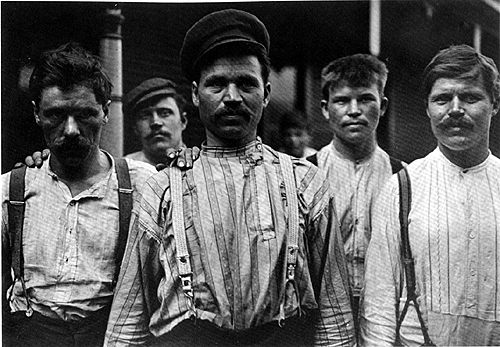
Russian Steel Workers. Homestead, PA 1908. Photo by Lewis Hine

Wednesday, January 31, 2007

RIP--Bam Bam Bigelow

Although I'm a huge fan of pro wrestling, I don't speak a lot about it on the blog. Last week, though, one of the great super-heavyweights, Scott Bigelow (aka Bam Bam Bigelow), passed away from as yet undisclosed causes. He was 45 years old. While he was never the biggest star in the industry at any point, and had been essentially out of wrestling for the past five years or so, he was phenomenally athletic for his size and was able to lead much worse performers (including Lawrence Taylor in the main event of a Wrestlemania) to very acceptable matches. He was safe in the ring and menacing on the mic, mostly for his real claim to fame: a bald skull riddled with tattoos, and deserved a lot more than he got.

Unfortunately, over the past decade, the mortality rate of pro wrestlers has gone down and down. As a result of the travel, the drugs, and the general beating the body takes in this industry, these athletes' bodies are shot much before their time. I don't know what killed Bam Bam but, given the history of these issues, it was either drugs or heart failure (which is often the result of years of drug and steroid abuse). Because pro wrestling, as much as I love the art, is a love 'em and leave 'em kind of industry, those who are no longer capable of working have no means to support themselves, no health insurance, no pension, nothing. There has always been talk in the business of supporting a union, but too many are afraid of blackballing to stand behind it. So it goes on and on, wrestlers die in the gutter because they broke their bodies giving their fan's a great time and making loads of money for their scumbag promoters. A real pity, but not just for Bam Bam and his family. This will go on, wrestlers will die, there'll be a "ten bell salute" to honor them, then they'll go on with the show and forget.

Burma

An interesting article from Asia Times points out that Burma (Myanmar) may be returning to constitutional rule. International pressure on the military regime that has ruled the country with an iron fist since 1988 has forced them to make some changes, though the failing health of the leading general, Than Shwe, has made this even more complicated as none of the other leading generals trusts the others and Than Shwe refuses to step aside. Than Shwe wants to remain president under the new constitutional government. This is unlikely because he likely doesn't have long to live. However, any move away from direct military rule is welcome news.

Historical Image of the Day


Site of Mountain Meadows Massacre. Utah, 1857. Photo from approximately 1900

Signs of the Times

What is wrong with the world when one of the best dreams you've had in recent weeks is that Karl Rove is revealed not only to be a "moral degenerate" (even by Republican standards), but also gets arrested for illegal dealings and corruption that we all suspect already exists in the White House?

In other news, in a Newsweek poll, 58% of Americans wish the Bush presidency were already over. Join the bandwagon, folks - we here at Alterdestiny have felt this way since January 2000. If only this 58% had felt this way in October 2004......

Tuesday, January 30, 2007

The Wonder of New Tech

As everyone knows, we here at Alterdestiny love technology. Moreover, we are great at manipulating it. I got a great deal on a friend's used HD television, which I thought was a really cool idea. So, I get the thing home today and, what'd'ya know, I hook everything up like I think I know how to (because the manual's bizarre, stylized, and arcane depictions make no sense) and nothing works. Finally, after three plus frustrating hours working with it, plugging in cords where I didn't know there were holes before, I got everything working, sort of. How can they expect the average person to understand their jargon without defining their terms? It's as if their desire is to have their televisions broken. Luckily, though, I will now be able to view the Super Bowl in High-Definition, which will better allow me to pretend I'm in Miami for the game without being forced to actually go to Miami. I love technology so much I could vomit all over myself.

Late-night blogging...

In one of the more random, meaningless blogs Alterdestiny has ever seen...

D over at Lawyers, Guns & Money refers to the Iraq mess as "The 'Raq".

My simple question - why has this not happened sooner, and gained greater creedence? After all, even during the war, vets referred to "The 'Nam", and since that's the only war we've declared as the United States that is longer than the current war, why not just go with "The 'Raq"?

Tuesday Forgotten American Blogging: Floyd Dominy

Today's episode of Bastard Blogging discusses Floyd Dominy. Dominy, the most obscure person on the 2007 Death List, is quite the bastard, let me tell you.

Floyd Dominy was the head of the United States Bureau of Reclamation from 1958 until 1969. He had one major goal: to dam every river in the nation regardless of the consequences. Dominy believed that all of nature should be harnessed to serve humanity. Dominy was born in central Nebraska in 1909. The need for water in this parched land led to an interest in dams and the use of nature for human good. He got his start in the Campbell County rangelands of northeastern Wyoming where he pushed forward an irrigation program over National Forest regulations. His success put him on the national map for such issues. For years after that, he rose through the ranks of the Bureau of Reclamation by pushing ahead projects, ignoring environmental regulations, and using his significant charisma to charm anyone who stood in his way.

For Dominy, nature itself has no value; its value only comes when humans can use it. His most famous action was pushing for Glen Canyon Dam. Glen Canyon was a remote part of the Utah-Arizona deserts before the dam. Navajos, Utes, and other native peoples had long used the area, but white presence in the region remained minimal. However, Dominy changed that. The Glen Canyon Dam closed its gates in 1963. The desert aesthetic that has become so prominent in American environmentalism was still in its formative stages and the place had just been discovered by people like Edward Abbey and David Brower. Brower particularly worked to publicize the beauty of the place and the need to preserve it, but to no avail. In fact, Brower had basically sold away any options to stop the dam when he made a deal to stop the dam at Echo Park in Dinosaur National Monument. He agreed to not challenge most of the Colorado River Project, including the proposed Glen Canyon Dam in order to save this national monument. At the time, no doubt it seemed a sensible bargain, but Brower regretted it for the rest of his life, especially after he was able to visit Glen Canyon.

To make it worse, Dominy co-opted the ideal of wild nature to justify his creation, calling the lake a great place to get to know nature: "If you're tired in mind and soul, in need of restful serenity, I don't know a better place. If you want to be alone, you can be alone. You just can't crowd Lake Powell's 1,860 miles of shoreline...You have a front-row seat in an amphitheater of infinity. The bright blue sky deepens slowly to a velvet purple and the stars are brilliant--glittering in that vast immensity above. Orange sandstone cliffs fade to dusky red--then to blackest black. The fire burns low--reflected in the placid lake.

There is peace. And a oneness with the world and God.

I know. I was there."


For Dominy, it's all about access. Unless people can access the land, it is being wasted and has no value. Thus, he actually believed he did the world good by flooding Glen Canyon. Now, people can visit the Natural Bridge for instance. As for the Navajo who held the land sacred, well, they were Indians and no one cared at the time, which he admitted to a friend of mine in an interview last year. On this particular point, he's probably not any more guilty than the rest of America during a period where Congress was actively terminating Indian rights. But still, the "people" using the land meant white people.

Dominy did not get to see all of his projects completed though. He really wanted the Grand Canyon to be dammed as well. Figuring that people didn't care about the river and only wanted to see the canyon walls, he couldn't understand the outrage this caused. David Brower and other environmental activists in these early years of environmentalism created a national outrage over the proposed Grand Canyon Dam.

Dominy also had something of an ego. He once said of his time in office, "I have no apologies. I was a crusader for the development of water. I was the Messiah. I was the evangelist who went out and argued persuasively for the harness of water for the benefit of people." Well, then. He was also notorious for his womanizing for decades. For a man who would call himself the Messiah, this is perhaps not surprising. Marc Reisner describes him as, "a two-fisted drinker; he had a scabrous vocabulary and a prodigious sex drive." One description of him reads, "All the wives were disgusted with him. Some of them refused to come to parties when he was going to be there, because he'd start propositioning them all."

Dominy was just part of a larger structure of dam building in the United States in the twentieth century. By 1980, only 2 major western rivers remained undammed--the Yellowstone and the Klamath. These dams caused massive declines in the populations of salmon and other fish. He and his employees introduced non-native species into these ecosystems such as trout, further denigrating the natural state of the rivers. They facilitated reckless agriculture and urban growth in the western deserts that is increasingly proving unsustainable. It destroyed hundreds of riparian ecosystems. No one holds greater responsibility for this than Floyd Dominy.

Oddly, Dominy was fired in 1969 by an even greater bastard--James Watt. Nixon had Watt fire Dominy because of his sexual improprieties. Dominy once confessed to Marc Reisner, "The FBI knows every woman I've ever fucked."

Today, the American West is dealing with the consequences of Dominy and the American government's obsession with dam-building. Siltation, salinization of land, water shortages, degraded ecosystems, unsustainable growth--all of this rests at least in part at the feet of Floyd Dominy.

The best readings on Dominy are Marc Reisner's classic Cadillac Desert: The American West and Its Disappearing Water and John McPhee's Encounters with the Archdruid, which includes a section on McPhee, Dominy, and Sierra Club president David Brower floating down the Grand Canyon. For Dominy's own words, see The Glen Canyon Reader, edited by Matthew Barrett Gross.

Southern Democrats

R. Neal at KnoxViews points us to the cover story from this week's The Nation where Bob Moser convincingly argues that the greatest mistake the Democrats have made in the last 35 years, and the mistake they continue to make, is writing off the South.

Moser, like myself, is a rabid supporter of Howard Dean's 50 state strategy. Dean has reinvigorated the party in the South, Great Plains, and mountain states. While Paul Begala and James Carville may call funding Democratic candidates in Alabama and Nebraska a waste of money, Moser shows that populist Democrats who don't run as Republican-lite but instead show they really care about the working and middle class people of the nation can win all over the nation, including the South. Moser excoriates the national party for not following Dean's strategy and not funding candidates in very winnable races across the region. He reminds us that Jim Webb was not supported by the party establishment and he won in Virginia and that John Yarmuth won over Republican incumbent Anne Northup in Kentucky without money from the party. He tells us the sad story of North Carolina Democrat Larry Kissell who ran what seemed like a hopeless race against the incumbent Republican Robin Hayes, the 6th richest person in Congress. Kissell pleaded with the establishment for money. He got none. He lost to Hayes by 329 votes. How many races could we have won if a little less money went to sorta-Democrat Harold Ford and was spread around the South?

Democrats need to be aggressive in the South. They need to stand for what they believe in. We don't have to run Heath Shuler to win in the region. If we run candidates who are locally popular, who have strong beliefs in economic and racial liberalism, and who can get good voter turnout from both blacks and whites (and increasingly Latinos as well), we can win all over the South. More importantly, the longer the national party writes off this entire region, the longer it will be before the Democrats become the nation's dominant party again. The first step is to have a presidential candidate in 2008 who is enthusiastic about campaigning in the South. It doesn't have to be a southerner, as Howard Dean is showing. Edwards obviously would be a good choice here. Richardson too. Obama, not sure. Clinton, hard to say. Bill of course is great in the South. Would she build upon that?

Depressing Climate Change News of the Day

Can I just shoot myself rather than witness the destruction of the Earth?

Grizzly bears in Yellowstone face extinction because of the widespread death of the whitebark pine. Global warming has created great conditions for the spread of the pine beetle. Earlier this decade, I watched as these bugs decimated northern New Mexico's population of piñon pine. Certain regions of the forests are full of dead trees today. It will take 100 years or so for those trees to grow back.

To make things worse, scientists fear that the bark beetle will be able to spread as far north as central Canada. This would allow the beetle to reach the forests that cross that nation and spread east and south. The trees of the eastern US have no resistance to this bug. If it reaches those forests, the destruction will be horrifying.

Good times.

Historical Image of the Day


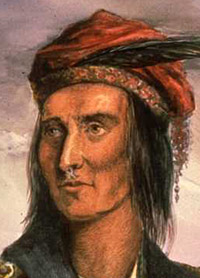
Tecumseh

Inequality, Class, and Race in the U.S.

Scott points us to this article concerning economic inequality in the United States, published by Brad Plummer. Among the more sobering statistics are the fact that, by the end of the 1990s, the wealthiest 1% in America earned 14% of the national income and owned a whopping 33% of all the wealth in the country (much of this the result of Democratic senators' deeds when they controlled Congress up until 1994).

Plummer and Scott accurately and wonderfully point out the broad implications of this, but it bears stressing, too, how race factors into this. It isn't a matter of causality - debates over whether "White senators don't care about the poor because they're largely minorities" or "White senators don't care about minorities because they're poor" - such a debate would transcend any productive analysis. What is worth examining is exactly how race and class frequently conjoin in the U.S. You can see it in any major urban center, be it the illustrations we all received in 2005 when Hurricane Katrina hit the Gulf Coast, or the East Side in Cleveland, or the ghettos in L.A., or even the South Valley in Albuquerque. Hell, it isn't coincidence that a large number of the homeless you see in Denver or New York City or Orlando are minorities.

What is particularly distressing is our failure to connect these factors. It's not just a lack of interest or ability among our politicians. It reaches out to all of those who ignore such problems, and indicates how severe a problem racism remains throughout the U.S., North, South, West, wherever. You don't have to think like David Duke to be racist - relatively very few Americans display the type of racism on display in cinematic dreck like "Crash." But refusing to acknowledge how not helping the poor automatically condemns majorities of minority groups in urban (and rural) centers via lesser education opportunities, urban development, and other programs, is in some ways even more sinister, for it leads a majority of our country to believe there is severe racism without necessarily confronting their own attitudes towards race AND class. Not to get too pedantic here, but if we're to confront racism and inequality (economic, racial, and cultural - after all, what is the fear of Muslims writ large besides the reinforcement of cultural hierarchies with America at the top?), then its time we start confronting ourselves and our politicians over the inequalities perpetuated in the U.S.

Monday, January 29, 2007

The Christ Year

As Mr. Trend pointed out earlier today, it is my birthday. Today, I turn 33. It is the Christ Year. I have few pretensions to surviving the year and many pretensions to being a spiritual guru to the world. Thus, I expect crucxification, or perhaps some other painful yet redemptive death. I am taking reservations for people to play a role. You can do something good like wash my feet or wrap my lifeless body in a robe or something like that. You would be rewarded with eternal life or maybe a good CD. You could also torture me, put a crown of thorns on me, or otherwise make my life hell. You will undergo eternal damnation. On the other hand, you will remain famous for eternity and maybe in 2000 years you can have the Harvey Keitel circa 4000 play you in a film.

Mexico Notes, Part 3

The third and final installment of my thoughts on my Mexico trip.

1. One of the coolest sites in Mexico City is the home of Leon Trotsky. In the lovely neighborhood of CoyocĂ¡n, Trotsky settled in the late 1930s, escaping from Stalin's Soviet Union. The story of Stalin's purges don't need to be repeated here, but Trotsky was the only major revolutionary leader to get out the country before Stalin killed him. It didn't matter in the long run, though it did buy him a few years of life. He went from place to place, Turkey, France, Norway, trying to escape Stalin but not too surprisingly, most governments were not too thrilled to have this revolutionary there. But by the late 1930s, Lazaro Cardenas took over the presidency. The most revolutionary of Mexican presidents, Cardenas made Mexico a haven for exiled radicals. Not only did he welcome Trotsky (and provided him with state-funded bodyguards), but during the late 30s, Mexico became a refuge for Republicans fleeing Franco's Spain. All of this could not keep Trotsky alive though. He originally lived at Frida Kahlo's house, but after sleeping with her, Diego Rivera broke with him and he was forced to get his own house. Soon after moving in, Mexican Stalinists, led by the artist David Siqueiros did a drive-by, firing dozens of bullets into the house. By a miracle no one died, but you can see the bullet holes still today. But the lover of Trotsky's secretary wormed his way into Trotsky's confidence and killed him with the famous ice-pick in the head. Sadly, no blood remains on the walls. But the place is still really cool. The original toilet is still there and, frankly, there's something to be said for seeing where Trotsky relieved himself. His grave is also in the yard. It's just a damn cool place.


2. Only a few blocks from Trotsky's house is Frida Kahlo's Blue House, where Trotsky stayed upon his arrival in Mexico. While Frida is not my favorite artist in the world and is somewhat overrated, it was quite cool to see her house. If you could design a house for a combination of beauty, light, and good workspaces, this would be it. It holds several of her works, some of Rivera's, and various other works. At the time, I understand monkeys used to hang out in the yard. It's real hard to imagine a monkey surviving in Mexico City today.

Art is just everywhere in Mexico. In the U.S., I feel like art is the province of the elite. Museums are often expensive. You rarely see art in the streets or in galleries for free or a nominal fee. It's not emphasized in the schools, the media, or any other public outlet. American collectors drive up the price of art, helping breed the feeling of elitism. But in Mexico it is so very different. I imagine that much of this comes from the post-revolutionary muralists and governments that produced art specifically intended for the masses. Cardenas particularly gave government support to muralists such as Diego Rivera, David Siqueiros, and Jose Clemente Orozco. Most importantly, he gave them the walls of government buildings for them to produce whatever they wanted, which were often revolutionary outlooks on Mexican history and society. Perhaps because people can view much of this art for free, at least on certain days of the week, art plays a much more prominent role in Mexican society than the U.S. Nearly every museum, even if it is not an art museum, has a room dedicated to modern art. I walked into one museum and not only did it have such rooms, but it also had an exhibit of Goya's bullfighting drawings. This was not particularly advertised, nor was it a major museum. It was just there for people to wander in and see. My favorite exhibition was by the Mexican artist Roberto CortĂ¡zar. Here's a bit on the exhibit I saw, which contained mostly heads like that shown here. I just thought it was great work. Where was this? In the anthropology museum in Puebla. Why was it there? Seemingly, just to support art.

3. The great archaeological site at Teotihuacan was pretty much all it is said to be. Very cool place. Mexican Indians made some truly amazing art. I didn't know that Teotihuacan was so old and basically abandoned before 1000. The Aztecs used it as part of their mythology but its original function was long gone. In several places that were hidden from the sun, the original paint still exists and that just makes it all the more cool. Also, these people could make some damn steps. How these very short people bounded up these steps is beyond me. They sure kicked my ass. Whew! Teotihuacan was also nice because it was quiet. I love Mexico City but it was really nice to get away from the noise. I actually saw some birds there. I think they were a flock of cedar waxwings, but I'm not so good at identifying birds. But seeing anything other than pigeons was wonderful. For my money, I like the Mayan ruins I've been to better, but this is more the aesthetic of the landscape than anything inherent in the ruins. The way CopĂ¡n comes out of the rain forest is super cool while Teotihuacan is part of a dry plain. But whatever. It was amazing and anyone who goes anywhere near Mexico City needs to get out there.

4. The only bummer about Teotihuacan were the hawkers. Anywhere you walked, you saw guys trying to sell you crap. Stuff made of obsidian, jewelry, a bunch of other stuff I didn't want. Worse, people were actually buying this stuff. I don't mind people trying to make a living and there were lots of stalls just outside the entrance of the ruins that were fine. But couldn't they keep it out of the ruins itself. But Mexico allows people to sell whatever whenever. In a country that is not overflowing in jobs, taking employment away from somewhere is quite unpopular. In Mexico City, former mayor (and the man who should be the current president) AndrĂ©s Manuel LĂ³pez Obrador worked for years trying to clear street stalls out of the historic district to very little effect. The area south of the zocalo is almost impossible to walk through because of the masses of street stalls and people. You can't spend more than 3 minutes on the subway without someone coming through selling things, from CDs to coloring books to Chiclets.

5. One problem that I faced in Mexico is making change. This is not just a Mexico thing. Costa Rica, Thailand, Malaysia, Honduras--it's all the same. If you have anything worth more than $5, it's a real pain to change it. A lot of places will just tell you they can't take it, even though they almost certainly can. When I went to Frida's house, I was paying for my friend as well. It was about $3 a person to get in. Thus, $6 for 2. I gave them the equivalent of a $20 and they said they couldn't take it. Given the amount of people who go to the site, and considering we were hardly the first people there that day, how it is possible that they didn't have 140 pesos for change? Why this happens, I just don't understand. In the villages, OK, but in Mexico City or Bangkok? Very strange.

Anyway, that about does it for my Mexico observations. It was a most wonderful trip. If you ever get the chance to explore Mexico, especially outside the border cities, do it!

Historical Image of the Day


Lawrence Welk

Happy Birthday

A happy birthday to one of my co-bloggers who, by being born on January 29, not only avoided sharing a birthday with Dick Cheney AND Phil Collins by one day, but who also shares a birthday with such fine company as Anton Chekov, W.C. Fields, distinguished Ohioans William McKinley and John D. Rockefeller, Jr., Tom Selleck, and fellow-Oregonian and "Free Willy" actor Jason James Richter. Distinguished company indeed...

Sunday, January 28, 2007

Disturbing

There is an excellent post at Gusts of Popular Feeling about plastic surgery in Korea. In particular, Matt writes about a student of his who cut her own tongue, believing it would help her speak English better. Even when I was there in the 90s, plastic surgery was all too common. Among the most unsettling forms of plastic surgery was women undergoing hymen replacement surgery, so that they would be "virgins" on their wedding day, even though they slept with their boyfriends before that.

Historical Image of the Day


Female Lynching Victim. Okemah, Oklahoma, 1911

Saturday, January 27, 2007

Uncle Lyrad's Lesson of the Evening: Falling

A word of advice. If you decide that it's a good idea to fall down, please, for your own safety, tuck your chin in and, when you land, roll toward your shoulder instead of taking it fully on your back. I know what your saying: "But Uncle Lyrad, it sounds better on the mat like that!" and you're right. It does. That better sound, though, is not worth the price. Trust me, I took one today that I'm still feeling the effects from.

The best way to handle the side effects from that though is to go out drinking and see Wayne "The Train" Hancock. I'm feeling better already.

Friday, January 26, 2007

Lyrad's Random 10

Better, better, better. That's all you ever say about our respective collections, Erik. Remember your post from June 12, 2006 on Oregon in which you say:

"...One thing about Portlanders though. They always talk about how their city is so much better than Seattle. A quick message to you all: shut the fuck up. If your city was actually better than Seattle, you wouldn't talk about it so much. Do you think Seattleites talk about how much better they are than Portland? No. Why? Because they don't care about you. Plus, there is no way that Portland can make this kind of claim until they have major league baseball. Right now, they are a AAA city in many ways. So again--shut the fuck up Portlanders...."

You can take your AAA music collection and cry alone in your room my friend, because you're about to read a major-league random 10:

1. Cibo Mato--Blue Train
2. Antonio Carlos Jobim w/Astrid Gilberto--Agua de Beber
3. Tom Waits--Grapefruit Moon
4. Ivie Anderson--Troubled Waters
5. The Del McCoury Band--It's Just the Night
6. Bob Ostertag--Oxblood
7. Steve Earle--Somewhere Out There
8. John Coltrane--Cousin Mary
9. Jay Cloidt--Auto/Motive
10. The Velvet Underground--One of These Days

Absurd Texts of American History (III, a)

I have a backlog of crazy stuff. Soon this will be more intermittent. But enjoy for now!

Today I am starting a multipart series based on the etiquette guide given to the All-American Girls Baseball League, which played from 1943-1954, entitled "A Guide for All-American Girls: How To....Look Better, Feel Better, Be More Popular." Its multipart because of all the great things in it.

Today, I will give you the introduction and the discussion of beauty routines.

"When you become a player in the All-American Girls Baseball League you have reached the highest position that a girl can attain in this sport. The All-American Girls Baseball League is getting great public attention because it is pioneering a new sport for women.

You have certain responsibilities because you too, are in the limelight. Your actions and appearance both on and off the field reflect on the whole profession. It is not only your duty to do your best to hold up the standard of this profession but to do your level best to keep others in line.

The girls in our League are rapidly becoming the heroines of youngsters as well as grownups all over the world. People want to be able to respect their heroines at all times. The All-American Girls Baseball League is attempting to establish a high standard that will make you proud that you are a player in years to come.

We hand you this manual to guide you in your personal appearance. We ask you to follow the rules of behavior for your own good as well as that of the future success of girls' baseball.

In these few pages you will find many of the simple and brief suggestions which should prove useful to you during the busy baseball season. If you plan your days to establish an easy and simple routine, so that your meals are regular and well balanced, so that you have time for outside play and relaxation, so that you sleep at least eight hours each night and so that your normal functions are regular, you will be on the alert, do your job well and gain the greatest joy from living. Always remember that your mind and your body are interrelated and you cannot neglect one without causing the other to suffer. A healthy mind and a healthy body are the true attributes of the All American Girl

Your ALL AMERICAN GIRLS BASEBALL LEAGUE BEAUTY KIT
Should always contain the following:

Cleansing Cream
Lipstick
Rouge--Medium
Cream Deodorant
Mild Astringent
Face Powder for Brunette
Hand Lotion
Hair Remover

You should be the best judge of your own beauty requirements. Keep your own kit replenished with the things you need for your own toilette and your beauty culture and care. Remember the skin, the hair, the teeth, and the eyes. It is most desirable in your own interests, in your teammates and fellow players, as well as from the standpoint of the public relations of the league that each girl be at all times presentable and attractive, whether on the playing field or at leisure. Study your own beauty culture possibilities and without overdoing your beauty treatment at the risk of attaining gaudiness, practise the little measure that will reflect well on your appearance and personality as a real All American girl.

Suggested Beauty Routine
"After the Game"

Remember, the All American girl is subjected to greater exposure through her activities on the diamond, through exertion in greater body warmth and perspiration, through exposure to dirt, grime and dust and through vigorous play to scratches, cuts, abrasions, and sprains. This means extra precaution to assure all the niceties of toilette and personality. Especially "after the game," the All American girl should take time to observe the necessary beauty ritual, to protect both her health and appearance. Here are a few simple rules that should prove helpful and healthful "after the game."

1. Shower well and soap the skin.
2. Dry thoroughly to avoid chapping or chafing.
3. Apply cleansing cream to face--remove with tissue.
4. Wash face with soap and water.
5. Apply skin astringent.
6. Apply rouge moderately but carefully.
7. Apply lipstick with moderate taste.
8. Apply eye make-up if considered desirable.
9. Apply powder.
10. Check all cuts, abrasions or minor injuries.

If you suffer any skin abrasion or injury, or if you discern any aches or pains that do not appear to be normal, report them at once to your coach-chaperon or the person responsible for treatment and first aid. Don't laugh off slight aliments as trivialities because they can often develop into serious infection or troublesome conditions that can handicap your play and cause personal inconvenience. See that your injuries, however slight, receive immediate attention. Guard your health and welfare."


Why they put "after the game" in quotation marks each time they use I don't know. I can think of some fun speculation about that.

Part 2 tomorrow.

Erik's Random 10

I haven't done one of these in awhile. But it's time to again show how much better my music colleciton is than my co-bloggers.

1. Maddy Prior, Honest Work
2. Here Today, Lonesome River
3. Bonnie Prince Billy, At the Break of Day
4. Johnny Cash, Wreck of the Old 97
5. Da Costa Woltz's Southern Broadcasters, Take Me Back to the Sweet Sunny South
6. Tom Waits, All Stripped Down
7. Wayne Shorter, Capricorn
8. Calexico/Iron & Wine, A History of Lovers
9. Don Byron, "Uh Oh Chango!"/White History Month
10. John Zorn, Etude #31

Historical Image of the Day


Colonial Slave Market. American South, 17th Century

Mister Trend's Random 10

1. "The Cemetary" - Architecture in Helsinki
2. "At the Bottom of Everything" - Bright Eyes
3. "The Secret Life of Arabia" - David Bowie
4. "My Love Is Real" - Buddy Guy
5. "Year of the Horse" - Sufjan Stevens
6. "Absolutely Cuckoo" - The Magnetic Fields
7. Liquid Days, Part II - "Open the Kingdom" - Philip Glass
8. "Wilderness" - Sleater-Kinney
9. "One of Us Must Know (Sooner or Later)" - Bob Dylan
10. Achnaten - Act II, Scene 2 - "Akhnaten and Nefertiti" - Philip Glass

Manohla Dargis Does Not Like Hustle and Flow

Which is OK, I guess. But let's not overdo the slamming of it. She writes about how it was picked up at Sundance:

And sometimes those bright people buy “Hustle & Flow,” a potboiler about sensitive pimps that was picked up here two years ago by the new team at Paramount Pictures amid a lot of crowing. Several lead players on that team are now history, and “Hustle & Flow” is on DVD, having earned little critical or public interest.

She goes on to say about its director:

Once upon a time, its writer and director, Craig Brewer, who also brought us “Hustle & Flow,” would have been churning out grindhouse quickies for Roger Corman. At Sundance, however, Mr. Brewer is a conquering hero, an auteur.

Except that the movie won an Academy Award for best song, a nomination for Terence Howard, and at least some attention. OK, this is not Citizen Kane. But come on. It's not that bad of a movie and going over the top to slam it is not helping her point about the hype machine at Sundance.

Joel Schumacher Sucks

OK, not such big news there.

But I saw the preview for his new movie, "23," with Jim Carrey tonight. It seems to have something to do with Carrey putting things together that add up to 23. Brillant no doubt.

Among the things in the preview that Carrey puts together is that the atomic bomb was dropped on Hiroshima on the 15th day of the 8th month.

That's not true. It was August 6. The Allies celebrated V-J Day on August 15, which marked the Japanese surrender.

Does Schumacher just think that Americans are too stupid to know that he is making shit up? Probably. Should Schumacher be banned from ever making another movie? Yes.