Showing posts with label Mexico. Show all posts
Showing posts with label Mexico. Show all posts
Wednesday, May 25, 2011

Monday, April 11, 2011
The Wondrous Food of Mexico
Alma Guillermoprieto on the glories of Mexican food, in my opinion one of the world's 3 great cuisines (along with Italian and Thai). I have been lucky enough to eat some of those jaw-droppingly amazing hand-patted tortillas. What I wouldn't give for one right now.
Thursday, September 09, 2010
Vigilantism in Mexico

A curious incident took place last month in Oaxaca. (See also here) A 17 year old kid, wasted out of his mind and probably desperate for another score, robbed a girl of her cellphone in broad daylight. He did this in one of the oldest and most stable neighborhoods of Ciudad Oaxaca, where most of the residents' families have lived for centuries. Instead of shaking their heads and watching the kid run away with the phone, residents chased him down. They then strung him upside down from a big tree, as you see above. I believe I know this very tree and the church behind it. And then they tried to figure out what to do with him. The kid was screaming, the cops came though they didn't do anything for hours, probably because they were almost as scared of the residents as the kid. Finally, they cut him down.
You never want to make too much out of a single event like this, but this incident is pretty emblematic of the increased failures of the Mexican state. Oaxaca has not suffered the same drug violence as many other parts of Mexico, but petty crime has risen significantly in the past year or so. And it's hardly surprising that residents are getting pretty sick and tired of it. Let's just quickly list how the government failed here:
1. Failed to keep kids in school
2. Failed to instill trust among its citizens in the police force
3. Failed to train its police force well enough to take charge of the situation upon arrival
4. Failed to hold crime down
5. Failed to provide any kind of options for this kid--even if he wanted to get off drugs; even if he wanted to get off drugs, treatment centers are few and far between, particularly for the poor.
It's hard to approve of vigilantism. But with the Mexican state so corrupt and incompetent, is is hardly surprising that people took the law into their own hands? Of course, they have started down a slippery slope. Will they kill the next punk they catch? Does the Mexican state, or the Oaxacan state government, have even the slightest ability to stop this from happening? Do they really even care?
Friday, July 02, 2010
Random World Cup Observation
Many people have a right to be complaining about the horrible officiating at the World Cup. However, Diego Maradona, whose Argentina squad never should have been allowed its first goal against Mexico (changing the entire complexion of the game), is about the last person who can legitimately complain.
Tuesday, March 02, 2010
Around Latin America
-An eventual return to Honduras for exiled and deposed ex-president Manuel Zelaya may have gotten more difficult this past week. Honduran prosecutors are trying to attain a warrant to arrest Zelaya for "fraud, document forgery and abuse of power." No word yet on whether these same prosecutors are going to try to secure warrants against senator-for-life Roberto Micheletti for his own abuses of power.
-Even as we continue to ignore the violence in Mexico (and our role in it), there are daily reminders that it affects the entire border region, not just Juarez.
-Could a call for a "plurinational uprising" from Confederation of Indigenous Nationalities of Ecuador threaten Rafael Correa's administration and ability to remain in office through the end of his term?
-In appalling environmental actions, Argentina's army apparently is burning its garbage at a base in the Antarctic within 200 feet of penguin nesting grounds.
-Although there has been bad blood between the two countries for well over a century, Peru has put that aside in the face of the humanitarian crisis facing Chile in the wake of this week's powerful 8.8-magnitude earthquake by offering construction materials to help its neighbor and occasional rival rebuild.
-Speaking of the Chilean earthquake, it turns out there will not be a single person on the planet who is not affected by the earthquake. The tectonic shift was powerful enough that it shifted the Earth's axis, resulting in a day that was 1.26 microseconds shorter.
-Brazil's indigenous Yanomani population has been devastated by disease and encroachment from outsiders in the recent past, and one scholar has a novel solution: prosecute Senator Jose Sarney, who was president from 1985-1990, with genocide for his role in letting gold mining companies enter into Yanomani territory, bringing with them disease and environmental degradation that have killed the Yanomanis and destroyed much of their homeland.
-On the subject of Brazil, there's also a nice little article up talking about the little-known (outside of Brazil) role of Middle Eastern immigrants in shaping the country's culture and politics over the last 100+ years, and it's well worth checking out.
-Finally, a pair of farewells to important Mexican figures. Writer Carlos Montemayor, whose fictional War in Paradise did much to shed light on the forgotten Mexican "Dirty War" of the 1960s and 1970s, died last week at the age of 62 (and the fact that a fictional work is the foremost work on the "Dirty War" speaks volumes about the absence of scholarship on the subject). And this week, Ana Maria Zapata Portillo, the last surviving daughter of Mexican revolutionary Emiliano Zapata, died at the age of 94.
Sunday, February 28, 2010
Spreading Mexican Violence
The narcoviolence in Mexico has begun spreading to Oaxaca.
Although most Americans see Mexico as an unvaried entity, in fact the violence has been extremely localized. Large parts of Mexico remain almost totally untouched. Oaxaca is one of those. But in recent days, two bad killings have taken place, including a head dumped on a major tourist beach in Puerto Escondido. The story is in Spanish, but here's a brief mention in the Times.
I wonder if the drug gangs will eventually start targeting tourists, or at least tourist centers like Cancun. There's been a couple of isolated incidents, but nothing major. If so, it could really undermine the Mexican economy and send Mexico on a Colombia-like path. Of course, the drug lords could be invested enough in the legal Mexican economy that they don't want this to happen.
But we have to ask ourselves what if anything the Mexican government will do to halt this violence. Despite President Felipe Calderon's crackdown on the drug lords, little if any headway has been made. The government has done nothing to correct the poverty that makes gangs so attractive to young men, they don't pay the police enough to make bribes undesirable, and the government has no vision except to crack heads.
Of course, the United States could do two things. First, it could make marijuana legal. It wouldn't end the drug wars, but it would undermine their profits significantly. Really, it's hard to see enough of a cocaine market in the U.S. for a non-producing state to devolve into civil war. Second, we could make guns much harder to buy. That'll never happen, because we have a national freak out any time the words "gun control" are mentioned. But over 90% of the guns owned by the cartels come from the U.S.
Sunday, February 21, 2010
Silly Idea of the Day
Planners have designed new, life-size replica of the Nahua capital of Tenochtitlan, complete with an IMAX theater, two Hilton Hotels, and two shopping malls (including one "dedicated to international designer fashions"). Because, as we all know, nothing says Nahua culture and empire like shopping malls and the name "Hilton."
h/t to Peter at the excellent blog Lat/Am Daily.
Tuesday, February 09, 2010
U.S. Spending on Latin America
Plan Colombia has a fascinating post detailing the U.S. spending on Latin America generally, and U.S. spending on Latin America when you take Mexico and Colombia out of the equation. While general spending on the region will be almost $2.6 billion in 2010 and nearly $2.1 billion in 2010 (a 15% drop in spending), the non-Mexico/non-Colombia number plummet: $1.3 billion dollars budgeted for the region in 2010, and nearly $1.4 billion for 2011.
This is interesting for a few reasons; first, there's the fact that, apparently, federal spending on Colombia and Mexico constitutes almost half of the budget this year. That's not remarkably surprising, but the figures are still rather stark. I think it's also intriguing that spending on non-Colombia/non-Mexico countries next year actually increases, even while the budget decreases by 15%. Most of that spending is planned for social and economic programs, with almost none of it being military spending; by contrast, almost all of the spending on Colombia and Mexico is military spending (again, no surprise). It would be interesting to see a further breakdown of exactly where that money is going - aid to Central America seems fairly likely, while aid to Brazil may be relatively low, given how well Brazil's economy is doing. Still, it's a pretty interesting breakdown, and says a lot about policy in the region, especially with regard to where our military money is going and who we feel "only" needs social help.
Wednesday, February 03, 2010
Around Latin America
-In a particularly tragic story, sixteen teenagers were shot and killed in Juarez this past week. The news has barely made a ripple in the United States, even though the casualties are greater than, say, Bloody Sunday, serving as a sad reminder not only of how horrible the violence in Juarez has gotten, but how immune the United States seems to be to what is going on just south of it's border.
-Rightist billionaire and Chilean president-elect Sebastian Piñera won the presidential run-off in mid-January. While he doesn't take office until March 11, some of his suggested policies and decisions are already raising eyebrows. As Greg points out, Piñera's desire to redirect money from copper away from the military budget indicates a growing willingness not just on the left, but on the right, to use Chile's income from copper in other ways, and the fact that a right-wing politician sympathetic to the economic policies of Pinochet has adopted this stance may mean the military will have to "come around" to the reality that it won't be getting as much funding from Chile's copper industry as it has grown accustomed to receiving. More troubling to many inside and outside of Chile, Piñera has also refused to divest of some of his financial properties while in office, leading some to ask if he isn't exposing himself to a conflict of interests between his financial holdings and his duties as president. This, on top of his profession that he thought the neoliberal policies under the Pinochet regime were the type of policies he would pursue, have many worried about his economic impact on Chile even before he takes office. Beyond that, it's worth noting that his brother appears to be the Chilean version of Billy Carter (and yes, that cake does look like what you think it looks like).
-In Peru, 41 military officers and soldiers have gone on trial for human rights violations for their roles in the murder of eight civilians in 1989. Although the trial is important for bringing justice, it also has become of political importance, as president Alan Garcia (who was also president from 1985-1990) tried to remove one of the officers from beyond the court's reach by giving him high-end political appointments. The trial, its timing (during Garcia's first administration), and Garcia's efforts to gain impunity for at least some of the officers raises important questions about Garcia's role in the violation of human rights during his administration, questions that are not and should not go away any time soon.
-Among the many victims of Colombia's never-ending civil war, the displaced are oft-forgotten. Many poor and small-landholders have lost their homes and lands, and wealthy families have swooped in to take it and then receive farm subsidies from the Uribe administration, serving as a powerful reminder of the fact that gross social inequalities and questionable political alliances are one of the biggest travesties of the Uribe administration.
-Lula continues to rely on hydroelectric dams for Brazil's future power sources. It just allowed the controversial Belo Monte dam on the Amazon river to proceed, in spite of opposition from environmentalists and residents in the Amazonian basin. With his term coming to an end this year, there will be many reasons to look back on Lula's administration and point at the positive things he accomplished; however, it already seems that his environmental policy may be one of the blackest marks on his administration, and the Belo Monte serves as just another strike against Lula on the environmental front.
-A European spaceport in French Guiana may be "booming," but it's isolating and alienating many French Guianans.
-Speaking of Europeans' presence in Latin America, though it seems unlikely to come to fruition this time, Russia has begun exploring the possibility of helping construct a canal through Nicaragua to connect the Atlantic and Pacific. Nicaragua has been the center of such talks since the early-1800s, so it's not clear why this time it will come to fruition. Nonetheless, it makes an interesting story, and if Russia goes through with helping Nicaragua finally construct a canal, there will probably be all kinds of hand-wringing among politicians in the United States.
-Evo Morales is not only interested in creating greater socio-economic and ethnic equality in Bolivia; he's also interested in opening up opportunities for women, a fact recently demonstrated in his appointments for cabinet: 10 of the 20 positions were filled by women, a first for Bolivia (and for many other countries in the world).
Sunday, January 24, 2010
Facial Hair of the Weekend

This marks the last of the "Mexican Revolution Facial Hair" series (see here for others). Álvaro Obregón (1880-1928) was one of the leading generals in Venustiano Carranzo's Constitutionalist army. Obregón achieved many of the major military victories of Carranza's forces in the 1914-1915 period, and was rewarded with the position of Minister of War in 1915. However, by 1917, Obregón
Monday, January 11, 2010
Around Latin America
-The longer-term effects of Micheletti's government are becoming increasingly clear, as Honduras is facing bankruptcy and the likelihood of foreign loans. Over the past several months since the coup, Micheletti's government has been drawing on reserves with no income (and certainly, the withdrawal of foreign investment in the wake of the illegal coup and global condemnation of the Micheletti government has not helped). This has left Honduras with no way to pay creditors as Lobo enters office at the end of the month. The result is that the only solution that seems to be on the table right now is foreign loans from institutions like the World Bank and IMF. Given the legacy of loans from these institutions in the 1960s, 1970s, 1980s, and 1990s, the economic future for Honduras looks fairly bleak. It seems increasingly likely that Honduras can now expect to be paying off the financial burden of the actions of the military and Micheletti for years and years and years to come.
-In a massive step backwards, a Colombian court last week released 17 members of the Army involved in the 2008 Soacha murder case. The soldiers involved were accused of killing unemployed men from Bogota and dumping their bodies in the jungle to disguise the dead as "rebels." The fact that these 17 officers will be free from justice for their roles in the murder of numerous innocent poor Colombians is bad enough; the fact that they did so in order to up the unit's body count and qualify "for a schedule of rewards, as established by Defense Ministry orders" is even worse, as it's just another way that the Colombian government is tacitly supporting the murder of innocent civilians in the name of "security."
-Meanwhile, the ongoing conflict in Colombia can lead to gruesome instances, such as the fact that dumped bodies frequently wash up along the shores of the Cauca River (among others): "While hardly Colombia's only river repository for human remains, the Cauca may well be its most prolific. It carries the bodies of drug gang toughs, of peasants dismembered by death squads, of innocents killed for being kin to somebody's rival." Now, one woman is making an effort to give the bodies the dignity in death that they did not receive in life.
-Martinique and French Guyana voted this weekend on whether they would gain greater independence from France. The referendums on increased autonomy failed in both places , in part no doubt because France can (and probably does) spend more on the two than they could spend themselves, and in part because, as the BBC article demonstrates, residents of both "departments" simply don't trust their political leaders enough to have them lead independent countries.
-Tensions in Paraguay over the possibility of a coup against Fernando Lugo continue to run high, with resulting popular mobilizations already preparing to defend Lugo.
-An ongoing strike among the bauxite sector in Guyana is getting ugly, as the workers' union has alleged instances of racial discrimination against the workers on the part of the company involved.
-While Chilean copper miners resolved their strike last week, smelters continued their strike, but are now apparently close to signing a deal as well. The smelters' strike and the miners' strike briefly drove the global price of copper up last week.
-Argentina is facing a potentially-major institutional crisis, as Cristina Kirchner has forcibly removed the president of Argentina's Central Bank from his position in order to open up reserves for the struggling Argentine economy and (perhaps) salvage some of her own political capital. That may seem innocuous, but Central Banks throughout Latin America tend to function independent of the executive branch, (theoretically) working for the long-term economic stability and growth of a country and not focusing on short-term political moves. If Kirchner is successful, it could be a troubling step towards Central Banks becoming part of political moves for politicians on both the left and right.
-It turns out, one of the Mexican broadcasters for the NFL is a horribly misogynistic pig.
-Finally, in an effort to boost coca-leaf production and spur the Bolivian economy, Evo Morales has an interesting solution. Meet Coca Colla.
Sunday, January 10, 2010
Facial Hair of the Weekend
 Emiliano Zapata (1879-1919). Although Zapata was from a moderately well-off family (in comparison to the peasantry) in the state of Morelos, he was still outraged by the gross inequalities between the landholding class and the landless peasantry, which constituted an overwhelming majority of the population in southern Mexico. Even before the Mexican Revolution, Zapata had begun fighting for greater rights and access to land for the peasantry. When the Revolution broke out in 1910, Zapata quickly became the leader of the Liberation Army of the South. When it became clear that Francisco Madero would not (or could not) effect the kinds of changes Zapata sought, Zapata soured on his leadership. Still, by 1914, Zapata was allied with Venustiano Carranza's Constitutional forces (including Pancho Villa), which were trying to overthrow Victoriano Huerta. By the end of 1914, Zapata's skills as a general were respected, but he was continuously dissatisfied with the slow level of reforms, and continued to take over cities and villages in the South, in an effort to strip elites of some of their power. When Carranza's government told Zapata to stand down, his response was effectively that if armed struggle wasn't going to bring reform, then certainly pacified, unarmed struggle would achieve nothing. Zapata's forces continued to cause trouble for Carranza in southern Mexico, but as Zapata was concerned with land reform in the south, his movement didn't ever really become a national one. In 1919, Zapata was ambushed and assassinated, dying a hero to many in the South, and although his message hasn't always persisted, his image as a hero of the people has continued to the present day in Mexico and beyond, most notably in the Ejército Zapatista de Liberación Nacional (EZLN) in Chiapas and surrounding areas.
Friday, January 08, 2010
Around Latin America
-The Honduran Supreme Court has appointed a judge to investigate a prosecutor's filed case against the military for its role in forcing Manuel Zelaya from the country on June 28. No warrants can be issued until the judge rules on the filing. That may sound nice, but given that this is the same Supreme Court that upheld the illegal removal of Zelaya, I don't think much will come from this. Still, if something is to happen, it has to start somewhere.
-Additionally, the Micheletti regime is apparently broke: "The Finance Minister for the de facto government, Gabriela Nuñez announced today that she does not currently have access to sufficient funds to pay government employees for January. It all boils down to cash flow. She said she has access to about 400 million lempiras, and needs a total of about 1,500 million lempiras. In addition, she noted that the government has run up large debts with suppliers, including 450 million lempiras for medical supplies, and a further 700 million lempiras owed to road construction and paving contractors." I don't know to what extent international reaction to the coup and reduction of financial support has played a role in this, but I suspect it must be at least somewhat significant, and nothing less than what the Micheletti has brought upon itself.
-Is Peru's economic star rising in Latin America? A road between Peru and Brazil and a growth in GDP of 9.8% last year indicate Peru may be in for a brighter future.
-Not as bright for Peru's future: illegal gold mining in Peru's Amazonian basin is causing long-term environmental damage : "it takes about five grams of mercury to extract a gram of gold. That mercury is usually tossed overboard, poisoning one of the world’s most biodiverse rain forests. And Borian’s form of mining is among the most benign. Illegal cartels with heavy equipment clear-cut and mine huge areas of virgin forest, alarming environmental activists."
-In response to Mexico City legalizing abortion, surrounding states are making it increasingly difficult to obtain an abortion in the rest of the country:
In response to a Mexican Supreme Court ruling in August 2008 upholding a Mexico City law permitting abortion during the first 12 weeks of pregnancy, 17 of 32 Mexican states have approved amendments to their constitutions declaring that life begins at conception and granting legal rights to fetuses, the Chicago Tribune reports. Veracruz, which in November 2009 became the most recent state to enact an antiabortion-rights amendment, has called on the federal government to consider adding a similar amendment to the national constitution.It's hard to be surprised by this. Anti-choice sentiment stemming from conservative social values and Catholicism made any kind of response in Mexico likely. Still, this particular response from other state governments, and the pressure for a national law banning abortion, is very unfortunate. While each state can do what it wants (in the same way the D.F. can and did), it would be very bad of there were a national law enacted in Mexico.
-According to Venezuela's state-run National Electric Corporation, the country could be facing a major power outage nationwide in the next 3-4 months if water levels in the reservoirs continue to drop. Weather is funny, so there's no way of predicting accurately what will happen in that time period; still, power loss for an entire country would be tough to deal with politically, socially, or economically.
-While the recent massive rainfall in Brazil has led to the deaths of dozens, it may have the opposite effect in terms of agricultural production, as "Brazil’s coffee crop may beat the 48.48 million bag record this year, the country’s crop supply agency said in a report which also raised forecasts for the newly-begun soybean harvest."
-Finally, Lula is expected to decide soon which company he will contract for the a $4.4 billion U.S. dollar fighter jet order. In addition to Boeing (a U.S. company), France's Dassault and Sweden's Saab are in consideration. If Boeing is selected, it would create thousands of jobs for the struggling U.S. economy, a fact that didn't deter Republican Senator George LeMieux from doing all he could to damage U.S.-Brazil relations prior to the approval last week of Thomas Shannon as ambassador to Brazil.
Thursday, January 07, 2010
Around Latin America
-A public prosecutor in Honduras has filed charges against the Honduran military for illegally removing Manuel Zelaya from Honduras forcibly when it overthrew him on June 28. The file charges the military with "abuse of authority." Meanwhile, Roberto Micheletti announced that he would not resign before the inauguration, staying on until January 27, but neither will he be attending the inauguration, which will certainly make the ceremony even more interesting.
-Argentine President Cristina Kirchner issued a decree this week that will open Argentina's military archives, declassifying thousands of documents from the period of Argentina's military dictatorship/"Dirty War" between 1976 and 1983. Upon issuing the decree, Kirchner declared, "The classified information and/or documentation which was not made public was not designed to protect the legitimate interests of a democratic State, but, on the contrary, served as a means of hiding the illegal actions of a de facto government." Now, if only Brazil could follow suit and open its military archives...
-A couple of cases and events in Brazil have stirred some concerns over freedom of the press in Brazil. The Supreme Court upheld a court ruling from July that barred one of Brazil's major newspapers, O Estado de Sao Paulo, from using legally-obtained information regarding a corruption investigation into former president and current president of the Senate Jose Sarney. That ruling alone would have set some media outlets and critics of the government on edge, but has in no way been aided by statements Lula made at the opening of the National Conference on Communications in Brazil, where he criticized Brazilian media, which he claimed "commits 'excesses', publishes 'lies', fabricates news and gets involved in campaigns that disseminate 'slander and abuse.'" While he's often right, particularly when one looks at O Globo or some of the more salacious and ridiculous daily newspapers that adorn kiosks throughout the country, he also insisted that he has "a sacred commitment to freedom of the press." While Lula's contempt for the media is well-known (and understandable), there's no reason to believe he's launching an attack on free speech; even if he were interested in doing so, why he would begin with just 10 months left in an 8-year presidency stretches logic and credibility. Still, these two events back-to-back have many of his most vocal critics speaking out, and has left even some traditionally-responsible news sources on edge.
-Suriname's first president, Johan Ferrier, has died at 99. Ferrier played an important role in Suriname gaining its independence from the Netherlands in 1975, and was rewarded with the presidency. While his arrival to office seemed like a major accomplishment, his departure was much darker; Ferrier resigned and relocated his family to the Netherlands as a military dictatorship established itself.
-Hopes for finding survivors in mudslides in Rio de Janeiro state are fading fast, in the wake of torrential rainfalls that hit the state and city over the New Year's holiday. At least 75 are reported to have died already, but that number could go up as the count and search continue. Meanwhile, the mudslides have prompted calls for shutting down Brazil's nuclear power plant. The plant is located near Angra dos Reis, where many of the mudslides have occurred.
-Finally, in the mildly salacious department: four Mexican priests have been defrocked for violating their vows of celibacy. The Church's position on celibacy is pretty hard to defend, but I guess if you're going to lose your job for something, that's a pretty good cause for job dismissal.
Sunday, December 20, 2009
Facial Hair of the Weekend
 Fransico "Pancho" Villa (1878-1923), general/caudillo in the Mexican Revolution. Villa was a part of Carranza's constitutional forces against Victoriano Huerta. Villa and Carranza had a falling-out over orders Carranza gave that prevented Villa from arriving in Mexico City before Carranza. In 1916, Villa raided Columbus, NM, leading to General John Pershing's useless "expedition" into Mexico to capture Mexico (which in turn elevated Villa's status as a popular hero). Villa finished out the revolution fairly quietly (for him), with minor mobilizations limited to Chihuahua. Upon the Revolution's so-called "end" in 1920, he lived on a ranch in Chihuahua, where he was assassinated while in his car in 1923 (and for those who aren't faint of heart, you can see video footage of the site, automobile, and Villa's bullet-riddled body here).
Thursday, December 17, 2009
Top Cartel Lord Killed in Mexico
I don't follow Mexican politics or the nuances of the drug war as closely as I probably should, but this is big news:
Two hundred sailors raided an upscale apartment complex and killed a reputed Mexican drug cartel chief in a two-hour gunbattle, one of the biggest victories yet in President Felipe Calderon's drug war.Arturo Beltran Leyva, the ''boss of bosses,'' and three members of his cartel were slain in the shootout Wednesday in Cuernavaca, just south of Mexico City, according to a navy statement. A fifth cartel member committed suicide during the shootout.
This in no way means the end of the drug trade, or the end of the cartels' power in Mexico. Still, this is definitely good news for President Calderon, who has been needing good news. And as pc points out, the news is everywhere in Mexico today.
Sunday, December 13, 2009
Facial Hair of the Weekend
 Venustiano Carranza (1859-1920). Carranza became political leader of Mexico in 1914 upon the overthrow of Victoriano Huerta. Carranza marked a return of revolutionary leadership (and amazing facial hair) to the presidency, but was unable to satisfy the forces of Emiliano Zapata to the South, Francisco "Pancho" Villa to the north, and increasingly later in his term, his own generals, whom he did not want running for president in 1920. While Carranza did push through major reforms during his time in office, his term was also marked by corruption. Carranza was assassinated by one of his former general's supporters in 1920 as he tried to flee Mexico City.
Saturday, December 05, 2009
Facial Hair of the Weekend
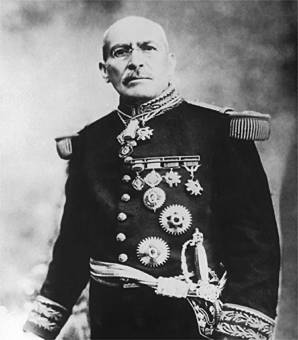 Victoriano Huerta, who (as Grigori noted) plotted with U.S. ambassador Henry Lane Wilson to overthrow Francisco Madero in 1913. Huerta quickly set up a quasi-military dictatorship upon assuming the presidency after Madero's murder. Newly-elected president Woodrow Wilson demanded Huerta step aside and let Mexico return to democracy, and recalled Wilson. When Huerta refused, Wilson began to support Venustiano Carranza's Constitutional Army (which included Álvaro Obregón, Francisco "Pancho" Villa, and Emiliano Zapata. Wilson's opposition and a series of military defeats led to Huerta's resignation in 1914. He went into exile, ending up in the United States, where he continued to plot a coup in Mexico, leading to the U.S. putting him under house arrest, where he remained until 1916, when he died from cirrhosis, leaving one to wonder just how much of an alcoholic Huerta had been as president.
(For other Mexican political leaders, see here)
Wednesday, December 02, 2009
More institutional reform in Mexico?
On Monday, President Felipe Calderón announced plans for some major structural reforms to Mexico’s political system (more here, here, and here). Among the numerous reforms announced, there are two I find both interesting and troubling. First, Calderón is going to try and push for allowing the immediate reelection of legislators and mayors. The second is the reduction in the number of legislators, presumably by reducing the number of legislators elected through proportional representation. I have written and the prohibition on reelection here before, please read that story for more background. While the issue of reelection comes up periodically, this time is notable both for the president’s public support and some signs that the other two major parties will also support it.
From the point of democratic theory, reelection is almost a necessary requisite for inducing both representation and accountability. Most of the arguments in favor of reelection are largely based on the theoretical benefits of reelection, and in fact, I know of no pundits or academics that are opposed to allowing for reelection in Mexico. Whenever reelection becomes a topic worthy of newspaper coverage, it is almost invariably in support of the reform, with these two most recent editorials in El Universal rehashing many of the same arguments in favor of reelection. The two major ones are: 1) reelection will force legislators to be accountable to voters, since voters will get to pass judgment after a single term, and 2) reelection will lead to a more professional legislature with institutional memory and career politicians dedicated to a legislative career.
One of the problems is, most Mexicans are against reelection, and this has been demonstrated again and again in national surveys. Some of the public resistance to reelection may be misguided based on a misinterpretation of Francisco Madero’s slogan of “effective suffrage, no reelection” during the 1910 revolution. Its not clear how this public resistance will manifest itself if the rules are changed, but it should not be ignored.
The other problem with the arguments in favor of reelection is that they ignore the complex interplay of numerous rules and practices that may work against the supposed benefits of reelection. In terms of the first benefit, greater accountability to voters, there are two issues that may impede accountability. First are the methods of candidate selection in Mexico. The use of primaries at the local level is growing, but there are still numerous cases where party leaders choose the candidate to be placed on the ballot without any voter input. The discretionary control that is written into party statutes and implemented in practice has numerous consequences for the relationship between representatives and voters. As the laws stand now, Mexico’s parties have complete control over who is placed on the ballot, meaning there is the possibility incumbent legislators could be forced off the ballot for angering party leaders (although likely a remote possibility). However, the greater issue is that legislators are going to be most responsive to those who help them get on the ballot and win the election. Understanding the relative role of party elites and voters in getting on the ballot and winning is crucial for understanding to whom the legislator will be most accountable. One recent editorial spent a single sentence on this issue, but really the benefits of reelection cannot be understood without a serious discussion of democratic candidate selection procedures. Second, Mexico’s politicians have a long history of progressive ambition, meaning they move around to various positions in political parties, as elected representatives, in the federal or state bureaucracy, or moving back and forth between politics and academia. While much of this is likely due to institutional rules that force this type of behavior, it is also a norm that may be hard to change. This type of ambition is fairly common in Latin America, even in places that allow reelection. The comparison is key, because in Latin American countries, party leaders exert fairly strong control over who gets on the ballot, and reelection to the same post is typically not a common goal for many legislators. Just because reelection may be allowed in Mexico, does not alter the goals of party leaders which may run against allowing individuals to develop strong bases of power in a single district, nor will it change in the short term the long term practice of changing positions every few years. In addition, since Mexico does allow non-consecutive reelection, when individuals do serve more than one term, they are more likely to be reelected through the proportional representation (PR) lists. The presence of the PR lists complicates the link between voters and representatives, if the informal practice of seeking reelection through the PR lists continues.
The above discussion leads to the potential problems with the second argument for reelection, a more professionalized legislature. Mexico already has a fairly powerful legislature, not only compared to its past prior to the late 1990s, but also compared to other Latin American legislatures. Allowing reelection may lead to more individuals with longer legislative careers who have greater experience navigating the legislative process. I do agree that professionalization is a problem. Right now, every three years the lower house, the Chamber of Deputies, is completely turned over. Since there are typically around 15-20% of legislators in each legislative term that have experience, these individuals help the newcomers learn the ropes. But, looking at the introduction of bills and the number of bills voted upon, the first year of each three year term is pretty thin in terms of activity. What we do see, is almost a year of wasted time every three years, and in the final year, a number of legislators who leave office early in search of other positions. Allowing reelection may lead to more legislative activity (although for better or worse really is something I can’t comment on). The other problem reelection might solve, is that there are a number of legislators who do virtually nothing. In terms of initiating a single bill, there are roughly 30% of legislators who can’t even do that, and another roughly 15-20% who either initiate their own bill or sign their name to someone else’s bill. These individuals show up to vote (although absenteeism on floor votes is also extremely high), but other than being warm bodies, there are a significant number of legislators who do not perform their most basic duty, to write legislation.
Yet, reelection might not be a panacea for solving these problems. Most legislators do not have the resources to engage in the research necessary to write good legislation. The party leaders have enormous control over the allocation of resources and staff, and without changing these internal rules and practices, Mexico’s legislators may not perform much differently.
The other potential reform I want to discuss is the reduction in the number of proportional representation legislators, typically referred to as los plurinominales, or for short, los pluris. Mexico’s Chamber of Deputies currently has 500 seats, 300 elected through single-member district plurality elections much like in the U.S., and 200 elected through a closed party list. The Senate has 128 seats, 32 of which are also selected through closed party lists. Each state legislature also has a varying number of pluris. Mexico first added these pluris way back in 1963 as a concession to opposition parties, and the PR seats were traditionally the only way the opposition parties could gain seats, as the ruling PRI (Institutional Revolutionary Party) completely dominated all of the district elections. Now, the pluris are typically chosen by the national party leadership of each major party, feature most of the key party leaders in both the Chamber of Deputies and the Senate, and are also used as patronage to hand out seats to important interest groups. There is some public anger against the pluris, largely because voters have absolutely no say over who can be placed on these lists or who ends up in the most powerful positions in the legislature. During the 2009 mid-term election, there was a small but vocal movement advocating for annulling one’s vote, in a protest against the perceived lack of responsiveness of the political system. One of the major demands of this movement was the elimination of the pluris. Some websites and facebook pages are now popping up pushing for their elimination, and a number of commentators are advocating for their elimination or reduction (here, here, here, and here).
I generally think this is a terrible idea, and there exist a couple of alternatives that may deal with the perceived unresponsiveness of the pluris. One recent editorial suggests that they get in the way and have no reason to exist. After looking at the evidence of what legislators do, not only do I disagree with this claim, but I found the opposite is true. It is the district legislators who are more likely to do nothing. Why is this the case? I think it is because the parties put their more experienced and talented people on the lists. Evidence is key in the discussion of eliminating the pluris. There definitely seems to be more public support for eliminating the pluris than reelection, so if reelection did not pass, but the reduction or elimination of pluris did, it is likely the legislature will perform even worse than it already does.
However, the major reason I think eliminating the pluris is a terrible idea, is that this might lead to a resurgence of PRI dominance through district elections. The PRI still has the best organized party in Mexico, and the reduction of the pluris could nearly cripple the center-left Party of the Democratic Revolution (although they are doing a good job destroying themselves), and return to one-party dominance in a number of states where the center-right National Action Party is not competitive. The party list seats were implemented to increase competition into the Mexican political system, and Mexico is not that far removed from the days of one-party dominance. Using proportional representation helps balance out disproportionality that comes from only using single-member districts.
How to deal with the lack of responsiveness of the party list legislators? The most basic is to open up the candidate selection of who occupies the lists. This could be done by using open-list PR, allowing voters to rank members of the list on a separate ballot, or through more direct primaries to allow voters to have a voice of who gets placed on the ballot. Another possible reform is to promote the increased use of dual candidacy. In most countries that employ a mixed electoral system like Mexico, candidates are allowed to run in a district race and also simultaneously be placed on the party list. Mexico’s major parties rarely use dual candidacy (although the PAN uses it more than the PRD or the PRI). If the party list candidates were forced to also run in a district race, then they would be more visible to voters, and potentially, more responsive. One interesting proposition is what is done in Japan, known as the “best loser” provision. In Japan, district candidates who lose are ranked on the party list after the election according how they performed in their district, encouraging them to do their best to attract votes in the district races regardless of their ability to win. I could envision in Mexico a system where the pluris are nothing more than those candidates who lost in the district race, rather a completely separate group of candidates who never have to campaign or communicate with voters. Electing losers has its own sets of problems and created controversy in a number of places such as Ukraine, New Zealand, and Japan (see numerous posts here this post about dual candidacy in mixed electoral systems). Yet, these types of changes would not only increase the responsiveness of the pluris, but also not lead to the potentially undesired consequence of reducing party competition in Mexico.
I do not want to come across as completely opposing either reelection or reducing the number of party list legislators. However, the lack of serious debate about both of these much discussed reforms in Mexico is troubling. (I want to thank Patrick Corcoran at Gancho for providing a number of links used here.)
Tuesday, December 01, 2009
Around Latin America
A few items regarding human rights worth noting:
-In Colombia, a court sentenced a former general to 40 years in prison for his role in the massacre of at least 49 civilians in 1997. Jaime Humberto Uscategui was accused of having ignored pleas for help from a local judge who reported the massacre, which took place over five days in July 1997. Uscategui not only ignored the pleas, but his garrison was the location where two planes of paramilitaries who committed the massacre landed and were dispatched. The fact that Uscategui (now 61) will hopefully spend the rest of his life in jail is a good step in curbing impunity for paramilitaries and for officers connected to paramilitaries in Colombia.
-Speaking of paramilitaries, a group of right-wing paramilitaries in Oaxaca apparently shot four children on Sunday, killing one. I don't know much about the particular political claims of the groups involved (though Erik or Yann may know more), but it's clear that Mexican right-wing paramilitary groups and even politicians are still trying to prevent indigenous groups and left-wing community organizations from organizing and effecting change in southern Mexico, and their silly display of power and intimidation this weekend resulted in a dead child.
-In Argentina, former dictator Jorge Videla is denying charges that he helped to put the kidnapped children of "disappeared" women in the homes of other families. Given that other kidnapping charges are among those that in 1998 helped to get Videla back in prison after Carlos Menem's unforgiveable pardon in 1990, these new charges could help in making sure Videla rots in prison until the day he dies.
Subscribe to:
Comment Feed (RSS)


