Roosevelt Has Never Been This Happy!
An ad from a Guatemalan Hooters:

I really don't know what I could possibly add to this.
Via Edge of the American West.
An ad from a Guatemalan Hooters:
This is a truly amazing photo of a sink hole that opened up in Guatemala City after all the rain from Tropical Storm Agatha. (Hat tip.) It's been a rough week for Guatemala, with both Pacaya and the torrential rains. 
The shot is CC licensed on flickr by the Gobierno de Guatemala. Just unbelievable.
 This has been a banner year for ash spew. My guess is that we will see a short term global temperature dip as a result of all of the recent activity. Cue climate change denialists... Now. Volcán Pacaya near Guatemala City and Volcán Tungurahua returned to active eruption this past week. Pacaya apparently emitted more than just ash on nearby communities, and the linked article includes a short but harrowing tale of one mother hiding with her kids under the bed as marble-sized hot rocks rained on her house.
I don't know either Pacaya or Guatemala City, but I do know Tungurahua and its nearby tourist haven Baños from years of traveling to Ecuador. Back in the 1990s Baños was a hopping backpacker's town, full of the retinue of Israeli, Australian, and Gringo shoestring travelers making the trip from Buenos Aires to Bogotá. Of course, this also meant there was a large ex-pat community running businesses catering to the travelers. I have fond memories of Baños, though I haven't been there in close to ten years. I spent part of my honeymoon there, including a day riding horses on the slopes of Tungurahua.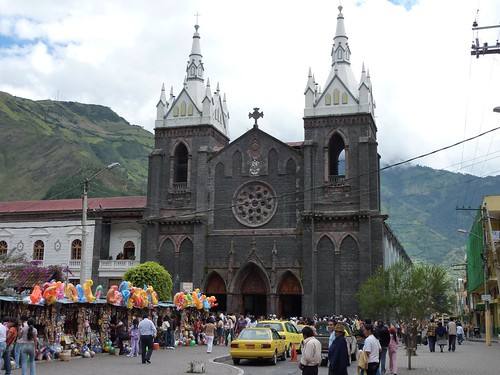 Baños's economy began to struggle in the late 1990s and early 2000s due to a series of eruptions from Tungurahua, which re-awoke in 1999. The latest major eruption, which sent ash to Guayaquil and on to the Pacific, will undoubtedly hurt the local economy again. In some ways, it seems that the precariousness of Baños's economy is analogous to the position Ecuador holds in the international economy-- dependent on outside dollars (both literally and figuratively), on the whims of natural phenomena beyond its control (be it volcanic eruptions, El Niño-induced droughts, etc.), and on the irrationalities of the international economic order. Baños is not only downstream from Tungurahua, it's also just upstream from a major hydroelectric dam project- the Agoyan Dam on the Pastaza River made famous again a few years ago in the opening scenes of John Perkins' Confessions of an Economic Hitman. It's a beautiful place, but its trapped, as Ecuador is more generally, between the grinding pressures of natural instability and international "development."
The growing presence of alien spirits in the Brazilian caipirinha has led enthusiasts to attempt to "rescue" their national drink. The Save the Caipirinha campaign was launched last month with an online petition that has attracted 10,000 signatures from cachaca fans, chefs, and celebrities."We formally declare that we no longer wish to see our caipirinha being made with vodka or sake instead of cachaca," reads the campaign manifesto, the brainchild of the Cachaca Leblon brand. "We do not accept that this drink, which is famous and respected around the world, be disrespected in Brazil."
I had hoped to write in depth about some of these stories in individual posts, but an unexpected trip out of town will keep me from blogging for several days. I still hope to come back to a couple of these, but until then, the stories themselves are well worth checking out.
-Death squads in Colombia have apparently begun targeting Afro-Colombian activists. The racial tensions in Colombia are often under-acknowledged, but stories like this serve as a strong reminder that complex race-relations among Afro-descendants and others in the Americas are not the monopoly of Brazil and the United States alone.
-Also in Colombia, another 14 soldiers have been set free from jail in the Soacha murders case. Like the previous 17 soldiers, the men were set free on a technicality, thus setting back efforts against paramilitary actions and human rights violations in Colombia even further.
-Guatemalan President Alvaro Colom has been cleared in the assassination of an opposition lawyer. The investigation arose when Rodrigo Rosenberg was murdered last May, with a videotape surfacing with Rosenberg claiming that if he were killed, it was because Colom had ordered it. The incident led to protests both against and in favor of Colom, and even the FBI had gotten involved with the investigation. The investigation ruled Rosenberg's death a suicide in which he tried to take down Colom's government with him, which sounds somewhat unlikely, but isn't so strange within the way the report narrates the events. They may be wrong still, but it appears Colom has emerged from this strange challenge to his office.
-Some in Brazil and the U.S. wonder if a new film on Lula's early years as a metal-worker and union leader will influence the elections this year. [I'll certainly have more on this later.]
-It turns out, Roberto Micheletti isn't the only perpetual participant in Honduran politics, as the Honduran Congress handed out 50 other lifetime government positions. And as for Micheletti himself, not only is he remaining in politics, but he plans to continue to be a very vocal participant.
-Finally, in Argentina, prison riots are bringing the issue of prisoners' rights to the fore in Argentina, which, like many other countries in the Americas (including the U.S.), suffers from an appalling penal system that demonstrates little concern for the conditions of prisons and rights of prisoners.
-In good news from Guatemala, this past week, an army officer was convicted for his role in the disappearance of eight indigenous villagers in 1981. Colonel Marco Antonio Sanchez was sentenced to 53 years in prison, and three of his subordinates also received prison sentences. While this isn't the first incident of conviction in an "enforced disappearance" case, it does mark the first time that a high-ranking military officer has been convicted in such a case. Meanwhile, lawyers entered damning evidence from secret Guatemalan military archives in the case of charges of genocide against former dictator Efraín Ríos Montt
-In bad news for women's rights in Brazil, a Brazilian doctor who performed abortions was found dead in her car last week. Authorities are investigating whether Dr. Neide Mota Machado's death was a murder or a suicide. Machado had had her medical license stripped earlier this year, after she was accused of performing nearly 10,000 abortions in Brazil (where abortion is illegal save for cases of rape, severe deformation of the fetus, or of a threat to the life of the mother). For those who feel that making abortion in the United States legal only in the cases of rape, incest, or health risks to the mother, it is worth pointing out that over 230,000 women entered hospitals due to complications from botched illegal abortions in 2008 alone.
-Finally, one of the darker aspects of the U.S. embargo on Cuba emerged in a recent story that alleged that "a dozen Cuban children with heart defects were forced to endure unnecessary surgery because the U.S. embargo blocked them from receiving American-made catheters." While the U.S. apparently made such exports to Cuba legal back in 1992, the paperwork is enough of a "hassle" that medical companies have little reward in going through all the bureaucracy imposed by the limited embargo, which allows medicine to get to Cuba. Even so, after $142 health care items were approved to go to Cuba in 2008, only $1.2 million worth of goods actually reached the island, according to this report. While I question the use of the term "genocide" to describe unnecessary surgeries on 12 children, there is no denying the fact that the embargo has very real consequences upon the daily lives and even survival of many Cubans, and this story just offers one more very stark reminder of that fact.
Between leaving New York and arriving in New Mexico, I suddenly found that I would be teaching (with all of the accompanying research and lecture-writing) at UNM this semester, on top of working on my dissertation, so blogging will not be as prevalent as I would like.
However, there are a few things related to human rights worth noting this week. First, Guatemala sentenced former military commissioner Felipe Cusanero to 150 years in prison for his role in 6 disappearances between 1982 and 1984. The sentence is a major one, because it is the first conviction of anybody for human rights abuses during the 36-year civil war. This is rather remarkable and depressing, given that upwards of 250,000 people were murdered during the civil war, and the armed forces committed nearly all (80%) of those murders. It's almost inexcusable that it's taken 13 years for even one conviction, but you have to start somewhere, and hopefully, many more will follow. And at least Guatemala did not give Cusanero some weak sentence, either.
In Argentina, a new book by a mother of one of the disappeared from the Dirty War (1976-1983) reminds us just how heartbreaking and difficult those cases continue to be as they haunt their families. In fighting for human rights and against abuses, it's easy to lose sight sometimes of how this still affects people daily, but just reading the opening sentence (quoted in the article) is a devastating reminder of how real the effects for many remain.
In Chile, a judge has issued arrest warrants for another 120 intelligence officers connected to torture and other crimes against humanity during the Pinochet regime, even while many torturers remain on the public payrolls in Chile. And for any who still think Pinochet led Chile for purely selfless reasons for 17 years, the fact that he managed to earn $25 million (with $20 million of it having "no justifiable origin") would hopefully destroy any such notions. Unfortunately, Cold War zealotry dies hard, and he'll still have his defenders for years to come.
Finally, only marginally related, a major obstacle to Alvaro Uribe's quest for a third term was overcome yesterday, as the Colombian House of Representatives approved the referendum bill for a third term (probably made him feel a bit better as he tries to recover from H1N1). It's still not a lock - the Court could surprise people and rule it unconstitutional, and the Colombian people could vote it down. But neither of those outcomes is very likely, given Uribe's support both on the courts and among the general Colombian population. For all of the spastic reactions from the right against Ecuador's Correa for seeking a second term or Manuel Zelaya trying to get a referendum for a second term before being unceremoniously overthrown in a coup, Uribe is currently the one Latin American leader that really seems to be pushing the boundaries of "democracy" with his efforts towards re-election right now.
While not as high as the U.S., a recent study has shown that Chile and Panama have the highest rates of imprisoned among their populations, with rates of 310 and 275 per 100,000, respectively. And I admit, I was somewhat surprised - I had expected Brazil to be higher (though it is fifth, with 226 per 100,000, behind El Salvador and Uruguay). On the other end of the spectrum, Bolivia has the lowest rates (85 per 100,000), followed by Guatemala (88), Paraguay (100), Ecuador (118), and Nicaragua (120).
Of course, extrapolating that data to actual population stats, Brazil's prison population is quantitatively higher than any other country in Latin America. What's more, statistics don't reveal the appalling conditions of Brazilian prisons (or elsewhere - I can't help but think that, with overcrowding going well above 120%, Panamanian prisons are also in bad shape). The report also makes several other observations that should be common sense, but still need to be said: that the crime rates are due to socio-economic factors like wide gaps between wealthy and poor, and not to a breakdown in societal morals; or that the death penalty (used in Guatemala and the U.S.) does not deter violent crime. I don't know if this report will accomplish any real change, but it does highlight the problems facing many countries in how to deal with crime, the appalling conditions many prisoners are facing, and the need to push hard for basic human rights for prisoners, too, no matter how heinous the crime.
A couple of weeks ago, I commented on the pending decision of a jury in the case of a brain-damaged Guatemalan whom a Florida hospital shipped back to his country instead of continuing to care for him. Well, last week, the jury rendered its decision:
A hospital that sent a seriously brain injured illegal immigrant back to Guatemala - over the objections of his family and legal guardian - did not act unreasonably, a jury found Monday.
This is a pretty disappointing decision. Obviously, the hospital was not in the easiest spot. What really disturbs me about this case, though, is that the hospital dumped Jimenez while the legal decision on what was to be done with him was still in the appeal process. And both sides on the case agreed that the laws need to better address the issue that affected Jimenez:Deputy Court Clerk Carol Harper said the unanimous six-member jury found in favor of the hospital and against the guardian of 37-year-old Luis Jimenez, a Mayan Indian from Guatemala.
[...] The hospital had cared for Jimenez, who was uninsured, for three years. But it was unable to find any nursing home to take him permanently because his immigration status meant the government would not reimburse his care. [...]
The lawsuit filed by Jimenez's cousin and legal guardian sought nearly $1 million to cover the estimated lifetime costs of Jimenez's care in Guatemala, as well as damages.The hospital said it was merely following a court order - which was being appealed at the time - and that Jimenez wanted to go home.
"There is no doubt that the state government and the federal government has to address the situation," [Jimenez's cousin and American caretaker's lawyer] said. "They can't let something like this happen again." [...]
But [hospital CEO and president Mark E. Robitaille] agreed lawmakers must step in to ensure hospitals are not put in the same position in the future.
There have been some victories for the broader issue of the rights of illegal immigrants in the years since the hospital deported Jimenez in 2003. Gaspar did win the appeal that was pending when the hospital shipped Jimenez back to Guatemala, establishing the precedent "that state judges cannot authorize what is tantamount to private deportation of undocumented immigrants, and that hospitals have to follow the federal requirements that are in place for the discharge of all people, including undocumented immigrants." Still, the fact that Jimenez was deported despite this later ruling, and that the hospital, in spite of clearly violating the court decision and legal process, will not have to pay for the care (and let's not forget, Jimenez was hit by an American drunk driver - he was not injured through his own actions or decisions) that now falls on Jimenez's family in Guatemala, is a disappointing ruling. Hopefully, the appeal works out in favor of Jimenez and his family, and they can benefit from some of the broader legal rights born out of the Jimenez case."This is not simply an issue facing Martin Memorial. It is a critical dilemma facing health care providers across Florida and across the United States," he added.
-It's been a really busy week. For starters, Manuel Zelaya has apparently returned to Honduras, but what's going to happen next is anybody's guess.
...UPDATE: Apparently he entered briefly, but has returned to Nicaragua to avoid arrest. We'll see what follows...
-Brazil has agreed to allow Paraguay to sell its surplus energy from the Itaipu dam to Brazilian companies other than the state-run Eletrobras. The Itaipu issue has been a stickler for years - Brazil needs more energy as it grows, and Paraguay has had a surplus thanks to the agreement to share power from the dam between the two countries when it was built back in the 1970s. Although Lula had originally said he would not review the contract from the 1970s when Lugo won election, he has since taken a more diplomatic stance (as is characteristic of his administration), and it now seems I was correct in suggesting that this would not be nearly the diplomatic crisis between the two countries that some scholars thought it would be.
-There's also great news on how Brazil has stemmed the spread of AIDS:
Two decades ago, it would have been hard to imagine finding an upside to an HIV crisis of the scope that Brazil had on its hands. The World Bank estimated that 1.2 million Brazilians would be infected by the turn of the century — by far the highest number of any country in the region. But today, there is plenty of good news to go around. Thanks to aggressive intervention, Brazil has only about half as many HIV cases as predicted. And the country's popular President Luiz Inácio Lula da Silva, or Lula for short, has taken the show on the road: HIV/AIDS assistance is becoming a powerful tool in the president's growing diplomatic chest.The article traces how Brazil's government offered free antiretroviral medicine to victims beginning in 1996 and aggressively launching both treatment and prevention programs (in what is simultaneously a reminder that government health programs can and do work, and that even Fernando Henrique Cardoso got some things right in his administration). It also links those efforts to Brazil's broader diplomatic accomplishments since Lula took office in 2002, and is well worth reading in its (relatively brief) entirety.
Major emerging powers such as China, India and Brazil are among nations that may recover fastest once the global economy picks up, Roubini told reporters at the conference. He also mentioned Chile, Uruguay, Colombia and Peru as countries better- positioned to grow. Countries facing the biggest challenges include emerging markets in Eastern Europe, such as Hungary, Bulgaria and Ukraine, he said.-In a stomach-churning story of despicable actions, a jury is considering a lawsuit against a Florida hospital that deported a brain-injured illegal immigrant back to Guatemala in 2003.
The lawsuit seeks nearly $1 million to cover the estimated lifetime costs of his care in Guatemala, as well as damages for the hospital's alleged "false imprisonment" and punitive damages to discourage other medical centers from taking similar action.
Jimenez was a Mayan Indian who was sending money home to his wife and young sons when in 2000, a drunken driver plowed into a van he was riding in, leaving him a paraplegic with the mental capability of a fourth grader. Because of his brain injury, his cousin Montejo Gaspar was made his legal guardian.
Jimenez spent nearly three years at Martin Memorial before the hospital, backed by a letter from the Guatemalan government, got a Florida judge to OK the transfer to a facility in that country. Gaspar appealed.
But without telling Jimenez's family - and the day after Gaspar filed an emergency request to stop the hospital's plan - Martin Memorial put Jimenez on a $30,000 charter flight home early on July 10, 2003.
The outcome of the case could play a major role in how hospitals deal with illegal immigrants in the future, making the case of major importance not just to health-care, but to immigration issues, as well as the basic decency of treating any person, regardless of nation, race, or creed, respectfully and tenderly.
As some of you may know, I am in Guatemala at the present, which is why I have been writing very little of late. However, to see someone writing about the place and to promote Southwestern University, where I teach, check out the blog Microlending in Guatemala, written by a recent graduate of the school.
Regular writing on my own work has taken up most of my time lately, leaving me unable to comment in depth on some stories from Latin America lately (though I thank Erik for picking up some of my slack). Still, it seems worthwhile just offering another quick pointing to several stories of interest across Latin America recently, and hopefully, I'll be back to regular blogging soon (though it depends how writing elsewhere goes).
-To follow up on Erik's post, indigenous peoples in Peru have responded to Garcia's sending of the military to extract oil from indigenous lands by saying they will return to "ancestral laws" and interpret any invasion as an act of aggression.
-Things have gotten really ugly really quickly in Guatemala in the wake of the murder of lawyer last week. Rodrigo Rosenberg was killed while riding his bike, and a video of Rosenberg was released that said if he were killed, it was because president Alvaro Colom had ordered the killing. In response, mass protests calling for Colom's resignation and supporting Colom have burst out. The UN and the FBI are getting involved to help solve the case, while an individual who, via Twitter, recommended people withdraw their money from one of the banks (currently of major relevance to the events, as the assassination apparently involves Rosenberg, two of his clients who were also murdered, Colom, and charges of corruption) is under house arrest, charged with trying to spark a panic. Meanwhile, both Colom's supporters and his opponents are claiming the other side is propped up by money from drug cartels. I hope to have more analysis on this later, but right now, I fully agree with Boz: if there is any truth to any of these claims, then it means that the drug cartels have entered national politics in Guatemala, and that is nothing but bad news.
-Massive rains and flooding in the northeastern states of Piauí and Maranhão in Brazil have left 300,000 people homeless, and it appears no sign the waters will go down for at least a couple of weeks. Meanwhile, a recent drought in the Center-South has forced Brazil to increase its importation of gasoline from Bolivia for energy needs, as hydroelectric energy production has dropped.
-Chile marked the 50th anniversary of the Torres del Paine national park by increasing its preservation-and-maintenance funding from $60,000 to $800,000/year, and asked UNESCO to put the park on the wildlife heritage list.
-In more environmental news, Argentina has established quota limits for fishing on three types of fish, in an effort to try to stave off over-fishing and eventual extinction of these species.
Mexico has finally sent former Guatemalan President Alfonso Portillo back to Guatemala after nearly 4 years in exile. Portillo was elected in 1999, and served from 2000 to 2004. During that time he managed to turn the Guatemalan government into a cesspool of corruption and stole just about everything he could before leaving office. When the Berger government came into power in 2004, they realized what had happened and started pushing corruption charges against Portillo. Portillo quickly fled and had been hiding in Mexico ever since.
This article on why Mayan, indigenous human rights activist, Nobel Peace Prize and presidential candidate Rigoberta Menchú finished 6th out of 12 in the Guatemalan election (garnering 3% of the total vote) is fascinating. It gets into traditional political reasons why she fared relatively poorly (it was her first time running, she’s never been a candidate for anything before, etc). However, what’s of real worth in the article are the reasons for her low performance based on politics of identity, gender, and race.
Many people tend to assume that “Mayans” are one culture, one people, one language, unified in the way that the Incas or the Nahua (of which the Aztecs were but a part) were. Nothing could be further from the truth. Although Spaniards who tried to enter the Yucatan and Central America in the 16th and 17th centuries often described the Mayan “empire” (based, in part, on the massive constructions at places like Chichen Itza and Copan), they Mayans were never unified. They have remained, through the centuries, very loosely bound linguistically, and there hasn’t been the level of political unity and organization that could constitute an “empire”. This isn’t to say the Mayans have ever lacked political organizational skills – they simply weren’t a broad, unified group that covered lots of territory in a single ruling entity. This is pretty common knowledge to those who study Latin America, yet the broader misperception persists, despite the Mayans in Mexico, Guatemala, and El Salvador having very different dialects and even languages, cultural practices, and political organzation and beliefs.
The article does a great job in making clear the diversity within the ethnically Mayan groups, whether it’s distinguishing the linguistic variations from one tribe to another; bringing up how gender norms and the patriarchal system in many Mayan communities, particularly among the elderly, may have worked against her; or discussing how Menchú is seen as an outsider despite being Mayan, simply because she has tended to be more involved in the international human rights movement, travelling often, than staying in Guatemala in her community.
I agree with the article’s assessment that, should she choose to run in 2011, she may have a better chance, simply because she’ll have more experience and knows better what she needs to do (though I find the article’s mentioning of the Mayan Calendar’s prediction for something amazing in 2012 to be a little….colonialist – in the sense of “ah, those indigenous traditions” – it’s not intentional perhaps, but if you’re going to mention some central aspect of their cultural beliefs, why include that one?). Still, it’s a good article that does a fine job dissecting why she may have only gotten 3% in a country that’s officially 40% indigenous.
Despite the Guatemalan civil war (which resulted in hundreds of thousands of dead indigenous peoples in a state-led campaign of genocide, among other things) having ended more than 10 years ago, there are signs that things may actually be getting worse in many ways. While the murder campaigns against indigenous peoples have subsided (though the poverty and racism has not), political violence is at an all-time high since 1996. Clara Luz López, a candidate for city council in Casillas, was shot and killed on her way home, bringing the total of political deaths to 40 up to now, with another 11 days before the election (September 9). Things are so bad that Álvaro Colom, one of the top presidential candidates, has a doctor who specializes in bullet wounds with him at all times, and travels only by helicopter.
Much of the violence comes from the rising involvement of drug lords in politics. Eager to see their influence spread to the political realm, many involved in the higher levels of the drug trade have resorted to violence to intimidate or remove opposition. The fact that the drug lords have managed to gain so much power in the post-civil war period is just one more way in which the U.S. drug policies have failed. Drug producers and transporters have continued to remain steps ahead of the law, and combatting the production instead of the consumption has neither slowed down consumption nor production, instead creating even greater violence in Latin America and elsewhere, including Afghanistan, where heroin production is growing astronomically again. Yet we continue to ignore the problem, while Guatemala once again is descending into a climate of terror and fear. There's no telling how the election will go, or if this violence will abate, but things are definitely bad in Guatemala, and there's no proof they are going to get better anytime soon.
In another example of the extremely depressing violent history of Central America, check out this story from the Guatemala Solidarity Network. 3 Salvadoran politicians were recently murdered in Guatemala. There was no attempt to cover this up. Interestingly, 4 Guatemalan police officers were arrested for the crime. They were then murdered in their jail cells. Interestingly, one of the murdered Salvadorans was the son of the vile Roberto D'Aubuisson, who organized the death squads of the 1980s.
Information on the case is sketchy. Was there a cover up? Were the Guatemalan officers killed because they did this so stupidly, i.e. in a vehicle tracked by GPS? Don't know. But in any case, wow. These were prominent Salvadoran leaders. Guatemala, not a good place.
I'd like to think that Central America is continuing on its long, slow road to stability. But with things like this, I just don't know.
Good times.


