Tuesday, February 17, 2009

Historical Image of the Day


Supreme Court Justice Stephen Johnson Field.

Field was a justice from 1863-97, the second longest tenure of any associate justice. Although named to the court by Lincoln, Field played an important role in turning the focus of the court away from black rights and toward protecting big business. He dissented in Munn v Illinois, allowing states to regulate railroads within their borders. He opposed the graduated income tax, anti-trust laws, and the Interstate Commerce Commission. He also sided with the majority in Plessy v. Ferguson.

Despite my intense dislike of almost every major decision Field made, he had a fine beard.

Rethinking Populism part 2: The Nation Gets It

By The Nation I of course mean the progressive journal.

I've grown increasingly tired of the chorus of blindness and deafness to the economic crisis floating around. It is not my intention to start a blog war or a bunch of drama with this, but I'll just say this: Layoffs are not an opportunity to "find yourself." Being broke is not fun. Unemployment--if you can even get it--isn't the same amount of money you'd get working. Health insurance disappears. People with multiple degrees don't start businesses from the ground up and miraculously succeed during downturns, let alone crises of this magnitude. They go hunting for any job they can get, and the ones they take that they're massively overqualified for? Guess who isn't getting those jobs.

When Chris Hayes at the Nation notes that:

Biden is "really pushing hard" on "a more progressive populist approach to economic policy," says Mike Lux, the transition's liaison to the progressive movement. "I'm just delighted that there's somebody with his clout that's doing this, otherwise our side would be in a lot worse shape."


He isn't talking about Biden being out on the campaign trail stoking up angry white folks. He's talking about recognizing that people on the street are suffering. He's talking about an awareness that this crisis isn't simply about "Zombie banks" (though the use of that term makes jokes about the zombie apocalypse a hell of a lot less funny). It's about real people losing jobs or unable to find them. And while Larry Summers is off in la-la land trying to make economic policy that still somehow fits his deregulation fetish, Biden's wife is teaching in a community college and he's still connected to the rest of the world.

But what I really wanted to call your attention to was this piece, a collection of stories from Nation readers who have found themselves unemployed and are struggling.

On January 14 I was told that because I was the last one hired in my department, I was to be laid off. I had heard about the procedures for layoffs, but still I was surprised by how I was treated: I had to clear my desk immediately (my computer was already locked), and my co-workers could not even look me in the eye, nor did my boss say goodbye. I have not heard from any of them since that day, and I don't expect to.

It saddens me that so many people of my generation are in the same boat: overeducated, underemployed and in over our heads in student loan debt. It is hard not to be angry at my parents' generation for their years of out-of-control consumerism and lax regulations. Fortunately, a lot of us are ready and willing to work hard to right so many wrongs.


The stories are hard to read, because they remind me that in only a few months this will be me, looking for a job in the worst economy I've ever seen, with student loans coming due and my health insurance cutting off. There are more here.

In January 2008 I was given a choice: take a 50 percent reduction in salary or be let go with three months severance pay. I chose severance, mostly due to the fact that I could not survive on the new salary. For the last year I've worked as a sales rep at another company for considerably less, trying to build a client base that took me years to get previously. I've burned through my savings just to get by and I'm unable to sell my house for what I owe on it even despite doing things the "right" way when I bought it. I have to stop paying the mortgage so I can pay for doctor visits for the kids and groceries. I can't afford the minor surgery and physical therapy to get a back problem fixed completely so I get by at the price of a dependency on pain meds, but hey--at least THOSE are generic and cheap. Despite a BA and management experience my attempts to find another position have been unsuccessful.


At the bone, this is what I mean when I say we need to rethink populism. Understanding the people that are suffering when we aren't, and supporting each other when we are. And especially, after the comments that have come up so far on the subject, recognizing the reasons why everyday people get angry and buy into xenophobia and all it entails.

Monday, February 16, 2009

It May Be A Little Late, but For What It's Worth...

"American Experience" on PBS is about Dr. Walter Freeman ("the lobotomy guy") tonight. It may be on re-runs, too - definitely worth checking out (though it's pretty disturbing at times).

...It turns out, it's not too late - PBS has put the whole hour-long show up online here. It was pretty well done, particularly in contextualizing Freeman's lobotomies by examining the ways America "treated" and dealt with patients with mental issues. At the same time, it wasn't overly sympathetic - yes, it had an abundance of Freeman's co-workers and children on it, but it also did a pretty good job highlighting that he was a man often consumed more by his personal quest for "triumph" than for the goodwill of any of his patients.

Historical Image of the Day


Our series of images of work in American history has concluded. For this week, Kim G suggested a series of beards. Always happy to oblige requests, this week's images will consist of late 19th century Supreme Court justices and their facial hair. 

Justice Howell Jackson of Tennessee. Named to the court by Benjamin Harrison, he served for 2 years before dying of tuberculosis. His most notable vote was to uphold a law providing a federal income tax, but he was in a minority. Eventually the income tax became the 16th Amendment to the Constitution because it was consistently popular but consistently overruled by a conservative Court. 

Sunday, February 15, 2009

The Shock Doctrine 1: Blank is Beautiful

The introduction to The Shock Doctrine had my blood boiling by the end of the first page. Naomi Klein quickly drops us in post-Katrina New Orleans, and moves from a young man at a shelter (run by Scientologists, a possibly-irrelevant detail that simply shows off Klein's adept writing) to the churning brains of Republican congressmen and business developers who can't wait to tear down what's left of New Orleans and remake it in their image.

I love New Orleans--lived there for four years during college--and people who fuck with it evoke rage in me much like people who hurt my friends. I want to kill. And this is what Klein is going for. Her book isn't just a history of an economic movement, it's a call to arms, an incitement to engagement and action.

From the developers, she introduces us to Milton Friedman, noting that the famed Chicago free-market theorist called himself a preacher, and indeed his dogmas spread like many religions: winning converts at the top of society and then being forced on those at the bottom whether they liked it or not.

Klein's thesis for the book, laid out so simply in her introduction, is that Friedman's theories of free market capitalism were dependent on disaster for implementation. A major collective trauma (think Katrina) is inflicted on a society, and then quickly the capitalists step in with their prescriptions for help: Privatize, deregulate, and cut social spending.

In New Orleans, the school system, never that great, is now a collection of charter schools, the teacher's union contract gone. Most of the former teachers were fired, and some were rehired by the private charter schools at reduced salaries. And we all know about what happened to the public housing, right?

"Only a crisis--actual or perceived--produces real change," Klein quotes Friedman, and this thought makes me cringe even more watching our economic crisis unfold.

Yes, the stimulus package just passed certainly is not Friedmanite policy, and for that I am thankful, but if it doesn't work and things only get worse, we may well end up with Republican majorities again and then, think of what could be implemented on a shocked and hungry America.

Klein says that the disaster capitalist Friedman disciples were "part of a movement that prays for crisis the way drought-struck farmers pray for rain and the way Christian-Zionist end-timers pray for the Rapture."

That sentence reminds me sharply of Max Weber's connection between capitalism and Calvinism, that Protestant movement that encouraged hard work in this world for a reward in the next. I'm sure there'll be more that will make this connection as I read on, but for now, it bears noting that the reason free market disciples came to power in this country was a marriage of convenience with the religious Right.

I've said before that when Bush and his cronies said "democracy," we should hear "capitalism," and when they said "freedom," we should hear "free markets." Klein also points out that the fight against communism which led to the fetishizing of capitalism in this country among everyday people was never framed as what it was: a fight FOR capitalism.

Klein isn't arguing for socialism, she's arguing for an examination of capitalism, one that is even more important right now. She notes that Friedmanite capitalism had, like many ideologies, a "signature desire for unattainable purity."

We cannot allow ourselves, in dealing with the current economic crisis, to fall prey to the same kind of thinking. Compromises will happen; mistakes will be made. What progressives have that neoconservatives don't is a concern for the welfare of everyone, and we can't let everyone suffer because of a desire for ideological purity.

(Make sure you read Matt's post as well. And please, comment, read along, discuss, point out things you think I missed...let's make this a real dialogue.)

The Return of Occasionally Useful Baseball Info Buried in Useless Minutiae

It's a good day when, like a songbird returning to the Northern Hemisphere, the Spring Training Blog makes its annual return. Every minute and unimportant detail can now be followed (Manny Acta sees a bright future for the Nationals! Juan Pierre is uncertain about his playing status! Aaron Harang has lost 25 lbs!) with the glee of an obsessive compulsive about to re-order my....er....his collection of 1300 CDs by genre, artist, and date. Oh, happy day!*


(*Sarcasm-free)

Populism and populism

In response to Sarah's post on reclaiming "populism" for the left, let me express why I find it a scary term.

In principle, I totally agree that "the people" should be in control of society and not a bunch of politicians and bankers. But the reality of populist movements in American society has generally not been good. The unleashed anger of the white working class has all too often manifested itself by attacking people for difference. It's allowed ugly racism and anti-Semitism to replace organizing for the well-being of all poor people.

I am probably permanently scarred on the term because of the Populist movement of the late 19th century. I don't want to get into too much detail on the movement's aims because they are so obscure and related to specific economic problems of late 19th century rural states. But here's the basic story. Farmers in the Plains and South were getting screwed big time by railroad interests who charged expensive and unfair rates to farmers to get their goods to market. The Gilded Age was a time when big corporations dominated American life and the railroads were among the most powerful. They worked with other monopolies to buy Congress and ensure zero regulation, including how much they paid their workers or how much they charged people to use their services. There were other issues as well that were forcing farmers into poverty, including a glutted cotton market that impoverished Southern farmers.

Beginning in 1867, farmers began to organize into the Grange movement, which was a sort of social organization of farmers. Although not particularly political at first, as conditions worsened and attempts to improve their collective economic lot failed, they turned their anger upon eastern bankers (i.e., Jews), railroad companies, and the "human vampires" who sucked the blood of the American farmer. In its early years, this movement seemed fairly successful. Between 1869 and 1874, farmers in several Midwestern states got laws passed limiting what railroads could charge. But the railroads successfully challenged these laws and in 1886, the Supreme Court ruled them unconstitutional in Wabash v. Illinois.

The Grange declined but farmers continued organizing into the Farmers' Alliance, which during the 1880s and early 1890s was a dominant force in many states. At first, the Alliance even included black farmers, who organized into associated but segregated Colored Farmers Alliances. In 1890, the Farmers Alliance met in Ocala, Florida to put together their political platform. It called for the graduated income tax, direct election of US senators, more credit, regulation of transportation and communication networks, and other economic ideas that are pretty obscure today. In 1892, they ran James B. Weaver for President who won Kansas, Colorado, Idaho, and Nevada, as well as electoral votes in Oregon and North Dakota. In 1896, the Democratic candidate William Jennings Bryan took over their platform, in particular the free coinage of silver, which was meant to increase currency and cause inflation, thus solving the very serious currency shortages that meant that farmers could not get credit. He lost and the high tide of the Populist movement passed. But many of the Populist ideas were adopted by the Progressive movement and became law during the 1900s and 1910s.

So what's the problem? Despite the early flirtation with biracialism, as time went on, Populism turned nasty. Always saturated with the anti-Semitism so dominant in American society during these years, Populist attacks upon Jews became harsher. Moreover, when people's economic woes didn't subside and when the path to changing those problems seemed impossible, that frustration and hatred turned upon black people, intellectuals, and anyone else who seemed different and threatening.

The biggest issue of course was racism toward African-Americans. Again, for the turn of the century South, the early years of Populism are about as good as it got. Even as late as 1900, poor whites and blacks worked together in North Carolina to briefly come to power. But many of the early Populist leaders spent the rest of their career as race-baiting small p populists, stirring up the anger of farmers who brought them to power by promoting white supremacy. Arguably the worst example is Tom Watson, the long-time Georgia politician. In his early years, Watson supported working with blacks. But after the failure of the Populists, he turned into a national firebreather for white supremacy. He remained in power through race baiting of the worst kind. He inflamed public opinion against the Jewish factory manager Leo Frank who was convicted (probably wrongly) of killing a girl who worked for him. When Frank's sentence was commuted in 1915, Frank was dragged from his jail cell and lynched after Watson had demagogued the issue for his own benefit and fanned the flames of anti-Semitic hatred. Watson also became a fanatical anti-Catholic, calling for the recreation of the Ku Klux Klan to fight against this menace.

William Jennings Bryan, while not exactly a Populist, knew that the anger of the poor at the outrages they claimed to suffer at the hands of outsiders kept him a leading national figure. He failed in his three runs for president and was not a particularly good Secretary of State under Woodrow Wilson. But he was popular and powerful enough to achieve these high positions of power. He's most known today for his defense of Tennessee's anti-evolution law in the Scopes Trial of 1925. In some ways, the Scopes Trial is the epitomy of small p populism for me. It's about poor white outrage over outsiders they see destroying their lives--in this case eastern elitist intellectuals who supposedly rejected God and hated religion.

So when I think of "populism" as a concept, I think of the race-baiting Tom Watson, the anti-intellectual William Jennings Bryan, and the millions of Americans who turned to hate when their economic outrage was awoken but not empowered. I think of the millions who listened to Father Coughlin in 1935 and Bill O'Reilly in 2009 as the descendants of America's historical populism. So when we talk about becoming populists ourselves, I have to know what that means exactly and how people will respond differently than in the past. Who are "the people?" What happens if they start turning toward hate when the big corporations retain control? Have we moved past such possibilities in today's society? Will people not turn against immigrants in violent ways?

There's no doubt that I get too hung up on the semantics of these things. But it's a lot easier to call for a populist movement than to control that anger if you actually do manage to raise the ire of millions. If that anger is channeled into concrete goals, it can be a good thing. CIO organizing in the 1930s is a great example of this. But if it is left free to flow in whichever way, it can also be dangerous.

Historical Image of the Day


Submarine worker, Electric Boat Company, Groton, Connecticut, 1943.

Some (gasp) not-terrible news from the domestic automobile industry?

It's been a tough year for car makers, and not just the Big Three, either. Every company has seen sales plummet by record margins. Could we be at the beginning of the end phase of this market contraction? Some industry people seem to think so, but it is unclear if this is an attempt at some moral-inflating spin or something real. There are some hard data to look at, cited in the linked article-- the renewed strength in the used-car market (indicating credit is slowly becoming more available), and that the rate of decline in sales, seasonally adjusted, seems to be at a plateau (not that you want to maintain a 40% deficit in sales, but at least it's not growing...)

This could be good news for the Big Three, even though GM recently lost the number one slot in domestic sales to Toyota. Ford, which has been forging through without the same level of goverment support its rivals have needed, has another reason to look to the future-- the reviews for the 2010 hybrid incarnation of its increasingly popular Ford Fusion are pretty favorable.

Car and Driver (certainly not a honk for the domestic auto industry)rated the 2010 hybrid Fusion higher than Toyota's hybrid Camry and the industry standard Prius. With better gas mileage than the hybrid Camry, and comprable to the Prius, the review reports that the Fusion's engineering is smoother and drives better. Also lauded is its "information delivery system"-- a console-based dashboard system that "teaches" you how to maximize the mileage you get. Driving a hybrid for maximum gas mileage is a different kind of driving, and the learning curve is often steep.

Along with the much-anticipated plug-in hybrid Chevy Volt, there are at least a few bright spots in the future. Of course, gas prices will have a lot to do with what happens with these vehicles (sales for the stalwart Prius have been in free-fall for months); at least Ford and Chevy have a fighting chance to have some sales activity when gas prices spike again. Also, Ford's hybrid batteries will use nickel metal hydride instead of lithium, which seems like a better situation-- though I am certainly not expert. The environmental problems associated with lithium (as well as shortages) seems to be a important topic.

Now, the bad news-- the Ford Fusion Hybrid is slated to be assembled in a non-union plant in Mexico. It's a shame that a Ford is taking a small, somewhat progressive step in their product, but not in the realm of labor. Think of the jobs that would be created or saved by building a new factory or re-tooling one that is slated for closing.

Discussing Latin America (II): Where is Nicaragua Headed? Part Two

Several days ago, Mr. Trend pointed out a couple contrasting interpretations about Nicaragua's economic future from Foreign Policy and World Focus. I won't rehash what was already said in the previous post, but I do want to make a few observations. 


First, the Foreign Policy article really has nothing useful to say about Nicaragua's future. The comparison with Iceland, as pointed out in the comments in the previous post, is absurd. Iceland is an industrialized nation with major connections to the global economy. The financial collapse in Iceland could not even possibly take place in Nicaragua largely because of the nature of Nicaraguan economy. Nicaragua is already incredibly poor, right up there with Haiti as one of the poorest countries in the western hemisphere. The connection between the health of financial institutions and the well being of most Nicaraguans is fairly tenuous; any collapse of financial institutions in Nicaragua would have an impact on the daily lives of people, but since they are so close to subsistence levels as of now, it is hard for me to imagine how a collapse would in any way be comparable to what happened in Iceland. 

Moreover, the reasons why Nicaragua's economy might be on the verge of collapse as stated by Foreign Policy make little sense. They first suggest a drop in remittances from the U.S. will affect the Nicaraguan economy. While the role of remittances from the US to Nicaragua does matter to a certain extent, it is much smaller than in other countries such as Mexico and El Salvador. There just aren't that many Nicaraguans living in the U.S. compared to other Latin American populations. Nicaragua also depends a lot on remittances from Costa Rica, so the extent to which the U.S. financial crisis affects the Costa Rican economy will matter just as much for the health of Nicaragua's. Maybe Mr. Trend has some insight on how Costa Rica is doing economically? I really have no idea. 

Foreign Policy also points out the fall in coffee prices as a sign of pending financial ruin in Nicaragua. Please. First off, Nicaragua exports other agricultural goods, as well as textiles and apparel. The economy is not completely dependent on coffee prices. Second, the fluctuations in coffee prices is basically a constant throughout Central American history. While they have an impact, governments and economies do not rise and fall with the price of coffee.

The World Focus piece seems a little over optimistic and sugar coats a lot, but I do tend to agree Nicaragua has the potential to grow economically. However, the key word here is 'potential.' What the article does not mention (because it primarily focuses on just Managua) is that there is a major lack of basic infrastructure in Nicaragua. This lack of infrastructure, such as paved roads, sewage, water, electricity, and development of  communications networks, is a major stumbling block for encouraging capitalist investment in the country. Tourist infrastructure is still fairly basic, and nonexistent in many parts of the country. As a result, tourism is likely to remain limited to those who enjoy a more rustic experience. 

The other major stumbling block is the political situation, and I don't mean just Ortega. Political and legal institutions are generally not respected, and have been in a constant state of flux since 1990. From an foreign investment standpoint, the fluidity of the rule of law may not be particularly attractive since the political situation is unpredictable. 

I want to make clear that my particular criticisms of the Nicaraguan economy and the state, are not a result of anything unique to Daniel Ortega, or the Sandinistas more generally. These are historical problems that I would argue go back to the beginning of the 20th century, and maybe before. Generally, I think recent governments, including Ortega's, have been making attempts to promote economic growth, but the problems they face are so huge that its hard to be optimistic about anything that happens in the short term.

Saturday, February 14, 2009

Let the Hilarity Begin

Awesome. My attacks on The Art of Manliness are being picked up by men's rights sites.

Warning, this site is incredibly scary. Read at your risk. These people are batshit insane.

The best part: they take my smart-ass comment that I am a man-hater literally.

Example 1:
"And it's true, I am a man-hater."
okay.
admitting your problem is an important step to recovery

Example 2:
I don't get it. He hates his own gender. What's this guy's angle?

Dude, my angle is that I want to castrate all men in order to give the world over to a race of Amazon superwomen who will enslave all ex-men. Isn't that obvious?

Oh, this is going to get pretty funny.

The Shock Doctrine

We're watching the collapse of capitalism in real time, slow motion.

The economic crisis was largely the result of a vast speculative bubble, one that inevitably had to burst, and those in charge of U.S. and global economic policy knew this, but did nothing to prepare for the impending crisis. The effect was magnified thanks to a deliberate ongoing campaign of ideologically-motivated deregulation for the sake of deregulating. In other words, this didn't just happen in a vacuum. It didn't sneak up. It was very much deliberate.

Naomi Klein's book The Shock Doctrine details exactly how we got to this point. The book came out in 2007, but right now serves as kind of a 'how did we get here,' with 'here' being the new Depression.

It's a fairly well-known and well-read book in progressive circles, and yet neither Matt nor I had read it yet. With the bottom falling out of the economy, and inspired by Erik and Rob's posts on From Colony to Superpower, we decided not just to read the book, but to blog it, reading chapter by chapter, in two places, to see what we each draw from it.

Reading The Shock Doctrine allows us to examine a series of cataclysmic events that have occurred over the past 50 years, so we can hopefully avoid repeating the same mistakes (or allowing the same warped, Utopian ideals to usurp the public debate).

Most importantly, to prevent the same tactics from being applied now, in the wake of the biggest global economic shockwave yet.

Because the more we read, the more imperative we think it is to tie Klein's thesis and investigations into what's happening right now, as Friedmanite ideologues continue to preach the doctrine of deregulation and tax cuts as panacea.

So starting tomorrow, we'll have posts up once a week, mine here, his at his blog. We agree on lots of things, but come from different backgrounds and areas of expertise, so I'm hoping we'll be able to draw different readings of the book. We're inviting all of you, whether you've read the book or not, to join in the discussion, and hope we can cross some of our audiences back and forth and gain some insight into the global economic mess.

The Problem with the New Deal

The most frustrating public historical narrative of the last month or so is the right-wing talking machine saying that the New Deal didn't work, that it worsened the economy, or in the words of Republican congressman Steve Austria, that it started the Great Depression!

I've been tempted to talk abou this several times, but as I am not really a New Deal scholar, and as many more qualified individuals around the blogosphere have responded strongly to this (see this great discussion of Eric Rauchway's new book on the New Deal at TPMCafe), I chose not to.

But via Yglesias, Bruce Bartlett nails an important point, even if I don't agree with all the details. The problem with the New Deal wasn't that it was too large and wasteful and led to too much of a deficit. The problem with the New Deal was that it was not nearly large enough to overcome the Depression. Conservatives love to point out that it was World War II that brought us out of the Depression. Yes, but they totally miss the point. World War II was a massive unprecedented government investment and intervention into the American economy. It dwarfed the New Deal in size and scope. That's why it ended it Depression. Instead of understanding this, conservatives just like to make vague connections between war and economic growth, two things they like a lot, and not worry about the details. That other wars haven't led to simiarl economic booms doesn't seem to deter them. But then they are conservatives and are too often blissfully ignorant of reality.

The lesson for current policy makers is that there is a real dangerous of going too small, despite the seemingly huge size of the deficit. I am very leery of drawing too close of connections between the Great Depression and today. 1933 and 2009 are an awful long time apart, the economy and society are incredibly different between the two periods, and there are issues today that no one could have dreamed off 76 years ago. But if we are going to draw lessons from the past for present problems, we might as well actually understand what happened then so that we avoid unnecessary mistakes.

Crisis of Masculinity Blogging: Special Saturday Edition

In the first installment of this series, one anonymous commentator wrote this about The Art of Manliness:

It's a bit antiquated (they emphasize the importance of wearing hats and shaving with double-edged razors a little more than I would), but the message seems to be pretty uncontroversial. Take care of your family, don't cheat on your wife, be a gentleman at parties and with guests. There's a section about how to throw a bachelor party that specifically celebrates the fact that strippers and sexual debauchery are falling out of fashion. Another section about men's magazines takes off points for juvenile attitudes toward sex, or with Maxim-like spreads of undressed starlets. I just came across "10 Reasons Real Men 'Go Green"".

I'm sure that you'll come across stuff that deserves criticism, but I think you might want to redirect your fire. No need to look for enemies.

It might seem this way at first. These people seem fairly innocuous. They are certainly not the fire breathing misogynists of so-called men's rights sites. That said, I'm not sure they are not spouting an equally disturbing brand of women-hating here. It's just in less vomit-inducing language. Here is a post by Will Briggs the site put up yesterday entitled, "Is Manliness Obsolete?" I find the attitudes and sexism in this post profoundly unpleasant.

For instance, Briggs bemoans what he calls, "post-manliness." What does this mean? It's a world where "we don’t admire courage, procreation, or the old manly ways." Since for these essentialists, masculinity=fatherhood, small families are an attack upon masculinity. Briggs worries that Europe and blue state America are committing a form of gender and race suicide, sending the old ideas and traditions to the grave and giving the floor over to the immigrants with their "different" (read dangerous and wrong) traditions.

What about women who don't want to have children? They don't play any role here. This is the quietly misogynist attitudes I am talking about. Ultimately, Briggs assumes that choices about children reside with men.

So, if men have given up on the old values, what do we have? Briggs poses the apocalyptic gender suicide question: "Would the human race be better off if each man were an irresponsible, impotent, stingy coward who couldn’t hold down a job or keep a friend?"

Wow. Which part of this question is more offensive/ridiculous:

A. That pussy boys can't hold a job or be a friend to anyone?
B. That having a potent sexuality that creates many children is the core of manhood?
C. That masculinity somehow relates to generosity? And does this then mean that people like Briggs loathe Wall Street CEOs, the Republican Party, and America's unwillingness to give foreign aid to poor nations? Somehow I don't think so. Not enough of a disconnect here I know.
D. That traditional notions of masculinity have led/would lead to a wonderful world?

All of the above? That's my answer. All 4 of these assumptions fall between laughable and rage inducing.

Actually, the most offensive is none of the above. The answer is in the explanations of the various points and in the conclusions. Because at the end, the real reason to be a traditional dick-swinging man is that women want it:
It’s a paradox: women don’t want the men they love to kill themselves on motorcycles, but they still don’t find cowardice in men attractive. (Neither do men, for that matter.) And it’s not symmetric. I don’t know many men who would say, “I think a woman should be strong and brave, to protect the man she loves.” Or women who hope for the relationship to go that way, either....

It delights women, too. To be blunt: if you say manliness is obsolete and we’re all just a mix of feminine and masculine, it probably won’t hurt you much socially with the ladies. But if you act on it — if you become that irresponsible, impotent, stingy coward who can’t hold down a job; or if you drop the symbols of manliness for a more feminine style, plucking your eyebrows and wearing a tastefully lacy dress (!) — it won’t just be other men who shudder and look away; it’ll be the women too.

I'm not entirely sure that anyone is saying humans are a random mix of masculine and feminine, but let's leave that aside. I certainly could focus on the deeply annoying homophobia in this statement. But I think I'm even more offended by the idea that if I don't take up traditional masculinity (as if such a thing isn't set in stone and isn't always shifting) and spread my seed and have children and be willing to kick the shit out of anyone that crosses me that I won't be able to hold a job, have a meaningful relationships with people, save a life if I ever find myself in that situation, give my time to helping out the world, or attract a person sexually, be that man or woman.

Manifestos like this are littered throughout The Art of Manliness. They are even more common in the discussion boards at so-called men's rights sites and at mail-order bride sites. While this site avoids the overheated anti-women pejoratives of those sites, the philosophy behind Briggs and the other writers over there should piss off both women and men. They are offensive to both.

In other words, here is my response to Will Briggs--Fuck you, you essentialist sexist insulting bastard. I suppose I should offer to fight you or something, but I'm not enough of a man to do so.

Historical Image of the Day


Halibut fishermen, Tacoma, Washington, 1888

Happy Singles Awareness Day!

I woke up this morning to one of the best Valentine gifts I can think of.

Finally, congress and our president realize that we can solve two of the biggest problems in the U.S. with one bill. 
The bill includes $71 billion for clean energy programs—more than three times the current spending for these same programs... H.R. 1 also adds $20 billion in clean energy tax incentives. The bill would “spark the creation of a clean-energy economy” that President Barack Obama promised during his inaugural address.
This will put people to work doing what we need to be focusing on most: reducing our dependence on petroleum and reducing our contributions to climate change.  But instead of losing US jobs, we will be creating much needed jobs that cannot be outsourced.  The constructions markets have been hit really hard by the recession, but this bill could directly and indirectly create as many 1 million jobs that focus on energy efficiency in federal buildings and low income housing.  So not only will we be creating jobs that stimulate the economy and reducing our impact on climate change, the taxpayers will also be saving money on heating and cooling federal buildings - up to 2 billion dollars.  
The bill will also provide much needed money for public transit.  The $16 billion for transit projects and high speed rail will create up to 20,000 jobs for every $1 billion invested.  Public transit will also make it easier for people to get to work where they can find higher paying jobs and make it easier for people to stretch their paychecks.  
So, I may be alone on one of the lamest and cheesiest holidays ever, but I can think of at least one reason to be really happy.  <3

Have We Seen the End of the Monroe Doctrine?

Foreign Policy In Focus has a fascinating brief editorial up by Philip Brenner and Saul Landau. In the article, the two men recommend Obama declare the official end of the Monroe Doctrine: "Obama could swiftly improve U.S. relations with Latin America by announcing the death of the Monroe Doctrine and then presiding over its funeral. Such a statement would cost him little domestically, and win him praise and appreciation throughout Latin America and much of the world."

This is a really interesting suggestion. Just off the top of my head, it strikes me that the "Monroe Doctrine," and, perhaps more importantly, the "Roosevelt Corollary," has not been less relevant to American Policy has not been this irrelevant and absent in American policy and rhetoric since at least the Great Depression - well before the atomic bombs, the Cold War, Castro, the collapse of the Soviet Union, etc. If Obama were to declare the end of the Monroe Doctrine, it very well may cost him little domestically. I suspect some Republican politicians and advisors would claim that Obama was "sacrificing security" in the "war on terror," but I just don't see how the American electorate could or even would care about this, even if Republicans shouted about how horrible it was until they are blue in the face. Joblessness is up, incomes are down, the economy is in the tank with no sign of improvement in the near future, health insurance is prohibitively expensive - I just can't see people putting this all aside to say, "No! Not the Monroe Doctrine!" And certainly, it would probably garner some goodwill within Latin America, though how much, I'm not sure - there's already a lot of goodwill right now directed towards the new administration, simply for being not-Bush.

I think towards the end, the brief article implies that, in many ways, the Monroe Doctrine is already in many ways dead. As I said above, since 9/11 and the "War on Terror," America's focus has shifted, and the Monroe Doctrine probably hasn't been as insignificant since the 1930s. And, as I've commented before, the Bush administration's focus on the Middle East and the Islamic World has been of great importance in helping Latin America establish its own political and economic autonomy without the U.S.'s interference.

I would go even further than Brenner's and Landau's explanation, though. It's not just that Lula, Hugo Chavez, Evo Morales, Nestor and Christina Kirchner, Fernando Lugo, Daniel Ortega, Rafael Correa, and others have overseen an unprecedented level of non-involvement from the U.S. politically. The development of Latin American economies independently of U.S. involvement has also effectively killed off the Monroe Doctrine. Many times in the past, we have used the Doctrine/Corollary not to defend simple political interests, but economic interests as well (such as the 1954 overthrow of Guatemalan president Jacobo Arbenz to protect in no small part the controlling interests high-ranking members of the Eisenhower administration had in banana production there, or the defense of American industries in Cuba prior to the Cuban Revolution). As Bush sent the U.S. into trillions of dollars of debt with ridiculous tax cuts and obscene spending in futile military involvements, Latin American economies began booming with trade, not just within their own region, but with partners in Africa, Europe, and, probably most importantly, China. All of this helped Latin America as a region to move from its traditional role as an exporter of primary goods to more diversified exporters and importers, giving countries like Brazil and others a stronger and more equitable role in the global economy. In effect, the current economic role Latin America has assumed has played an even greater role in rendering the Monroe Doctrine a dead letter than the elections of this decade.

Just to clarify, I don't think the declaration or actual "death" of the Monroe Doctrine means the U.S. will never ever try to influence the political landscape of a Latin American country again. It takes a pretty naive view of international relations and an enormous ignorance of American history to presume that any powerful nation (which still includes the U.S.) will not try to work for the outcome that's most satisfactory to its interests, including direct or indirect pressure when possible. By that same token, though, it genuinely feels like the era of the U.S. support of any leader (including dictators) who kowtows to our geopolitical and economic visions is over, and I think the Bush administration, the rise of the so-called (and falsely-treated as unified) "left" in Latin America, and economic development in the region have played an enormous role in this shift. Declaring the end of the Monroe Doctrine publicly may be little more than a symbol at this point, but it would be an important symbol that could play an interesting, and perhaps even important, role in re-shaping our relations with Latin American countries. I don't see any evidence that Obama will do it, but it would be a great way to mark the changes that have already happened in U.S.-Latin American relations.

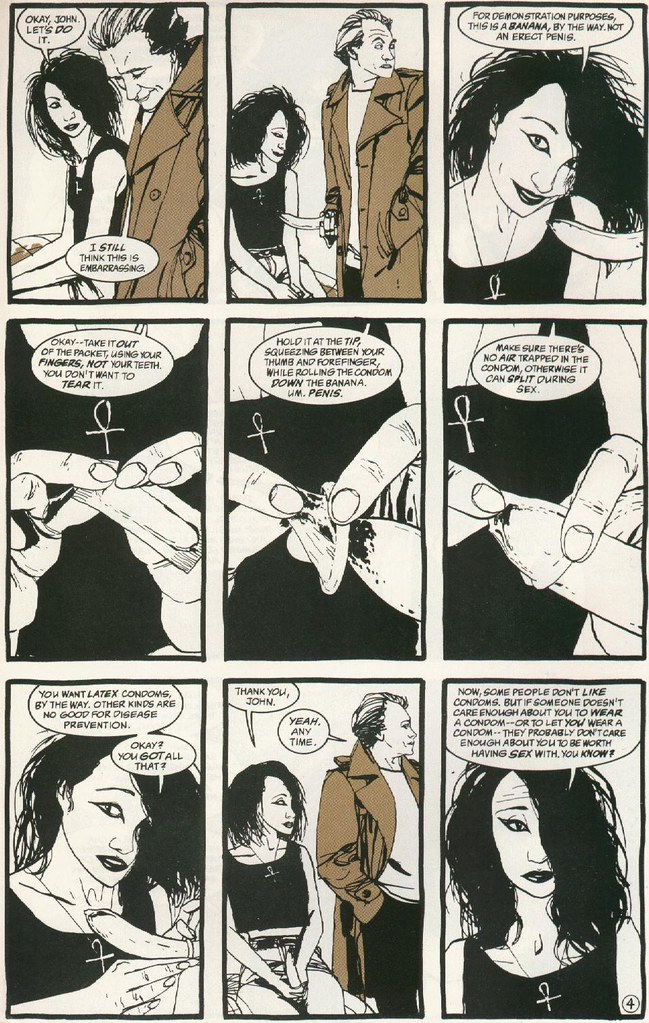
National Condom Week

According to my email from Planned Parenthood this morning, it's National Condom Week. They sent out a link to their playlist of their favorite condom videos on YouTube, but I found something even better:


This is from Neil Gaiman's "Death Talks About Life," a PSA comic about HIV and condom use, from 1994. It's out of print now, but was collected in Death: The High Cost of Living, which was one of the first comics I ever bought. Or you can read the whole thing at that link. (Also will soon be in an Absolute Death from Vertigo, so for those of you who are fangirls like me, rejoice!)

While I'm referencing holidays and comics writers, it is my duty to repost the sentiments of the wicked Warren Ellis:

Happy Valentine’s Day to all. And to those who hate the day, I say this: Valentine’s Day is a Christian corruption of a pagan festival involving werewolves, blood and fucking. So wish people a happy Horny Werewolf Day and see what happens.

Friday, February 13, 2009

Tragic

For all the talk of people who make America "safer," this was somebody who really did make America a safer and better place. As Scott says, the entire crash is a tragedy, but "this was especially horrible." Our thoughts and sympathies to all those who lost loved ones in the Buffalo crash.

Update by Erik: Not to mention the loss of human rights worker Alison Des Forges.

Rethinking Populism


Rachel Maddow addressed populism the other night and got me thinking. During the election, we most often heard populism mentioned in reference to Sarah Palin and Mike Huckabee, and often in a sort of derogatory tone from certain David Brooks-ish commentators who pined for a more elitist Republican party (oh, the irony, it is thick).

But populism is inherently little-d democratic, and should also be a mainstay of today's Democratic party. Yet we somehow got pigeonholed as the party of East Coast and West Coast champagne liberal snobs. The party that actually supports the rights of working people got written off as the party of pointy-headed rich intellectuals.

Barack Obama won by not being afraid of that label and utterly defusing it. The idea of calling this man, raised by a single mother and forged in the streets of Chicago as a community organizer, was somehow more elitist than a guy who couldn't remember how many houses he owned, was laughable.

Also laughable were the desperate attempts of his opponents to make him look out of touch. Hillary Clinton's stage-managed whiskey shot, anyone?

This might be the election where we figured out that populism doesn't mean condescending to America. It means actually understanding the crap Americans are going through.

Michelle Goldberg (h/t matttbastard, who inspires more of my posts than I should admit to you lately), wrote an excellent piece about the rise of the Sarah Palin wing of the Republican party.

Now, the irony is that the more marginalized the GOP becomes, the more powerful the religious right becomes within it because it’s one of the last constituencies standing. The 2006 and 2008 elections each left the party more socially conservative than before, as moderates were defeated. The remaining voters seem to like it this way: According to a recent Rasmussen poll, a plurality of Republicans think their party has been too moderate during the Bush years, and fully 55% of them want their party to model itself more on Sarah Palin. The conservative intelligentsia has spent the past generation hymning the virtues of simple heartland believers indifferent to the opinions of coastal eggheads and cultured cosmopolitans. Now, they’re going to have to realize that that includes them.


She referenced Tom Wolfe's famous "Radical Chic" essay, which pokes fun at Leonard Bernstein's attempt to hobnob with Black Panthers.

In one of my courses last year, we read Wolfe the same week as we read Hunter S. Thompson. Thompson was the kind of populist that we should be looking at now, moving forward. The consummate outsider, constantly angry at the powerful, constantly on the side of the little guy.

When I get angry at NPR's Science Friday for being completely clueless about the purpose of an auto industry bailout, it's that spirit that I'm invoking.

It's not condescendingly taking a whiskey shot or implying that your audience is racist. It's much more than that. Obama managed to ride populist support into the White House without ever attempting to change who he was. Because he gets it. He knows what it's like to be broke, to have to decide between paying your heat and buying food. And yeah, it's been a long time and two Ivy League schools since he's had to make those choices, but I don't think he's forgotten.

Thoughts? I think populism is a word we should be looking at and reclaiming more. (as in, this might be the first post in a series.)

Historical Image of the Day


Grocery store workers, Oak Ridge, Tennessee, 1945

Thursday, February 12, 2009

Crisis of Masculinity Blogging: Special Thursday Edition

The need for men to compete in sports against other men or engage in strenuous physical activities with groups of other men has been a central tenet of various crises of masculinity through American history.

In the Progressive Era, boxing, football, hunting, and fishing became very popular activities among the middle and upper classes. There's a reason boxing became respectable, football becomes popular, and hunting laws are enacted at the same time: the support of Progressive masculinity worriers.

Hiking became a popular activity for many reasons in the 1950s and early 1960s, but men looking to escape the feminizing suburban home and demanning gray flannel suit job played a major role.

Our friends at The Art of Manliness buy into this idea whole hog. The post starts in a classic totalizing manner, stating "Men like to compete." Do they now? All men? If I don't like to compete, does that make me less of a man. Have I castrated myself because I'd prefer to read, or I don't know, do most anything else? I guess so.

The post goes on, linking to a 1933 magazine article suggesting 10 manly competitve feats such as the one-legged arm wrestling pictured above, and stating:

All of them pit you against another man in a pure mano-a-mano showdown. All of them call on different muscles and not only require brute strength, but good balance and a bit of skill as well. So next time you and your buddies are bantering about who is the strongest, don’t settle the dispute with a cliche impromptu wrestling match. Challenge your friends to back up their bluster, move the furniture, and let the real games begin.

First of all, who the hell just starts wrestling? Men who engage in a "cliche impromptu wrestling match" need to grow the hell up to begin with. Second, they need to examine very seriously why they feel the need to struggle on the floor with another person, unless you are engaging in some sort of consensual sex act.

Again, the assumption here is that real men like to compete with each other. Now, I can be a competitive guy in the rare times I engage in sports activity, though this is mostly directed at myself and my consistently crappy performance. But I certainly never defined myself as a man over it. And I most definitely do not believe that I need to prove myself whenever I am with other men. This idea of proving yourself plays a central role in masculinity worriers' arguments. What I want to know is who they think they need to prove themselves to? Themselves? Their friends? Women? The nation? All of the above? I go with all of the above. I think these kinds of activities, most certainly including arm wrestling, are about deep insecurities within the souls of some men. I think it has inherently little do with being a proper man. The social constructions of gender can mask people's own personal problems behind ideas of gender. I really believe that people who attach this sort of masculine test to any kind of sporting or competitive activity may lack self-esteem. They need to win, or at least to compete hard, to reaffirm that, in fact, life is worth living.

The sexual overtones of all of this are pretty obvious. It's hardly a coincidence that the most blatant homophobia often comes from those who engage in sporting activities that can simulate sex in interesting ways, as perhaps suggested by the "back wrestling" pictured here. There's a lot of self-denial and sexual repression going on in these competitions. They need to physically interact with someone of your sex is overwhelming for many people, but the social norms allowing for it are not there. So sex has to be simulated in some way.

Maybe I've overstating things here, but I'm not so sure. Masculinity worriers have long been the most virulent homophobes. To give one of many examples, The Marquis of Queensbury rules governing boxing were established in the Progressive Era to make the sport clean enough that men could watch such a manly activity and learn from them without seeing savagery too unrestrained. The Marquis of Queensbury's son was Oscar Wilde's lover. It was the same Marquis of Queensbury who had Wilde thrown into prison for homosexuality, outraged that such immoral activity could exist. Meanwhile, he's throwing himself into rough physical activity in all-male environments right and left.

Historical Image of the Day


Coal miners emerging from a shift. Harlan County, Kentucky, 1946

Discussing Latin America (II): Which Way Is Nicaragua Headed?

Last week, the Latin Americanist put up two conflicting articles on Nicaragua. On the one hand, Foreign Policy suggested that Nicaragua was one of five countries that could be "the next Iceland" (i.e., go bankrupt), saying remittances from the to Nicaragua, which play a major role in the Nicaraguan economy, will probably drop, perhaps drastically. This drop would accompany a drop in coffee exports, one of Nicaragua's major sources of income in the international market, as prices drop off in the face of a global depression (this is nothing new - Brazil was similarly hit in the 1930s, and Costa Rica and others were ravaged in the 1970s and early 1980s. Incidentally, in the case of Costa Rica, the collapse in the coffee economy actually played a major role in the development of eco-tourism as an alternate source of national income, a hugely successful policy that is still keeping that country stable even today). Finally, Foreign Policy argues that Ortega's increasingly authoritarian rule is isolating foreign partners, leading to reduced international aid for and investment in Nicaragua under Ortega.

On the other hand, World Focus foresees Nicaragua on the verge of great economic success. In the video, it reports that anti-Americanism has declined, leading to a growth in tourism. It also suggests that Ortega has taken a pro-business stance that has helped the economy to grow, and that while there is political opposition, the economy is ready to boom because of the increased business opportunities for foreign investment and a rise in tourism.

Clearly, these are two diametrically opposed stances. I asked Yann about this, and he will have more to say later, but I wanted to comment on a few things (though I will defer to his expertise on Nicaragua, which is much greater than mine). I suspect it falls somewhere between the two. I really don't see any evidence that Nicaragua's government is about to go bankrupt, for a couple of reasons. First, from what I can see, there's just no evidence that it's on a major economic precipice. Secondly, it goes without saying that Iceland's particular conditions and contexts are different from Nicaragua's. I can't see any current or historical reasons or evidence to believe that, if Nicaragua were to really flounder economically, organizations like the IMF or the World Bank wouldn't be ready to swoop in with more loans that Ortega very well may take. After all, the U.S. has had economic interests in Nicaragua for well over one hundred and fifty years. Yes, the U.S. has withdrawn aid due to Ortega's actions, but we've never had a problem looking the other way in the past when it was to our financial or political interests.

That said, I don't think Nicaragua's really ready to boom, either. Ortega can make all of the pro-business pitches he wants, but the fact that the U.S. and the European Union are witholding aid are important. Businesses may be investing in Nicaragua, and that could set off some of the aid withdrawal, but not all. What is more, the World Press article seems to put a lot of faith on the importance of tourism and ex-pats, which would be fine if we weren't in the midst of a global recession with no sign of exiting anytime soon. But we are, and one of the first things that goes when recessions hit globally is tourism. Certainly, some people who would have like to go to Asia or Africa or some expensive vacation may opt for Nicaragua instead, but I don't think that would be a very significant number of people. And the evidence for an inexpensive lifestyle seems deceptive, as the report only cites an American ex-pat who comments, "I can afford it. I can live the good life on a postal pension." That's fine, but that says more about borderline colonialist and exploitative mentalities than it does about the general cost of living for Nicaraguans themselves, many of whom remain in poverty despite government programs designed to finally help Nicaragua's poor.

In short, it will be interesting to see where Nicaragua goes, but it's as interesting to see how two respected journalistic sources could come to opposite conclusions on this issue. Again, I think it's somewhere in the middle - Nicaragua is neither about to experience a full-blown collapse, nor is it about to enter a new golden age. Political repression under Ortega is a real problem. And while he may be making strides to help the poor, his human rights record is far from good, and claims that he wants "equality for all" are hard to swallow when one considershis stance towards women's rights). If push came to shove, I'd probably have to say Nicaragua is facing an uphill climb, simply because there are few countries in the global economy right now that aren't facing an uphill climb, but I could be wrong. I look forward to Yann's comments on this.

Wednesday, February 11, 2009

Pre-Fab Housing

Sarah Williams Goldhagen has an interesting, if flawed, article on the history, aesthestics, and sustainability of pre-fabricated housing in America. It's a good article, but I have trouble buying the idea that pre-fab housing is any kind of solution for American housing problems.

First, I don't buy the idea that mass producing houses on an assembly line really solves any contemporary American problem. While she's right that this would have been a good idea to start 50 or 100 years ago, it's not as if the United States has a real shortage of housing stock. Sure, local zoning laws cause all kinds of problems; perhaps a sustained attack on these local prerogatives in 1910 or 1947 would have been useful. But if anything, we have too much housing, not too little.

Toward the end of the article, Goldhagen argues that pre-fab housing could be a greener alternative to current housing practices. It's entirely possible, but more because current construction practices are about as anti-environmental as possible. Almost anything would be better. Were the government to force developers to adopt greener standards, maybe pre-fab would be a good idea. But then again, if the government did this, wouldn't Goldhagen's thesis be undermined? The greatest environmental problems with American housing revolve around sprawl and addiction to the autombile and I'm not sure how single-family units change this, regardless of how they are built. Even her examples of green pre-fab are basically experimental projects. Sure it's possible that those ideas could get adopted by developers, but it sure as hell is unlikely. I'm quite unaware of utopian urban plans being adopted by a majority of developers. The federal government simply has not played a central enough role in urban planning to make these ideas a reality.

Goldhagen is a lot more convincing on the aesthetic history of pre-fab housing, which I found quite interesting and definitely recommend reading.

Roberto Alomar

I'm really shocked to find out that Roberto Alomar is suffering from, and apparently dying from, AIDS. He's been suffering since at least 2005, so medicine seems to be doing the trick, but he's had a lot of horrible things happen to his body. I'm not an expert on the latest in HIV medicine, so I'm not sure how long someone can stay alive who is already experiencing the cancers associated with the disease.

He was really a great second baseman. I know people hated him because of the spitting incident with the umpire. But he was truly fantastic. I believe he is eligible for the Hall of Fame next year and I hope the voters place him there. I also hope he lives long to see it. He's probably a borderline candidate. According to Baseball Reference, his most similar batters are Barry Larkin, the massively overrated Derek Jeter, Lou Whitaker, Frankie Frisch, and Julio Franco. That is one hall of famer, one who will be, two who clearly deserve it (Larkin and Whitaker), and Franco. Middle infielders are pretty underrepresented in the Hall. That Whitaker, Alan Trammell, and Bobby Grich aren't in there is highway robbery. All of this suggests that Alomar will be a borderline candidate. But I think his clear dominance for several years places him in a Ryne Sandberg category.

Anyway, I was a big Blue Jays fan when I was a kid. Alomar was freaking awesome. And I hope his career is recognized during his likely short lifetime.

New Series: Wednesday Crisis of Masculinity Blogging

The other day, I was looking for images for my classes. I happened to run across this amazing and bizarre website, The Art of Manliness.

One of the strangest issues in American culture and history is this constant "crisis of masculinity" that American men seem to have. Going all the way back to at least the 1830s it seems that men are always freaking out about their manhood. I've discussed this issue in depth for the Progressive Era in both my master's thesis and dissertation. The rise of feminism sent a lot of men over the edge; the "thoughts" of these people, if in fact they deserve the title, can be seen on various men's rights websites and the trolls in comment threads at feminist blogs.

So I figure that it's a worthy project to document some of this weirdness, past and present, in a weekly series I'll be calling Wednesday Crisis of Masculinity Blogging. The Art of Manliness is like a punching bag for me, but I'll try and focus on other topics and websites too, both past and present.

The first post focuses on the manifesto of The Art of Manliness.


Welcome to The Art of Manliness- a blog dedicated to uncovering the lost art of being a man.

The Art of Manliness is authored by husband and wife team, Brett and Kate McKay. It features articles on helping men be better husbands, better fathers, and better men. In our search to uncover the lost art of manliness, we’ll look to the past to find examples of manliness in action. We’ll analyze the lives of great men who knew what it meant to “man up” and hopefully learn from them. Every week we seek to uncover the essential skills and knowledge today’s man needs to know. Since beginning in January 2008, The Art of Manliness has already gained 19,000+ subscribers and continues to grow each week.

Why the Art of Manliness?

My idea for the Art of Manliness came about as I was reading Men’s Health magazine. It seemed to me that the magazine’s contents were continually going downhill, with more and more articles about sex and how to get six pack abs. Was this all there was to being a man?

And as I looked around at the men my age, it seemed to me that many were shirking responsibility and refusing to grow up. They had lost the confidence, focus, skills, and virtues that men of the past had embodied and were a little lost. The feminism movement did some great things, but it also made men confused about their role and no longer proud of the virtues of manliness. This, coupled with the fact that many men were raised without the influence of a good father, has left a generation adrift as to what it means to be an honorable, well-rounded man.

Talking about good, clean, wholesome manliness was to me a niche seemingly not covered on the web or elsewhere and I decided to start The Art of Manliness to talk about all things manly- both the serious and the fun, but with the ultimate eye toward encouraging readers to be better husbands, fathers, brothers, men.
I don’t claim to have all the answers, nor do I claim that I’m an expert on all things manliness. I started this blog not because I had all the answers to being a man, but because I wanted to explore the questions with other men. Thankfully, I’ve found a whole community of men who wish to discover the lost art of manliness too.

OK then. There's more than a little baggage here. You can already see why this site is such a fruitful source for my interests.

Central to this blog is the idea that men in the past had qualities now lost. While this guy is less directly anti-feminist than some, he basically blames feminism for making men "confused." The answer--looking back to the great men of the past. Who are these men? Theodore Roosevelt (who I assure you will be a frequent topic in this series). John Wayne. Bare-knuckle boxers. Cowboys. Basically, romanticized visions of white men standing up for themselves, their women, their race, and their society.

Of course, what this doesn't take into account is the fact that Roosevelt himself was utterly freaked out about what it meant to be a man. The construction of the John Wayne like western hero in the late 19th and early 20th centuries was a direct reaction to these fears. Providing a model of western manhood was a primary project of Progressive Era masculinity worriers. As the frontier was conquered and as swift and radical changes transformed American culture, American men worried that the core ingredients of American men were being lost. The Virginian and the dime novel westerns were popular because they provided access to a supposed lost past of masculine values. The Boy Scouts became popular as a way to teach these values to our children. Teaching boys to be men filled the annals of the period's children literature.

In other words, the posers on this website are looking back to posers of the past as examples of 100% red-blooded American manhood.

In order to get this series some attraction, I'm going to have special editions of Wednesday Crisis of Masculinity Blogging throughout the next week. You can see my marketing skills in full effect! Then we'll go to the weekly discussions. I'll probably focus mostly on this site for the next week.

Finally, I fully expect at some point to attract readers of this site who will hate on me. They'll accuse me of committing gender suicide or something. And it's true, I am a man-hater. So I apologize in advance to my fellow writers. But it could get real entertaining.

Discussing Latin America - A (Very Belated) Response on Political Parties

Awhile back, Yann and I discussed the nature of political parties whose identities were rooted in a particular historical figure. I originally pondered the roles of figures like Augusto Sandino, Farabundo Martí, and Juan Peron might have had in current party politics in Nicaragua, El Salvador, and Argentina, respectively. Yann had some really great thoughts, particularly in regards to efforts to re-interpret past national figures into current worldviews of national and global politics in Latin America. These figures can remain controversial, as with Sandino ("Whether or not Sandino was an anti-imperialist hero, or a criminal lunatic is still very much a debate in Nicaragua"), but Yann argued strongly that my exclusion of Bolivar was perhaps misplaced, as Chavez has attempted to re-interpret Bolivar as one of the original "anti-imperialists." While I think (and I believe Yann agreed) that Bolivar differed from a Marti or Sandino in that Bolivar is still a part of the nationally-accepted myth of Venezuela when compared to Sandino or Marti, I agree that, in light of Chavez's efforts to re-interpret Bolivar, we can lump him in with the other two.

However, I want to actually address the issue of Peronism. Yann suggested that Peronism was the outlier from these groups/parties, as he founded the party that became central to national political contestation, rather than serving as a model for future parties, a la the Sandinistas' uyse of Sandino and the FMLN's use of Marti. Yann went on to suggest that we could therefore consider Peron closer to Chavez or Castro in that their parties were "formed around charismatic individuals."

I agree in that sense, but I think we shouldn't necessarily overstate that differentiation, either. In terms of party creation, I completely agree. However, I think there are important similarities between Peronism and the Sandinistas as they currently exist. Peron has been dead for nearly 40 years now, and his two administrations (1946-1955 and for 9 months, from 1973 to his death in 1974) had radically different legacies. Peron certainly was never a left-wing leader, but historically he was probably one of the most "populist" leaders of Latin America. In spite of his efforts at top-down control, the workers' movement developed strongly under Peron, and in many ways used and developed further Peron's fight for causes that often are (probably rightfully) considered "left," including labor rights, more equal wealth distribution, greater control and profit from laborers' efforts, etc. With Peron out of the country for 18 years, this leftward shift among many in the Peronist party happened without having Peron be able to directly counter them or divulge his true beliefs on these issues. At the same time, more conservative sectors that were drawn to his top-down (and even borderline authoritarian) control of the movement and social change, as well as his more fascistic sympathies, seemed justified in their beliefs of what Peronism was when he returned in 1973, far more right-wing in his campaign, brief administration, and attitudes than many portions of his own party. In short, Peron was able to represent, in his words, deeds, and ideas, many different things to different groups, and none of those groups was completely "wrong" or "right." (And this isn't even to consider those who hated and stood against Peron from start to finish).

All this is to say that I think Peronism and Peron doesn't represent a complete break from the divisive role Sandino and Marti had in their own countries. Yes, Peron formed his namesake party, and Sandino and Marti did not. However, the image of Peron was a divisive one almost from the start, not just among his party and other parties in Argentina, but within the party itself, and his absence for 18 years only exacerbated these divisions. You still see this today - the Peronists are still deeply divided and torn over the role they should take, a division made even deeper by the military's "Dirty War" of 1976-1983 and the presidency of Carlos Menem, a Peronist who drove Argentina to economic collapse with his extreme neoliberalism while opening old wounds by pardoning convicted war criminals from the dictatorship.

As one final note here, I agree with Yann that Chavez has the potential to be similar to Peron down the line. I would also add Lula to this mix. The PT is completely Lula - he was one of its founders, he has been its main leader and spokesperson since its formation in the early 1980s as Brazil's dictatorship opened, and he has been its only presidential candidate in Brazil's 5 post-dictatorship elections (the failed elections of 1989, 1994, 1998, as well as the victory of 2002 and re-election in 2006). Come 2010, Lula's term is up, and the PT is facing the first post-Lula election of its existence. As Yann cautioned, it is too soon to say for sure if Lula (or Chavez, or Castro) will end up having the same effect as Peron on their parties. The PT in 2010 will be aided in no small part that Lula is still alive, and can make clear which direction he thinks the party should go. Still, he faces a difficult challenge, as divisions among middle-class intellectuals and ideologues vs. workers and politicians seeking more practical demands have emerged. Indeed, Lula's own administration has jaded many of his more intellectually leftist supporters, who felt he abandoned the true "revolutionary" cause when he actually had to navigate real political channels (in this regard, I have little sympathy for such ideologues, I openly admit). I'm certainly not saying the PT will end up going down the same road as Peron's Partido Justicialista, and I would be amazed to see Lula end up doing a massive rightward shift, both for ideological and historically contextual reasons. Still, I think that, as with Chavez and Castro, it will be very interesting to see how the PT functions in a post-Lula road, and Peronism will more likely than not serve as a fascinating and important point of comparison and contrast.

Historical Image of the Day


Lounge section of dining car, Erie Railroad Company, 1949

I wish I knew how to make these images larger. Too often, their awesome is lost in translating them to site. You can always click on them and they will go to full size, but that takes work for the reader.

If anyone has advice, let me know.

Action: UAFA to be reintroduced

From Immigration Equality:

Great News!
Rep. Jerrold Nadler plans to reintroduce the Uniting American Families Act on Feb. 13!

You can make the bill a success by convincing your Representative to support the bill from Day One. Reintroducing the bill with as many cosponsors as possible will show powerful momentum for the rights of gay and lesbian binational couples!

Please call your Representative and ask them to be an original cosponsor of the “Uniting American Families Act of 2009”

Tuesday, February 10, 2009

Revisiting Republican Repsonsibility for Hate Crimes

Last June, I discussed the horrible murders of two Knoxville, Tennessee parishioners of a Unitarian church. I lived in Knoxville for 3 years and know members of that church. The killer attacked the church because of its liberal views. Inspired by Limbaugh, Hannity, Beck, Savage, O'Reilly, and the other right-wing hate-filled gasbags, he took their views to their logical extreme and acted. The result was tragedy, as well as the predictable right-wing silence.

Sara Robinson notes that the killer has been sentenced to life behind bars. Upon his sentencing, he released a rambling message discussing his actions. Robinson excerpts part of it:

"Know this if nothing else: This was a hate crime. I hate the damn left-wing liberals. There is a vast left-wing conspiracy in this country & these liberals are working together to attack every decent & honorable institution in the nation, trying to turn this country into a communist state. Shame on them....

"This was a symbolic killing. Who I wanted to kill was every Democrat in the Senate & House, the 100 people in Bernard Goldberg's book. I'd like to kill everyone in the mainstream media. But I know those people were inaccessible to me. I couldn't get to the generals & high ranking officers of the Marxist movement so I went after the foot soldiers, the chickenshit liberals that vote in these traitorous people. Someone had to get the ball rolling. I volunteered. I hope others do the same. It's the only way we can rid America of this cancerous pestilence."

"I thought I'd do something good for this Country Kill Democrats til the cops kill me....Liberals are a pest like termites. Millions of them Each little bite contributes to the downfall of this great nation. The only way we can rid ourselves of this evil is to kill them in the streets. Kill them where they gather. I'd like to encourage other like minded people to do what I've done. If life aint worth living anymore don't just kill yourself. do something for your Country before you go. Go Kill Liberals."

Again, this is Republican eliminationism at its highest levels. None of this man's inspirations went on the air to apologize for their words. None condemned his man or his ideas. With all the hate they spew, some people are going to act. Listening to the radio or watching Fox News is not going to be an outlet for them, it's going to be an inspiration for action. Limbaugh and his ilk have a lot of blood on them, not just in Iraq but at home too.

Evaluating Booker T. Washington

Kelefa Sanneh's piece on Booker T. Washington in the February 2 issue of The New Yorker (available only in abstract form online) is a solid reconsideration of this complex man. It's hard to feel more ambivalent toward a historical figure than I do about Washington. Here was a man who basically told his people to stop fighting for civil rights, accept segregation, and work hard. On the other hand, here was a man trying to improve the lives of African-Americans in rural Alabama in the late 19th and early 20th centuries who had to work within the system to survive.

There are two common views of Washington, depending on who you talk to. For some, he is an ideal person to raise into the pantheon of great African-Americans. I was talking to a student the other day who is also an elementary school teacher. In her school, pictures of Washington adorn the walls during Black History Month. He stressed education, working hard, and raising yourself up by your bootstraps. He was the first African-American to eat dinner with the president (Theodore Roosevelt). He was a groundbreaker. Therefore, he is a hero.

The other common view is that Washington was a sellout. This view holds that W.E.B. DuBois is a much greater role model than Washington because he urged organizing for fight for equal political, social, and economic rights. Washington knelt before the white man and accepted whatever crumbs the master threw from the table and told his people to do the same. His views were increasingly discredited during his own lifetime and completely dismissed after World War II. His institution, Tuskegee, was used by the military to conduct venereal disease experiments of African Americans without their knowledge, which seems to sum up Washington in a poetic but sad way.

I have trouble disagreeing with either one of these views. I do think Washington was something of a sellout. On the other hand, several years ago I had an hour long argument with an activist friend of mine defending Washington against these very charges. Washington was working in rural Alabama. It was real easy for DuBois to call for the fight when he spent most of his life in the North. If Washington used DuBois' rhetoric, not only would his funding have gone away, but his life would have been in danger. On the other hand, maybe he should have moved to the North and tried to take as many African-Americans as possible with him. Things weren't that much better in the North, but they could hardly have been worse than in the Black Belt at the turn of the twentieth century.

I find Washington's inclusion on pantheon of acceptable African-Americans to discuss in schools very interesting. This same student said that DuBois is nowhere to be found on school walls. This almost reinforces the negative views of Washington. He's acceptable to teach because he is utterly unchallenging. No Malcolm X he! He's like the sanitized version of Martin Luther King that dominates schoolchildren's (and then adults') understanding of King, except that it's pretty much realistic for Washington.

Ultimately it's really hard to judge Washington either way. One could excuse his public statements, noting his location, need for funding, and behind the scenes work against lynching more easily if he actually didn't seem to believe them himself. Sanneh suggests that he did seem to often work for himself rather than his people. He frequently used common black stereotypes to talk about African-Americans. He fought vigorously against any challenges to his authority and truly believed that he was "the black president" as people called him after he met Roosevelt. He wasn't above bribing newspapers and intimidating people who stood in his way.

To fall back on the old historians' cop-out, Booker T. Washington was an extremely complex man who defies easy depiction. His supporters and detractors are almost equally valid in their portrayal of him. Thinking hard about Washington again reminds me of the unbelievably bizarre, twisted, and depressing history of race relations in the United States, when a man like Washington can be incredibly brave and a complete sellout at the exact same time.

The Post I Didn't Want to Write

I was going to title this post, "The Hypocrisy of Outrage," but my hatred of Alex Rodriguez and my concomitant need to defend him made me change my mind.

Let's go back to 2000. Everyone knew that McGwire, Sosa, Bonds, and these other sluggers were on the roids. Their arms were as big as my leg. No one really thought they were doing it through working out and eating well. Maybe people fooled themselves into thinking they were just taking the right supplements. But rumors abounded about steroids.

No one cared. No one investigated this. The owners didn't bat an eyelash. Players were hitting lots of home runs. People came to the ballpark and watched the game on TV. Everyone made a ton of money.

But now we find out that these guys were doing it unfairly. And we are outraged by this! How dare they blaspheme the sanctity of the game!!!

Give me a break. You knew A-Rod and everyone else was juicing. I knew it. Everyone knew it. We all chose to look the other way. To say that Clemens, Bonds, and Rodriguez shouldn't go to the Hall of Fame is a joke. First, who are we going to be voting for in say 2015? Anyone? Second, these guys are all three clear Hall of Fame players even without the drugs. I can see not voting for McGwire. He was finished before the drugs. He was Richie Sexson before he became Babe Ruth. Sammy Sosa and Rafael Palmeiro may be somewhat more marginal cases. But Clemens, Bonds, and Rodriguez are three of the best players to ever play the game. They were before the drugs and they still are. Anyone who doesn't vote for these guys is crazy.

I really loathe A-Rod on so many levels. Probably unreasonably so. But give the guy a break. While he created this problem, he's no different than hundreds of other guys. If we are going to crucify him, shouldn't we also know the names of the other 103 players who tested positive. That's the equivalent of over 4 teams.

There, now I've written a post defending Alex Rodriguez. I have to shower the filth off.

The People We Have To Deal With

Fred Barnes' idiotic refutation of climate change has been making the rounds the last few days. Barnes says that it's been cold lately. This is his proof. When pressed for actual evidence, he said, "I'm not going to do your research for you." Because he's not going to do any research at all.

It's hard to know what to do with climate change deniers. More broadly, how do we deal with prominent right-wing journalists who have platforms who reach millions of people, yet prefer to deny reality. Are their heads in the sand? Are they just evil?

My guess is a combination of the two. Barnes is probably not all that smart. At the same time, what he wants is to get the Republicans back in power as soon as possible. So trashing every position held by a Democrat is his highest priority. He's attacking scientific findings, but I'll bet when it comes to weapons technology he's as pro-science as it gets. He's selecting what he wants to know, which suggests a touch of evil as well as a choice of ignorance. David Roberts has a great piece about how Barnes and other right-wing journalists have one source for their climate change denying information: the office of Oklahoma senator and certified idiot James Inhofe. Who needs scientists when you have the single worst senator in office today?

When we talk about climate change specifically, people like Barnes can hold a lot of sway because it's still really hard to get people to think about climate rather than weather. It's been cold in the Northeast for much of the winter. Because they are cold right now, the earth must not be warming at all! It's all a hoax. Al Gore becomes the butt of jokes. Meanwhile, Australia is setting record high temperatures and suffering through deadly fires. Texas has been 10 degrees warmer than average all winter. And while either of these circumstances could happen independently and thus aren't specifically the fault of climate change, the overwhelming evidence shows that the earth is warming and that extreme weather will be more common. But how to communicate this complexity to the public? I have no answer, but without a simple message it's really hard to convince people that their world is changing irrecovably and that we must take immediate action to stop it.

Meanwhile, birds are wintering further north every year because of warming. And salamander populations are collapsing in Central America for the same reason. But it's cold outside!

Historical Image of the Day


Hawaiian cowboys, Waimea, Hawaii, 1899