Thursday, December 10, 2009

Around Latin America

-In good news from Guatemala, this past week, an army officer was convicted for his role in the disappearance of eight indigenous villagers in 1981. Colonel Marco Antonio Sanchez was sentenced to 53 years in prison, and three of his subordinates also received prison sentences. While this isn't the first incident of conviction in an "enforced disappearance" case, it does mark the first time that a high-ranking military officer has been convicted in such a case. Meanwhile, lawyers entered damning evidence from secret Guatemalan military archives in the case of charges of genocide against former dictator Efraín Ríos Montt, who seized power in 1982 during Guatemala's 36-year civil war and who oversaw some of the worst crimes against humanity during the war. While Montt is far from conviction still, the fact that a jury has found Sanchez guilty, combined with the horrible details of the military documents in the Montt case, allow hope that Montt finally pays for his crimes. And while an acquittal would be an injustice, the simple fact that formerly-secret military documents have now become public, revealing just how horrible Montt's "administration" (and others during the civil war) were will deal a major blow to any efforts to rehabilitate Montt or the right in this war.

-In bad news for women's rights in Brazil, a Brazilian doctor who performed abortions was found dead in her car last week. Authorities are investigating whether Dr. Neide Mota Machado's death was a murder or a suicide. Machado had had her medical license stripped earlier this year, after she was accused of performing nearly 10,000 abortions in Brazil (where abortion is illegal save for cases of rape, severe deformation of the fetus, or of a threat to the life of the mother). For those who feel that making abortion in the United States legal only in the cases of rape, incest, or health risks to the mother, it is worth pointing out that over 230,000 women entered hospitals due to complications from botched illegal abortions in 2008 alone.

-Finally, one of the darker aspects of the U.S. embargo on Cuba emerged in a recent story that alleged that "a dozen Cuban children with heart defects were forced to endure unnecessary surgery because the U.S. embargo blocked them from receiving American-made catheters." While the U.S. apparently made such exports to Cuba legal back in 1992, the paperwork is enough of a "hassle" that medical companies have little reward in going through all the bureaucracy imposed by the limited embargo, which allows medicine to get to Cuba. Even so, after $142 health care items were approved to go to Cuba in 2008, only $1.2 million worth of goods actually reached the island, according to this report. While I question the use of the term "genocide" to describe unnecessary surgeries on 12 children, there is no denying the fact that the embargo has very real consequences upon the daily lives and even survival of many Cubans, and this story just offers one more very stark reminder of that fact.

Wednesday, December 09, 2009

Rio's Eco-Wall

Rio is building walls around some favelas, presumably to protect the surrounding forest. I'm not sure how I feel about this. I definitely support saving as much forest as possible. But it's not like the Brazilian government is all the committed to forest protection. Compared to what happens everyday in the shrinking Amazon forests, the favela residents are making next to no impact. Is the wall segregation and social control, as the residents suggest? Or is this the Brazilian government making a positive environmental statement in an area where they can exert some real control? I tend to believe the favela residents here. This really screams of social control masquerading as environmental protection.

Historical Image of the Day


Cotton pickers, Arkansas, 1935

Ketchup Is A Vegetable

The 2009 version thanks to the milk lobby.

Honduran President-Elect Proposes a General Amnesty, and Why It's a Terrible Idea

This seems like a terrible idea:

Honduras' president-elect said Tuesday he wants amnesty for ousted President Manuel Zelaya and for all of those involved in the June 28th coup that deposed him.

"There should be (an amnesty) for all those involved," Porfirio Lobo said in Costa Rica, where he met with Costa Rican President Oscar Arias and Panamanian President Ricardo Martinelli in an effort to build support for his presidency and break his nation's isolation.

I understand why Lobo may want to do this. He certainly is walking a tight line between acknowledging it was a coup and not irritating the military so that they do it again.

Still, in the larger picture, this is just a terrible, terrible, terrible idea. The fact that you forgive the military and Micheletti does not only offer the message that future coup-leaders who overthrow democratically-elected leaders can expect to be let off scot-free; it also forgives Micheletti and the military for the gross acts of human rights violations, ranging from censorship to curfews to blatant violence against Hondurans, in the wake of the June 28 coup. If you want to know how well these "general amnesties" work, just ask Brazil, whose military government offered a general amnesty in 1979 that allowed political exiles back in the country and set political prisoners free, but also prevented torturers and murderers in the military from ever being charged in their crimes. As a result, to this day, Brazil has not fully reconciled and confronted the legacy of its dictatorship, and particularly the repressive arm, in ways that Chile and Argentina have. Connected to this, practices of torture and executions by military police against the poor continue to this day in Brazil, with little interest in inquiring as to the institutional origins or continuation of these practices.

Again, Lobo's declaration isn't without its logic, particularly in the short-term. But if a general amnesty in Honduras goes through, letting Micheletti and the coup-leaders off the hook, then Lobo will have established a dangerous precedent for the future, and Honduras may never fully deal with the real causes, events, and legacies of the coup and Micheletti's repressive regime.

Tuesday, December 08, 2009

Urban Films

tIn the spring I am teaching a new class on American cities. It has an environmental focus, but also looks heavily at race and sex.

As I often do, I want to have a film assignment. What films would you suggest students watch that get at American cities in a particular time and place. Right now, I'm leaning toward Taxi Driver and Traffic in Souls (a silent about white slavery). But what do you all think?

Report: Police Killed 11,000 People in Favelas in Last Six Years

At the beginning of the year, I commented on reports that Rio's police were trying new tactics in the favelas in an attempt to reduce the power of drug gangs in the favelas. However, I expressed skepticism of how well it would work broadly, since the program was for two favelas, and not the 1000+ favelas of Rio (a concern that Rio's police chief also expressed in the excellent Jon Lee Anderson article). Last week, NPR also highlighted the program in the Santa Marta favela, basically updating the report on which I had commented in January. In some ways, I'm encouraged by the fact that, after almost a full year, the police have not abandoned this program. If you're going to establish infrastructure and a relationship with people who live in the favelas in order to undermine the drug lords, then you need to have a long-term presence of a benevolent state (rather than lightning-flash attacks and retreats of repressive forces), and NPR's report suggests that the program is getting that support. At the micro-level, this is encouraging, even if some officers still believe "a heavy hand is necessary in violent slums."

Unfortunately, that heavy hand has been devastating in the favelas, as a new report suggests that the police have killed over 11,000 people in the favelas in the last six years, with many of those killings being execution-style murders. Even if many of those killed were involved with violent crime, they should receive a trial and sentencing. Brazil's prison system may be bleak (another issue too complicated to get into here), but it's still better than summary executions. Certainly, Santa Marta is a point of light in police tactics, but the overall picture is still extremely bleak, and until Brazil (and not just Rio) launches major programs in the style of the Santa Marta program and completely eliminates impunity for police involved in extrajudicial killings, the murder of innocent civilians, and participation in militias, then conditions in the favelas are unlikely to get any better.

Six Charged in Murder of Former Chilean President Eduardo Frei

In one of the more intriguing human rights cases in the Southern Cone, six men have been charged in the murder of former Chilean president Eduardo Frei. Frei had been president of Chile from 1964 to 1970, and while Frei wasn't a "radical," he did launch some significant reform programs in Chile, including agricultural reforms. While Salvador Allende would push for even broader social and economic reforms, many of Allende's own efforts were extensions of processes Frei had already begun. Frei had originally been opposed to Allende's administration and reforms, but in the wake of the overthrow of Allende in 1973 and the establishment of the Pinochet regime, Frei became a major leader in the effort to organize opposition to the regime. As the report mentions, Frei died mysteriously in 1982, and rumors that he was murdered because he was too powerful a threat against the Pinochet regime have existed for years.

Indeed, Frei isn't even the only Latin American ex-president who many feel was murdered; many suspect that Brazil's Juscelino Kubitschek (who governed from 1955 to 1960, and who "built" Brasilia) was likewise murdered in Brazil. Although Kubitsheck died in a car crash in 1976, there is reasonable evidence not only that a military vehicle forced him off the road to almost certain death, but that the military used this technique against other high-profile opponents to the dictatorship, including Zuzu Angel, who died in the same year as Kubitschek and who suspected the military was trying to kill her after she fought to find out what happened to her son, whom the military had disappeared.

Which leads us back to the Frei case. While I don't have high hopes, it would be wonderful if this unprecedented case could have long-term results in places like Brazil. While it seems the Chilean prosecutors have a case against these six men, I honestly don't know how strong that case is. That said, if the charges result in conviction and jail time in Chile, maybe the case could set a precedent for similar investigations into the deaths of Kubitschek, Angel, and others in Brazil. I don't think it will result in trials - the 1979 amnesty law granted amnesty to both political prisoners and members of the military involved with torture and murder. But at this point, just learning the truth about these deaths, be they Frei's or Kubitschek's or anybody else's, is more than a worthwhile quest unto themselves.

Monday, December 07, 2009

Historical Image of the Day


Sod house and owner, South Dakota, 1913

Forgive the lack of posting from me--things have been both crazy busy and deeply unstable on my end, a combination that does not lend itself to production.

Historical Image of the Day


This week's theme is agriculture in American history.

Cimarron County, Oklahoma, 1936

Sunday, December 06, 2009

Historical Image of the Day


Death mask of Aaron Burr, 1836

Why I Hate Notre Dame Football

There's actually many reasons. But this, from the Chicago Sun-Times, is one really good reason:

Notre Dame fans want the best coach possible, yet they keep scratching all the top candidates off their list. Mike Leach is a Mormon. Jim Harbaugh is divorced. Jon Gruden had a DUI. Randy Edsall hasn't won enough, Pat Fitzgerald isn't old enough and Skip Holtz doesn't recruit well enough. Then there's the latest controversy that's lighting up the message boards of what might be the most plugged-in fan base in the nation: Cincinnati coach Brian Kelly is said to be pro-choice. Where precisely Kelly stands on what should be a private issue is uncertain, and frankly nobody's business, but if true it could be a deal-breaker for many on the Catholic university's campus.


God, I hope they fail forever.

Saturday, December 05, 2009

Historical Image of the Day


New Amsterdam, 1640

Things That Seem Like Useless Ideas: Giuliani to Serve as "Security Advisor" for Rio 2016 Olympics

I really don't understand what Brazil hopes to get out of an ex-mayor who A) wasn't terribly competent or able before or in the wake of 9/11 (the one thing that would give him any claim to "legitimacy" on security matters); B) has an appalling record in dealing with poverty (something that is a characteristic of Rio's favelas, and Brazil in general, which has one of the highest income gaps in the world); and C) wasn't exactly connected to the most ethical police leaders (and Rio certainly has its own problems with corrupt police). Still, Rio has apparently contracted Rudy Giuliani and his "security" firm, to help the city prepare for the Olympics in 2016. I guess if there's any silver lining in this, it's that some analysts in the story seem to think this may indicate Giuliani will not run for the Senate next year. Still, I hate to see Rio hire a man whose reputation far outpaces his actual policies, just so New York state can be spared.

Facial Hair of the Weekend

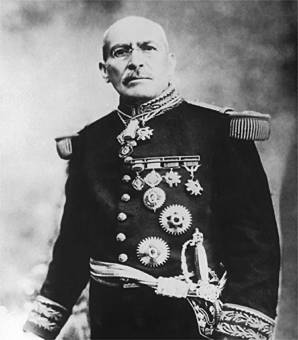
Victoriano Huerta, who (as Grigori noted) plotted with U.S. ambassador Henry Lane Wilson to overthrow Francisco Madero in 1913. Huerta quickly set up a quasi-military dictatorship upon assuming the presidency after Madero's murder. Newly-elected president Woodrow Wilson demanded Huerta step aside and let Mexico return to democracy, and recalled Wilson. When Huerta refused, Wilson began to support Venustiano Carranza's Constitutional Army (which included Álvaro Obregón, Francisco "Pancho" Villa, and Emiliano Zapata. Wilson's opposition and a series of military defeats led to Huerta's resignation in 1914. He went into exile, ending up in the United States, where he continued to plot a coup in Mexico, leading to the U.S. putting him under house arrest, where he remained until 1916, when he died from cirrhosis, leaving one to wonder just how much of an alcoholic Huerta had been as president.

(For other Mexican political leaders, see here)

Friday, December 04, 2009

Trend's Random 10

Just for fun (before diving back into work), a random random 10.

1. "You Don't Know What Love Is" - Sonny Rollins
2. "I Hate the Way You Love" - The Kills
3. "Rondón I" - Ensemble Músíca Fícta
4. "Minha Mulher" - Caetano Veloso
5. "Blue Train" - John Coltrane
6. "No Surprises" - Radiohead
7. "Bend Over Beethoven" - !!!
8. "Our Pasts, Like Lighthouses" - Rock Plaza Central
9. "Óskabörn Pjódarinnar" - Sigur Rós
10. "Surprise Ice" - Kings of Convenience

Abortion Doctors--American Heroes

Meet Dr. LeRoy H. Carhart, late-term abortion doctor in Omaha, Nebraska and American hero.

Historical Image of the Day


Engraving of New York City, 1719-21

Little-Known Aspects of Latin America - Afrikaners in Argentina

Of all of the immigrant groups to Latin American countries that I knew about, Afrikaners who immigrated to Argentina were not among those with which I was familiar.

Once they lived here in their thousands, but now only a handful of Afrikaans-speaking Boers remain in the windswept Patagonian coastal town of Comodoro Rivadavia and its hinterland.

Between 1903 and 1909, up to 800 Boer families trekked by ship to this lonely spot on Argentina's east coast, about 1500km north of Tierra del Fuego.

They had suffered badly in the 1899-1902 South African War. Some had lost family members in Kitchener's infamous concentration camps; others had their farmhouses destroyed by British troops.

Most of the Boer men who shipped out to settle in South America, taking their wives and children with them, had fought in the war against Britain, the nation that had seized their former independent republics of Transvaal and Orange Free State. The Boers left because they had no desire to live under their conqueror's thumb.
Unfortunately, the Afrikaner-speaking peoples of Argentina are nearly gone, even while their contributions to Argentina cannot be denied:
It is a Patagonian paradox that the Afrikaners who helped turn Comodoro Rivadavia from a tiny settlement with few buildings into a large and noisy oil town, now number so few. Local legend says it was Boers drilling for water who made the first oil strike, in a region that currently supplies a considerable portion of Argentina's fuel needs.
It's not uncommon to find ethnic, cultural, and immigrant groups that you would not expect to find in places where you wouldn't expect to find them, be it Laotians in Amarillo, TX or Japanese in Brazil. Still, Afrikaners in Argentina is up there in terms of "unexpected," and it would be fascinating to learn more about their historical presence in and contributions to Argentina.

Thursday, December 03, 2009

"Fat-Killings" in Peru a Cover-Up for Extrajudicial Police Killings

A couple of weeks ago, a story made the rounds about a gang in Peru killing people for their fat, which they then sold to cosmetics companies. It was macabre but strangely intriguing. Unfortunately, it turns out that the police's report of these killings was untrue, and the truth is much more disturbing:

Peru's police chief dismissed the head of his criminal investigations unit Tuesday amid suggestions that officers may have invented a story about a murderous gang of human fat thieves, perhaps to distract from allegations of police killings. [...]

Former Deputy Interior Minister Carlos Basombrio suggested some police cooked up the story to divert attention from a recently published magazine article alleging police had killed 46 suspects in 2007 and 2008 in the coastal town of Trujillo.

"My hypothesis is that they were mainly trying to cover up the tremendous revelation of extrajudicial killings of criminals in Trujillo made by Ricardo Uceda ... in Poder magazine," Basombrio wrote on the political analysis blog Espacio Compartido.

Extrajudicial killings in any case are bad; the fact that some police in Peru have made up this story about a gang killing people for their fat in order to cover up the police's own illegal activities is just sad. It's really hard to find any good news in a story involving dozens killed, be it by gangs or by police, but I suppose if the police are prosecuted for this, then at least there will be some sense of justice in eastern Peru.