Showing posts with label Ecuador. Show all posts

Thursday, September 30, 2010

More Protests in Ecuador

The situation in Ecuador seems to be growing more serious. Rebellious police claim to have overthrown a state governor and taken the state government offices. Protests continue in Quito.

I highly recommend following the Bloggingsbyboz twitter feed for updates.

Unrest in Ecuador

Sprung up this morning, seemingly out of nowhere. Will report more if there is more to report. Protesting security forces have evidently taken over the airport, unclear if they are marching against President Correa directly or against benefit cuts.

Monday, August 02, 2010

182,152 pages in the Chevron trial

It's an impressive number. Judge Leonardo Ordonez, president of the provincial court of the Sucumbios in Ecuador's Oriente, has said he won't be able to rule this year on the suit between indigenous communities of the region and Chevron Corporation in part because of the extent of the filings in the case, totaling 182,152 pages. How many of those pages are superfluous motions, document dumps, and the like by Chevron? The case has dragged on for 17 years now.


By the way, the indigenous communities claim that during Texaco's twenty years in Ecuador, the company was responsible for dumping 345 million gallons of crude oil, and another 18 billion gallons of contaminated waste water into the Oriente. Compare that to BP's release of approximately 185 million gallons into the Gulf. Of course, the BP contamination is much more dramatic because of its rapidity, and because releasing into the Gulf allowed the oil to spread rapidly. It took Texaco a much longer time to contaminate Ecuador's slice of Amazonia. That, and there is no "first world" media obsession with the destructive deeds of the past. This is also the case with the Niger delta, which has been horribly devastated by unregulated petroleum extraction.

And that last bit is a real part of the problem. Why do oil companies behave as they have in places like Niger and Ecuador? Because they thought they could get away with it in countries that lack robust environmental regulation, monitoring capacity, and political will to take foreign corporations to task. In many cases, the possibility for a regulatory structure was coercively quashed by the international debt regime, which forced desperate countries to privatize and deregulate their economies in return for renegotiated debt service.

Compensation for the victims of this system of petroleum exploitation is too little too late, but it is at least something. Here's hoping that Ordonez can wade through the rest of that paper in the next 6-10 months and give a just ruling.

Tuesday, June 01, 2010

Historical Image of the Day: Tungurahua

As I mentioned a few days ago, Tungurahua Volcano near Baños, Ecuador has been erupting again. Here's an image from the 1770s portraying an earlier eruption:


And another from this past February by flickr user lostinawave:

Saturday, May 29, 2010

Volcanic Eruptions in Guatemala and Ecuador

This has been a banner year for ash spew. My guess is that we will see a short term global temperature dip as a result of all of the recent activity. Cue climate change denialists... Now. Volcán Pacaya near Guatemala City and Volcán Tungurahua returned to active eruption this past week. Pacaya apparently emitted more than just ash on nearby communities, and the linked article includes a short but harrowing tale of one mother hiding with her kids under the bed as marble-sized hot rocks rained on her house.

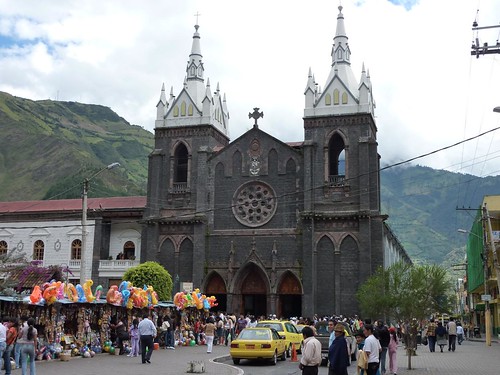
I don't know either Pacaya or Guatemala City, but I do know Tungurahua and its nearby tourist haven Baños from years of traveling to Ecuador. Back in the 1990s Baños was a hopping backpacker's town, full of the retinue of Israeli, Australian, and Gringo shoestring travelers making the trip from Buenos Aires to Bogotá. Of course, this also meant there was a large ex-pat community running businesses catering to the travelers. I have fond memories of Baños, though I haven't been there in close to ten years. I spent part of my honeymoon there, including a day riding horses on the slopes of Tungurahua.

Baños's economy began to struggle in the late 1990s and early 2000s due to a series of eruptions from Tungurahua, which re-awoke in 1999. The latest major eruption, which sent ash to Guayaquil and on to the Pacific, will undoubtedly hurt the local economy again. In some ways, it seems that the precariousness of Baños's economy is analogous to the position Ecuador holds in the international economy-- dependent on outside dollars (both literally and figuratively), on the whims of natural phenomena beyond its control (be it volcanic eruptions, El Niño-induced droughts, etc.), and on the irrationalities of the international economic order. Baños is not only downstream from Tungurahua, it's also just upstream from a major hydroelectric dam project- the Agoyan Dam on the Pastaza River made famous again a few years ago in the opening scenes of John Perkins' Confessions of an Economic Hitman. It's a beautiful place, but its trapped, as Ecuador is more generally, between the grinding pressures of natural instability and international "development."


(Cross posted here.)

Thursday, April 01, 2010

Bad News for Environment and Environmentalists in the Amazonian Basin

There have been some pretty terrible news stories regarding the Amazonian basin over the last few days that are worth pointing out.

First, a leading Amazon activist was shot and killed yesterday in the state of Para, just hours after a court delayed the retrial for the murder of Dorothy Stang. Pedro Alcantara de Souza was the leader of landless farmers in the rural state of Para, and two men on motorcycles apparently shot Souza 5 times in the head while Souza was riding his bicycle. While authorities are sending a team from Belem (the capital of Para) to investigate, the murderers have not been taken into custody. I usually hate to jump to conclusions, but given the strength of elite landowners in the region, combined with Souza's opposition to what are often illegal land-grabs on the part of those same elites, this was almost certainly a contract murder. Such is the way it often works when individuals fight for greater land reform and more equal distribution in the Amazon; it happened with Stang, it happened with Chico Mendes, and it most likely has happened again with Souza.

Additionally, foreign industry is also taking a toll on the environment, with the government's help. I've commented before that environmental policy may be one of, if not the single, deficiencies historians may find in Lula's government. These problems are not always limited to the Amazon, either; a hydroelectric dam that the Brazilian government contracted out to a Canadian company is wreaking havoc on both the environment and citizens in rural Minas Gerais. The dams are one of Lula's pet projects, and he's pushed heavily for hydroelectric power to supply Brazil's growing population with energy. In doing so, he's been nearly blinded by the highly-problematic use of dams, even while ignoring less destructive options like sun- and wind-power (and with well over 4500 miles of coastline, Brazil could easily take advantage of both). Instead, people in the interior are forced to witness dislocation and destruction in the name of hydroelectric power. Certainly, as he gets ready to leave office, Lula is enjoying some of the highest approval ratings he's ever had. However, it's worth repeating: his administration has been far from perfect, and as we begin to assess it historically, environmental policy will mostly likely be a dark stain on what has probably been one of the greatest administrations Brazilian history has seen.

Of course, Brazil isn't the only one facing these issues from foreign investment. This week, a court ruled in favor of Chevron in an arbitration case between the oil giant and Ecuador. Chad has commented before on the role of petroleum companies in the Spanish Amazon. Certainly, oil companies didn't need any more encouragement to degrade the environment and the residents of the Amazonian basin, but the court's ruling in this case certainly strengthens Chevron's arguments that it has done nothing wrong in spite of overwhelming evidence otherwise.

Tuesday, March 02, 2010

Around Latin America

-An eventual return to Honduras for exiled and deposed ex-president Manuel Zelaya may have gotten more difficult this past week. Honduran prosecutors are trying to attain a warrant to arrest Zelaya for "fraud, document forgery and abuse of power." No word yet on whether these same prosecutors are going to try to secure warrants against senator-for-life Roberto Micheletti for his own abuses of power.

-Even as we continue to ignore the violence in Mexico (and our role in it), there are daily reminders that it affects the entire border region, not just Juarez.

-Could a call for a "plurinational uprising" from Confederation of Indigenous Nationalities of Ecuador threaten Rafael Correa's administration and ability to remain in office through the end of his term?

-In appalling environmental actions, Argentina's army apparently is burning its garbage at a base in the Antarctic within 200 feet of penguin nesting grounds.

-Although there has been bad blood between the two countries for well over a century, Peru has put that aside in the face of the humanitarian crisis facing Chile in the wake of this week's powerful 8.8-magnitude earthquake by offering construction materials to help its neighbor and occasional rival rebuild.

-Speaking of the Chilean earthquake, it turns out there will not be a single person on the planet who is not affected by the earthquake. The tectonic shift was powerful enough that it shifted the Earth's axis, resulting in a day that was 1.26 microseconds shorter.

-Brazil's indigenous Yanomani population has been devastated by disease and encroachment from outsiders in the recent past, and one scholar has a novel solution: prosecute Senator Jose Sarney, who was president from 1985-1990, with genocide for his role in letting gold mining companies enter into Yanomani territory, bringing with them disease and environmental degradation that have killed the Yanomanis and destroyed much of their homeland.

-On the subject of Brazil, there's also a nice little article up talking about the little-known (outside of Brazil) role of Middle Eastern immigrants in shaping the country's culture and politics over the last 100+ years, and it's well worth checking out.

-Finally, a pair of farewells to important Mexican figures. Writer Carlos Montemayor, whose fictional War in Paradise did much to shed light on the forgotten Mexican "Dirty War" of the 1960s and 1970s, died last week at the age of 62 (and the fact that a fictional work is the foremost work on the "Dirty War" speaks volumes about the absence of scholarship on the subject). And this week, Ana Maria Zapata Portillo, the last surviving daughter of Mexican revolutionary Emiliano Zapata, died at the age of 94.

Sunday, February 14, 2010

Ecuador's Version of the Tea Party Movement?

A little memo to Jaime Nebot, the mayor of Guayaquil: it's not a "dictatorship" when the leader is popularly elected within legally-approved constitutional mechanisms. It's not a "dictatorship" when you don't like his policies. It's not a "dictatorship" when the government gave your city $175 million instead of the $192 million you asked for, and trying to help the poorer areas get wealthier and not working to increase the gap between rich and poor regions is not controlling everyone. It is simply working for a more balanced and just society, within the strictures of democracy. If you don't like it, it doesn't make the other guy a dictator; it makes you the "opposition" within a democratic republic. Deal with it.

Wednesday, February 10, 2010

the people vs. texaco/chevron ii

I promised a few weeks ago a series of posts on oil, Indians, and the Ecuadorian state, and here's number two.


The history of petroleum exploitation in Ecuador that led to a class action suit on the human and environmental fallout is long and sordid. Oil in Ecuador, as in a number of other Latin American countries, lies beneath the soils of Amazonian jungle. That physical reality has resulted in a confluence of players acting in a story of resource exploitation, ecological destruction, and nation-state development, bringing together international petroleum speculators, evangelical protestant missionaries, state agents, and indigenous communities. In fact, in the case of Ecuador it seems that petroleum exploitation and protestant evangelism almost always go hand in hand.

Ecuador's Oriente region has held a strange position in its national mythologies precisely because of oil. For the vast majority of its existence, Ecuador as a country struggling with regional tensions between the Sierra and the Pacific coast, but in the 20th century it recast itself as an Amazonian nation. In part, this was directly the result of insecurities over its ability to maintenance territorial integrity, and in part it was the result of the insecurities produced by the global capitalism defined by the developmentalist and modernizationist pressures from the 1950s on. Both of these insecurities had their roots in oil. In 1830, at the moment of it's founding, the nation state of Ecuador claimed territory covering approximately 1 million square kilometers, lands that were effectively reduced by a border war with Peru in 1942 to just 270,670 square kilometers.[1] The 1942 loss to Peru was extraordinarily traumatic for the nation, expressed a few decades later thusly by Pedro Saad, then president of the Ecuadorian Communist Party:
(S)ince 1942 we are a country, a generation, that has lived with the stigma of something worse than defeat- with the brand of flight before the enemy. Since then we are a losing country.[2]
And what was lost? Essentially control over a vast area of potential oil reserves in the Amazonian section of the country. The 1942 border war with Peru was a cynical war, funded by oil interests. On its face, the 1941-1942 border conflict that resulted in the Rio Protocol was simply an extension of border conflicts between the two nations going back to the wars of Independence. A more conspiratorial explanation lies the the highly political maneuvering of Royal Dutch Shell and Standard Oil of New Jersey to control the potential stores of the Amazon Basin. Ecuador initially granted exploration and exploitation rights to a front company for Standard Oil, dating back to the 1920s, for a total of some 1.6 million hectares of the Oriente. But in 1937, Ecuador passed a new national petroleum law that opened the region more broadly to foreign interests, and subsequently granted a lease on exploration and exploitation of some 10 million hectares of the forest to Royal Dutch Shell, effectively ousting Standard Oil from the region. In response, supposedly, Standard Oil financed Peruvian military expansion, and encouraged Peruvian border belligerence.

Regardless, the loss of territory to Peru in the Rio Protocol left an indelible mark on national policy, highlighting not only the need to maintain territorial integrity, but also the need to occupy and develop that territory as a means to substantiating claims to national sovereignty.

As part of the 1937 concessions to Royal Dutch Shell, the company founded a town bearing its name on the Pastaza River, at the beginning of the Amazon basin east of the cordillera, and down the road from Baños, Ecuador. The town wasn't much more than an airstrip, and was abandoned by Shell in 1948. It quickly became a headquarters for protestant missionaries and the Ecuadorian military, both of whom had interests in consolidating access and control over the indigenous groups of the Amazon Basin. The symbolism is too perfect-- oil, missionary, state agent together to exploit the technological advantages of the airplane for their unique, but intertwined civilizing, development missions.

[1] Erika Silva, Los mitos de la ecuatorianidad, 2nd ed. (Quito: Abya-Yala, 1995): 19.

Tuesday, February 09, 2010

Mapping out a Potential Post-Uribe Political Landscape in Colombia - Juan Manuel Santos

Even if Alvaro Uribe is determined to be ineligible for a third term, it's quite possible that the next president of Colombia could be equally terrible on human rights. Uribe's former defense minister, Juan Manuel Santos, has said that if Uribe is ruled ineligible, Santos will be the candidate for the ruling Unity party. Santos's background as Minister of Defense is full of controversy. It was under his watch when the Colombian military attacked a FARC camp and killed Raul Reyes. While many Colombians were thrilled with the news, there was the little issue of Santos having the military violate Ecuadorian sovereignty in the attack. Additionally, Santos admitted that extrajudicial killings and the murder of civilians were not infrequent under his watch. While he claimed he admitted as much so that the Ministry could "resolve" the problem, he did not really take any substantial activity to combat tese type of extrajudicial and paramilitary activities, which continue to be one of the biggest problems for human rights in Colombia.

Santos's potential candidacy isn't some pipe dream, either. Certainly, Uribe is seeking re-re-election, a move that Congress has approved. However, the possibility of a third campaign for Uribe is not a done deal. While a top judge has recommended the rejection of a referendum on allowing a third term for Uribe, and even a majority of Colombians opposing a third term for the current president. While far from decisive, this legal and popular opposition gives some hope that democracy in Colombia can continue as it has. But with candidates like Santos, it's hard to imagine that there will be any real effort to rein in the out-of-control paramilitary activity in the country.

Tuesday, September 22, 2009

The Myth of the Ecological Indian, Ecuador Style

In the new Ecuadorian constitution is a provision granting rights to nature. Specifically:

“Nature, or Pachamama . . . [now] has the right to exist, persist, maintain and regenerate its vital cycles, structure, functions and its processes in evolution.”

What does this mean in reality? That remains to be seen. Frankly, I'm skeptical it will add up to anything much. So long as Rafael Correa or people of his ideological ilk remain in power, I imagine the government will use the provision when it wants to crack down on foreign oil companies and other multinational corporations. I find it extraordinarily unlikely that they will use the law to prosecute local developers or everyday interactions between people and the land, regardless of how damaging they might be.

In a rhetorical sense, Ecuador's law is groundbreaking. And rhetoric matters. But I don't think we should read too much into it.

What we really shouldn't do is go down the path of this Utne Reader article and claim that became part of the Constitution because Ecuador's indigenous people are more in touch with nature than the rest of us:

Adopting Ecuador’s constitutional approach in many countries would require nothing short of “a fundamental change in both the legal and cultural atmosphere,” Margil says. The prevailing view that nature is property is deeply rooted in the Abrahamic tradition of monotheistic faiths, which include Christianity, Islam, and Judaism. This tradition shaped an understanding of nature as a divine gift to be dominated for the benefit of humankind. This is not, however, the only way to conceptualize the natural world.

Many indigenous cultures take a more eco-spiritual approach, positing nature as sacrosanct and viewing humans as members of a balanced, natural system. It’s no fluke, notes Earth Island Journal (Winter 2009), that the Andean earth goddess Pachamama, or Mother Universe, figures into the new constitution. The indigenous concept of sumak kawsay, or harmonious/humane living, also appears. With 40 percent of its population indigenous, Ecuador was almost certainly predisposed to becoming an early adopter of nature’s rights on a constitutional scale.

Oh boy. This is known as the Myth of the Ecological Indian. Off and on going back to the Enlightenment and Rousseau's idealized noble savage, whites have seen indigenous people as having a special relationship with nature. Note that this has rarely been supported by evidence, bur rather has existed as a philosophical construct to serve western needs to analyze themselves. In the late 1960 and early 1970s, the environmental movement resurrected this myth in order to critique how whites destroyed nature. Its most famous manifestation is the Crying Indian ad, seen here:


Native Americans have used this myth to further their own political aims, and good for them. This includes the indigenous people of Ecuador, which have effectively worked with environmental organizations over the past 20 years to fight petroleum companies who want to exploit their lands.

In the end though, the Myth of the Ecological Indian is just that, a myth. In reality, Ecuadorans want to control their own oil supply and not let Texaco or Shell come in and take all the resources and the profit. Who can blame them for this? But their own development of oil is hardly likely to be more nature-centric than Texaco's.

In any case, the Myth of the Ecological Indian also dehumanizes indigenous people, taking power to control their own lives away from them. When native peoples haven't acted like environmentalists thought they should (for example, when the Makah people in Washington started whaling), environmentalists say they aren't acting like Indians. What does that even mean? It means that for 200 years whites have had very particular, if shifting, ideas of what "Indians" act like without actually considering that the might act just like you and me.

I was dismayed though not surprised to see this myth perpetrated once again. It's been under heavy critique in the last 10 years, but among a lot of young idealistic environmentalists it holds an awful lot of water. I try in my environmental history classes to beat this myth to a pulp, but it persists.

Update: Upon further research, I had forgotten that President Correa, who pushed for these changes to the Constitution, actually has been working with multinational mining companies to expand their operations in indigenous territory, leading to riots and deaths in the protests against this. All this shows is that the constitutional bit on the environment is almost without meaning and that the author of the Utne article bought into it hook, line, and sinker with very little research.

Monday, July 20, 2009

Around Latin America

-It's been awhile since we did any updates on Honduras. Micheletti and Zelaya had agreed to negotiations with Costa Rican president Oscar Arias, and while things were looking good for awhile, they now appear to be breaking down. Zelaya has vowed to cross the border back into his home country by foot if a resolution is not agreed upon by the end of this week. Meanwhile, the U.S. is ratcheting up its rhetoric, telling Micheletti that, if Zelaya is not restored to power, the U.S. will impose "severe sanctions" on Honduras. Some are critical of the Obama administration for waiting this long to take such a strong stance, but it strikes me as the right approach: let the negotiations begin, with mediation by a smart and respected diplomat, and if/when Micheletti refuses to back down from the coup, raise the specter of fierce economic reprisals if Zelaya's (democratically-elected) administration is not returned to power.

-American interrogators apparently were not the only government agents present during interrogations in Guantanamo. According to one report, Chinese agents also had unsupervised access to a number of Uighur detainees held in Cuba after September 11th. This isn't terribly surprising, given China's efforts to crack down on Uighur separatism and general mobilization, a case that's resurfaced recently as massive protests and clashes recently erupted between Uighurs, Chinese, and the state police in western China, resulting in the deaths of 100s. Equally unsurprising is that Chinese agents were allowed into Guantanamo to interrogate prisoners, even while Congressional representatives were denied access to examine conditions. Still, the Chinese-U.S. collaboration in the "war on terror" is an interesting and unexplored topic, and if this story is any indicator, could mark some rather dark interactions between the two countries, in Cuba and elsewhere.

-I've commented before on the close ties between Colombian paramilitaries and Alvaro Uribe's administration, as well as the impossibility of attaining peace in Colombia until the government cracks down as hard on paramilitaries as on the FARC. Lillie points to one more way in which the government is trying to cover up paramilitary violence, as well as offering some fascinating news I had not heard about the search in Brazil for the bodies of guerrillas who were killed and "disappeared" in the Araguaia region in the early 1970s (as well as the controversy of having the military look for the very bodies it is accused of having executed and dumped.)

-Speaking of the FARC, Colombia is claiming it has evidence that the FARC financially sponsored Rafael Correa's election. Correa insists he did not know about it, and I imagine he didn't. Beyond that, I think Boz's analysis of what Correa needs to do is pretty spot-on.

-In a very noble cultural move, Cuba is restoring the 120-meter tall mural painted onto a mountainside in the 1950s by muralist Leovigidio Gonzalez. The restoration will weather-proof the mural, and the project will incorporate the labor of local campesinos, helping jobs in the region.

-I couldn't agree more with Evo Morales: Bolivians (and Brazilians, and Argentines, and Ecuadorans, and people in the United States, and etc...) need to be more aware of the role of dictatorships in Bolivia (and Latin America) in the past, the causes of their rises to power and the effects of their regimes, the lessons (positive and negative) that civilian governments have learned, and the ways in which repression continue to manifest themselves in the world today.

-Brazil is outraged over Britain's decision to quite literally dump its shit on Brazil:

Brazilian police are investigating after 64 containers with more than 1,400 tonnes of hazardous UK waste were found in three of the country's ports.

The authorities say that among the material which was brought in illegally they discovered batteries, syringes, condoms and nappies.

Since the initial discovery, another 25 containers with hospital waste were found, also apparently from England.

The dumps happened in Santos (one of Brazil's most important ports, located in Sao Paulo) and in Rio Grande do Sul. To add insult to insult, one of the bins was filled with dirty toys with a note saying to wash the toys before giving them to "poor Brazilian children." Britain has promised to take "immediate steps," but it's a pretty embarrassing and despicable action nonetheless.

-Also in Brazil, in the "lack of sensitivity" department:
Jobless people seeking information about their benefits on the Brazilian Labor Ministry's Web site were forced to type in passwords such as "bum" and "shameless."
Labor Minister Carlos Lupi is apologizing for the situation - and he blames a private company that created the site's security system.
The government had previously decided against renewing the company's contract, prompting the speculation that the website gaffe was a revenge-prank on the part of the company.

-In one final bit on Brazil, according to a new academic study, Brazil is the global leader in a dubious category: soccer-related deaths. The report says that 42 people have been killed in the last 10 years, putting Brazil ahead of Italy and Argentina.

-In Venezuela, former Defense Minister Italo del Valle Alliegro has been criminally charged for his role in ordering the repression of protests that resulted in the deaths of hundreds and probably thousands of people dead in 1989. The protests, known as "Caracazo," were in response to government-imposed price hikes, and as the article points out, the failure to punish any authorities for the excessive force in response has been a dark stain on the human rights record of Venezuela since 1989.

-In good news on the (non-Dirty War) human rights front, Argentine courts have ordered a reopening of the investigation into the 1994 bombing of a Jewish organization that killed 85 and injured over 300. Recent developments have included beginning a more thorough and nuanced investigation than the one that simply said Iran was to blame, and has allowed the re-admission of evidence that had been acquired prior to the date that a judge had bribed a suspect to falsely blame the police for the bombing.

-On a more light-hearted note for Argentina, and in what is a very interesting case of how individual cultures can force international companies to adapt, Pepsi is now changing its logo to read "Pecsi" in Argentina, making the spelling match the pronunciation Argentines have given to the soda for years.

-There are many reasons why Alberto Fujimori is a disgusting human being, and his conviction today for embezzlement only adds to that long list. Still, to get at the essence of Fujimori's evil, you'd be hard-pressed to find a better quotation that sums it all up than the one Fujimori issued today: "I only accept the deeds; I accept neither the legal responsibility, nor the punishment nor the civil reparations." (h/t to Lillie).

-If anybody has any information on the apparent arson of the Ministry of Health in Guyana, it could be financially useful: president Bharrat Jagdeo is offering a $25 million reward for information leading to the arrest of the perpretrators.

-Finally, as Erik can no doubt attest, traveling in Costa Rica (and in many parts of the world) can be quite an adventure, particularly outside of the cities. This interesting (and kind of frightening) display shows the poor condition of many bridges throughout Costa Rica, from San Jose to the rural areas. Having lived there for awhile several years ago, it looks like travel has only gotten more "adventurous."

Wednesday, March 04, 2009

Is Brazil the Next Major "Imperialist" Power in South America?

A few weeks back, Upside Down World published an interesting report asking if Brazil is "creating its own 'backyard' in Latin America?" The article looked at Brazil's rapidly expanding foreign investments in recent years (from $250 million dollars US in 2003 to $10 billion dollars US in 2004 alone) and some recent points of contention (with Ecuador and Paraguay, particularly), and asks if Brazil is on its way to becoming an imperialist force in the region. It chronicles the various investments Brazil has made recently, from cattle farms in Uruguay to private companies' involvement in Ecuador to the Itaipu dam agreement with Paraguay to suggest Brazil may be trying to become a hegemonic power in Latin America.

I find the charge of "Brazilian imperialism" interesting but wrong-headed. I suppose from the strictest economic standpoint, Brazil's growth may look somewhat like imperialism, particularly to the political left of the region. I have a hard time buying into this right now, though, simply because countries can only grow their investments internally so much before they have to invest elsewhere. Brazil has invested wisely, and is succeeding for this. Accusing Brazil of becoming "imperialist" simply because it has succeeded in what all of the countries of South America have been trying to do to one degree or another for quite some time makes about as much sense to me as accusing a successful local coffee shop of becoming "corporate" when it expands and has multiple locations in an area.

What is more, I think the "imperialist" charge loses any legitimacy when it comes to dealing with the term from a geopolitical standpoint (because it's not just about economics). Indeed, I would even suggest that having Brazil become such a major global force is probably a net gain for South America as a whole. For too long, Latin America (including Brazil) hasn't really had a powerful geopolitical or economic voice that was willing to stand up for its interests in the global market. Now that Brazil is gaining that power, and has similar past experiences with its neighbors in the global economy, Brazil is definitely in the position to defend the region as a whole, and to use its power to sway American and European powers. I admit that Brazil could disregard its neighbors demands on issues such as equality and fair treatment in the way that the United States and Europe has traditionally disregarded anything that didn't line their own pockets and the pockets of their allies.

However, this just doesn't seem likely to me. First, these are Brazil's neighbors, and not just foreign countries, and it would really hurt Brazil's standing in the region. Secondly (and deriving from the first point) Brazil's global standing in the economy, while growing exponentially, is still relatively new and fragile, and Brazil can't afford to isolate entire neighboring countries where it has invested so heavily. Unlike China, the U.S., or major European countries (at least before the global meltdown), Brazil could not just cut its losses in one part of the world and focus elsewhere without major repercussions in its own economy. Thus, I think it is fair to say that, at least thus far, Brazil in the 2000s has been rather sympathetic to the interests of its neighbors, even while it tries to defend its own economic interests. There was evidence of this "sympathy-factor" when Evo Morales nationalized petroleum production, including holdings by Brazil's Petrobras, back in 2007. Lula calmly responded to the nationalization and took Morales on his word to "re-work" the deal, ultimately still getting a good deal on gas coming from Bolivia, but with terms more favorable to Bolivia than they previously had been, as well. The Paraguay case makes things look bad, but the Itaipu issue has been a contentious one that has been bubbling for years. It may still work to Paraguay's disadvantage, which would be disappointing and unfortunate. Brazil has a lot invested in that dam in terms of economy and infrastructure, and it very well may end up being shortsighted in its efforts to get the best deal possible for Brazil, while angering Paraguay and perhaps offending neighboring countries. But the operative word here is "may" - things still aren't resolved, and there's not a lot of concrete evidence that lets us conclude already that the Itaipu discussions are going to go well or poorly. And even if things do work out in a way in which Brazil comes off as an economic bully on this issue, I still don't think the dam and the recent issues between Ecuador and Brazil (which were since resolved) are enough to really point towards an emerging but latent imperialism on Brazil's part, at least not right now. I could be wrong on this down the road - presidents do funny things for strange reasons sometimes - but for the foreseeable future, at any rate, I really don't see Brazil joining the "traditional exploiters" in its treatment of the other South American countries anytime in the near future.

Monday, January 26, 2009

Relations between Brazil and Ecuador Normalize

Last month, I wrote about Ecuador defaulting on its loans to Brazil. At the time, I commented that the defaulting, combined with tensions between Brazil and Ecuador over dams Brazilian companies constructed in Ecuador, had created a lose-lose situation for both Brazil and Ecuador; the former was paying financially and had strained relations with one of its "leftist" allies on the continent, while the latter was isolating itself and creating a situation that would cause problems both presently and in the future both in terms of diplomacy and in terms of Ecuador's on infrastructural development.

Apparently, cooler heads have prevailed, though, as a couple of weeks ago (I haven't really had time to get around to this until now) Ecuador has paid back Brazil's BNDES for the funds to build the dams, and, in response, Brazil has sent its ambassador back to Ecuador, thereby reopening normalized relations between the two countries. While Brazil does gain a bit here diplomatically, it's really Ecuador that wins out in resolving this problem. Brazil was one of the few friends and willing foreign creditors able to help out Ecuador as the global economies deal with crisis; had Ecuador continued to alienate itself from Brazil, it would have faced real obstacles in infrastructural development, financial aid, and diplomatic relations in the region. I completely agree with Boz that Ecuador blinked first because it really couldn't afford not to, and this does help Brazil strengthen its position in the region even further. Overall, I think it's a satisfying end to what was a point of contention between the two countries that could have been increasingly damaging (particularly for Ecuador) had it been drawn out further.

Saturday, December 13, 2008

Ecuador Defaults on Its Loans - What Does It Mean for South America?

Back in October, I began wondering if relations between Ecuador and Brazil were not starting to head south. Dissatisfied with the work that Odebrecht, one of the largest construction firms in Brazil, had performed on dams in Ecuador, Correa expelled the company and siezed control of the dams in question. This was a particularly inflammatory action because Lula's government, ever trusting on the power of negotiations, had made strong efforts to work out a settlement between Odebrecht and Ecuador, and Ecuador, which gave hints that it may be willing to settle, rather quickly reversed course. In response, Brazil suspended a trade mission to Ecuador, and the sale of 24 Super Tucano jets (from Brazil) was frozen. Relations on both sides were harmed, as Brazil and Ecuador both had financial and infrastructural benefits they could have co-benefited from before things got tense.

Well, if things were tense before, they will get ugly now, as Ecuador has defaulted on its loans. As Boz pointed out, when Ecuador was trying to get support in the region for its default, Brazil was less than welcome to working with Ecuador on the issue, in part because of Correa's somewhat abrasive attitude towards Brazil back in September and October. The default only worsens things, as Odebrecht was not the only matter at issue back in October; Brazil's development bank (the BNDES) had invested $243 million in aid to help Ecuador, and the expulsion of Odebrecht and the default put that money at risk for Brazil. Brazil has already announced that it will no longer lend money to Ecuador, given its history of defaulting (in addition to this year, Ecuador also defaulted on loans in 1999, as well as in the 1980s.

Nor is Brazil the only one at risk here. By defaulting, Venezuela, one of Correa's creditors, is now going to probably have to swallow at least $400 million in bonds, at a time when the economy in Venezuela is already threatened by the low price of oil right now.

Right now, it's still pretty difficult to really come down on one side or another in this issue. I certainly don't think Ecuador "defaults out of spite." The default on loans is something Correa has been threatening since he ran for president in 2006. What is more, he's not some economic idiot or an uninformed ideologue - he has a PhD in international economics. That said, I think his move has a very real chance of seriously harming Ecuador's relations with its neighbors. Defaulting on IMF and World Bank loans that impose neoliberal economics is one thing; defaulting to friendly nations like Brazil and Venezuela, who can relate to the experience of onerous debts and who are providing a far more friendly, regional alternative to the IMF and World Bank is a very different matter. And Ecuador certainly isn't defaulting due to a lack of funds - it apparently has $5.65 billion in cash reserves right now, so this isn't a case of "we simply can't afford it." It definitely seems, as Ishmael put it, that "this is an ideological dispute more than a strictly economic one (in as much as you can separate the two)." And I'm not totally unsympathetic to Correa's desire to wipe the slate clean from debts established by previous administrations, and try to lead economic reform from within.

At the same time, Brazil and Venezuela certainly aren't "predatory creditors." Those two countries have been at the forefront in helping South America as a whole become a stronger economic bloc, breaking some of its economic dependence on trade deals and loans with the U.S. and Europe and strengthening the region's own economic power in the global economy (as well as helping to improve infrastructure and social programs). However, as two growing regional and, in the case of Brazil, global economic powers, they are experiencing one of the downsides that comes with a global economic presence: not all investments pay off in the end. This may not be the first time Brazil has had a debtor default in loans to Brazil, but I certainly can't think of a previous instance, and certainly not one with this magnitude both economically and geopolitically.

I think overall, everybody is losing in this. Correa's choice may be right for his country financially, but his general abrasiveness is really alienating and is putting Ecuador more and more in a corner by itself. What is more, Ecuador simply does not have all of the capabilities to establish major infrastructural development and independence on its own right now, and relies on its neighbors for basic construction and military needs (as the Odebrecht case and its fallout demonstrated), so the temporary economic benefits it may gain from defaulting are still mixed. And Brazil and Venezuela certainly are losing out: after trying to help a neighbor with a similar political ideology (i.e., more "left" than "right"), they are left swallowing hundreds of millions of dollars in loans, just as the global economy gets weaker. They really have no incentive to help out Ecuador in the future, and I wouldn't blame them for refusing to do so. I wouldn't say that Ecuador's regional relations are irreparably damaged, but given this default and (in the case of Brazil) previous contentions with its neighbors, Ecuador is looking pretty isolated right now.

Monday, September 29, 2008

Ecuador Passes Constitutional Reform

Amid all of the chaos and political news this weekend, a major Latin American event has fallen to the wayside. As I mentioned a couple of months ago, Ecuador's constituent assembly approved a new Constitution, sending the issue to be voted upon by the people. This weekend, Ecuador's population approved the new constitution by a remarkable margin (early data have it at 63% in favor and 29% against). As Boz notes, the complete failure to get any mobilization against the Constitution shows how weak and unorganized the opposition to Correa is in Ecuador, and how much Ecuadorans are tired of the old, weak, imbalanced political system that has led to constant political and economic instability.

This is a huge deal politically and institutionally for Ecuador. Among other things, it will give Ecuador's presidents more power, which is actually a good thing, given how unstable their office has been in the face of a too-powerful Congress. Additionally, this is good for social justice in Ecuador, as it will offer more social programs, and as the shift in institutional power within Ecuador's governance will reduce the power of an extreme minority of landed, almost always non-indigenous elites. It's safe to say that the privileges and cronyism of elite politicians, and the resultant governmental inefficiency, should be greatly reduced, and the social and economic landscape of Ecuador's politics is much more wide open than it has been in the past.

The victory is also an obvious approval of Correa's administration among Ecuadorans, a widespread support that has geopolitical relevance, given the U.S.'s not-major-but-not-insignificant antagonism to his administration (Correa is closer to Chavez and Morales than to Uribe or the U.S.). The short-term and long-term significance this victory has for Ecuador, for Correa, for regional politics, and for even hemispheric geopolitics, cannot be overstated, and it will really be interesting to see how things go for Correa from here.

Sunday, August 03, 2008

Around South America

-In Peru, official outrage erupted as a magazine ran pictures of a nude model sitting astride the national flag. Defense officials are outraged, wanting prosecution of the journal, while the journal's editor suggests there is no higher patriotism than celebrating national holidays and symbols by placing a naked woman on top of the flag. Seriously.

-Alvaro Uribe offered the rarest of rare things yesterday: criticism of the U.S. from his own mouth. Uribe took the U.S. to task for giving extradited drug-lords lighter sentences in return for information. I'm not sure who's right or wrong here; I don't think that more draconian sentences is going to solve the drug problem in Colombia (working on the demand-side will), but certainly lighter sentences in the U.S. prisons probably don't have many drug-lords shaking in Colombia, either.

-Ecuador's constituent assembly approved a new constitution for the country, now sending the issue to a national vote referendum at the end of September. Among the items that would be included in the new Constitution (if the population approves it, which it may not do) would be broader social programs; more presidential power to accomplish things (as the system is established now, Ecuador's Congress, wracked by cronyism, inefficiency, and a political elite that does little but take care of its own, can and does easily prevent anything from being done by what is probably a too-weak executive authority; the new constitution hopes to amend this); the president could close Congress once, but Congress could also unseat the president (with elections following in either circumstance); and, very interestingly for a Latin American and/or Catholic country, give same-sex unions the same rights as opposite-sex marriages.

-Bolivian indigneous groups from the Eastern lowlands are planning to meet with Congress in September to discuss how Chevron lied to Congress in an attempt to avoid paying $16 billion (with a "b") in damages for polluting the region (the decision stems from a case filed way back in 1993, and still has to receive a judge's approval some time next year). Representatives from the Cofan, Secoya, and Siona tribes are trying to get reimbursed for environmental damage caused by "dumping 18.5 billion gallons of toxic waste into Amazon waterways from 1964 to 1990, thereby decimating the ability of the indigenous groups to live off the rainforest. Texaco [bought by Chevron in 2001] also built roughly 1000 unlined open-air waste pits that have been leeching toxins into the soil and groundwater for decades." The indigenous leaders will be traveling in order to talk to Congress themselves and explain how Chevron's lobbyists, including Trent Lott, John Negroponte, and many other governmental officials past and present, have misled Congress and tried to get the U.S. government to pressure Ecuador to drop the case with the threat of withdrawal of economic support from Ecuador. (Erik may be right about coal companies in the U.S., but in my book, globally none is as despicable as the oil companies are.)

-Argentina's president Kristina Fernandez Kirchner has an amazingly sane take on how to deal with the drug issue, proposing to decriminalize possession and work harder at rehab programs and going after distributors and dealers (if you're going to attack the supply-side, that's the way to do it).

-The New York Times finally gets around to talking about the economic growth in Brazil that I've discussed before (for example, here, here, here, and here). The report offers the general picture of growth, but there are some pretty impressive stats, including the facts that "Brazil has shrunk its income gap by six percentage points since 2001, more than any other country in South America this decade," and that "while the top 10 percent of Brazil’s earners saw their cumulative income rise by 7 percent from 2001 to 2006, the bottom 10 percent shot up by 58 percent." I would just blatantly point out what the New York Times does not here, but is something I absolutely believe: these changes have happened in large part because of Lula's approach to governing, which has not shied away from investment but has avoided privatizations or short-term fixes, while simultaneously investing public money into social programs. Certainly, Brazil still has a very long way to go in terms of the income gap. Still, the facts that Lula's social programs are doing more than anybody predicted, people are gaining more access to purchasing goods that they previously never could afford, and Brazil's economy doesn't have any signs of slowdown ahead, as its currency is doing great and it's industrial base has diversified, are all excellent news, and I think a lot of the credit does belong to Lula on this.

-While we're on the subject of Lula, he took a new step in environmental protection, setting up a fund designed to "promote alternatives to forest-clearing for people living in the Amazon, and support conservation and sustainable development." As critical as I (and Erik and Randy) have been of Lula on environmental policy, this is truly a great step, primarily because it not only puts money into conservation efforts, but also because it puts money towards social programs that will hopefully prevent people from deforesting for money. I don't begrudge him his efforts to maintain sovereignty on the Amazon and in fact actually think the fund finally puts some efforts behind Brazil's rhetoric. (Up to this point, Brazil has often insisted that the Amazon is its business, and has often bristled at outside help, but without ever really trying to do much financially itself). Anyhow, this is just a small step, and will not radically shift Lula's environmental legacy. That said, it's still a great step in the right direction, and it's the best step he's taken environmentally yet.

-And finally, an interesting (if sometimes disjointed) article at the Times uses the rumor of a Brazilian immigrant winning the lottery to get into broader issues of what "the American dream" means to immigrants, how the economy's collapse is affecting them, and the ways in which modern technology allows Brazilians in the U.S. and Brazil to communicate more quickly than ever.

Monday, March 24, 2008

Lots Going on in Latin America

In trying to catch up with what had happened in Latin America in the 5 days I was without internet, I quickly discovered that there was lots going on, and I don't have time to go into each item and comment in detail. Still, these stories from last week are well worth checking out, with a major tip of the hat to the good folks at the Latin Americanist, Boz, and frequent commenter Randy.

-I agree with Boz - while many people ignored and even laughed at Lula's suggestion for a South American Defense Council in February, the Ecuador/Colombia events gave Lula's proposal sudden prescience. The one thing I will add here is that the fact that sucha good idea came from Brazil prior to these events does not surprise me - while he has numerous (and usually irrational) detractors in Brazil, from a purely objective standpoint I find Lula to be one of the most intelligent and downright sensible presidents, particuarly in foreign policy, that I've ever seen or studied, in Brazil and elsewhere. This offers just one more example of that sensibility and leadership.

-In the wake of the imprisonment and probably torture and rape of a 15-year-old girl in Brazil last year, it seems the prisons are at it again, with a 12-year-old girl being kept near male inmates in a prison in Mato Grosso do Sul. As the Latin Americanist points out, this is now the third such incident in fewer than 4 months. There are many areas in which Brazil's prison system is appalling, but this is just a totally new and inexcusable level of abuse.

-Japan wants Peru to give former Peruvian president (and Japanese citizen) Alberto Fujimori a fair trial. The way to guarantee this trial is fair is to see Fujimori jailed for human rights abuses during his administration. I don't care if he fought against the rebel Shining Path successfully and brought "economic success" to Peru (though I'm always leery of those who have nostalgia for the way things were in the 90s in Latin America - the 90s generally tended to be unfair beneficiaries of appalling neo-liberal policies); the fact that he also oversaw military and even paramilitary forces that killed innocent civilians as well as members of the Shining Path should result in jail time and disgrace.

-Rodolfo Eduardo Almiron Sena, a high-ranking member of the Argentine Anticommunist Alliance (AAA), a paramilitary right-wing group that participated in the murder of leftists and "subversives" prior to and during Argentina's Dirty War, was extradited from Spain to Argentina to face trial. Sena fled prior to the Dirty War, but the AAA had already participated in hundreds of random killings prior to 1976, so here's hoping he meets the same fate as various members of the military, the Church, and others who also aided in human rights violations in Argentina.

-And finally, in my absence, Randy was on a roll, with great analysis and comments on cocaine production arriving to Brazil's Amazon (on which I may have further thoughts later), why we should ignore the crocodile tears of Baby Doc Duvalier, in exile in France, and the polyglot nature of Suriname, which is indeed one of the "forgotten 3" of Latin America (along with French Guyana and Guyana - a friend and I always joked that he would be the first "French Guayanist" scholar, and I the first "Surinamist," in Latin American History.

Monday, March 03, 2008

The Developing Crisis between Ecuador, Colombia, and Venezuela

To be up front, I am not a specialist in international relations, and in terms of Latin America, I am nowhere near as studied in Colombia/Venezuela/Ecuador as I am in Brazil or the Southern Cone.

That said, the new developments between Colombia, Ecuador, and Venezuela are rather intense, and have I think a real chance to get worse. Late last week, Colombia announced it had killed Raul Reyes, FARC's "number 2" (although, as Boz points out, this is a simplification of a complicated command structure in the FARC). As the story develops, it appears that Colombia actually invaded Ecuadoran airspace, and the Colombian military crossed into Ecuador without permission to kill Reyes, who was in Ecuador's national territory. In response, President Rafael Correa of Ecuador has sent troops to the Colombia-Ecuador border, withdrawn his ambassador from Colombia, and expelled Colombia's ambassador from Ecuador. Hugo Chávez has also shut down Venezuela's embassy in Colombia, and sent troops to the Colombia-Venezuela border, threatening war if Colombia tries to invade Venezuela, even to attack members of the FARC or the ELN. And while Colombia has apologized to Ecuador, Ecuador says the apology is insufficient, while Colombia claims it has found evidence in the camp of the 17 FARC members that Ecuador was in contact with FARC. Suffice to say, things are, at the moment, rather tense.

I don't really know what the implications of all this will be. Certainly, the relations between Chávez and Uribe can't get much worse, and have been drastically declining since Uribe inexplicably (and, although it all worked out OK, rather indefensibly) kicked Chávez out of the delicate hostage negotiations in November). Plus, both Chávez and Uribe stand to gain from the bump in approval ratings in their respective country that such national disputes often engender (some are saying Chávez in particular could benefit given his allegedly lagging status in Venezuela, but I simply have virtually no faith in any of the polling mechanisms in Venezuela, given the extreme partisanship, pro- or anti-Chavista, that runs throughout many "non-partisan" organizations there).

But the Ecuador element is more troubling. Correa has yet to prove himself to be somebody who acts without just reason, so the fact that he has taken this this far already shows how serious he feels it to be. While national soveriegnty and the control of borders used to be sufficient enough an argument for war or a highly-charged national response in its own right, today it seems a bit differnet, given the nature of guerrilla tactics and less immediate antagonism to such border-violations (witness the lack of outcry when Turkey entered Iraq a few weeks ago to go after Kurdish PKK "terrorists"). I get the sense that many may say, "So what? So Colombia went a couple miles into Ecuador to get some "terrorists." What's the big deal?" Given the way the world has globalized not just in terms of economy, but also technologically, culturally, and even politically, the respect for national borders doesn't strike me as being as strong as it may once have been. This is in no way aided by the fact that, sometimes national territory means virtually nothing to major world powers (the U.S.'s support of Contra bases in Costa Rica and Honduras) while other times, national borders must be protected at all costs (the Malvinas War).

But territorial issues have always been sensitive in Latin America, from the independence movements to today. One simply has to look at the ongoing battle over the northern third of Chile, won in the wake of the War of the Pacific, which deprived Bolivia of its one outlet to the ocean and which Peru and Bolivia still insist belongs to them even today, over 120 years after the war itself. Wars of this type were not uncommon in Latin America, having affected the territorial control of Bolivia, Paraguay, and even Ecuador itself, which lost land to Peru in a war in 1945, and over which eruptions flared again in 1995. One can see how Colombia's invasion of Ecuador's border could be more than a little upsetting to Ecuador.I think Colombia's charges that Ecuador was in contact with the FARC are a weak defense, at least until it becomes clearer to how deep these contacts ran. Colombia itself only mentioned "possible" connections betwen FARC-Ecuador, and I find it unlikely that Ecuador was really closely tied to FARC. If such contact did exist, it doesn't necessarily mean Ecuador was being overly friendly.

I'm not convinced yet this will erupt into some regional war. I think cooler heads have to prevail, though, and given Uribe's brashness in invading Ecuador, and neither Uribe nor Chávez is exactly a calm, patient, diplomatic figure. War benefits nobody here, though (save maybe for the FARC, who can use the war as a breather to regroup). There still hasn't been much said from other Latin American countries on the issue; Lula is asking his Minsiter of Foreign Relations for more information, but the president of Brazil's Câmara has already said that, if necessary, Brazil should try to use its role in the region to avoid crisis as a neutral moderator (i.e., representing neither Colombia nor Ecuador nor Venezuela). Hopefully, things will calm down. Still, war is not out of the question, and it will definitely be worth seeing how the events play out between these three countries (and the rest of the region) over the next few weeks.

Sunday, April 01, 2007

Lots Going on in Latin America

There's a lot going on in Latin America this weekend that's worth bringing up. First, and most importantly in terms of states and peoples, there is a constitutional crisis brewing in Ecuador. President Rafael Correa is seeking Constitutional change, which is desperately needed in a country with an unfairly strong legislative and judicial branches, and a very weak presidency (hence the presence of 5 different presidents over 8 years). Correa is seeking to strengthen the executive branch, making the President actually be able to effect change in Ecuador without the traditional elites pushing him (or any subsequent presidents) against the will of the people who elected him. Still, the reinstatement of 57 of his opponents to Congress is going to make things difficult. There will be a lot more news coming from Ecuador, but hopefully, they will be able to get constitutional change established so that the President can actually try to help improve his country.

In Mexico City, the council is poised to pass a bill allowing Mexican women the right to an abortion in the first three months of pregnancy. Latin America has almost uniformly rejected the right for a woman to have the option to chose a safe, medical abortion (of course resulting in numerous unsafe abortions, as well as an unfair ability for wealthy women to gain an "unofficial" but medical abortion while the poor are unable to do so). Although this bill is only in Mexico City, and is already facing fierce protest from many sectors of the traditional Catholics in ther city, its importance is huge, both for women in Mexico and as what could end up being the first step in the broader rights of women in Mexico and throughout Latin America.

Finally, there is (of course) Brazil. Lula is in the States this week, following up Bush's visit to Brazil two weeks ago. Of course, the media is once again portraying Lula as far closer and more friendly to Bush than he is (nevermind that just two weeks ago he called Bush's tariffs "nefarious"). While Lula is undeniably involved in open dipolmacy in a non-stand-offish way (I wouldn't quite go so far as to call it "friendly") with the U.S., it's not as if he's a Tony Blair or a John Howard or even a Pervez Musharraf. It looks like this visit will have very little outcome or major devlopments (though Bush's concession that he is willing to lower tariffs is alone at least a change from his usual "no way, nohow" approach).

And in an oddly short story, the Brazilian government is providing free wireless internet to Indigenous peoples in the Amazon as part of its broader goal to save the Amazon by combatting illegal and corporate logging in the Amazon. Unfortunately, I'm not quite sure how this will help the illegal logging (I suspect the goal is building support networks and spreading info via the internet), but the story is so short, and it's unfortunately the only one I could find.